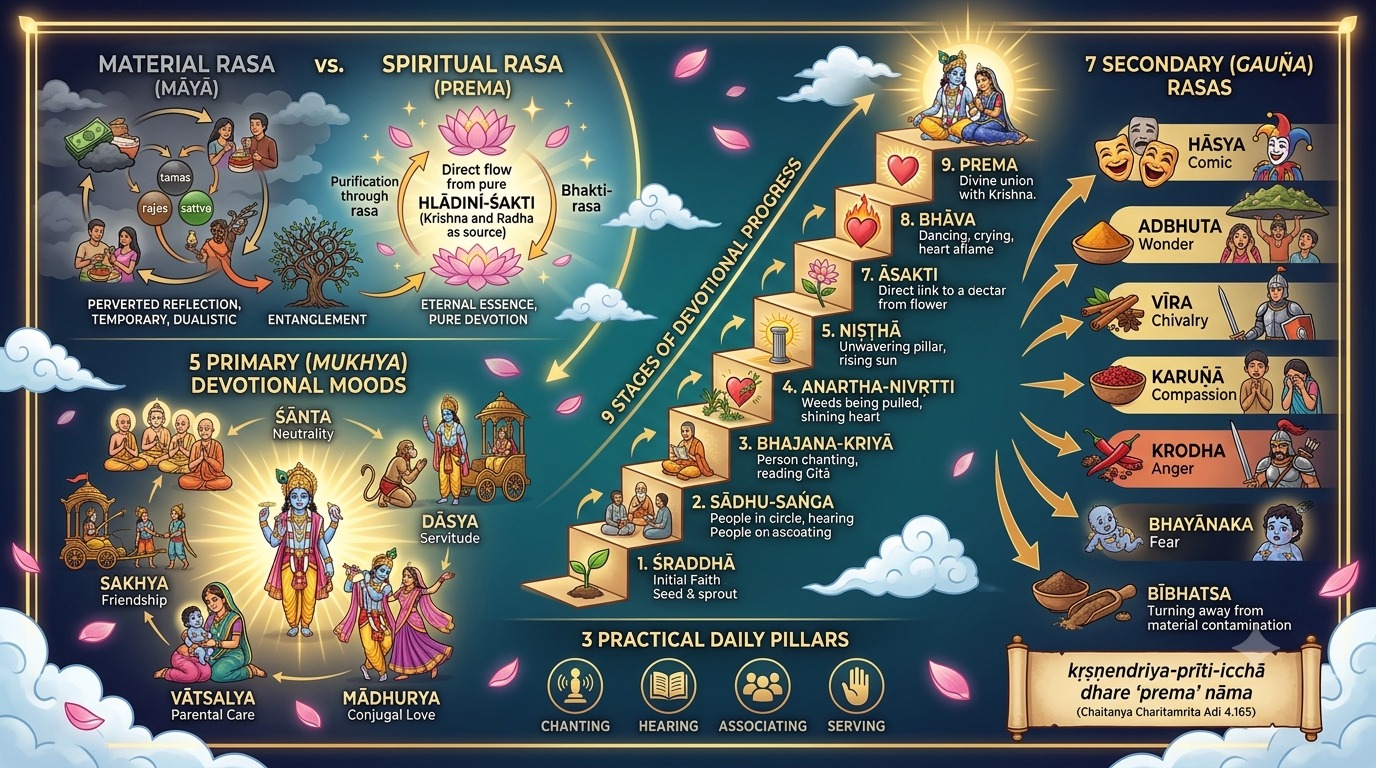
Material Reflection vs. Eternal Spiritual Relationships. The Aesthetics of Divine Love
In classical Indian aesthetics, rasa refers to the emotional flavor or essence of artistic expression. In his monumental 16th-century treatise Bhakti-rasāmṛta-sindhu (“The Ocean of the Nectar of Devotion”), Srila Rupa Goswami transformed this concept into a spiritual psychology.
From the perspective of Gaudiya Vaishnavism, rasa is not a temporary emotional state created by human drama, but the eternal, dynamic relationship between the individual soul (jīva) and the Supreme Personality of Godhead, Sri Krishna.
The Architecture of Rasa: Material vs. Spiritual
Understanding rasa requires distinguishing between its expression in the material realm and its pure form in the realm of spirit.
Material Rasa: The Perverted Reflection
In the material world, rasa operates under the influence of the three modes of material nature (guṇas): goodness (sattva), passion (rajas), and ignorance (tamas).
[Spiritual World: Pure Hladini-Sakti] ──(Reflection through Maya)──> [Material World: Three Gunas]
- Origin: Arises from the identification of the soul with the physical body and mind.
- Nature: Dualistic (pleasure and pain), temporary, and fleeting.
- Mechanism: Relies on external, material sense objects. Over time, material emotions lead to fatigue, burnout, or heartbreak (virahti) because the material container cannot hold infinite desire.
- Ultimate Result: Entanglement in saṃsāra (the cycle of birth and death).
Spiritual Rasa: The Eternal Essence
Spiritual rasa (bhakti-rasa) belongs to the internal potency (svarūpa-śakti) of the Lord, specifically His pleasure-giving potency (hlādinī-śakti).
- Origin: Awakens when the purified consciousness (śuddha-sattva) of the soul reconnects with Sri Krishna.
- Nature: Absolute, self-manifest (svayaṁ-prakāśa), and ever-expanding (vṛddhi-śīla).
- Mechanism: Relies on transcendental service (sevanonmuka) through hearing, chanting, and remembering.
- Ultimate Result: Complete spiritual absorption and eternal liberation into pure love of God (prema-bhakti).
As Srila Rupa Goswami opens the Bhakti-rasāmṛta-sindhu:
akhila-rasāmṛta-mūrtiḥ
prasṛmara-ruci-ruddha-tārakā-pāliḥ
kalita-śyāmā-lalito
rādhā-preyān vidhur jayati
“Let Sri Krishna, the Supreme Personality of Godhead, be glorified! He is the reservoir and original source of all nectarine rasas (akhila-rasāmṛta-mūrtiḥ). By His all-attractive features, He subdues all souls and is eternally loved by Srimati Radharani.”
The Five Mukhya Rasas (Primary Devotional Moods)
Srila Rupa Goswami categorizes the permanent loving attitudes (sthāyī-bhāva) into five primary (mukhya) rasas. These represent the fundamental eternal relationships a soul can have with Krishna.
| Primary Rasa | Translation | Divine Archetype / Example | Characteristic Feature |
|---|---|---|---|
| Śānta | Neutrality | Four Kumaras, Yogis | Steady awe and reverence without active service. |
| Dāsya | Servitude | Hanuman, Daraka, Chitraka | Active desire to render humble service to the Master. |
| Sakhya | Friendship | Arjuna, Sridama, Subala | Equal intimacy, playful banter, and uninhibited trust. |
| Vātsalya | Parental Care | Mother Yasoda, Nanda Maharaja | Protective, nurturing love where God is cared for as a child. |
| Mādhurya | Conjugal Love | Srimati Radharani, the Gopis | Complete self-surrender, intense intimacy, and sweet loving exchanges. |
1. Śānta-Rasa (The Mood of Peaceful Neutrality)
In śānta-rasa, the devotee appreciates the Supreme Lord’s greatness, majesty, and opulence with a peaceful mind. There is deep reverence, but no strong personal intimacy or active desire for personal service.
The Material Analogy
A citizen standing at a respectful distance watching a benevolent king process through the city streets. The citizen respects the king’s law and admires his sovereignty, but has no personal relationship with him.
The Spiritual Reality
The transcendentalist sees God as the Supreme Brahman or Parama-ātma, experiencing deep tranquility.
In the Srimad-Bhagavatam (10.87.14), the personified Vedas express this mood:
jaya jaya jahy ajām ajita doṣa-gṛbhitā-guṇāṁ
tvam asi yad ātmanā samabhirudhdha-samasta-bhagaḥ
“Victory, victory unto You, O Unconquerable One! By Your own intrinsic power, You crush the illusory energy, Māyā…”
2. Dāsya-Rasa (The Mood of Devotional Servitude)
In dāsya-rasa, the awe of śānta-rasa transitions into active, affectionate service. The devotee views Sri Krishna as the Master (Prabhu) and themselves as the humble servant (dāsa).
The Material Analogy
A loyal employee or devoted personal assistant who takes pride in fulfilling their master’s orders with care and diligence.
The Spiritual Reality
In the spiritual world, dāsya-rasa is free from material servitude’s exploitation or fatigue. It is motivated solely by the master’s satisfaction.
In the Bhakti-rasāmṛta-sindhu (2.5.27), Daraka, Krishna’s chariot driver, expresses this mood:
prabho dehi ājñāṁ kiṁ karāṇi
“O Lord, please command me! What service may I render unto You?”
Lord Hanuman’s relationship with Lord Rama in the Ramayana is the pinnacle of dāsya-rasa, where every breath is dedicated to the Lord’s mission.
3. Sakhya-Rasa (The Mood of Fraternal Friendship)
In sakhya-rasa, the sense of awe and reverence completely disappears. The devotee views Sri Krishna as an equal companion (sakhi or sakha). They play together, wrestle, share food, and tease one another.
      [ Śānta: Awe & Reverence ]
                  │
                  ▼
     [ Dāsya: Respectful Service ]
                  │
                  ▼
┌───────────────────────────────────────┐
│ Sakhya: Reverence Dissolves           │
│ (Krishna becomes a equal friend)      │
└───────────────────────────────────────┘
The Material Analogy
Childhood best friends who share secrets, trade snacks, wrestle in the yard, and treat each other as absolute equals without formality.
The Spiritual Reality
When Krishna and the cowherd boys (gopas) roam the forests of Vrindavan, the boys climb on Krishna’s shoulders when he loses a wrestling match or put half-eaten fruit into His mouth.
In the Srimad-Bhagavatam (10.12.11), Sukadeva Goswami highlights the good fortune of these friends:
itthaṁ satāṁ brahma-sukhānubhūtyā
dāsyaṁ gatānāṁ para-daivatena
māyāśritānāṁ nara-dārakeṇa
sākaṁ vijahruḥ kṛta-puṇya-puñjāḥ
“Those who are engaged in self-realization appreciate Krishna as Supreme Brahman; those in dāsya-rasa serve Him as the Supreme Personality; those under illusion see Him as an ordinary child. But the cowherd boys, having accumulated vast spiritual merit, play with Him as their equal friend.”
4. Vātsalya-Rasa (The Mood of Parental Affection)
In vātsalya-rasa, the devotee considers themselves the guardian or parent of Sri Krishna. Here, the awe of God’s power is so thoroughly eclipsed by love that the devotee worries for God’s safety, feeds Him, binds Him when He is mischievous, and protects Him from harm.
The Material Analogy
A mother caring for her toddler—worrying if he has eaten, wiping his face, kissing his scraped knee, and disciplining him when necessary out of deep affection.
The Spiritual Reality
Mother Yasoda sees Krishna not as the creator of the cosmos, but as her delicate little boy who needs milk, butter, and protection from dark woods. When Krishna showed her the entire universe inside His mouth (viśvarūpa), she was briefly bewildered, but her vātsalya-rasa immediately covered her awe, and she simply thought, “My child must be getting sick or hallucinating,” pulling Him onto her lap.
In the Srimad-Bhagavatam (10.9.18), Sukadeva Goswami praises Yasoda’s unique privilege:
sva-mātā svicchiṣyāṇām
na tathā me priyo janaḥ
nemaṁ viriñco na bhavo
na śrīr apy aṅga-saṁśrayā
“Neither Brahma, nor Siva, nor even the Goddess of Fortune who rests upon the Lord’s chest, received such mercy from the Supreme Savior as was received by Mother Yasoda.”
5. Mādhurya-Rasa (The Mood of Conjugal Love)
Mādhurya-rasa is considered by Gaudiya Vaishnavism to be the Rasa-raja—the king of all rasas. It incorporates the qualities of all previous four rasas (peace, service, friendship, and care) while adding the ultimate dimension of romantic intimacy and absolute self-surrender.
The Material Analogy
The intense passion of lovers. However, Gaudiya acharyas emphasize that material romance is driven by kāma (lust—desire for one’s own sense gratification), whereas mādhurya-rasa is pure prema (unconditional love—desire solely for Krishna’s pleasure).
The Spiritual Reality
Srimati Radharani and the gopīs of Vrindavan exemplify this state. They abandon social standing, family ties, and personal comfort solely to bring happiness to Sri Krishna.
In the Caitanya-caritāmṛta (Ādi 4.165), Krishnadasa Kaviraja Goswami outlines the distinction between material lust and spiritual love:
kāma, prema,—doṅhāra ekale lakṣaṇa
ātmendriya-prīti-icchā tāre bali ‘kāma’
kṛṣṇendriya-prīti-icchā dhare ‘prema’ nāma
“Lust and love have different characteristics. The desire to satisfy one’s own senses is called kāma (lust). The desire to satisfy the senses of Lord Krishna is called prema (pure love).”
The Seven Gauna Rasas (Secondary Devotional Moods)
In addition to the five primary rasas, Srila Rupa Goswami outlines seven secondary (gauṇa) rasas. These secondary moods are indirect or situational. They arise periodically during specific pastimes to heighten and enrich the primary rasa.
              ┌── Hāsya (Laughter)
              ├── Adbhuta (Wonder)
              ├── Vīra (Chivalry)
Secondary ────┼── Karuṇā (Compassion)
Gauna Rasas   ├── Krodha (Anger)
              ├── Bheyānaka (Fear)
└── Bībhatsa (Disgust)- Hāsya (Comic / Laughter): Joyful laughter arising from Krishna’s witty remarks or Vidusaka’s funny antics.
- Adbhuta (Wonder / Astonishment): Amazing amazement, such as when the inhabitants of Vrindavan saw Krishna lift Govardhan Hill on His little finger.
- Vīra (Chivalry / Heroism): Devotional heroism displayed in battles on behalf of Krishna, as seen with Arjuna on the battlefield of Kurukshetra.
- Karuṇā (Compassion / Pathos): Compassionate grief felt by devotees when separated from Krishna or seeing Him in apparent distress.
- Krodha (Anger): Righteous anger directed at demoniac entities who oppose Krishna or interrupt devotional service.
- Bhayānaka (Fear): Devotional fear, such as Little Krishna’s fear when Mother Yasoda holds a stick to bind Him.
- Bībhatsa (Disgust): Devotional aversion toward non-devotional, material, or anti-spiritual activities.
These secondary rasas do not exist independently in eternity; rather, they act like spices (sañcārī-bhāva) that enhance the main feast of the five primary rasas.
The Practical Path: Awakening Rasa
According to Gaudiya Vaishnavism, spiritual rasa cannot be fabricated, artificially mimicked, or manufactured through material effort. It exists eternally within the sleeping consciousness of the soul.
In the Caitanya-caritāmṛta (Madhya 22.107), Srila Rupa Goswami explains how rasa is uncovered:
nitya-siddha kṛṣṇa-prema ‘sādhya’ kabhu naya
śravaṇādi-śuddha-citte karaye udaya
“Pure love for Krishna is eternally established in the hearts of living beings. It is not something to be obtained from an external source. When the heart is purified by hearing and chanting, this divine love naturally awakens.”
Through the practice of sādhana-bhakti—specifically under the guidance of a spiritual master, chanting the Hare Krishna mahā-mantra, and hearing the Srimad-Bhagavatam—the dirt of material conditioning (anarthas) is cleansed. As the heart becomes pure (śuddha-citta), the soul’s eternal relationship (sthāyī-bhāva) with Sri Krishna naturally reveals itself, bringing the soul into the eternal ocean of bhakti-rasa.
In Gaudiya Vaishnavism, advancing on the path of devotional service (bhakti) is described as a gradual, systematic evolution of consciousness. It is not an overnight transformation, but a structured inner progression mapped out in detail by Srila Rupa Goswami in the Bhakti-rasāmṛta-sindhu.
The Nine Stages of Devotional Progress
The journey from initial curiosity to pure love of God (kṛṣṇa-prema) unfolds across nine distinct stages:
[Ādau Śraddhā] ──> [Sādhu-saṅga] ──> [Bhajana-kriyā] ──> [Anartha-nivṛtti]
│
[Prema] <── [Bhāva] <── [Āsakti] <── [Ruci] <── [Niṣṭhā] <─────┘
ādau śraddhā tataḥ sādhu-saṅgo ’tha bhajana-kriyā
tato ’nartha-nivṛttiḥ syāt tato niṣṭhā rucis tataḥ
athāsaktis tato bhāvas tataḥ premābhyudañcati
sādhakānām ayam pemṇaḥ prādurbhāve bhavet kramaḥ
(Bhakti-rasāmṛta-sindhu 1.4.15–16)
Phase 1: Foundation & Clearing the Debris
- Śraddhā (Initial Faith): A spark of appreciation or curiosity about spiritual life, often inspired by reading scriptures or hearing from realized souls.
- Sādhu-saṅga (Association with Devotees): Seeking out the company of those advanced in bhakti. Progress accelerates exponentially in supportive spiritual fellowship.
- Bhajana-kriyā (Practice of Devotional Service): Taking up regular spiritual practices under guidance (dīkṣā and śikṣā)—notably daily chanting, deity worship, and reading scripture.
- Anartha-nivṛtti (Clearing Unwanted Habits): The weeding phase. As spiritual practice deepens, deeply rooted material conditioning, bad habits, envy, and pride begin to drop away. This is often the most challenging stage, requiring patience and steady determination.
Phase 2: Steady Growth & Natural Attraction
- Niṣṭhā (Steadfastness): Devotional practice becomes steady, uninterrupted, and firm. You no longer practice out of obligation, but with consistent dedication regardless of mind or mood.
- Ruci (Taste): A genuine, deep attraction and relish for spiritual activities—hearing kīrtan, chanting, and discussing philosophy become effortlessly joyful.
- Āsakti (Deep Attachment): The focus shifts from the process of devotional service to the Object of service—Sri Krishna Himself. Spiritual thoughts become natural and constant.
Phase 3: Spiritual Awakening
- Bhāva (Ecstatic Love): The preliminary stage of pure love (prema-pallava or the bud of love). Spiritual emotions break through the mind into the heart.
- Prema (Pure Unconditional Love): The ultimate goal. The heart is completely dissolved in love for Sri Krishna, completely free from material contamination, bringing full realization of one’s eternal rasa.
Practical Daily Steps to Move Forward
To move through these stages in daily life, Gaudiya Vaishnavism emphasizes three core practical pillars:
               ┌── 1. Śravaṇa & Kīrtana (Chanting & Hearing)
Practical ─────┼── 2. Seva & Sādhu-Saṅga (Service & Fellowship)
Pillars        └── 3. Anukūlya & Varjana (Favorable Choices)
1. Cultivate the Primary Limbs (Śravaṇa & Kīrtana)
- Mantra Meditation: Consistently chant the Hare Krishna mahā-mantra daily with focus and attentiveness.
- Daily Scripture Reading: Read foundational texts like the Bhagavad-gītā As It Is and Śrīmad-Bhāgavatam to align your intellect with spiritual truth.
2. Seek Fellowship & Service (Sādhu-saṅga & Sevā)
- Connect with Practitioners: Regularly hear from and render service to experienced devotees.
- Practical Service (Sevā):** Offer your unique talents, professional skills, or physical effort in service to the divine or the community.
3. Align Your Daily Habits
- Accept What Helps (Anukūlyasya Saṅkalpa):* Adopt habits that calm the mind—like a sattvic vegetarian diet (*prasādam), regular sleeping habits, and clean living.
- Reject What Hinders (Prātikūlyasya Varanam):** Minimize environments, media, and habits that trigger anger, lust, greed, or material distraction.
The Secret of Progress: Bhakti does not rely on intellectual genius or material wealth; it thrives on sincerity (sāralya) and humility (tṛṇād api sunīcena). Small, honest daily effort done with devotion attracts the grace that pulls the soul forward.
Bhakti Rasa
Material Reflection vs. Eternal Spiritual Relationships. The Aesthetics of Divine Love
In classical Indian aesthetics, rasa refers to the emotional flavor or essence of artistic expression. In his monumental 16th-century treatise Bhakti-rasāmṛta-sindhu (“The Ocean of the Nectar of Devotion”), Srila Rupa Goswami transformed this concept into a spiritual psychology.
From the perspective of Gaudiya Vaishnavism, rasa is not a temporary emotional state created by human drama, but the eternal, dynamic relationship between the individual soul (jīva) and the Supreme Personality of Godhead, Sri Krishna.
The Architecture of Rasa: Material vs. Spiritual
Understanding rasa requires distinguishing between its expression in the material realm and its pure form in the realm of spirit.
Material Rasa: The Perverted Reflection
In the material world, rasa operates under the influence of the three modes of material nature (guṇas): goodness (sattva), passion (rajas), and ignorance (tamas).
[Spiritual World: Pure Hladini-Sakti] ──(Reflection through Maya)──> [Material World: Three Gunas]
- Origin: Arises from the identification of the soul with the physical body and mind.
- Nature: Dualistic (pleasure and pain), temporary, and fleeting.
- Mechanism: Relies on external, material sense objects. Over time, material emotions lead to fatigue, burnout, or heartbreak (virahti) because the material container cannot hold infinite desire.
- Ultimate Result: Entanglement in saṃsāra (the cycle of birth and death).
Spiritual Rasa: The Eternal Essence
Spiritual rasa (bhakti-rasa) belongs to the internal potency (svarūpa-śakti) of the Lord, specifically His pleasure-giving potency (hlādinī-śakti).
- Origin: Awakens when the purified consciousness (śuddha-sattva) of the soul reconnects with Sri Krishna.
- Nature: Absolute, self-manifest (svayaṁ-prakāśa), and ever-expanding (vṛddhi-śīla).
- Mechanism: Relies on transcendental service (sevanonmuka) through hearing, chanting, and remembering.
- Ultimate Result: Complete spiritual absorption and eternal liberation into pure love of God (prema-bhakti).
As Srila Rupa Goswami opens the Bhakti-rasāmṛta-sindhu:
akhila-rasāmṛta-mūrtiḥ
prasṛmara-ruci-ruddha-tārakā-pāliḥ
kalita-śyāmā-lalito
rādhā-preyān vidhur jayati
“Let Sri Krishna, the Supreme Personality of Godhead, be glorified! He is the reservoir and original source of all nectarine rasas (akhila-rasāmṛta-mūrtiḥ). By His all-attractive features, He subdues all souls and is eternally loved by Srimati Radharani.”
The Five Mukhya Rasas (Primary Devotional Moods)
Srila Rupa Goswami categorizes the permanent loving attitudes (sthāyī-bhāva) into five primary (mukhya) rasas. These represent the fundamental eternal relationships a soul can have with Krishna.
| Primary Rasa | Translation | Divine Archetype / Example | Characteristic Feature |
|---|---|---|---|
| Śānta | Neutrality | Four Kumaras, Yogis | Steady awe and reverence without active service. |
| Dāsya | Servitude | Hanuman, Daraka, Chitraka | Active desire to render humble service to the Master. |
| Sakhya | Friendship | Arjuna, Sridama, Subala | Equal intimacy, playful banter, and uninhibited trust. |
| Vātsalya | Parental Care | Mother Yasoda, Nanda Maharaja | Protective, nurturing love where God is cared for as a child. |
| Mādhurya | Conjugal Love | Srimati Radharani, the Gopis | Complete self-surrender, intense intimacy, and sweet loving exchanges. |
1. Śānta-Rasa (The Mood of Peaceful Neutrality)
In śānta-rasa, the devotee appreciates the Supreme Lord’s greatness, majesty, and opulence with a peaceful mind. There is deep reverence, but no strong personal intimacy or active desire for personal service.
The Material Analogy
A citizen standing at a respectful distance watching a benevolent king process through the city streets. The citizen respects the king’s law and admires his sovereignty, but has no personal relationship with him.
The Spiritual Reality
The transcendentalist sees God as the Supreme Brahman or Parama-ātma, experiencing deep tranquility.
In the Srimad-Bhagavatam (10.87.14), the personified Vedas express this mood:
jaya jaya jahy ajām ajita doṣa-gṛbhitā-guṇāṁ
tvam asi yad ātmanā samabhirudhdha-samasta-bhagaḥ
“Victory, victory unto You, O Unconquerable One! By Your own intrinsic power, You crush the illusory energy, Māyā…”
2. Dāsya-Rasa (The Mood of Devotional Servitude)
In dāsya-rasa, the awe of śānta-rasa transitions into active, affectionate service. The devotee views Sri Krishna as the Master (Prabhu) and themselves as the humble servant (dāsa).
The Material Analogy
A loyal employee or devoted personal assistant who takes pride in fulfilling their master’s orders with care and diligence.
The Spiritual Reality
In the spiritual world, dāsya-rasa is free from material servitude’s exploitation or fatigue. It is motivated solely by the master’s satisfaction.
In the Bhakti-rasāmṛta-sindhu (2.5.27), Daraka, Krishna’s chariot driver, expresses this mood:
prabho dehi ājñāṁ kiṁ karāṇi
“O Lord, please command me! What service may I render unto You?”
Lord Hanuman’s relationship with Lord Rama in the Ramayana is the pinnacle of dāsya-rasa, where every breath is dedicated to the Lord’s mission.
3. Sakhya-Rasa (The Mood of Fraternal Friendship)
In sakhya-rasa, the sense of awe and reverence completely disappears. The devotee views Sri Krishna as an equal companion (sakhi or sakha). They play together, wrestle, share food, and tease one another.
      [ Śānta: Awe & Reverence ]
                  │
                  ▼
     [ Dāsya: Respectful Service ]
                  │
                  ▼
┌───────────────────────────────────────┐
│ Sakhya: Reverence Dissolves           │
│ (Krishna becomes a equal friend)      │
└───────────────────────────────────────┘
The Material Analogy
Childhood best friends who share secrets, trade snacks, wrestle in the yard, and treat each other as absolute equals without formality.
The Spiritual Reality
When Krishna and the cowherd boys (gopas) roam the forests of Vrindavan, the boys climb on Krishna’s shoulders when he loses a wrestling match or put half-eaten fruit into His mouth.
In the Srimad-Bhagavatam (10.12.11), Sukadeva Goswami highlights the good fortune of these friends:
itthaṁ satāṁ brahma-sukhānubhūtyā
dāsyaṁ gatānāṁ para-daivatena
māyāśritānāṁ nara-dārakeṇa
sākaṁ vijahruḥ kṛta-puṇya-puñjāḥ
“Those who are engaged in self-realization appreciate Krishna as Supreme Brahman; those in dāsya-rasa serve Him as the Supreme Personality; those under illusion see Him as an ordinary child. But the cowherd boys, having accumulated vast spiritual merit, play with Him as their equal friend.”
4. Vātsalya-Rasa (The Mood of Parental Affection)
In vātsalya-rasa, the devotee considers themselves the guardian or parent of Sri Krishna. Here, the awe of God’s power is so thoroughly eclipsed by love that the devotee worries for God’s safety, feeds Him, binds Him when He is mischievous, and protects Him from harm.
The Material Analogy
A mother caring for her toddler—worrying if he has eaten, wiping his face, kissing his scraped knee, and disciplining him when necessary out of deep affection.
The Spiritual Reality
Mother Yasoda sees Krishna not as the creator of the cosmos, but as her delicate little boy who needs milk, butter, and protection from dark woods. When Krishna showed her the entire universe inside His mouth (viśvarūpa), she was briefly bewildered, but her vātsalya-rasa immediately covered her awe, and she simply thought, “My child must be getting sick or hallucinating,” pulling Him onto her lap.
In the Srimad-Bhagavatam (10.9.18), Sukadeva Goswami praises Yasoda’s unique privilege:
sva-mātā svicchiṣyāṇām
na tathā me priyo janaḥ
nemaṁ viriñco na bhavo
na śrīr apy aṅga-saṁśrayā
“Neither Brahma, nor Siva, nor even the Goddess of Fortune who rests upon the Lord’s chest, received such mercy from the Supreme Savior as was received by Mother Yasoda.”
5. Mādhurya-Rasa (The Mood of Conjugal Love)
Mādhurya-rasa is considered by Gaudiya Vaishnavism to be the Rasa-raja—the king of all rasas. It incorporates the qualities of all previous four rasas (peace, service, friendship, and care) while adding the ultimate dimension of romantic intimacy and absolute self-surrender.
The Material Analogy
The intense passion of lovers. However, Gaudiya acharyas emphasize that material romance is driven by kāma (lust—desire for one’s own sense gratification), whereas mādhurya-rasa is pure prema (unconditional love—desire solely for Krishna’s pleasure).
The Spiritual Reality
Srimati Radharani and the gopīs of Vrindavan exemplify this state. They abandon social standing, family ties, and personal comfort solely to bring happiness to Sri Krishna.
In the Caitanya-caritāmṛta (Ādi 4.165), Krishnadasa Kaviraja Goswami outlines the distinction between material lust and spiritual love:
kāma, prema,—doṅhāra ekale lakṣaṇa
ātmendriya-prīti-icchā tāre bali ‘kāma’
kṛṣṇendriya-prīti-icchā dhare ‘prema’ nāma
“Lust and love have different characteristics. The desire to satisfy one’s own senses is called kāma (lust). The desire to satisfy the senses of Lord Krishna is called prema (pure love).”
The Seven Gauna Rasas (Secondary Devotional Moods)
In addition to the five primary rasas, Srila Rupa Goswami outlines seven secondary (gauṇa) rasas. These secondary moods are indirect or situational. They arise periodically during specific pastimes to heighten and enrich the primary rasa.
              ┌── Hāsya (Laughter)
              ├── Adbhuta (Wonder)
              ├── Vīra (Chivalry)
Secondary ────┼── Karuṇā (Compassion)
Gauna Rasas   ├── Krodha (Anger)
              ├── Bheyānaka (Fear)
└── Bībhatsa (Disgust)- Hāsya (Comic / Laughter): Joyful laughter arising from Krishna’s witty remarks or Vidusaka’s funny antics.
- Adbhuta (Wonder / Astonishment): Amazing amazement, such as when the inhabitants of Vrindavan saw Krishna lift Govardhan Hill on His little finger.
- Vīra (Chivalry / Heroism): Devotional heroism displayed in battles on behalf of Krishna, as seen with Arjuna on the battlefield of Kurukshetra.
- Karuṇā (Compassion / Pathos): Compassionate grief felt by devotees when separated from Krishna or seeing Him in apparent distress.
- Krodha (Anger): Righteous anger directed at demoniac entities who oppose Krishna or interrupt devotional service.
- Bhayānaka (Fear): Devotional fear, such as Little Krishna’s fear when Mother Yasoda holds a stick to bind Him.
- Bībhatsa (Disgust): Devotional aversion toward non-devotional, material, or anti-spiritual activities.
These secondary rasas do not exist independently in eternity; rather, they act like spices (sañcārī-bhāva) that enhance the main feast of the five primary rasas.
The Practical Path: Awakening Rasa
According to Gaudiya Vaishnavism, spiritual rasa cannot be fabricated, artificially mimicked, or manufactured through material effort. It exists eternally within the sleeping consciousness of the soul.
In the Caitanya-caritāmṛta (Madhya 22.107), Srila Rupa Goswami explains how rasa is uncovered:
nitya-siddha kṛṣṇa-prema ‘sādhya’ kabhu naya
śravaṇādi-śuddha-citte karaye udaya
“Pure love for Krishna is eternally established in the hearts of living beings. It is not something to be obtained from an external source. When the heart is purified by hearing and chanting, this divine love naturally awakens.”
Through the practice of sādhana-bhakti—specifically under the guidance of a spiritual master, chanting the Hare Krishna mahā-mantra, and hearing the Srimad-Bhagavatam—the dirt of material conditioning (anarthas) is cleansed. As the heart becomes pure (śuddha-citta), the soul’s eternal relationship (sthāyī-bhāva) with Sri Krishna naturally reveals itself, bringing the soul into the eternal ocean of bhakti-rasa.
In Gaudiya Vaishnavism, advancing on the path of devotional service (bhakti) is described as a gradual, systematic evolution of consciousness. It is not an overnight transformation, but a structured inner progression mapped out in detail by Srila Rupa Goswami in the Bhakti-rasāmṛta-sindhu.
The Nine Stages of Devotional Progress
The journey from initial curiosity to pure love of God (kṛṣṇa-prema) unfolds across nine distinct stages:
[Ādau Śraddhā] ──> [Sādhu-saṅga] ──> [Bhajana-kriyā] ──> [Anartha-nivṛtti]
│
[Prema] <── [Bhāva] <── [Āsakti] <── [Ruci] <── [Niṣṭhā] <─────┘
ādau śraddhā tataḥ sādhu-saṅgo ’tha bhajana-kriyā
tato ’nartha-nivṛttiḥ syāt tato niṣṭhā rucis tataḥ
athāsaktis tato bhāvas tataḥ premābhyudañcati
sādhakānām ayam pemṇaḥ prādurbhāve bhavet kramaḥ
(Bhakti-rasāmṛta-sindhu 1.4.15–16)
Phase 1: Foundation & Clearing the Debris
- Śraddhā (Initial Faith): A spark of appreciation or curiosity about spiritual life, often inspired by reading scriptures or hearing from realized souls.
- Sādhu-saṅga (Association with Devotees): Seeking out the company of those advanced in bhakti. Progress accelerates exponentially in supportive spiritual fellowship.
- Bhajana-kriyā (Practice of Devotional Service): Taking up regular spiritual practices under guidance (dīkṣā and śikṣā)—notably daily chanting, deity worship, and reading scripture.
- Anartha-nivṛtti (Clearing Unwanted Habits): The weeding phase. As spiritual practice deepens, deeply rooted material conditioning, bad habits, envy, and pride begin to drop away. This is often the most challenging stage, requiring patience and steady determination.
Phase 2: Steady Growth & Natural Attraction
- Niṣṭhā (Steadfastness): Devotional practice becomes steady, uninterrupted, and firm. You no longer practice out of obligation, but with consistent dedication regardless of mind or mood.
- Ruci (Taste): A genuine, deep attraction and relish for spiritual activities—hearing kīrtan, chanting, and discussing philosophy become effortlessly joyful.
- Āsakti (Deep Attachment): The focus shifts from the process of devotional service to the Object of service—Sri Krishna Himself. Spiritual thoughts become natural and constant.
Phase 3: Spiritual Awakening
- Bhāva (Ecstatic Love): The preliminary stage of pure love (prema-pallava or the bud of love). Spiritual emotions break through the mind into the heart.
- Prema (Pure Unconditional Love): The ultimate goal. The heart is completely dissolved in love for Sri Krishna, completely free from material contamination, bringing full realization of one’s eternal rasa.
Practical Daily Steps to Move Forward
To move through these stages in daily life, Gaudiya Vaishnavism emphasizes three core practical pillars:
               ┌── 1. Śravaṇa & Kīrtana (Chanting & Hearing)
Practical ─────┼── 2. Seva & Sādhu-Saṅga (Service & Fellowship)
Pillars        └── 3. Anukūlya & Varjana (Favorable Choices)
1. Cultivate the Primary Limbs (Śravaṇa & Kīrtana)
- Mantra Meditation: Consistently chant the Hare Krishna mahā-mantra daily with focus and attentiveness.
- Daily Scripture Reading: Read foundational texts like the Bhagavad-gītā As It Is and Śrīmad-Bhāgavatam to align your intellect with spiritual truth.
2. Seek Fellowship & Service (Sādhu-saṅga & Sevā)
- Connect with Practitioners: Regularly hear from and render service to experienced devotees.
- Practical Service (Sevā):** Offer your unique talents, professional skills, or physical effort in service to the divine or the community.
3. Align Your Daily Habits
- Accept What Helps (Anukūlyasya Saṅkalpa):* Adopt habits that calm the mind—like a sattvic vegetarian diet (*prasādam), regular sleeping habits, and clean living.
- Reject What Hinders (Prātikūlyasya Varanam):** Minimize environments, media, and habits that trigger anger, lust, greed, or material distraction.
The Secret of Progress: Bhakti does not rely on intellectual genius or material wealth; it thrives on sincerity (sāralya) and humility (tṛṇād api sunīcena). Small, honest daily effort done with devotion attracts the grace that pulls the soul forward.