Mysticism, Slokas, and the Ultimate Path in Modern Times
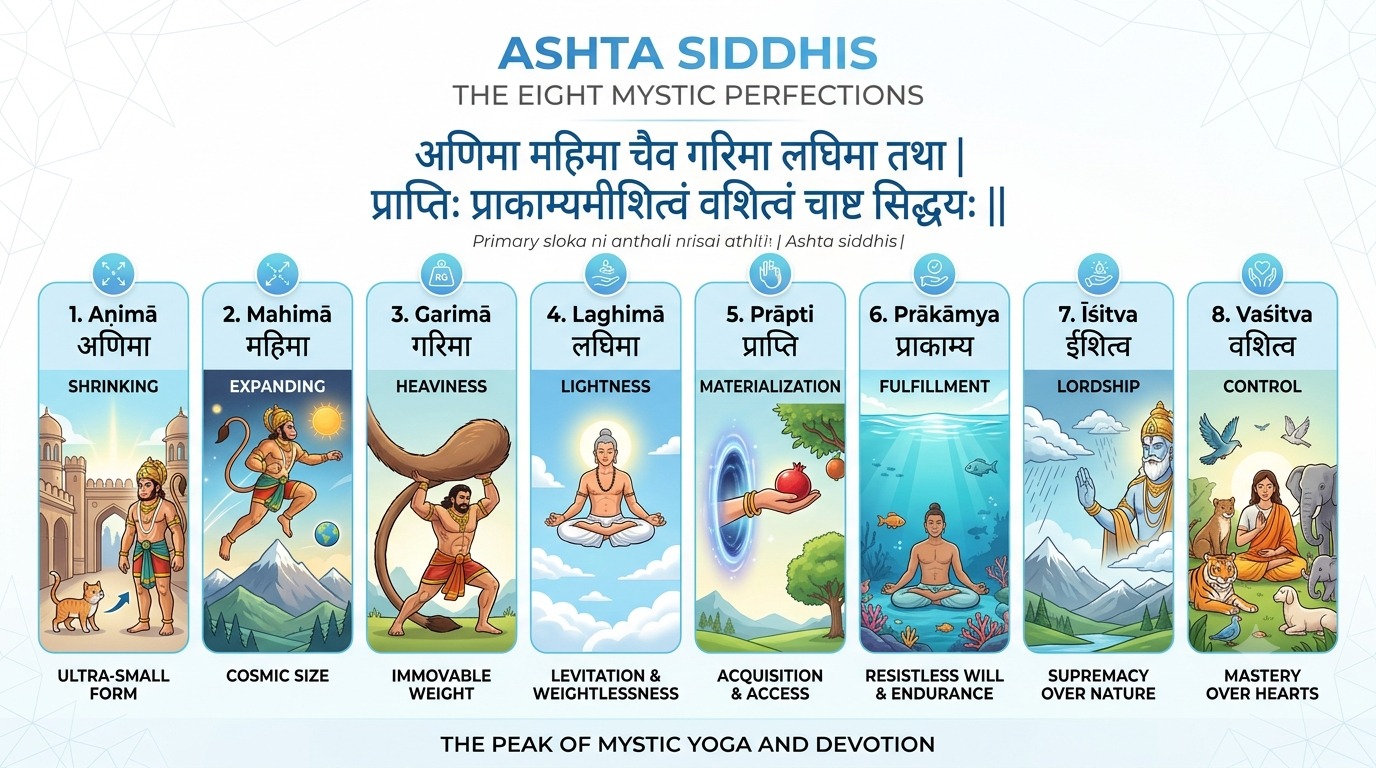
Across ancient Indian philosophy, yoga literature, and epic lore, few concepts capture human imagination like the Ashta Siddhis (the eight primary mystic perfections). These extraordinary abilities represent the absolute pinnacle of classical Ashtanga Yoga and Tantra—powers that bend the laws of physics, material space, and human limitations.
In this blog, we explore what these eight mystic perfections are, examine their traditional Sanskrit slokas and scriptural examples, address whether they can be attained in our modern age, and uncover the highest recommendations according to the Gaudiya Vaishnava school of thought.
What Are the Ashta Siddhis?
In classical yogic texts—including Patanjali’s Yoga Sutras and Lord Krishna’s instructions in the Srimad Bhagavatam (Canto 11, Chapter 15)—mystic perfections (siddhis) are described as natural byproduct milestones attained when a practitioner masters breath control (pranayama), sense withdrawal (pratyahara), and deep concentration (dharana and dhyana) on the Supreme.
The Defining Sanskrit Sloka
The classical verse enumerating the eight primary perfections is recorded in traditional yogic literature:
Aṇimā mahimā chaiva garimā laghimā tathā |
Prāptiḥ prākāmyam īśitvaṁ vaśitvaṁ chāṣṭa-siddhayaḥ ||
The 8 Primary Siddhis: Meanings & Scriptural Examples
1. Aṇimā (अणिमा) — Shrinking Smaller Than the Smallest
- Meaning: The power to reduce one’s physical body to the size of an atom or particle.
- Scriptural Example: In the Ramayana, when Lord Hanuman reached Lanka to search for Sita Devi, he assumed a tiny form (Anima) so he could navigate the heavily guarded city undetected at night.
2. Mahimā (महिमा) — Expanding Larger Than the Largest
- Meaning: The ability to expand one’s physical form to cosmic proportions.
- Scriptural Example: Lord Vamana expanded into His Trivikrama form, spanning the entire universe in just three steps. Hanuman also expanded into a giant form while burning Lanka and during his battle with Kumbhakarna.
3. Garimā (गरिमा) — Becoming Infinitely Heavy
- Meaning: The power to increase body density and weight until one becomes immovable by any physical force.
- Scriptural Example: During the Mahabharata era, when Bhima attempted to move Hanuman’s tail out of his path in the Gandhamadana mountains, Hanuman rendered his tail so heavy using Garima that even the mighty Bhima could not lift it an inch.
4. Laghimā (लघिमा) — Becoming Lighter Than Air
- Meaning: The power to reduce one’s weight to less than a feather, enabling levitation and travel through air or ether.
- Scriptural Example: Great yogis like Agastya Muni and Narada Muni walked on air currents across planetary systems using Laghima without needing mechanical vehicles.
5. Prāpti (प्राप्ति) — Unrestricted Access & Materialization
- Meaning: The ability to reach any object or place across dimensions instantly—even touching the moon with one’s fingertips.
- Scriptural Example: Advanced mystics could reach out their hand from India and pick a fruit directly from the trees of Janaloka or Meru without moving physically.
6. Prākāmya (प्राकाम्य) — Irresistible Will & Experience
- Meaning: The power to experience or obtain anything desired, including surviving underwater or entering any plane of existence at will.
- Scriptural Example: King Saubhari Muni used Prakamya to create 50 identical physical bodies simultaneously so he could live in 50 grand palaces with his wives without splitting his consciousness.
7. Īśitva (ईशित्व) — Absolute Lordship Over Material Nature
- Meaning: The ability to exercise dominion over the natural elements (earth, water, fire, air, ether) and command sub-controllers of nature.
- Scriptural Example: Sage Vishwamitra created an entirely new celestial realm in space for King Trishanku when the traditional heavens refused entry.
8. Vaśitva (वशित्व) — Subjugation & Absolute Control
- Meaning: The power to bring all living entities and material energies under one’s complete influence or control.
- Scriptural Example: Lord Shiva and great avatars possess natural Vashitva, causing wild animals, celestial demigods, and naturally opposing forces to live in total peaceful submission around them.
Can We Obtain Ashta Siddhis Today?
The realistic answer from both scriptural and practical perspectives is virtually no.
In the present age of Kali Yuga (the age of quarrel and distraction), attaining genuine Ashta Siddhis through classical Hatha or Raja Yoga is practically impossible for several reasons:
- Strict Prerequisites of Satya Yuga: Classical Ashtanga Yoga requires complete sensory withdrawal, uninterrupted vows of celibacy (brahmacharya), pristine mountain environments free from human disturbance, and thousands of years of uninterrupted meditation.
- Physical & Lifespan Constraints: Human bodies in Kali Yuga are short-lived, easily diseased, and subject to constant mental agitation.
- Prevalence of Illusion & Charlatans: Most claims of mystic powers today are sleight of hand, hypnotherapy, or subtle spirit manipulations rather than genuine Ashta Siddhis.
Even in ancient times, achieving these powers required centuries of rigorous austerity (tapasya)—and more importantly, they were considered dangerous detours on the spiritual journey.
The Gaudiya Vaishnava Perspective on Mystic Powers
In *Gaudiya Vaishnava philosophy—established by *Sri Chaitanya Mahaprabhu (1486–1534 CE) and expounded by the Six Goswamis of Vrindavan—mystic powers (siddhis) are viewed not as spiritual achievements, but as glittering obstacles.
1. What Lord Krishna Says in Srimad Bhagavatam
In the 11th Canto of the Srimad Bhagavatam (Chapter 15), Lord Krishna lists all mystic powers to His devotee Uddhava, but concludes with a vital warning:
Antarayaan Vadantyeta Yunjato Yogamuttamam.
Mannisthasya Madatmano Madyajakasya Matkrite ॥
“For one who practices the highest yoga—offering devotional service unto Me—these mystic perfections are declared to be obstacles and a waste of time.”
— Srimad Bhagavatam (11.15.33)
Gaudiya Acharyas point out that seeking supernatural powers inflates the subtle ego (ahankara), tying the soul tighter to the material world. A true devotee (bhakta) desires only the pleasure and service of Sri Krishna, not personal power or control.
2. The Trap of Siddhis vs. Pure Love (Prema)
Srila Rupa Goswami writes in Bhakti-rasamrita-sindhu that liberation (mukti) and mystic powers (siddhi) are like two enchantresses that block the entry of pure devotional love (suddha-bhakti):
As long as the desire for material enjoyment (bhukti) or subtle liberation/powers (mukti/siddhi) resides in the heart, the sweet taste of Krishna-prema cannot awaken.
What Is Best to Do Today? The Gaudiya Vaishnava Remedy
According to Sri Chaitanya Mahaprabhu and the Gaudiya tradition, the best and most effective path for spiritual perfection in Kali Yuga is *Sadhana Bhakti, centered on *Harinama Sankirtana (congregational chanting of the Holy Names).
| Aspect | Mystic Yoga Path (Ashtanga) | Gaudiya Bhakti Path (Sankirtana) |
|---|---|---|
| Goal | Acquisition of supernatural powers (siddhis) or impersonal merging | Awakening pure, unconditional love for Krishna (Krishna-prema) |
| Method | Intense physical postures, long breath control, solitude | Chanting, hearing (Sravanam-Kirtanam), honoring prasadam, association of saintly persons |
| Accessibility | Requires thousands of years, ideal health, pristine environment | Accessible to anyone, anywhere, regardless of age, background, or physical ability |
| Risk Factor | High risk of pride, fall down, and spiritual stagnation | Completely safe; protected by divine grace and humility |
Recommended Daily Practice
To achieve the ultimate perfection of human life today, Gaudiya Vaishnavism outlines three actionable practices:
- Chanting the Maha-Mantra:
Focus your mind on the sound vibration of the Hare Krishna Maha-Mantra:
Hare Krishna, Hare Krishna, Krishna Krishna, Hare Hare
Hare Rama, Hare Rama, Rama Rama, Hare Hare
- Cultivating Humility & Tolerance:
Sri Chaitanya Mahaprabhu gave the foundational mood of practice in His Sikshashtakam (Verse 3):
Trinad api sunichena taror api sahishnuna |
Amanina manadena kirtaniyah sada harih ||
“One should chant the holy name of the Lord in a humble state of mind, thinking oneself lower than the straw in the street; one should be more tolerant than a tree, devoid of all sense of false prestige, and ready to offer all respect to others.”
- Engaging in Unalloyed Service:
Instead of seeking the power to shrink (Anima) or grow (Mahima), a practitioner seeks to “shrink” their false ego and “grow” their love and compassion for all living beings.
While the Ashta Siddhis showcase the immense potential of the subtle material laws, they are ultimately fleeting sparks. For seekers today, trading the pursuit of temporary mystic powers for the eternal nectar of divine love (Prema) is considered the highest wisdom.