The Eight Ecstatic Transformations of Bhakti
Anyone who has watched a devotee break into tears during kirtan, or seen goosebumps rise on someone’s arms as a Bhagavatam verse is recited, has witnessed something Indian aesthetic and devotional literature named and studied over a thousand years ago. These involuntary bodily reactions are not random. They belong to a precise, ancient classification called the Ashta Sattvika Vikaras — the eight sattvika transformations.
This article walks through what the Ashta Sattvika Vikaras are, where the concept comes from, the eight individual vikaras with their Sanskrit names and meanings, the classical slokas that describe them, and real examples from scripture — especially the life of Sri Chaitanya Mahaprabhu, who is considered the fullest historical example of all eight appearing together.
What Does “Ashta Sattvika Vikara” Mean?
The term breaks down simply in Sanskrit:
- Ashta — eight
- Sattvika — arising from sattva, the mode of purity, goodness, and subtle consciousness
- Vikara — transformation, modification, or involuntary change
Put together, Ashta Sattvika Vikara refers to the eight involuntary physical transformations that occur in the body when consciousness is overwhelmed by intense, pure emotion — most classically, emotion directed toward the divine. These are not acted, forced, or performed. They arise spontaneously when bhava (a wave of deep emotional realization) floods the mind so completely that it spills over into the body itself.
The idea has two overlapping homes in the Indian intellectual tradition:
- Natya Shastra, the foundational Sanskrit treatise on dramaturgy and aesthetics attributed to Bharata Muni, where sattvika bhavas are catalogued as part of the machinery of rasa (aesthetic emotion) on stage.
- *Bhakti-rasamrita-sindhu, Srila Rupa Goswami’s sixteenth-century masterwork on devotional theology, where the same eight transformations are reframed specifically as symptoms of *prema — pure love of God — rather than dramatic performance.
Rupa Goswami’s own definition sets up the concept before listing the eight:
kṛṣṇa-sambandhibhiḥ sākṣāt kiñcid vā vyadhānataḥ
bhāvais cittam ihākrāntaṁ sattvam ity ucyate budhaiḥ
sattvād asmāt samutpannā ye ye bhāvās tu sāttvikāḥ
— Bhakti-rasamrita-sindhu 2.3.15–16 (first half)
This says, in essence, that when the heart is overtaken by emotions connected to Krishna — whether directly or through some indirect cause — that condition of the heart is called sattva, and whatever transformations arise from that sattva are called sattvika.
The Root Sloka Listing All Eight
The single most-quoted verse in this whole tradition is the one that names all eight vikaras in a single breath:
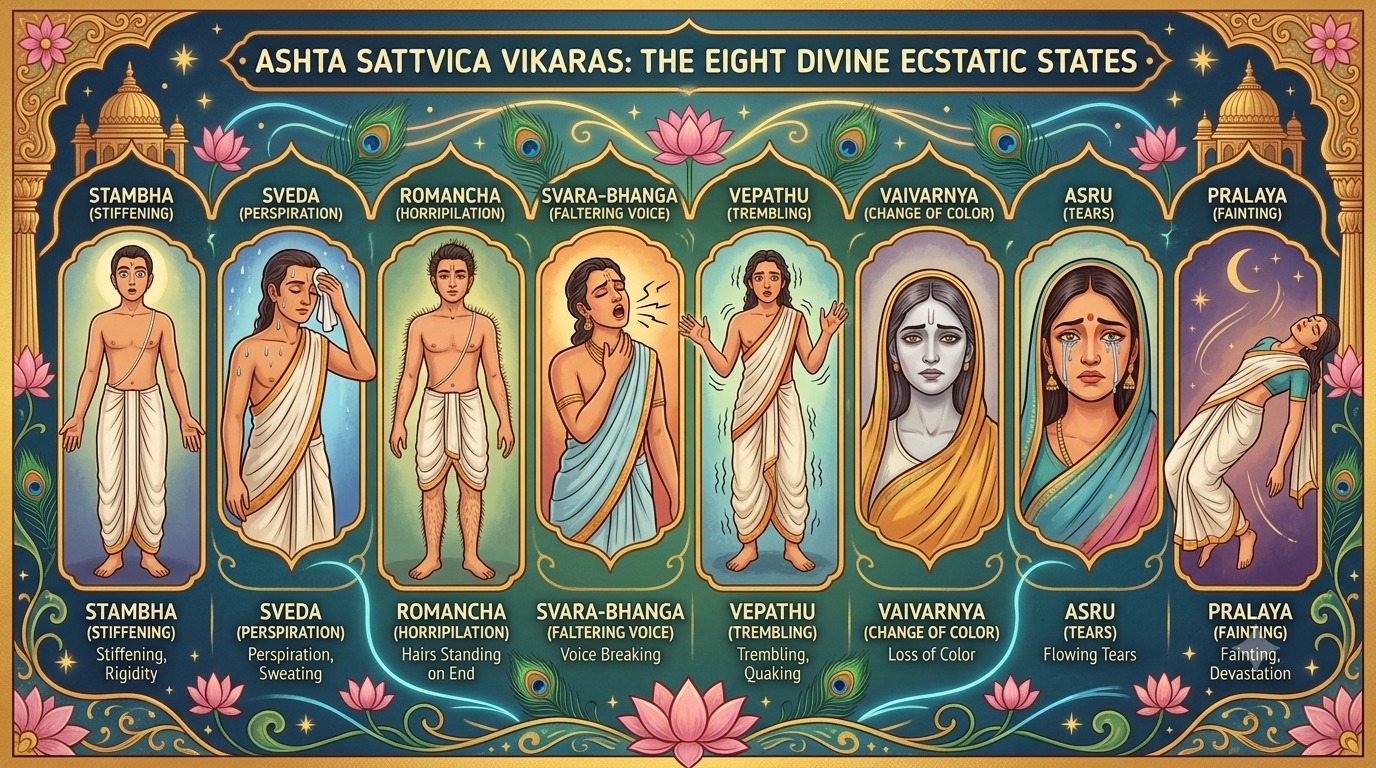
stambhaḥ svedo ‘tha romāñcaḥ svara-bhedo ‘tha vepathuḥ
vaivarṇyam aśru pralaya ity aṣṭau sāttvikāḥ smṛtāḥ
— Bhakti-rasamrita-sindhu 2.3.16
Translation: “Stunned immobility, perspiration, standing of the hairs on end, faltering of the voice, trembling, change of bodily color, tears, and devastation (fainting) — these eight are known as the sattvika transformations.”
Every popular list of the Ashta Sattvika Vikaras, whether in a temple discourse or a dance manual, ultimately traces back to this one sloka.
The Eight Vikaras, One by One
1. Stambha (स्तम्भ) — Paralysis or Stupefaction
Stambha is a sudden freezing of the body — motion stops, breath seems to stop, the person stands rooted like a statue. It happens when the mind is so completely absorbed that it temporarily forgets how to direct the body at all.
Example: Devotees describe long moments during the chanting of the holy name, or at the sight of the deity’s face (darshan) in a beautifully decorated temple, where a person simply cannot move, as if time itself has paused for them.
2. Sveda (स्वेद) — Perspiration
An unprovoked sweat breaks out, even without physical exertion or heat, because the internal “fire” of intense emotion agitates the body’s subtle currents.
Example: A singer overcome mid-verse during an emotional bhajan, sweating despite standing still in a cool hall.
3. Romancha / Pulaka (रोमाञ्च / पुलक) — Horripilation
The hairs of the body stand on end — goosebumps in modern terms — as a direct, almost electric response to a wave of devotional feeling.
This is the vikara most explicitly referenced in the Bhagavad Gita’s eleventh chapter, when Arjuna beholds the universal form of Krishna:
tataḥ sa vismayāviṣṭo hṛṣṭa-romā dhanañjayaḥ
— Bhagavad Gita 11.14
“Then Arjuna, filled with wonder, his hair standing on end, [bowed his head to the Lord].” Here hṛṣṭa-romā is precisely the romancha vikara, triggered by the overwhelming vision of the cosmic form.
4. Svarabheda (स्वरभेद) — Faltering of the Voice
The voice cracks, chokes, or breaks entirely, unable to complete a sentence, as the throat itself is gripped by emotion.
Chaitanya Mahaprabhu prays for exactly this symptom in his celebrated Shikshashtakam:
nayanaṁ galad-aśru-dhārayā vadanaṁ gadgada-ruddhayā girā
pulakair nicitaṁ vapuḥ kadā tava nāma-grahaṇe bhaviṣyati
— Shikshashtakam, Verse 6
“O Lord, when will My eyes fill with streaming tears, My voice choke up (gadgada), and My body thrill with horripilation, simply upon uttering Your holy name?” This single verse names three vikaras at once — asru (tears), svarabheda (choked voice), and romancha (hair standing on end).
5. Kampa / Vepathu (कम्प / वेपथु) — Trembling
An uncontrollable shaking or shivering of the limbs, distinct from ordinary fear-trembling because it arises from being emotionally overpowered rather than threatened.
The Bhagavad Gita gives a striking non-devotional but textually parallel example when Arjuna, overwhelmed before the battle, describes his own body:
sīdanti mama gātrāṇi mukhaṁ ca pariśuṣyati
vepathuś ca śarīre me romaharṣaś ca jāyate
— Bhagavad Gita 1.29
“My limbs give way, my mouth is drying up, my body trembles (vepathu), and my hair is standing on end (romaharsha).” Though Arjuna’s cause here is grief and anxiety rather than devotional bliss, the physiology described is the same set of sattvika symptoms — showing how ancient this bodily vocabulary of overwhelming emotion is in Sanskrit literature.
6. Vaivarnya (वैवर्ण्य) — Change of Bodily Color
The complexion pales, yellows, or otherwise visibly shifts, as blood flow and internal energy are redirected by the force of the emotional wave.
Example: Devotees are described turning pale or losing their natural color when suddenly reminded of separation from the divine beloved (viraha), a recurring theme in Vaishnava poetry about Radha’s longing for Krishna.
7. Ashru (अश्रु) — Tears
Perhaps the most familiar and universally recognized vikara — spontaneous weeping, whether from longing, joy, gratitude, or awe. Unlike ordinary crying, ashru in this context flows without conscious effort or intention, purely as an overflow of the heart.
8. Pralaya (प्रलय) — Devastation or Fainting
The most extreme of the eight: a complete loss of ordinary bodily awareness, collapse, or fainting, when emotion reaches a pitch the nervous system simply cannot sustain in a conscious state. In Vaishnava hagiography this is described as the rarest and highest of the eight, appearing only in the most intense moments of divine absorption.
Chaitanya Mahaprabhu: The Living Example of All Eight
While the Natya Shastra treats these transformations mainly as tools for actors to convey emotion on stage, the Gaudiya Vaishnava tradition insists on a crucial distinction: these symptoms are never to be imitated. They are proof of genuine, spontaneous spiritual ecstasy, not technique.
Sri Chaitanya Mahaprabhu (1486–1534) is repeatedly described in the Chaitanya Charitamrita as manifesting all eight vikaras simultaneously during kirtan. One well-known verse states plainly:
prabhura aṅge dekhe aṣṭa-sāttvika vikāra
āścarya sāttvika dekhi’ haila camatkāra
— Chaitanya Charitamrita, Antya-lila 14.100
“They saw all eight kinds of sattvika transformations manifest in the Lord’s body. Seeing such wonderful sattvika symptoms, everyone was struck with amazement.” This passage is treated as the definitive real-world case study of the Ashta Sattvika Vikaras occurring together in a single person, at a single moment.
Other figures associated with these ecstasies in the Bhagavata tradition include King Prithu, described as increasing in devotional ecstasy while worshiping the Lord’s feet, and various gopis and sages in the Bhagavata Purana whose bodies are said to have exhibited these signs during moments of profound remembrance of Krishna.
Sattvika Bhava vs. Sattvikabhasa: A Crucial Distinction
Rupa Goswami is careful to distinguish genuine sattvika bhava from its mere resemblance, called sattvikabhasa. He notes that even those pursuing liberation or ordinary sense pleasure can sometimes display similar physical symptoms while singing or hearing the holy names — tears, trembling, and so on — but without the underlying foundation of rati (established loving attachment to Krishna), these are only a semblance:
sarvānanda-camatkāra hetur bhāvo varo ratiḥ
ete hi tad-vinā bhāvān na camatkāritāśrayāḥ
— Bhakti-rasamrita-sindhu 2.3.70
The point is that the eight physical signs by themselves are not proof of spiritual advancement; what matters is the emotional depth and purity behind them. This is why the tradition warns strongly against theatrically imitating stambha, ashru, or pralaya to appear pious — the vikaras are meant to be read as evidence of an inner state, not performed for outer effect.
Why the Ashta Sattvika Vikaras Still Matter Today
For students of Indian aesthetics, the eight vikaras remain foundational to understanding how classical dance, drama, and poetry represent inner emotional states through the body — a vocabulary still used by teachers of Bharatanatyam, Odissi, and Kathak when training dancers in abhinaya (expressive performance).
For practitioners of bhakti, the list functions differently: not as performance technique, but as a way of recognizing genuine spiritual transformation when it happens — in oneself or in others — and understanding why devotional literature so often describes saints weeping, trembling, or falling silent mid-sentence when overcome by remembrance of the divine.
Either way, the Ashta Sattvika Vikaras offer something rare: a precise, centuries-old vocabulary for what happens when the human body becomes a visible mirror of an otherwise invisible, overwhelming emotion.
Quick Reference: The Eight Sattvika Vikaras
| No. | Sanskrit | Meaning |
|---|---|---|
| 1 | Stambha | Paralysis / stupefaction |
| 2 | Sveda | Perspiration |
| 3 | Romancha (Pulaka) | Horripilation / hair standing on end |
| 4 | Svarabheda | Faltering, choked voice |
| 5 | Kampa (Vepathu) | Trembling |
| 6 | Vaivarnya | Change of bodily color |
| 7 | Ashru | Tears |
| 8 | Pralaya | Fainting / devastation |
Frequently Asked Questions
Are the Ashta Sattvika Vikaras found in the Bhagavad Gita?
The Gita does not name them as a formal list of eight, but individual symptoms — trembling, hair standing on end, a drying mouth — appear in Arjuna’s description of his own distress (Chapter 1) and his awestruck response to the universal form (Chapter 11), using the same Sanskrit vocabulary later systematized in the Bhakti-rasamrita-sindhu.
Where does the formal list of eight come from?
The most quoted source verse is Bhakti-rasamrita-sindhu 2.3.16 by Srila Rupa Goswami, building on the broader sattvika bhava framework of Bharata Muni’s Natya Shastra.
Can these symptoms be practiced or imitated?
Traditional teaching holds that genuine sattvika vikaras cannot be manufactured; they arise spontaneously from deep emotional or spiritual absorption. Deliberately imitating them is discouraged as inauthentic (sattvikabhasa).
Who is considered the classic example of exhibiting all eight?
Sri Chaitanya Mahaprabhu, as described extensively in the Chaitanya Charitamrita, particularly in the Antya-lila, where all eight are said to have appeared on his body simultaneously during sankirtana.