History, Power, and the Most Polarizing Text in Indian History
Few texts in human history provoke as much visceral reaction as the Manusmriti (also known as the Manava-Dharmashastra). To its fiercest critics, it is the foundational blueprint for systemic caste inequality and patriarchal oppression in South Asia. To academic historians, it is an intriguing snapshot of ancient legalism and Brahminical hegemony. To modern political commentators, it is a lightning rod that never stops burning.
Strip away the political shouting matches, and one question remains: What does the Manusmriti actually say, and why does it still dictate public discourse thousands of years later?
What Is the Manusmriti?
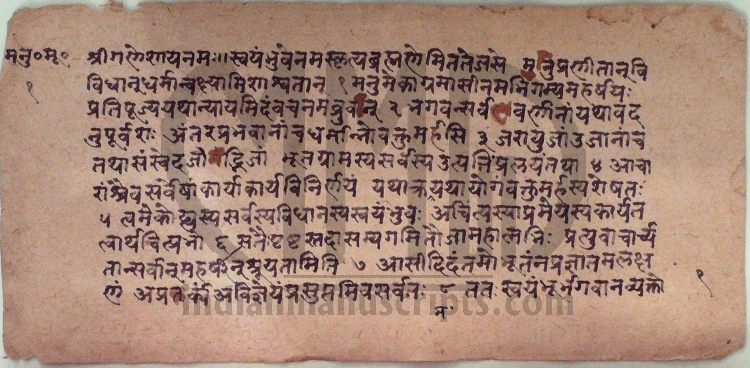
Attributed to *Swayambhuva Manu—the mystical first human and progenitor of mankind in vedic cosmology—the *Manusmriti is a Sanskrit treatise on Dharma (duty, law, and social ethics). Svayambhuva Manu, the first Manu of the current cosmic age (Kalpa), who was born from Brahma and married to Shatarupa. The text itself presents a discourse given by Manu and Bhrigu on dharma, covering duties, rights, laws, conduct, and virtues. Each chapter’s colophon often states that the text is Bhṛgu-proktā, meaning “spoken by Bhrigu,” indicating that Bhrigu narrated or recorded Manu’s teachings
Modern scholars date it as composed roughly between *200 BCE and 300 CE. it consists of *2,684 verses divided across 12 chapters. It doesn’t read like a modern constitution or a unified penal code; instead, it blends:
- Cosmology & Creation: How the universe and social classes originated.
- Achar (Conduct): Daily rituals, dietary restrictions, and rites of passage.
- Vyavahara (Law): Civil, criminal, and kingly administrative laws.
- Prayaschitta (Expiation): Penance, karma, and rebirth mechanics.
The text has been subdivided into twelve Adhyayas (chapters). The text can be broadly divided into four, each of different length. and each further divided into subsections:
- Creation of the world
- Source of dharma
- The dharma of the four social classes
- Law of karma, rebirth and final liberation
Dharmaśāstra
They are Sanskrit Puranic Smriti texts on law and conduct, and refer to treatises (śāstras) on Dharma. These texts are elaborate law commentaries, often more theoretical than practical. There are many Dharmaśāstras, variously estimated to number from 18 to over 100. Each of these texts exists in many different versions, and each is rooted in Dharmasutra texts – the most important are the sutras of Apastamba, Gautama, Baudhayana, and Vasistha.
The textual corpus of Dharmaśāstra were composed in poetic verse, and are part of the Smritis, constituting divergent commentaries and treatises on ethics particularly duties, and responsibilities to oneself and family as well as those required as a member of society.
Key Dharma Shastras
Manusmriti (Laws of Manu): This is one of the most well-known Dharma Shastras, attributed to Manu, the legendary first lawgiver. It outlines the duties and responsibilities of individuals based on their varna (social class) and ashrama (stage of life). The text covers various aspects of life, including family law, inheritance, and social conduct
Yajnavalkya Smriti: This text is attributed to the sage Yajnavalkya and is known for its comprehensive treatment of law and ethics. It addresses various legal matters, including marriage, property rights, and the duties of individuals in different social roles
Narada Smriti: This Dharma Shastra focuses on the duties of individuals and the administration of justice. It provides guidelines for legal procedures and the conduct of judges, emphasizing the importance of dharma in governance
Parashara Smriti: Attributed to the sage Parashara, this text deals with various aspects of law and ethics, particularly in relation to family and social duties
These texts collectively form a significant part of Hindu legal and ethical literature, influencing both ancient and modern Indian society. They provide insights into the moral and social framework that governed the lives of individuals in ancient India.
The Core Controversies: Why it Triggers Firestorms
The Manusmriti isn’t controversial by accident; its core structure codifies absolute social stratification and institutionalized hierarchy.
1. The Rigid Hierarchy of Varna (Caste)
The text institutionalized a strict hierarchy originating from the cosmic deity Brahma, assigning innate duties, privileges, and punishments based on birth:
- Brahmins (Priests/Scholars): Assigned spiritual authority, exempt from capital punishment, granted tax privileges.
- Kshatriyas (Rulers/Warriors): Tasked with protection, governance, and physical enforcement.
- Vaishyas (Traders/Farmers): Assigned commerce and agriculture.
- Shudras (Laborers/Servants): Excluded from sacred Vedic learning (Vedas), mandated to serve the top three classes.
Crucially, punishment under the Manusmriti was not equal before the law. The lower your birth, the harsher the physical penalty for the exact same crime—a stark contrast to modern legal equality.
2. Patriarchy and Control Over Women
The text presents a deeply contradictory view of women, famously praising them in one verse while completely stripping away their autonomy in others:
“Where women are honored, there the gods rejoice…” — Manusmriti 3.56
Yet, later chapters enforce absolute subjugation:
“Her father protects her in childhood, her husband protects her in youth, and her sons protect her in old age; a woman is never fit for independence.” — Manusmriti 9.3
Was It Ever the “Actual Law” of India?
Here is where popular narrative meets cold historical nuance.
| Epoch | Was Manusmriti the Unified Legal Code? | Historical Reality |
|---|---|---|
| Ancient / Medieval Period | No | India was governed by local customs (Deshachara), guild rules (Sreni), and local royal decrees. Manusmriti was an idealist Brahminical treatise, not an enforced national law code. |
| British Colonial Era | Partially | Seeking a unified law code to govern native subjects, British orientalists (led by Sir William Jones in 1794) translated Manusmriti, mistakenly codifying it into Anglo-Hindu Law. |
| Post-1950 Modern India | No | The Indian Constitution, drafted by Dr. B.R. Ambedkar, completely replaced religious codes with equal civil rights, outlawing untouchability and birth-based discrimination. |
Key Points
- A Product of its Era: reflecting the Brahminical sociopolitical situation.
- Colonial Amplification: British administrators over-indexed on the text, turning a theoretical treatise into actual applied civil law for Hindus.
- Obsolete Legally, Potent Symbolically: While completely rendered null by the Constitution of India, its ideological legacy remains a central battleground in debates over caste, feminism, and social justice.
The Historiographical Debate: Was the Manusmriti Enforced or Just An Ideal?
While modern political discourse often treats the Manusmriti as an all-powerful constitution that governed ancient Indian courts, mainstream historians and Indologists hold a far more nuanced view. The central debate among historians revolves around a single question: Was the text an enforced legal reality, or merely a utopian blueprint written by Brahmin scholars?
1. The “Brahminical Utopia” View (Text vs. Practice)
Leading Indologists such as Patrick Olivelle and Donald Davis Jr. argue that the Manusmriti was primarily a prescriptive text rather than a descriptive code of law.
- Lack of State Enforcement: Ancient India was not a centralized state with a uniform legal system; it was a patchwork of kingdoms, chiefdoms, and self-governing village assemblies.
- Local Custom Over Text: Practical justice was largely administered through local corporate bodies—such as Jati (caste) councils, Sreni (merchant guilds), and Gram Sabhas (village assemblies). These bodies operated on customary law (Deshachara), which often contradicted the rigid prescriptions of the Manusmriti.
- Literary Idealism: Historians point out that texts like the Manusmriti represented a Brahminical vision of an “ideal order” (Dharma) created during times of political instability (such as the fall of the Mauryan Empire), meant to assert cultural authority rather than serve as a daily court manual.
2. The “Ideological Hegemony” View (Structural Impact)
Conversely, social historians and subaltern scholars (such as Dr. B.R. Ambedkar and later Dalit historians) emphasize that focusing purely on courtroom enforcement misses the broader point.
- Social Engineering: Even if a king did not hold a physical copy of the Manusmriti in court, its core principles—graded inequality, ritual purity, and caste endogamy—deeply shaped the socio-cultural fabric.
- Royal Patronage: Rulers frequently sought legitimacy from Brahmin scholars, who served as royal advisors (Purohits) and judges. Thus, Dharmashastric ideology heavily influenced royal decrees (Rajashasana) and judicial punishments, particularly against lower castes and women.
3. The British Colonial Intervention (The Turning Point)
The consensus among historians—including Richard Lariviere and *Bernard Cohn—is that the *Manusmriti received its ultimate legal enforcement under British rule, not ancient dynasties.
When the British East India Company took administrative control of Bengal in the late 18th century, they sought a codified, “native” legal system similar to European civil codes.
- Orientalist scholars like Sir William Jones translated the Manusmriti into English in 1794, falsely assuming it was the “Hindu Bible” or the universal law book of all Hindus.
- The British elevated this specific text to the status of statutory law in colonial courts under Anglo-Hindu Law.
- By doing so, the colonial state effectively rigidified fluid local customs and froze a dynamic legal tradition into a single, highly orthodox text.
The Manusmriti Deconstructed: Caste, Imperialism, and Spiritual Reform
The Fire at Mahad
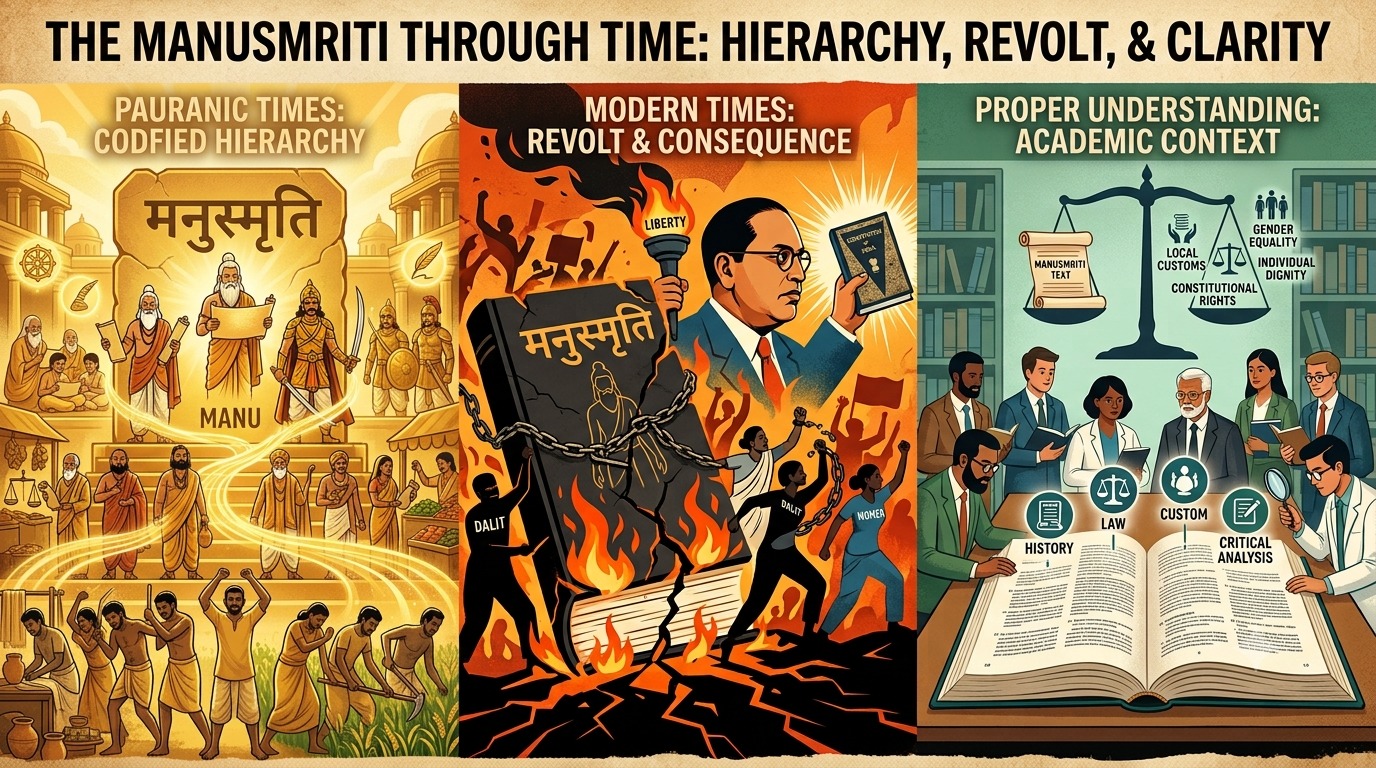
On December 25, 1927, in the small town of Mahad, Maharashtra, a fire was lit that fundamentally altered India’s social trajectory. Dr. B.R. Ambedkar, along with thousands of Dalit activists, publicly burned a copy of the Manusmriti (Mānava-Dharmaśāstra).
This was not merely a protest against an ancient text; it was a rejection of an entire social philosophy.
Today, the Manusmriti sits at a volatile crossroad. To understand its legacy, we must analyze three radically different forces that shaped it: *the Ambedkarite critique, **British colonial codification, and *the Gaudiya Vaishnava spiritual counter-narrative.
1. The Ambedkarite & Dalit Critique: The Architecture of Graded Inequality
For Dr. B.R. Ambedkar and the Dalit civil rights movement, the Manusmriti was not a benign legal document—it was the ideological blueprint for systemic oppression.
┌─────────────────────────────────────────────────────────────┐
│ AMBEDKARITE CRITIQUE │
├──────────────────────────────┬──────────────────────────────┤
│ Socio-Legal Stratification │ Codified unequal rights │
│ Sanctified Patriarchy │ Denied women independence │
│ Economic Subjugation │ Restricted Shudra ownership │
└──────────────────────────────┴──────────────────────────────┘
Key Pillars of the Ambedkarite Analysis:
- Graded Inequality: Ambedkar observed that standard legal systems enforce either total equality or absolute binary divides. The Manusmriti, however, engineered graded inequality—a system where rights, punishments, and social privileges were strictly proportional to birth rank.
- The Denial of Economic & Educational Mobility: The text contained explicit injunctions restricting lower-caste groups (Shudras and Avarnas) from accumulating wealth or accessing Vedic education, sealing social mobility across generations.
- Patriarchal Subjugation: Ambedkar highlighted how the text reduced women—regardless of caste—to perpetual dependents of male relatives, stripping them of independent financial autonomy.
The burning of the text at Mahad (Manusmriti Dahan Din) signaled that genuine constitutional democracy could not co-exist with birth-based scriptural sanction.
2. The British Imperial Lens: Codification & Weaponization
A common historical oversight is assuming the Manusmriti functioned as a universal “Hindu Bible” for thousands of years before modern times. Historical evidence shows a far more complex reality: prior to British rule, India operated on fluid, localized, and negotiable custom laws (Deshachara).
The British East India Company fundamentally transformed this ecosystem.
[Pre-Colonial India] [Colonial Transformation]
Fluid Local Customs ───► Sir William Jones Translates Manusmriti (1794)
Multiple Legal Texts ───► Monolithic Civil Code Enforced in Courts
Negotiable Social Strata ───► Rigid Census & Statutory Caste Classifications
How Colonial Rule Distorted the Text:
- The Search for a Universal Code: In 1794, Orientalist Sir William Jones translated the Manusmriti into English. Seeking an easy administrative tool to rule millions, British officers selected a Brahmanical text and applied it as the universal personal law for all non-Muslim Indians.
- Freezing the Fluidity: By enforcing specific interpretations of the Manusmriti through British courts, colonial legal authorities froze dynamic, evolving social customs into rigid statutory categories.
- Administrative Convenience: Through the Census of India (most notably from 1881 to 1911), British administrators categorized populations into hard-coded caste hierarchies, turning fluid social identities into concrete political divisions.
3. The Gaudiya Vaishnava Perspective: Daiva-Varnashrama vs. Hereditary Caste
While the Dalit movement fought the text through socio-political rejection, Gaudiya Vaishnavism—revived by Śrī Caitanya Mahāprabhu in the 16th century and expanded by reformists like Śrīla Bhaktisiddhānta Sarasvatī Ṭhākura in the 20th century—dismantled birth-based caste from within Hindu theology.
                 ┌─────────────────────────┐
                 │ GAUDIYA VAISHNAVA VIEW  │
                 └────────────┬────────────┘
                              │
    ┌─────────────────────────┴─────────────────────────┐
    ▼                                                   ▼
┌───────────────┐                                   ┌───────────────┐
│ Smriti Status │                                   │ Spiritual     │
└───────────────┘                                   └───────────────┘
Time-bound; subordinate to Shruti                   Universal access to devotion
Theological Breakdown:
1. Smriti vs. Shruti Hierarchy
Gaudiya theology categorizes the Manusmriti as Smriti (contextual, time-bound social guidelines) rather than Shruti (immutable eternal truths like the Upanishads or Bhagavad-gita). Smriti rules naturally change across historical epochs (Kala-Patra-Desha).
2. Character Over Birth (Guna-Karma vs. Janma)
Bhaktisiddhanta Sarasvati Thakur fiercely opposed the orthodox Smarta hereditary priest class. Citing texts like the Bhagavad-gita (4.13) and Srimad-Bhagavatam, he established that social classification (Varna) is defined solely by individual qualities (Guna) and work (Karma)—never by birth (Janma). He awarded the sacred thread of Brahminhood to individuals born in non-Brahmin and lower-caste families based on their character and spiritual aptitude.
3. Ultimate Transcendence (Sarvopadhi-Vinirmuktam)
Caitanya Mahāprabhu taught that the soul (Atman) is beyond all material designations—caste, nationality, gender, and status. In pure devotional service (Bhakti), anyone—regardless of birth—can attain the highest spiritual perfection, rendering birth-based social hierarchies irrelevant on the spiritual plane.
Comparative Summary Matrix
| Domain | Ambedkar / Dalit Philosophy | British Colonial Policy | Gaudiya Vaishnavism |
|---|---|---|---|
| Core View on Text | Instrument of institutional oppression; to be rejected. | Uniform statutory law code for governance. | Time-bound Smriti; subordinate to pure devotion. |
| View on Caste | Oppressive social structure to be completely eradicated. | Fixed administrative category for imperial control. | Birth-based caste rejected; replaced by character/aptitude (Guna/Karma). |
| Primary Goal | Constitutional equality, social liberty, and justice. | Bureaucratic efficiency and legal standardization. | Universal spiritual awakening beyond material designations. |
Conclusion
The story of the Manusmriti is a lesson in how texts interact with power:
- For Dr. B.R. Ambedkar, dismantling its authority was a prerequisite for human dignity and constitutional rights.
- For the British Empire, standardizing it was a convenience of imperial governance that left a legacy of social rigidity.
- For *Gaudiya Vaishnavism, transcending its social codes through *Bhakti proved that true spirituality requires rejecting birth-based privilege in favor of inner character and devotion.
Understanding these three distinct analytical lenses allows for a comprehensive, historical, and nuanced understanding of one of the world’s most debated ancient texts.