Tragic Downfalls of Noble Men : Ancient Stories of Lust, Passion and Illusion
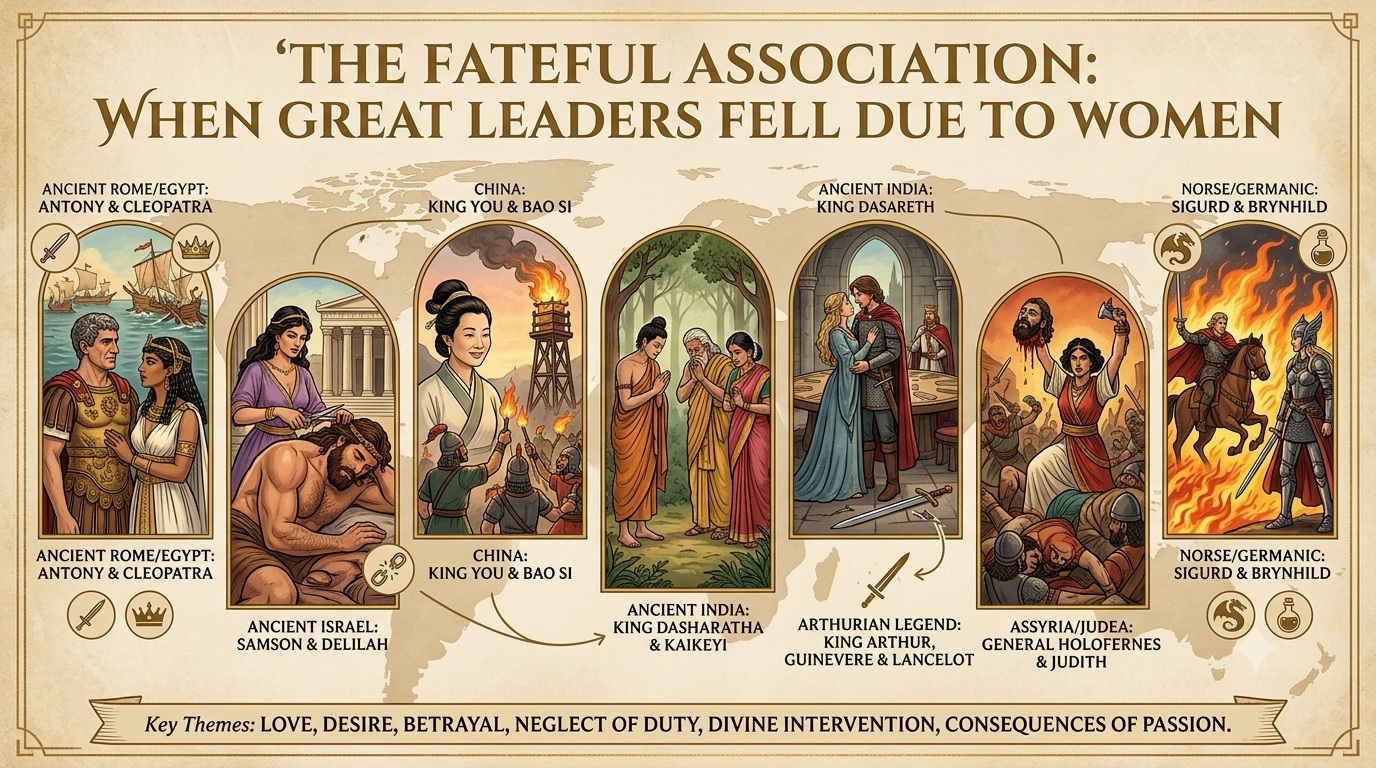
Throughout ancient history, literature, and mythology across the globe, the archetype of the “fated association”—where a powerful ruler, warrior, or king suffers political ruin, loss of power, or death due to his obsession, influence, or romance with a woman—is a recurring theme.
Here are prominent ancient stories from different traditions around the world.
1. Rome & Egypt: Mark Antony & Cleopatra
One of history’s most famous political downfalls stemming from a romantic alliance occurred in the late Roman Republic. *Mark Antony, one of Rome’s most powerful triumvirs and military generals, formed a deep romantic and political union with *Cleopatra VII, Queen of Egypt.
- The Downfall: Antony’s deep attachment to Cleopatra alienated his Roman allies and rival Octavian (later Emperor Augustus). Octavian exploited public fear in Rome, claiming Antony had turned his back on Roman virtues and was handing empire territories over to an Egyptian queen.
- The Result: Octavian declared war. Following their decisive naval defeat at the Battle of Actium (31 BCE), Antony’s legions deserted him. Believing a false rumor that Cleopatra had committed suicide, Antony fell on his sword, ending the Roman Republic and giving rise to the Roman Empire.
2. Ancient Israel: Samson & Delilah
In Hebrew scripture and ancient Near Eastern tradition, Samson was an invincible Israelite judge granted superhuman strength by God to protect his people against the Philistines.
- The Downfall: Samson fell in love with Delilah, a woman from the Valley of Sorek. Philistine leaders bribed Delilah with silver to discover the secret of Samson’s immense power. Despite repeated trickery, Samson eventually succumbed to her persistence and confessed that his strength resided in his uncut hair.
- The Result: Delilah had a servant shave Samson’s head while he slept. Weakened and betrayed, Samson was captured, blinded, and imprisoned by the Philistines, ending his reign as leader before his final destructive act at the temple of Dagon.
3. Ancient China: King You of Zhou & Bao Si
During the Western Zhou Dynasty (8th century BCE), King You of Zhou became infatuated with Bao Si, a legendary beauty who rarely smiled.
- The Downfall: Desperate to make her laugh, King You abused the kingdom’s military beacon system—lighting the signal fires meant to warn noble lords of an enemy invasion. When the lords arrived in full armor only to find no threat, Bao Si laughed. Pleased, the King repeatedly lit the beacons to amuse her, destroying his lords’ trust.
- The Result: When real Quanrong nomads invaded the capital in 771 BCE, King You lit the beacon fires, but no noble lords responded, assuming it was another prank. King You was killed, the capital was sacked, and the Western Zhou Dynasty collapsed.
4. Ancient India: King Dasharatha & Kaikeyi (The Ramayana)
In the ancient Indian epic Ramayana, King Dasharatha of Ayodhya was a wise and powerful monarch whose downfall stemmed from a promise made to his beloved young queen, Kaikeyi.
- The Downfall: Years prior, Kaikeyi had saved Dasharatha’s life on the battlefield, earning two unfulfilled boons (promises). On the eve of Rama’s (Dasharatha’s eldest son) coronation as crown prince, Kaikeyi—influenced by her maid Manthara—demanded her two boons: that her own son Bharata be crowned king, and that Rama be exiled to the forest for 14 years.
- The Result: Bound by his royal oath and honor, Dasharatha was forced to yield. Rama willingly departed into exile, but King Dasharatha, heartbroken and overwhelmed by grief over the separation from his beloved son, died shortly after.
5. Ancient Greece: King Menelaus, Paris, and Helen of Troy
In Greek mythology, the downfall of entire city-states was sparked by the abduction/elopement of *Helen, wife of King Menelaus of Sparta, by *Paris, Prince of Troy.
- The Downfall: Influenced by Aphrodite, Paris took Helen to Troy, provoking Menelaus and his brother, King Agamemnon of Mycenae, to assemble an unprecedented coalition of Greek leaders and siege Troy.
- The Result: The decade-long Trojan War brought down the great Trojan civilization, led to the deaths of iconic leaders like Hector, Achilles, and Priam, and ultimately destabilized the victorious Greek kingdoms upon their return home.
6. China: Emperor Xuanzong & Yang Guifei (Tang Dynasty)
Emperor Xuanzong ruled China during the peak of the Tang Dynasty—a golden age of prosperity, art, and imperial strength. However, his later years were consumed by his infatuation with Yang Guifei (Consort Yang), recognized as one of the Four Beauties of ancient China.
- The Downfall: Xuanzong became so enamored with Yang Guifei that he neglected daily state governance. To please her, he promoted her relatives to top government posts—most notably her corrupt cousin Yang Guozhong, who alienated key military commanders.
- The Result: The instability triggered the An Lushan Rebellion (755 CE), which shattered the Tang Dynasty. As the rebels marched on the capital, fleeing imperial guards mutinied and refused to protect the Emperor unless Yang Guifei was executed. Devastated, Xuanzong was forced to allow her execution by strangulation, lost his throne shortly after, and spent his remaining years in grief.
7. Ancient India: Sage Vishwamitra & Menaka (Puranas)
Vishwamitra was a powerful king who renounced his throne to become a Brahmarshi (supreme sage). Through centuries of intense ascetic meditation (tapasya), he accumulated immense spiritual power capable of rivaling the gods.
- The Downfall: Indra, King of the Devas, feared Vishwamitra’s growing spiritual power would allow him to overthrow the heavens. Indra sent Menaka, the most alluring celestial nymph (apsara), to earth to disrupt his penance.
- The Result: Vishwamitra succumbed to Menaka’s beauty and passion, abandoning his spiritual practice for 10 years. Upon realizing he had lost all the divine energy accumulated over centuries, he left Menaka (and their newborn daughter, Shakuntala) to restart his hard-won penance from scratch.
8. Post-Trojan War Greece: King Agamemnon & Clytemnestra
*Agamemnon, King of Mycenae and commander-in-chief of the Greek forces during the Trojan War, returned home victorious after a ten-year siege, bringing back the Trojan princess *Cassandra as his war prize.
- The Downfall: Agamemnon’s downfall stemmed from two women: his wife Clytemnestra and his sacrifice of their daughter Iphigenia. Before the war, Agamemnon sacrificed Iphigenia to appease the goddess Artemis for favorable winds. Deeply embittered, Clytemnestra took a lover (Aegisthus) while Agamemnon was away and plotted revenge.
- The Result: Upon his triumphant return, Clytemnestra welcomed Agamemnon with a crimson carpet and invited him to take a bath. While trapped in a net-like robe, Agamemnon was murdered in his own palace by Clytemnestra and her lover.
9. Arthurian Legend: King Arthur, Queen Guinevere & Lancelot
In British lore, King Arthur established the ideal medieval kingdom of Camelot with his round table of knights.
- The Downfall: Arthur married *Guinevere, but she engaged in a secret, long-standing love affair with *Sir Lancelot, Arthur’s most trusted knight and champion.
- The Result: When the treasonous affair was exposed by Mordred, Arthur was bound by law to condemn Guinevere to death. Lancelot rescued her, sparking a civil war between Arthur’s loyalists and Lancelot’s supporters. Taking advantage of the chaos, Mordred usurped the throne, leading to the fatal Battle of Camlann, where Arthur was mortally wounded and Camelot fell into ruin.
10. Ancient Assyria / Judea: General Holofernes & Judith
In the Deuterocanonical Book of Judith, Holofernes was the feared, brutal general of the Assyrian King Nebuchadnezzar. He led a massive campaign to crush the Kingdom of Judea and laid siege to the mountain city of Bethulia.
- The Downfall: Judith, a courageous and wealthy Jewish widow, entered the enemy camp under the pretense of offering military intelligence. Transfixed by her beauty and intellect, Holofernes invited her to a private banquet to celebrate his anticipated victory.
- The Result: Consumed by lust and intoxicated by wine, Holofernes passed out on his couch. Judith drew his own ceremonial sword and beheaded him. She smuggled his head back to Bethulia; upon discovering their supreme general dead, the leaderless Assyrian army panicked and was routed by the Israelite forces.
11. Ancient India (Magadha): King Bimbisara & Amrapali
King Bimbisara of Magadha (6th century BCE) was one of ancient India’s most powerful monarchs, expanding his empire and strengthening his rule.
- The Downfall: Disguised as a commoner, Bimbisara entered the rival republic of Vaishali and met *Amrapali, the famed *Nagarvadhu (royal courtesan) and artist. Bimbisara fell deeply in love, keeping his true identity hidden while spending days in Vaishali.
- The Result: His secret visits to an enemy capital created severe political vulnerabilities. Upon discovering her true status and his identity, the political friction weakened his position. Later, his ambitious son Ajatashatru—disillusioned by his father’s actions and eager for power—imprisoned Bimbisara and usurped the throne, leaving the old king to starve in captivity.
12. Arthurian Legend: Merlin & Nimue (The Lady of the Lake)
Merlin, the arch-mage and chief advisor to King Arthur, was the ultimate power behind Camelot—possessing prophecy, dynamic magic, and political foresight.
- The Downfall: Merlin became infatuated with Nimue (also known as Vivien), an adept student of magic. Driven by his obsession, Merlin taught her his most secret spellcraft, including the magic to bind and trap a person indefinitely.
- The Result: Fearing Merlin’s influence and power, Nimue turned his own spells against him. She trapped the legendary wizard inside an impenetrable oak tree (or stone tomb, depending on the version), removing Arthur’s greatest protector right before Camelot descended into civil war.
13. Ancient China (Three Kingdoms): Dong Zhuo, Lu Bu & Diaochan
During the collapse of the Han Dynasty, the tyrant warlord Dong Zhuo controlled the imperial court, protected by his unbeatable adopted son and champion general, Lü Bu.
- The Downfall: To eliminate the tyrant, the minister Wang Yun devised a “chain stratagem” using Diaochan, a legendary beauty. Both Dong Zhuo and Lü Bu were separately promised her hand, sparking fierce jealousy between the ruler and his top general.
- The Result: Lü Bu’s obsession with Diaochan eclipsed his loyalty to Dong Zhuo. Manipulated by his hatred over the romantic rivalry, Lü Bu assassinated Dong Zhuo in broad daylight, ending his oppressive reign but plunging China deeper into the chaos of the Three Kingdoms era.
14. Persia: King Kay Kavus, Sudabeh & Prince Seyavash (Shahnameh)
In the legendary Persian epic Shahnameh (Book of Kings), King Kay Kavus ruled Iran during a period of constant conflict with rival kingdom Turan.
- The Downfall: Kay Kavus’s wife, Queen *Sudabeh, became obsessed with her stepson, the noble Prince *Seyavash. When Seyavash rejected her advances, Sudabeh falsely accused him of attempting to rape her. Blinded by his affection for Sudabeh, Kay Kavus forced his son to undergo a life-or-death trial by fire to prove his innocence.
- The Result: Seyavash emerged unharmed from the flames, proving his innocence, but the rift between father and son was irreparable. Heartbroken by his father’s distrust and Sudabeh’s intrigue, Seyavash fled to rival Turan, where he was eventually betrayed and executed. His death triggered decades of devastating wars that nearly destroyed Iran.
15. Ancient Rome: Sextus Tarquinius, Lucretia & the Fall of the Monarchy
In 509 BCE, Tarquin the Proud (Tarquinius Superbus) was the seventh and final King of Rome. His son, Prince Sextus Tarquinius, brought down the entire Roman monarchy through his brutal actions against a noblewoman.
- The Downfall: Sextus became obsessed with Lucretia, a Roman noblewoman renowned for her virtue and wife of the nobleman Collatinus. Sextus entered her home under the guise of guest hospitality and assaulted her at knifepoint.
- The Result: Lucretia summoned her father, husband, and the nobleman Lucius Junius Brutus to reveal the crime before taking her own life to preserve her honor. Outraged by the royal family’s tyranny and dishonor, Brutus led a massive uprising, drove King Tarquin and his family into exile, destroyed the 244-year-old Roman monarchy, and established the Roman Republic.
16. Norse: Sigurd, Gunnar & Brynhild
In Germanic and Norse tradition, Sigurd (Siegfried) was the greatest hero of the age, and Gunnar was the King of the Burgundians.
- The Downfall: Sigurd originally awakened and won the love of the warrior Valkyrie Brynhild, but after receiving a potion of forgetfulness, he married Princess Gudrun instead. Sigurd then disguised himself as King Gunnar to pass a wall of fire and win Brynhild’s hand for Gunnar.
- The Result: When Brynhild later discovered the deception—that Sigurd, not Gunnar, had conquered the flames—she felt deeply betrayed and humiliated. Driven by pride and anger, Brynhild coerced Gunnar into orchestrating Sigurd’s murder. Following Sigurd’s death, Brynhild committed suicide, and the loss of their primary champion left Gunnar’s realm vulnerable to invasion, leading to the destruction of the royal house.
17. Ancient Japan: Retired Emperor Heizei & Fujiwara no Kusuko
During the early Heian Period (810 CE), Retired Emperor Heizei stepped down from power due to ill health, handing the imperial throne to his younger brother, Emperor Saga.
- The Downfall: Heizei was heavily influenced by his favorite imperial consort, Fujiwara no Kusuko, and her ambitious brother Nakanari. Kusuko sought to regain political power by persuading Heizei to move the imperial capital back to Nara and challenge Emperor Saga’s authority.
- The Result: Emperor Saga responded swiftly, stripping Kusuko of her titles and deploying troops to block Heizei’s movements (an event known as the Kusuko Incident). Upon realizing the rebellion had failed, Kusuko committed suicide by poison, her brother was executed, and Heizei was forced to shave his head and live as a Buddhist monk until his death, leaving his faction completely destroyed.
18. King Shantanu & Goddess Ganga (Mahabharata)
King Shantanu of Hastinapur, a forefather of the Pandavas and Kauravas, was a powerful Kuru monarch who fell deeply in love with the river goddess Ganga.
- The Downfall: Ganga agreed to marry Shantanu on one condition: he must never question her actions, no matter how harsh, or she would instantly leave him. As they had children, Ganga drowned their first seven newborn sons in the river. Consumed by grief and love, Shantanu remained silent until she was about to drown their eighth child. Driven to despair, Shantanu broke his vow and demanded she stop.
- The Result: Ganga spared the eighth child—who grew up to be *Bhishma—but vanished forever, leaving Shantanu heartbroken. Desperate for another companion years later, Shantanu sought the hand of *Satyavati. Satyavati’s father agreed only if her children inherited the throne, forcing Bhishma to take his legendary oath of lifelong celibacy and renounce his kingship. This succession crisis planted the seeds for the destructive Kurukshetra War.
19. King Yayati, Devayani & Sharmishtha (Mahabharata / Puranas)
*King Yayati, an ancestor of the Kuru dynasty, was a celebrated warrior king who married *Devayani, daughter of the sage Shukracharya (guru of the Asuras).
- The Downfall: As part of a compromise, Devayani was accompanied by Sharmishtha, an Asura princess forced to serve as her maid. Shukracharya warned Yayati never to engage romantically with Sharmishtha. However, Yayati secretly fell in love with Sharmishtha and fathered three sons with her in secret.
- The Result: When Devayani discovered the betrayal, she reported it to her father. Furious at Yayati’s broken promise and unrestrained desires, Shukracharya cursed the king to instantly lose his youth and become a frail, decrepit old man. Though Yayati later transferred the curse to his son Puru, his reign and legacy were permanently tarnished by his insatiable desires.
20. Bhasmasura & Mohini (Vishnu Purana)
Bhasmasura was a formidable Asura who performed extreme penance to earn a boon from Lord Shiva.
- The Downfall: Shiva granted him the power to turn anyone into ashes (bhasma) simply by placing his hand on their head. Emboldened by his invincibility, Bhasmasura immediately tried to test the power on Shiva himself to claim his domain. Lord Vishnu intervened by assuming the form of Mohini, an enchanting dancer of matchless beauty.
- The Result: Captivated by Mohini, Bhasmasura forgot his quest for power and begged her to marry him. Mohini agreed on the condition that he match her dance steps move for move. Entanced by her dance, Bhasmasura mimicked a gesture where Mohini placed her hand on her own head—striking his own head and reducing himself to ashes on the spot.
21. Ravana & Rambha / Vedavati (Ramayana)
While Ravana’s ultimate downfall is famously tied to his abduction of Sita, the Uttara Kanda of the Ramayana details how earlier abusive associations with women laid the supernatural foundation for his defeat.
- The Downfall: Fueled by unchecked power, Ravana assaulted Vedavati (an ascetic woman devoted to Vishnu) and violated Rambha (the celestial nymph betrothed to Nalakuvara, son of Kubera).
- The Result: Vedavati immolated herself, vowing to be reborn to bring about his total destruction (later manifesting as Sita). Furthermore, after the assault on Rambha, Nalakuvara cursed Ravana that if he ever touched another woman against her will, his seven heads would shatter into pieces. This curse prevented Ravana from forcibly violating Sita, giving Rama time to build an alliance, invade Lanka, and slay him.
22. King Pradyota, Vasavadatta & Udayana (Classical History / Lore)
In ancient historical lore (recorded in Bhasa’s classical plays like Svapnavasavadattam), King Udayana of Vatsa was a skilled ruler famous for his mastery of the veena and taming wild elephants.
- The Downfall: King Pradyota (Mahasena) of Avanti captured Udayana through a ruse and held him prisoner in Ujjain. To keep him contained, Pradyota appointed Udayana to teach music to his daughter, Princess Vasavadatta.
- The Result: The teacher and student fell deeply in love. Rather than negotiating his freedom or focusing on his kingdom’s defense, Udayana eloped with Vasavadatta on a royal elephant, abandoning his capital. His absence allowed rival kingdoms to encroach upon Vatsa’s territory, forcing his ministers into complex political trickery to restore his realm.
23. Indra and Ahalya: The Curse of Gautama Maharishi
- The Story: Smitten by Ahalya’s beauty, Indra disguised himself as Sage Gautama while the sage was away doing his morning rituals at the river. Assuming the form of her husband, Indra deceived Ahalya.
- The Downfall & Curse: When Gautama returned unexpectedly and caught Indra leaving his hermitage, the furious sage cursed the King of Gods. Gautama cursed Indra to be covered in a thousand vulvas (representing his unchecked lust), causing him immense shame. When Indra begged for mercy, Gautama mitigated the curse, converting the marks into a thousand eyes—making Indra Sahasraksha (“the thousand-eyed one”). Ahalya was cursed to be Invisible until freed by Lord Rama ages later.
24. Nahusha: The Loss of the Throne
During Indra’s self-imposed exile to cleanse his sin of slaying Vritra, Heaven was left without a ruler. The Devas invited Nahusha, a virtuous earthly king, to temporarily occupy Indra’s throne.
- The Story: Upon assuming the role of Indra, Nahusha was corrupted by absolute power and luxury. He became obsessed with Indra’s queen, Sachi (Indrani), and demanded she accept him as her husband.
- The Downfall: Sachi agreed on one condition: Nahusha must arrive at her quarters in a palanquin carried by the Saptarishis (the Seven Great Sages). Driven by impatience, an intoxicated Nahusha kicked the venerable sage Agastya, shouting “Sarpa, Sarpa!” (“Faster, faster!”).
- The Result: Enraged by his arrogance, Sage Agastya cursed Nahusha to instantly become a python (Sarpa) and fall from the heavens down to earth. With Nahusha deposed, Indra was welcomed back to his throne.
Remedy
Gaudiya Vaishnavism does not view these accounts merely as historical events or romantic tragedies, but as instructional allegories and cosmic realities meant to guide a practitioner (sadhaka) on the path of pure devotion (bhakti-yoga).
Here are the key take-home learnings from the Gaudiya Vaishnava perspective:
1. The Invisibility and Power of Maya (Material Illusion)
In Gaudiya philosophy, the material world is governed by Maya—the illusory energy of the Supreme Lord (Krishna). Maya utilizes two primary forces:
- Attraction to form/beauty (Kama – lust or material desire)
- Infallible pride (Ahamkara – ego and the desire to be the enjoyer)
Stories like Indra and Ahalya, or King Yayati and Devayani/Sharmishtha, illustrate that no matter how elevated one’s status is—whether a king, a powerful sage, or the King of Heaven—uncontrolled material desire can pierce even the strongest mental defenses.
Key Lesson: Never become complacent. Even advanced spiritualists or powerful leaders can slip if they assume they are immune to material distraction.
2. Shift from “Enjoyer” (Bhokta) to “Servant” (Dasa)
The core disease of material existence in Gaudiya Vaishnavism is misplaced lordship. The soul (jiva) is inherently an eternal servant of Krishna (jivera ‘svarupa’ haya-krsnera ‘nitya-dasa’).
When a leader or king sees a woman, territory, or kingdom solely as an object for their own personal enjoyment, they usurp Krishna’s position as the Supreme Enjoyer (Supreme Bhokta).
- Material Desire (Kama):** Seeking to gratify one’s own senses using another person.
- Spiritual Love (Prema):** Seeking to give pleasure to Krishna and seeing all living beings as His parts and parcels.
Key Lesson: Falls occur when love (prema) degrades into selfish enjoyment (kama). True protection comes from viewing everyone and everything as belonging to the Supreme Lord.
3. The Danger of Aparadha (Offenses)
In many of these ancient stories, the downfall is initiated by disrespect toward pure devotees, sages, or holy entities (such as Indra disrespecting Sage Durvasa, or Ravana offending Vedavati).
In Gaudiya Vaishnavism, Vaishnava Aparadha (offending a devotee of the Lord) is called the Hati-Mata—the “mad elephant offense.” Just as a mad elephant enters a garden and uproots all the flowering plants, committing offenses against holy persons destroys one’s accumulated spiritual merit and clarity, leaving one vulnerable to low desires.
Key Lesson: Humility (Trinad api sunichena) and respect toward all living beings are essential safeguards against spiritual fall down.
4. The World of Dualities vs. Pure Bhakti
The material world is inherently unstable. In the Bhagavad Gita (15.7), Krishna notes that the living entities are struggling with the six senses, including the mind. Stories of kings falling from grace show that:
- Material position (kingship, wealth, beauty) is fleeting.
- Material relationships based on physical attraction end in grief or loss.
- Even heavenly elevations (like Indra’s throne) are temporary (ksine punye martya-lokam visanti).
Key Lesson: Real security cannot be found in material power, romantic idealism, or political status—only in unalloyed devotion to Radha-Krishna.
5. Compassion Over Condemnation
Importantly, Gaudiya Vaishnavism views struggling souls with immense compassion. When Indra was humbled by Krishna under Govardhan Hill or cursed by Gautama Rishi, his downfalls served a higher purpose: they destroyed his false pride (mada) and brought him to his knees in genuine surrender.**
Sri Chaitanya Mahaprabhu taught that no matter how fallen someone is, the chanting of the Holy Names (Sankirtana) can purify any heart and restore the soul to its original, blissful state.
Key Lesson: Downfalls highlight the weakness of the material condition, but genuine repentance (anutapa) and surrender (saranagati) always reopen the door to divine grace.
Summary Matrix
| Story Context | Material Dynamic | Gaudiya Vaishnava Realization |
|---|---|---|
| Indra & Ahalya | Uncontrolled lust overriding duty | Kama destroys intelligence; mind must be controlled through nam-smaran. |
| Indra & Govardhan | Ego & entitlement to worship | Krishna removes pride from His devotees to bring them back to humility. |
| King Yayati | Insatiable desire for youth & indulgence | Material desires are never quenched by enjoyment; they grow like fire fed by fuel. |
| Ravana / Bhasmasura | Viewing others as objects of exploitation | Attempting to enjoy what belongs to God leads to complete self-destruction. |