Stop Chasing “Passion.” Find Your Dharma: The Hard Truth About Sacred Purpose
Most self-help gurus sell you soft advice: “Follow your passion,” “Manifest your dreams,” “Protect your vibe.” It’s nonsense. Passion fades when work gets tough, and manifestation without execution is just daydreaming. If you want a life of undeniable authority, momentum, and inner alignment, you don’t need more motivation—you need Dharma.
Dharma isn’t a fluffy wellness term. It is an ancient, uncompromising framework for duty, order, and radical personal accountability. In short: Dharma is doing what you were built to do, regardless of whether you feel like doing it.
What Is Dharma?
Derived from the Sanskrit root dhri—meaning “to support, hold, or sustain”—Dharma is the natural law that holds the cosmos together.
- The Dharma of fire is to burn.
- The Dharma of water is to flow.
- Your Dharma is the unyielding pursuit of your core purpose.
People mistake Dharma for a luxury or a hobby. They treat it like something you look for after you secure a comfortable life. Wrong. Dharma is the foundation. Living out of alignment with your true nature causes chronic friction, burnout, and existential drift.
“Better is one’s own duty, though devoid of merit, than the duty of another well performed.”
— The Bhagavad Gita
When you attempt to live someone else’s life—chasing someone else’s title, bank account, or lifestyle—you violate your Dharma. You become a poor imitation of someone else instead of a master of yourself.
Vaishnava Perspective
While traditional views frame Dharma primarily as socio-cosmic duty (Varnashrama Dharma) or moral law (Sanatana Dharma), the Gaudiya Vaishnava perspective—rooted in the teachings of Chaitanya Mahaprabhu (1486–1534)—radically redefines the concept.
The conventional duties are considered temporary or preliminary (Gauṇa Dharma). The ultimate, essential nature of every living entity is Jaiva Dharma (the soul’s eternal function), which is unalloyed loving devotional service (Bhakti) to Krishna.
The Hierarchy of Dharma
Human duty is divided into two distinct categories:
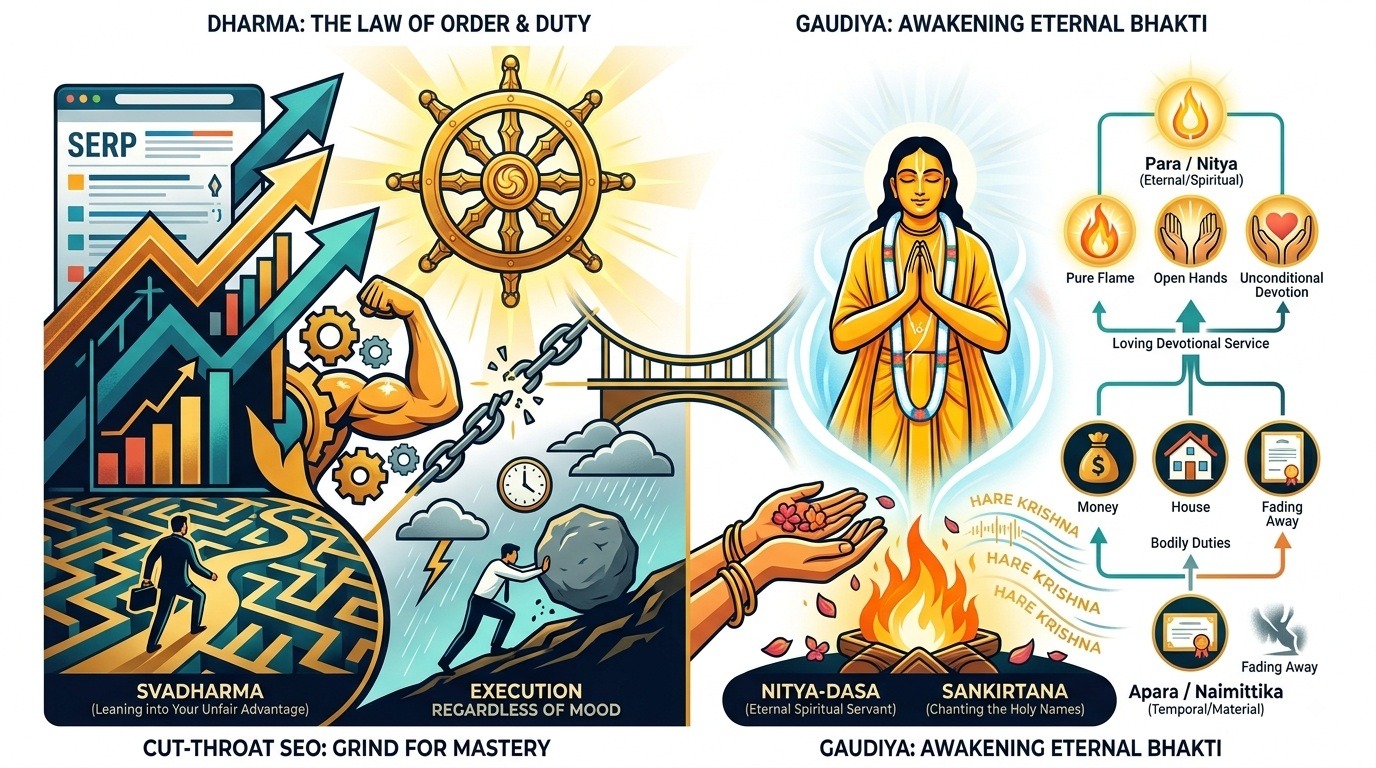
| Dharma (Duty/Nature) | Apara / Naimittika | Para / Nitya |
|---|---|---|
| Nature | Material / Temporal | Spiritual / Eternal |
| Activities | • Bodily designations • Social & family duties • Ends with the body | • Pure soul activity • Loving devotional service (Bhakti) |
- Naimittika (Apara) Dharma: Relative duties bound to time, place, and the physical body (e.g., career, citizenship, bodily preservation).
- Nitya (Para) Dharma: The eternal, unchanging nature of the spirit soul (jīva). According to the foundational verse by Chaitanya Mahaprabhu:
“Jīvera ‘svarūpa’ haya—kṛṣṇera ‘nitya-dāsa'”
(The intrinsic identity of the soul is to be an eternal servant of Krishna.)
Key Core Tenets
### 1. Acintya-Bhedābheda (Inconceivable Oneness & Difference)
The philosophical foundation of the Gaudiya school, codified by Jiva Gosvami and Baladeva Vidyabhushana. The soul (jīva) is simultaneously one with God in quality (spiritual essence), yet eternally different in quantity (God is infinite; the soul is infinitesimal).
Because of this eternal distinctness, the ultimate goal is relationship, not merging into an impersonal void (Moksha).
### 2. Transcendental Love (Prema) Over Salvation
While many traditional paths aim for Moksha (liberation from rebirth), the Gaudiya school considers Moksha to be merely a byproduct. The fifth and highest goal of human life (Pañcama-puruṣārtha) is Kṛṣṇa-prema—unconditional, ecstatic divine love.
### 3. The Central Role of Śrīmatī Rādhārāṇī
Krishna is the Supreme Enjoyer (Shaktiman), and Radha is His supreme feminine potency (Hladini Shakti—the pleasure-giving energy).
- Radha represents the absolute zenith of devotion.
- Gaudiya practitioners aim to serve Krishna under the guidance and mood of Radha and her associates (Manjari-bhava).
### 4. Yuga-Dharma: Chanting the Holy Names
The specific Dharma prescribed for the current age (Kali-yuga) is Sankirtana—the congregational chanting of the Hare Krishna Maha-Mantra:
$$\text{Hare Krishna, Hare Krishna, Krishna Krishna, Hare Hare}$$
$$\text{Hare Rama, Hare Rama, Rama Rama, Hare Hare}$$
By chanting, one cleanses the heart of material misidentifications and awakens the latent soul-level Nitya Dharma.
Comparison: Traditional Dharma vs. Gaudiya Perspective
| Feature | Conventional / Vedic View | Gaudiya Vaishnava View |
|---|---|---|
| Primary Focus | Cosmic order, moral code, civic duty (Varnashrama) | Loving devotion to Krishna (Prema-Bhakti) |
| Ultimate Goal | Righteous living (Dharma), Wealth (Artha), Pleasure (Kama), Liberation (Moksha) | Divine Love (Kṛṣṇa-prema), transcending the basic four goals |
| Identity | Defined by caste, ashrama, or physical birth | Eternal spiritual servant (Nitya-dasa) |
| Highest Practice | Ritual sacrifices, meditation, or self-realization | Chanting the Holy Name (Nama-Sankirtana) |
The 4 Pillars of Unshakable Dharma
To execute on your purpose, you must master the four foundational principles that govern aligned action:
tapaḥ śaucaṁ dayā satyam
iti pādāḥ kṛte kṛtāḥ
adharmāṁśais trayo bhagnāḥ
smaya-saṅga-madais tava
(Srimad Bhagavatam 1.17.24)
| Four Pillars of Dharma | Sanskrit | Meaning | Principle That Breaks It |
|---|---|---|---|
| Truthfulness | Satya | Honesty, integrity, and living according to truth | Gambling |
| Purity | Śauca / Suci | Maintaining purity in thoughts, words, relationships, and actions | Illicit Sex |
| Austerity | Tapasya | Self-discipline, sense control, and voluntary restraint | Intoxication |
| Mercy | Karuna | Compassion and avoiding unnecessary harm to living beings | Meat Eating |
According to Vedic teachings, Satya (truthfulness), Śauca (purity), Tapasya (austerity), and Karuna (mercy) are important principles of a dharmic life. Practising these principles helps cultivate spiritual discipline, compassion, integrity, and self-control.
Why Ignoring Your Dharma Kills Momentum
When you trade your true calling for easy gratification or societal approval, the cost isn’t just boredom—it’s stagnation.
### 1. You Waste Energy on Resistance
Fighting against your own nature requires immense cognitive effort. When your daily work conflicts with your internal values, every hour feels like a grind.
### 2. You Lose Your Competitive Edge
You will never beat someone who is executing their Dharma. While you are forcing yourself to care, they are operating in state-of-flow alignment.
### 3. You Become Dependent on External Validation
If you aren’t driven by internal duty, you’ll constantly chase likes, promotions, and praise to fill the void.
How to Audit and Execute Your Dharma Today
Ready to stop drifting and start building? Use this 3-step tactical protocol to align your trajectory:
- Identify Your Unfair Advantage: What comes naturally to you that feels like grueling work to others? That overlap of innate skill and intense focus is where your Svadharma lives.
- Eliminate Misaligned Obligations: List every project, relationship, or goal you are maintaining strictly out of guilt or ego. Systematically ruthlessly cut or delegate them.
- Commit to Unconditional Action: Duty does not ask if you are tired. Once your path is clear, execute daily regardless of mood or immediate payoff.
The Bottom Line
Dharma doesn’t care about your excuses. It demands clarity, discipline, and absolute commitment to your purpose.
Stop asking what the world can give you. Find your duty, take responsibility, and execute.
The foundational slokas (Sanskrit verses) that anchor the entire discussion, bridging the execution of earthly duty with the ultimate eternal devotion.
### On Owning Your Unfair Advantage (Svadharma)
śreyān sva-dharmo viguṇaḥ para-dharmāt sv-anuṣṭhitāt
sva-dharme nidhanaṁ śreyaḥ para-dharmo bhayāvahaḥ
— Bhagavad Gita 3.35
- Translation: “It is far better to discharge one’s prescribed duties, even though faultily, than another’s duties perfectly. Destruction in the course of performing one’s own duty is better than engaging in another’s duties, for to follow another’s path is dangerous.”
- The Connection: Stop copying someone else’s blueprint. Your Svadharma is your lane; stay in it, even when it gets gritty.
### On Execution Regardless of Mood (Grind & Mastery)
karmaṇy evādhikāras te mā phaleṣu kadācana
mā karma-phala-hetur bhūr mā te saṅgo ’stv akarmaṇi
— Bhagavad Gita 2.47
- Translation: “You have a right to perform your prescribed duty, but you are not entitled to the fruits of action. Never consider yourself the cause of the results of your activities, and never be attached to not doing your duty.”
- The Connection: The ultimate antidote to “waiting for motivation.” You control the input (execution); you surrender the output (the algorithm, the metrics, the wealth).
2. Awakening Nitya Dharma
When you elevate from temporary material duty (Apara Dharma) to the eternal function of the soul (Para Dharma), these are the foundational texts of the Gaudiya tradition.
### On the Ultimate Spiritual Dharma (Para Dharma)
sa vai puṁsāṁ paro dharmo yato bhaktir adhokṣaje
ahaituky apratihatā yayātmā suprasīdati
— Srimad Bhagavatam 1.2.6
- Translation: “The supreme occupation [dharma] for all humanity is that by which men can attain to loving devotional service unto the transcendent Lord. Such devotional service must be unmotivated and uninterrupted to completely satisfy the self.”
- The Connection: This defines the shift from Naimittika (temporary bodily duties) to Nitya (eternal spiritual duty). True satisfaction only comes when action is unmotivated by selfishness (ahaituki) and unbroken by circumstance (apratihata).
### On the Constitutional Identity of the Soul (Jaiva Dharma)
jīvera ‘svarūpa’ haya—kṛṣṇera ‘nitya-dāsa’
kṛṣṇera ‘taṭasthā-śakti’ ‘bhedābheda-prakāśa’
— Chaitanya Charitamrita, Madhya 20.108
- Translation: “It is the living entity’s constitutional position to be an eternal servant of Krishna because he is the marginal energy of Krishna and a manifestation simultaneously one with and different from the Lord.”
- The Connection: Spoken by Chaitanya Mahaprabhu, this single verse summarizes the entire Gaudiya philosophical framework (Acintya-Bhedābheda) and establishes your truest identity: an eternal servant (nitya-dasa).
### On the Yuga-Dharma (The Execution Protocol for this Age)
harer nāma harer nāma harer nāmaiva kevalam
kalau nāsty eva nāsty eva nāsty eva gatir anyathā
— Brihan-naradiya Purana (quoted in CC Adi 17.21)
- Translation: “In this age of quarrel and hypocrisy (Kali-yuga), the only means of deliverance is chanting the holy name of the Lord. There is no other way. There is no other way. There is no other way.”
- The Connection: The specific mechanism (Sankirtana) to awaken Bhakti. The repetition (“no other way” three times) highlights the absolute exclusivity and urgency of this practice in the modern age.
### The Ultimate Conclusion: Surrender
sarva-dharmān parityajya mām ekaṁ śaraṇaṁ vraja
ahaṁ tvāṁ sarva-pāpebhyo mokṣayiṣyāmi mā śucaḥ
— Bhagavad Gita 18.66
- Translation: “Abandon all varieties of religion [temporary dharmas] and just surrender unto Me. I shall deliver you from all sinful reactions. Do not fear.”
- The Connection: Krishna’s final instruction. Once one awakens to their Nitya Dharma (eternal devotion), all lower-level societal and material duties (sarva-dharmān) are naturally transcended by full surrender to the Supreme.