
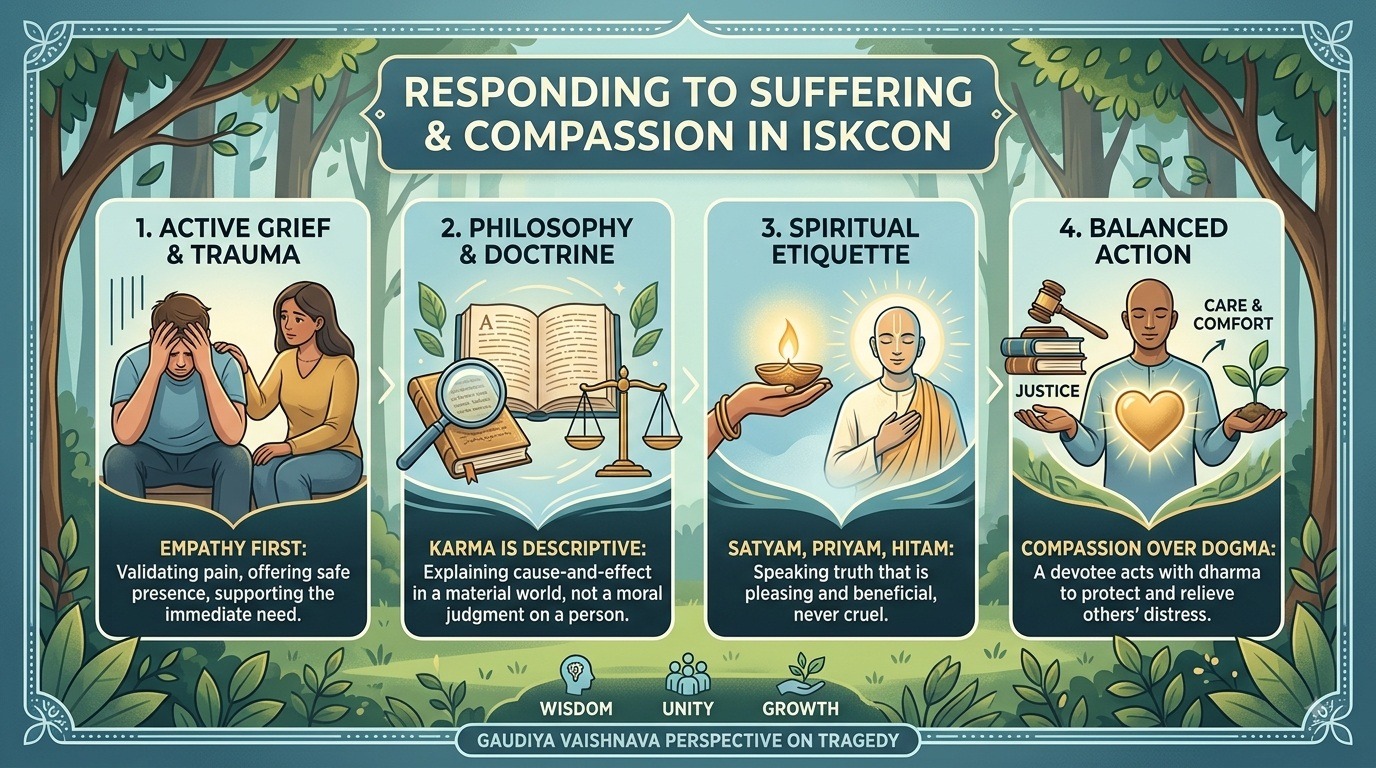
When tragedy strikes, invoking karma can sound cold or insensitive. Here is how to balance Vedic philosophy, spiritual etiquette, and genuine empathy when addressing suffering, crime, and grief.
Balancing the metaphysical reality of karma with active, living compassion (dayā or karuṇā) is one of the primary tests of a devotee’s spiritual maturity.
When practitioners weaponize karma to act indifferently toward suffering, they betray the very core teachings of their own tradition. Gaudiya texts and teachers balance these two principles through a clear hierarchy: karma explains the mechanics of the material universe, but compassion is the ultimate duty of a human being.
1. The Distinction Between Mechanics and Duty
Karma operates like a law of nature—similar to gravity. However, acknowledging gravity does not mean you let someone fall off a cliff.
- Karma is Descriptive, Not Prescriptive: Karma describes how cause-and-effect works in the material world (saṁsāra). It does not give orders on how a human being should act toward others.
- Compassion is the Higher Law (Dharma):* Regardless of why a person is suffering, the Vaishnava’s prescribed action is active relief and love. In the *Srimad-Bhagavatam (4.12.36), the mark of an advanced soul (mahātmā) is defined:
“Great personalities are always distressed by the distress of others, and they feel happy when others are happy.”
2. The Ideal of Para-Duhkha-Duhkhi
The highest ideal for a Gaudiya Vaishnava is to become a para-duhkha-duhkhi—one who suffers upon seeing the suffering of others.
The tradition celebrates saints who actively interrupted or took on others’ karma out of radical compassion, rather than leaving them to “face their karma”:
- Vasudeva Datta: In the Caitanya Caritamrta (Madhya 15.162–163), the devotee Vasudeva Datta prays to Chaitanya Mahaprabhu, asking to take on the entire karmic burden and hellish suffering of all living beings so they can be freed.
- King Rantideva: In the Srimad-Bhagavatam (9.21.12), King Rantideva famous prays: “I do not desire liberation or heavenly states. I desire only to take upon myself the suffering of all living beings so that they may be relieved of their pain.”
If karma were meant to be an excuse for cold indifference, these fundamental texts would praise detachment over self-sacrifice. Instead, they exalt radical empathy.
3. “Truth Without Compassion Becomes Cruelty”
Prominent Gaudiya teachers explicitly warn against misusing philosophical concepts to bypass basic human empathy:
“Truth without compassion often becomes cruelty. Truth without context often becomes distortion.”
— Chaitanya Charan Das (ISKCON Educator)
While Srila Prabhupada (ISKCON’s founder) taught karma academically to explain why evil exists without blaming God, he simultaneously established large-scale food relief programs (like Food for Life), disaster assistance, and spiritual outreach. He instructed his followers that a Vaishnava must care for both the soul and the body of a suffering person.
4. How Maturity Integrates Both Concepts
When a mature Vaishnava processes suffering, they apply karma and compassion in two completely different directions:
| HOW SUFFERING IS VIEWED | APPLIED TO ONESELF | APPLIED TO OTHERS |
|---|---|---|
| “If I suffer, it is my own karma, and I must learn humility.” | “If others suffer, it is my duty to help with love and care.” |
- To Oneself (Humility): When I face personal hardship, I attribute it to my own past mistakes/karma and try not to blame God or others.
- To Others (Active Compassion): When others face tragedy, I do not analyze their karma. I view them with unconditional empathy and act to alleviate their distress through safety, care, justice, and practical support.
5. Spiritual Etiquette: Satyam, Priyam, Hitam
In the Bhagavad Gita (17.15), speech is defined as a discipline (tapas):
“Austerity of speech consists in speaking words that are truthful, pleasing, beneficial, and not causing agitation to others.”
Even if a practitioner believes karma is the underlying metaphysical law of the universe, blurted-out theological explanations during intense suffering violate this standard:
- It agitates and traumatizes: Telling a victim of assault or a grieving parent “it’s your karma” causes profound emotional distress and spiritual alienation.
- It ignores context (Desha, Kala, Patra):* Vedic wisdom stresses that any truth must be spoken considering the *time, place, and circumstance/recipient. What is appropriate in a classroom study of philosophy is entirely inappropriate at a hospital bedside or funeral.
6. Compassion (Karuna) Trumps Philosophical Dogma
The defining characteristic of an advanced spiritual practitioner is compassion for suffering beings (para-duhkha-duhkhi—one who feels distress at the distress of others).
- Philosophy vs. Empathy: Philosophy is meant to comfort the mind, not weaponize judgment. When someone is in pain, they need empathy, safety, practical support, and comfort, not a lecture on past lives.
- Cosmic Law vs. Human Duty: Karma explains how the physical universe processes action, but human beings are called to act with dharma (duty, protection, and love). Blaming karma erases the moral culpability of perpetrators and ignores the victim’s immediate need for care and justice.
7. Why Blunt “Karma” Answers Are Counterproductive
| What Is Intended | What Is Communicated |
|---|---|
| Explaining cosmic order and why bad things happen in a temporal world. | Victim-blaming: Suggesting the victim “deserved” or “asked for” rape or murder. |
| Offering a philosophical framework for suffering. | Cold indifference: Using spiritual doctrine as an excuse to avoid sitting with someone’s grief. |
| Upholding scriptural truths. | Spiritual bypassing: Ignoring human pain and real-world justice in favor of quick religious platitudes. |
A guide on what to say depending on the situation, keeping compassion at the forefront.
1. When Speaking to Someone in Active Grief or Trauma
If the person asking is a victim, a grieving relative, or simply deeply shaken by a recent tragedy, do not offer theological explanations or mention karma. Offer empathy, presence, and practical solidarity.
Examples of What to Say:
- Validating the Pain:
“I am so deeply sorry this happened. It is completely unfair, heartbreaking, and cruel, and there are no words that can make sense of this kind of horror.”
- Offering Support Over Explanation:
“I don’t know why terrible things like this happen to good people, but I am here for you. How can I support you right now?”
- In Cases of Crime (Rape, Murder):
“This was an act of terrible violence, and the perpetrator is fully accountable. What happened to you/them is wrong, and you deserve justice, care, and total support.”
2. When Asked philosophically in a Discussion
If someone brings this up as a thoughtful question in a calm, non-crisis environment (e.g., “Why does God allow rape or murder to happen?”), you can balance cosmic philosophy with human ethics.
A Balanced, Empathetic Reply:
“That is one of the hardest questions anyone can ask. From a spiritual perspective, the tradition speaks about free will and karma—the reality that human beings make real, sometimes terribly evil choices, and actions carry consequences in this world.
However, *knowing a philosophical law doesn’t make a tragedy any less horrific. A spiritual understanding never excuses the criminal, nor does it mean a victim ‘deserved’ harm. The immediate duty of any human or devotee isn’t to judge or lecture, but to demand justice, protect the vulnerable, and act with deep compassion.”*
Stating a metaphysical truth improperly can convert a spiritual reality into a social untruth.
To handle this without diluting the truth or abandoning basic human compassion, consider the following approach:
1. Separate the Meta-Truth from the Immediate Reality
When a house is on fire, the “truth” is that chemical combustion is taking place. But if you yell about chemistry to someone trapped inside, you aren’t being truthful—you are being useless.
- The Cosmic Level: Karma explains the cosmic machinery of why suffering exists in the material world (duḥkhālayam).
- The Human Level: Your immediate dharma (duty) in front of a suffering person is active relief, justice, and compassion.
By focusing on help and empathy during a crisis, you are not denying karma; you are fulfilling the higher truth of human duty (dharma)**.
2. Reframing the Truth: Karma Is Not a Blame Tool
A common mistake is treating karma like a courtroom verdict that justifies cruelty. In Vedic philosophy, karma is not meant to be weaponized against others.
- For yourself: You use karma to build personal accountability (“I must reflect on my actions and accept life’s difficulties with humility”).
- For others: You use dayā (compassion) to relieve their burden.
- For criminals: The law of karma does not excuse perpetrators of crime (like rape or murder). The aggressor acts out of free will and incurs severe future karma, while societal justice must still be strictly enforced.
3. How to Speak the Truth Without Diluting It
If someone asks you directly about the philosophy during or after a tragedy, you can present the truth accurately without being insensitive by using three principles:
A. Acknowledge Free Will and Evil
Instead of saying, “It was their karma,” frame it around free will:
“The philosophy teaches that human beings have free will, and when people misuse that free will to commit evil, it creates horrific suffering. The perpetrator is completely responsible for their choices.”
B. Distinguish Between the Law and Our Response
“While cosmic laws like karma explain how cause and effect work in the universe over time, our spiritual duty as human beings right now is never to sit back and judge. Our duty is to act with love, seek justice, and relieve suffering wherever we find it.”
C. Practice Satyam Priyam (Truth Spoken Kindly)
Vedic texts state that truth should be spoken kindly and beneficially (satyaṁ brūyāt priyaṁ brūyāt). If speaking a truth causes unnecessary trauma or drives someone away from spiritual life, it fails the scriptural definition of proper speech (tapas of speech, Bhagavad Gita 17.15).
Quick Reference: Do’s and Don’ts
| Do | Don’t |
|---|---|
| Focus on the victim’s safety, feelings, and need for justice. | Don’t say “It’s past karma” or “Everything happens for a reason” to someone in pain. |
| Hold space for anger, grief, and confusion. | Don’t use spiritual concepts to bypass natural human emotions. |
| Place moral responsibility squarely on the perpetrator. | Don’t make the victim feel blamed or invalidated. |
| Admit that human minds cannot always fathom the depth of suffering. | Don’t offer cold, clinical theological platitudes. |
Summary
Bluntly telling a victim of crime or tragedy that “it’s your karma” is not a sign of high philosophy—it is a sign of immaturity and spiritual arrogance. True Gaudiya Vaishnavism teaches that while karma governs the universe’s mechanics, human beings are judged by how deeply they embody Krishna’s quality of compassion (dayā).
You do not need to lie or compromise the philosophy of karma to be compassionate. The truth is that karma governs the universe, but compassion governs the devotee. Presenting compassion first is not diluting the truth—it is practicing the highest part of it.