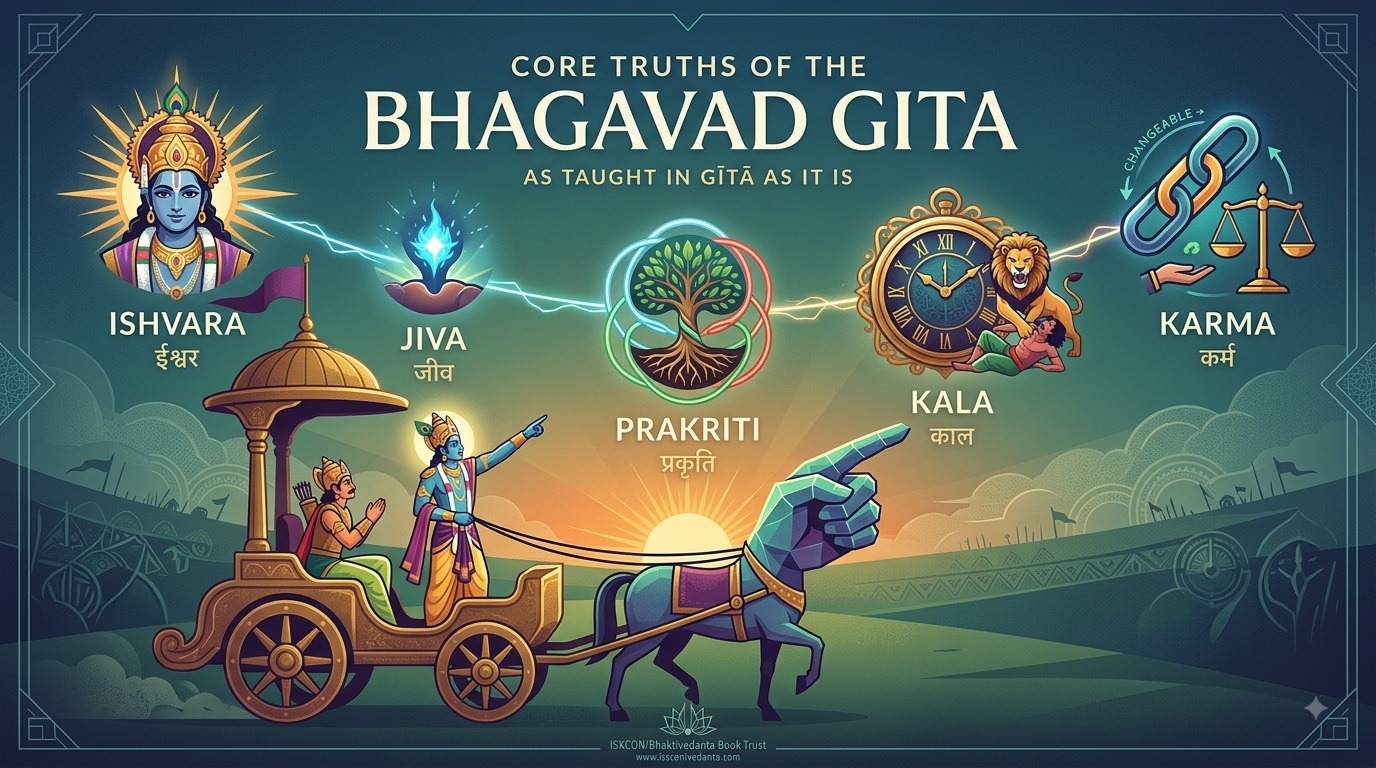
In the introduction to Bhagavad-gītā As It Is, His Divine Grace A.C. Bhaktivedanta Swami Prabhupada explains that the entire science of the Gita revolves around five basic truths:
- Ishvara (The Supreme Controller)
- Jiva (The Living Entity)
- Prakriti (Material Nature)
- Kala (Eternal Time)
- Karma (Action & Reaction)
Four of these five elements—Ishvara, Jiva, Prakriti, and Kala—are eternal (sanatana), while Karma is temporary and changeable. Understanding the dynamic between these five factors holds the secret to breaking free from material suffering and reconnecting with Krishna.
1. Ishvara: The Supreme Controller
The Concept
In Gaudiya Vaishnava philosophy, Ishvara refers to the Supreme Being, Lord Sri Krishna. He is the ultimate cause of all causes (sarva-karana-karanam), the supreme proprietor of everything in existence, and the ultimate enjoyer. While living entities have localized control over small things, Krishna exercises total control over the entire cosmic manifestation.
The Shloka (Chapter 10, Verse 8)
अहं सर्वस्य प्रभवो मत्तः सर्वं प्रवर्तते।
इति मत्वा भजन्ते मां बुधा भावसमन्विताः॥
Ahaṁ sarvasya prabhavo mattaḥ sarvaṁ pravartate
Iti matvā bhajante māṁ budhā bhāva-samanvitāḥ
Translation: “I am the source of all spiritual and material worlds. Everything emanates from Me. The wise who perfectly know this engage in My devotional service and worship Me with all their hearts.”
Real-World Example
- The Government & The Citizen: Think of a large nation’s power grid. Millions of homes use electricity, but none of them generate or govern the grid—the central power station does. Krishna is the cosmic power station supplying life, consciousness, and laws to the entire universe.
2. Jiva: The Individual Living Entity
The Concept
The Jiva is the soul—a tiny, spiritual spark (jiva-tattva) that is qualitative equal to Krishna (being eternal, full of knowledge and bliss), but quantitative minute. The Jiva is never the supreme lord; it is part and parcel of Krishna (mamaivamsho). Due to free will, when the Jiva forgets its loving relationship with Krishna, it falls into the material world and accepts temporary physical bodies.
The Shloka (Chapter 15, Verse 7)
ममैवांशो जीवलोके जीवभूतः सनातनः।
मनःषष्ठानीन्द्रियाणि प्रकृतिस्थानि कर्षति॥
Mamaivāṁśo jīva-loke jīva-bhūtaḥ sanātanaḥ
Manaḥ-ṣaṣṭhānīndriyāṇi prakṛti-sthāni karṣati
Translation: “The living entities in this conditioned world are My eternal fragmental parts. Due to conditioned life, they are struggling very hard with the six senses, which include the mind.”
Real-World Example
- Sun and Sunlight: Krishna is like the sun, and the individual Jivas are like tiny rays of sunlight. A ray of sunlight has heat and light just like the sun, but a single ray can never claim to be the entire sun power station itself.
3. Prakriti: Material Nature
The Concept
Prakriti is Krishna’s energy. It operates in two forms: Inferred/Inferior Nature (Apara-prakriti—made of 8 elements: earth, water, fire, air, ether, mind, intelligence, and false ego) and Superior Nature (Para-prakriti—the living spiritual souls). Material nature operates under the three modes (Gunas): Goodness (Sattva), Passion (Rajas), and Ignorance (Tamas).
The Shloka (Chapter 7, Verse 5)
अपरेयमितस्त्वन्यां प्रकृतिं विद्धि मे पराम्।
जीवभूतां महाबाहो ययेदं धार्यते जगत्॥
Apareyam itas tv anyāṁ prakṛtiṁ viddhi me parām
Jīva-bhūtāṁ mahā-bāho yayedaṁ dhāryate jagat
Translation: “Besides these, O mighty-armed Arjuna, there is another, superior energy of Mine, which comprises the living entities who are exploiting the resources of this material, inferior nature.”
Real-World Example
- The Puppet & The Strings: Imagine a stage play where puppets move. The puppets represent our physical bodies. The three modes of nature (Sattva, Rajas, Tamas) are the invisible strings moving us, controlled by the laws of Prakriti under Krishna’s ultimate direction.
4. Kala: Eternal Time
The Concept
Kala is the impersonal time factor—an unyielding, eternal energy of Krishna that drives all change, growth, decay, and destruction in the material universe. Nothing in the material world can resist Kala. It forces the Jiva through the four material miseries: birth, old age, disease, and death.
The Shloka (Chapter 11, Verse 32)
श्रीभगवानुवाच।
कालोऽस्मि लोकक्षयकृत्प्रवृद्धो लोकान्समाहर्तुमिह प्रवृत्तः।
Śrī-bhagavān uvāca:
Kālo ’smi loka-kṣaya-kṛt pravṛddho lokān samāhartum iha pravṛttaḥ
Translation: “The Supreme Personality of Godhead said: Time I am, the great destroyer of the worlds, and I have come here to destroy all people.”
Real-World Example
- The Ticking Clock & An App Expiry: You can download the sleekest app on a smartphone, but if it has a 30-day trial license, time will automatically lock you out when the clock runs out. Similarly, no matter how rich or powerful a person becomes, the clock of Kala inexorably revokes their physical body when their allotted time expires.
5. Karma: Action and Reaction
The Concept
Karma is the work performed by the Jiva while entangled in Prakriti under the influence of Kala. Every material action generates an equal and opposite reaction (good karma brings material pleasure, bad karma brings suffering). Crucially, among the 5 subjects, Karma is the ONLY ONE that can be altered or completely erased. By engaging in Bhakti-yoga (pure devotional service to Krishna), a person becomes free from the law of Karma (Karma-bandhana).
The Shloka (Chapter 3, Verse 9)
यज्ञार्थात्कर्मणोऽन्यत्र लोकोऽयं कर्मबन्धनः।
तदर्थं कर्म कौन्तेय मुक्तसङ्गः समाचर॥
Yajñārthāt karmaṇo ’nyatra loko ’yaṁ karma-bandhanaḥ
Tad-arthaṁ karma kaunteya mukta-saṅgaḥ samācara
Translation: “Work done as a sacrifice for Vishnu has to be performed; otherwise work causes bondage in this material world. Therefore, O son of Kunti, perform your prescribed duties for His satisfaction, and in that way you will always remain free from bondage.”
Real-World Example
- The Financial Debt vs. A Full Pardon: Committing bad deeds is like taking high-interest credit card debt—eventually, the bank comes to collect payment (suffering). Good deeds are like putting cash in savings (temporary reward). But surrendering to Krishna in pure devotion is like receiving a total debt wipeout from the supreme bank authority—releasing you completely from the cycle.
Summary Matrix: The 5 Topics at a Glance
| Subject | Translation | Nature | Ultimate Relationship |
|---|---|---|---|
| Ishvara | Supreme Controller | Eternal (Sanatana) | Sri Krishna / The Master / Object of Love |
| Jiva | Soul / Living Entity | Eternal (Sanatana) | The Eternal Servant (Jivera svarupa haya krsnera nitya-dasa) |
| Prakriti | Material Energy | Eternal (Sanatana) | Controlled by Krishna; venue for Jiva’s reform |
| Kala | Eternal Time | Eternal (Sanatana) | Executes Krishna’s dynamic willpower |
| Karma | Action & Reaction | Temporary | Dissolves through devotional service (Bhakti) |
Conclusion
As Srila Prabhupada repeatedly emphasizes in his purports, the goal of human life is to harmonize our Jiva existence with Ishvara (Krishna), using our remaining Kala (time) to perform devotional service instead of material *Karma, thereby transcending the bondage of *Prakriti.