The Sacred Science of ISKCON Attire: Spiritual & Health Secrets Behind Vaishnava Paraphernalia. The Deep Spiritual and Scientific Reasons Behind Dress Codes
Walking into an ISKCON temple, you are instantly greeted by vibrant colors, sacred markings, and distinct attire—from clay on the forehead to wooden beads around the neck.
- Is this just a religious uniform, an ancient Indian dress code, or cultural dogma?
- Far from being arbitrary fashion, every item worn by an ISKCON devotee is a bio-spiritual tool designed according to Vedic scriptures, subtle energy systems, and Ayurvedic health principles.
Core texts like the Bhagavad Gita emphasize internal devotion (Bhakti), intent (Bhava), and purity of mind (Shuddhi) over external aesthetics. Traditionally, scriptures emphasize cleanliness and natural fabrics (like unstitched cotton or silk) rather than a specific “fashion style.” The focus was on wearing fresh, clean clothes suited for spiritual practice (Sadhana).
Much like wearing a uniform to school or a suit to a corporate office, dressing in traditional attire sets a psychological state of reverence, detachment from worldly vanity, and focus on prayer. Modest clothing to maintain decorum and minimize distraction for fellow devotees.
1. Sacred Markings & Neck Ornaments
Tilak (Urdhva Pundra)
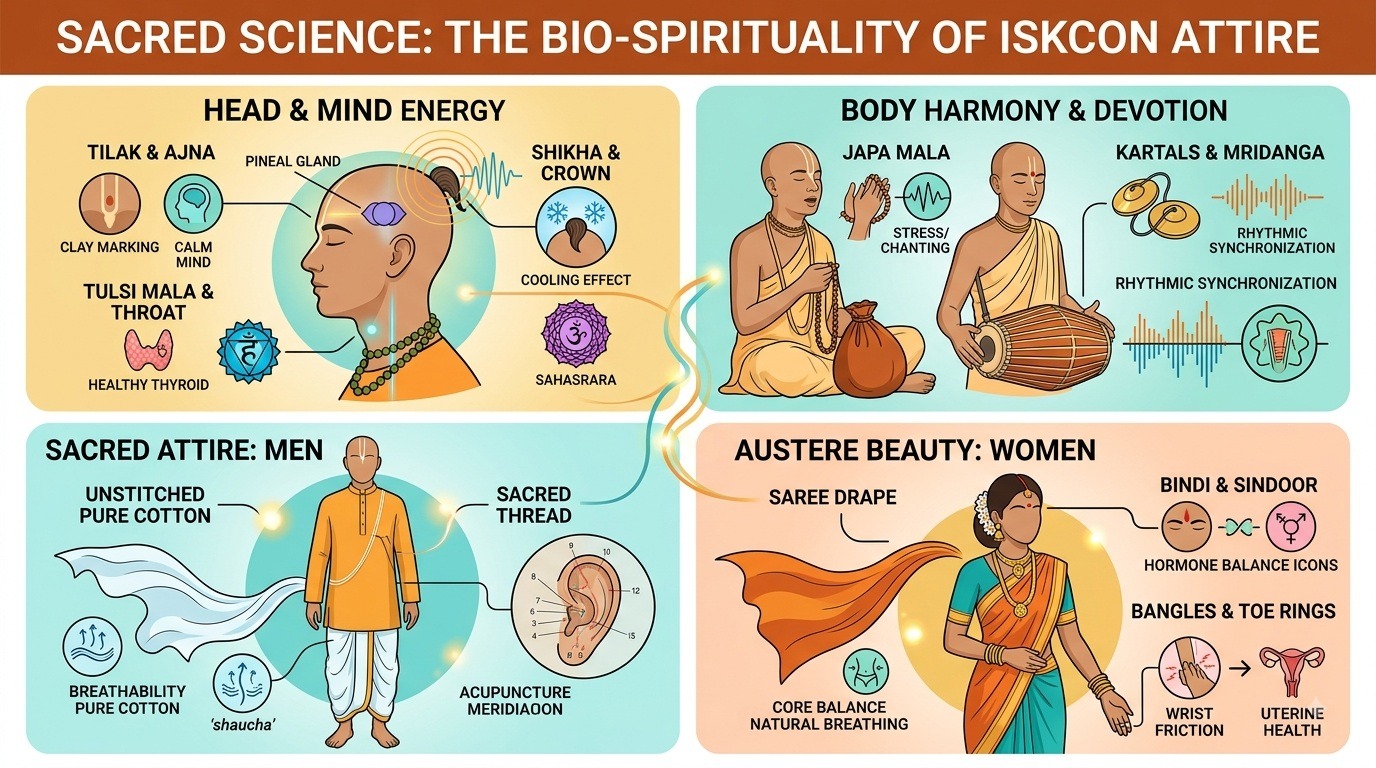
The distinct marking made with sacred clay (Gopi Chandan) on the forehead and 12 parts of the body.
- Spiritual Reason: Represents the temple of Lord Vishnu on the body. The two vertical lines represent the lotus feet of Krishna, and the leaf shape at the bridge of the nose represents a Tulsi leaf. Marking 12 body parts acts as a spiritual armor (Kavacha) dedicating the body to Krishna’s service.
- Scientific & Ayurvedic Reason: Applied at the Ajna Chakra (third eye region). Sacred clay contains natural cooling minerals that soothe the pineal and pituitary glands, reducing stress, enhancing focus, and regulating body heat.
Kanthi Mala (Tulsi Neckbeads)
One, two, or three strands of beads carved from the sacred Tulsi plant worn snugly around the neck.
- Spiritual Reason: Denotes surrender to Lord Krishna. In Vaishnava scripture, wearing Tulsi beads protects the soul at the time of death and reminds the wearer of their perpetual connection to the Divine.
- Scientific & Ayurvedic Reason: Tulsi (Ocimum sanctum) possesses potent bio-electric and antibacterial properties. Constant contact with the skin near the throat (Vishuddha Chakra) helps regulate the thyroid gland, boosts immunity, and purifies the subtle electrical pathways of the nervous system.
2. Daily Chanting & Hair Discipline
Japa Mala & Bead Bag
A string of 108 Tulsi beads kept inside a cloth bag (Gomukhi) for meditative chanting.
- Spiritual Reason: Used to chant the Hare Krishna Maha-Mantra. The bag keeps the sacred beads clean, unseen by onlookers to prevent subtle pride, and free from external contamination.
- Scientific & Ayurvedic Reason: Rolling the wooden beads between the thumb and middle finger stimulates key acupressure points connected to brain function, inducing an alpha-wave mental state that decreases cortisol and calms the nervous system.
Shikha (Tuft of Hair)
A small tuft of hair kept uncut at the crown of the head by male devotees, while the rest is shaved.
- Spiritual Reason: Protects the highest spiritual center (Brahmarandhra). During intense meditation or spiritual transition, this region serves as the focal energy exit/entry point.
- Scientific & Ayurvedic Reason: Located over the Sahasrara Chakra and a vital Ayurvedic marmapoint (Adhipati Marma). Leaving hair here cushions and regulates electromagnetic energy at the crown of the head, promoting mental clarity and brain cooling.
3. Men’s Sacred Attire
Dhoti, Kurta & Kaupina
Traditional unstitched cotton cloth draped around the lower body (saffron for celibate monks/brahmacharis; white for householders/grihasthas) over a basic loincloth (kaupina).
- Spiritual Reason: Unstitched clothing represents purity (Shaucha), simplicity, and freedom from worldly vanity. Saffron signifies renunciation, while white represents purity in worldly duties.
- Scientific & Ayurvedic Reason: Allows unrestricted air circulation around the lower body, preventing fungal growth and keeping the reproductive organs cool—essential for sperm health and hormonal balance. The lack of tight synthetic elastic prevents lymphatic blockage around the groin.
Yajnopavit (Sacred Thread)
A triple-strand thread worn over the left shoulder across the chest by initiated brahmanas.
- Spiritual Reason: Symbolizes spiritual second birth (Dvija) and vows of cleanliness, truthfulness, and scriptural study. The three cords remind the wearer of their debts to God, sages, and ancestors.
- Scientific & Ayurvedic Reason: Worn diagonally across vital acupressure zones. Wrapping the thread around the right ear during natural eliminations stimulates the auricular nerve system, aiding intestinal peristalsis and bladder control.
4. Women’s Sacred Attire & Ornaments
| Paraphernalia | Spiritual Significance | Scientific / Health Reason |
|---|---|---|
| Saree | Embodies modesty, elegance, and traditional female energy (Shakti). It preserves devotional focus during worship. | Wraps gracefully around the midriff without tight pressure, protecting core organs and aiding natural abdominal breathing and thermoregulation. |
| Kumkum / Sindoor | Applied in the hair parting by married women to invite auspiciousness and pray for their husband’s longevity. | Traditionally made from turmeric, lime, and mercury mineral (Cinnabar), which lowers stress, balances blood pressure, and stimulates sex drive via the Adhipati Marma. |
| Mangalsutra | A sacred necklace of black and gold beads given during marriage as a protective talisman. | Gold generates warmth and vitality, while black beads absorb negative environmental energies, shielding the heart region (Anahata Chakra). |
| Bangles & Anklets (Payal) | Represent domestic auspiciousness and devotional joy in serving the Divine. | Constant friction on the wrists improves blood circulation. Metallic anklets (silver) re-ground electrostatic energy from the feet back into the earth. |
| Nose Rings & Earrings | Honors the body as a temple of Krishna and reflects divine feminine grace. | Piercing the left nostril aligns with female reproductive acupressure points, easing menstrual pain and childbirth. Ear lobes house key reflexology points for brain health. |
| Flowers in Hair (Gajra) | Offered first to the Deities and worn as Prasad, spreading spiritual fragrance. | Natural floral aromatics (jasmine, rose) act as natural aromatherapy, lowering anxiety and balancing mood. |
5. Protective Ornaments & Energetic Alignment
Waist Belt (Kamarbandh / Kati Sutra)
A cloth sash or cord tied around the waist.
- Spiritual Reason: Keeps clothes secure during temple service, dances (Kirtan), and deity worship, signaling readiness for active devotional service (Seva).
- Scientific & Ayurvedic Reason: Supports the lumbar spine, maintains pelvic alignment during prolonged sitting/standing, and gently compresses the abdominal area to stimulate digestive fire (Agni).
Amulets & Kavacha
Sacred metal capsules containing holy dirt, mantras, or protective symbols worn on the arm or neck.
- Spiritual Reason: Acts as a spiritual shield against subtle negative energies, evil eye (Drishti), and planetary afflictions.
- Scientific & Ayurvedic Reason: Metals like silver, gold, or copper in constant contact with the skin exert trace oligodynamic (antimicrobial) effects and influence subtle bio-energetic fields.
6. Additional Personal & Ritual Items
Charanamrita / Prasadam Ring (Silver/Gold/Panchadhatu)
Rings worn on specific fingers, often engraved with Vaishnava symbols (like Hare Krishna mantra, lotus, or tilak) or set with sacred gemstones.
- Spiritual Reason: Reminds the devotee that their hands belong in the service of Krishna—whether preparing food, offering flowers, or playing instruments.
- Scientific & Ayurvedic Reason: Rings made of Panchadhatu (five traditional metals: copper, zinc, lead, iron, silver) or pure silver act as subtle galvanic conductors. They balance body temperature, regulate electromagnetic energy through finger nerve endings, and exert micro-pressure on specific acupressure meridians tied to heart and liver function.
Angavastra / Chadar (Upper Shawl)
A long cloth draped across the shoulders by male devotees during worship, chanting, or lectures.
- Spiritual Reason: Covers the upper body during sacred ceremonies to show respect, modesty, and focus before the Deities and spiritual master.
- Scientific & Ayurvedic Reason: Draped over the upper chest and back, it protects the lungs and thoracic region from sudden temperature drops during early morning worship (Mangala Aarti at 4:30 AM), preserving core thermal balance.
Pavitra / Kusha Grass Ring
A ring woven from sacred Kusha (Desmotachya bipinnata) grass worn during high-level Vedic rituals and fire sacrifices (Yagnas).
- Spiritual Reason: Kusha grass is considered exceptionally pure in Vedic literature. It acts as an insulator against spiritual pollution during sacred rituals.
- Scientific & Ayurvedic Reason: Modern physics notes that Kusha grass is a natural dielectric insulator (it blocks electrical conduction). During meditation or yagna, it prevents the subtle electrical bio-energy generated by the body from leaking into the ground.
7. Additional Women’s Traditional Paraphernalia
| Paraphernalia | Spiritual Significance | Scientific / Health Reason |
|---|---|---|
| Bichhiya (Toe Rings) | Worn on the second toe of both feet by married women as a sign of marital commitment and auspiciousness. | The nerve from the second toe connects directly to the uterus and passes through the heart. Constant friction from silver toe rings regulates uterine blood flow, keeping the reproductive system healthy and regularizing menstrual cycles. |
| Maang Tikka | An ornament worn hanging on the central parting of the hair, resting on the center of the forehead. | Rests directly on the Ajna Chakra. The weight of the metal gently presses this acupressure node, soothing the nervous system, reducing headaches, and aiding mental focus. |
| Bazu Band (Upper Armlet) | A band worn tightly around the upper arm by women during festivals and Deity worship. | Applies steady pressure on the upper arm muscles, improving blood circulation to the arms and stimulating reflexology points that aid cardiovascular health. |
| Alta / Mehendi (Henna) | Red dye applied to hands and feet during festivals and temple dancing (Kirtan). | Henna and Alta possess powerful medicinal cooling properties. Applied to feet and hands, they cool the body’s nerve endings, reduce stress, and prevent skin infections. |
8. Devotional Accessories & Sacred Implements
Tilak Stamp Sets (Wood/Metal)
Engraved wooden or metallic stamps used to quickly mark Vaishnava symbols (like the Holy Name, Conch, or Chakra) on the body with Gopi Chandan clay.
- Spiritual Reason: Imprints the sacred symbols of Vishnu onto the physical body, transforming the physical frame into a sanctified altar.
- Scientific & Ayurvedic Reason: Uniform application of clay onto key lymphatic nodes on the arms, chest, and neck allows even absorption of the cooling minerals present in the clay.
Wooden Khadau (Paduka)
Traditional wooden sandals worn by sannyasis (monks) or used around temple grounds.
- Spiritual Reason: Wood is an unrefined, pure natural element that avoids the use of leather (which comes from animal violence).
- Scientific & Ayurvedic Reason: Wood is a non-conductor of electricity. Walking on wooden footwear insulates the body’s bio-static magnetic field from being drained into the earth, conserving vital energy (Ojas). The central wooden peg between the toes presses reflexology points that improve eyesight and nerve response.
9. Puja & Sacred Material Standards
Pure Silk or Raw Cotton Pujari Attire (Pavitra Vastra)
Special unstitched silk or pristine cotton garments worn exclusively while worshipping the Deities (Pujari seva).
- Spiritual Reason: Ensures strict ritual purity (Shaucha). Silk is considered inherently pure (Nitya-shuddha) in Vedic tradition and does not absorb subtle psychic impurities easily compared to synthetic fibers.
- Scientific & Ayurvedic Reason: Natural silk and raw unbleached cotton have high dielectric properties, acting as natural insulators. They prevent the body’s subtle bio-energetic potential (Ojas) from leaking during high-energy ritual practices, while allowing optimal skin respiration.
Kusha Grass Sitting Mat (Asana)
A mat woven from sacred Kusha or Darbha grass used for sitting during Japa (bead chanting) and scriptures study.
- Spiritual Reason: Sanctioned in the Bhagavad Gita (Chapter 6, Verse 11). Sitting on an elevated kusha asana prevents energy dissipation and grounds the mind during meditation.
- Scientific & Ayurvedic Reason: Kusha grass has unique electromagnetic insulating properties. Resting on it isolates the body’s natural electric field from the earth’s ground potential, conserving metabolic heat and nerve energy during prolonged seated meditation.
Harinam Printed Shawl / Chaddar
A lightweight cotton shawl printed with the Holy Names (Hare Krishna Maha-Mantra or Radhe Radhe).
- Spiritual Reason: Inscribing the divine names on fabric acts as a continuous visual and vibrational remembrance (Smaranam) of God for both the wearer and anyone who looks at them.
- Scientific & Ayurvedic Reason: Wearing light-colored cotton imprinted with natural vegetable dyes reflects harsh solar radiation, keeping the upper torso cool while providing psychological calmness through visual sacrality.
10. Subtle Body & Facial Enhancements
Gopi Dots & Facial Chandan Art
Intricate white clay (Gopi Chandan) and sandalwood paste dots painted above the eyebrows and around the outer eyes, especially by female devotees during festivals (Kirtan and Ratha Yatra).
- Spiritual Reason: Mimics the transcendental beauty of the Gopis of Vrindavan, celebrating divine aesthetic joy and devotion (Madhurya Bhava).
- Scientific & Ayurvedic Reason: Applied around the supraorbital ridge and temporal regions. Pure sandalwood paste contains cooling terpenes that constrict micro-blood vessels, easing eye strain, alleviating tension headaches, and calming optic nerve firing.
Pure Sandalwood Paste (Chandan) on the Chest & Forehead
Applying freshly ground pure sandalwood paste mixed with camphor or rose water to the chest and forehead.
- Spiritual Reason: Represents divine cooling grace (Prasadam), relieving spiritual heat (Tapa) caused by material desires.
- Scientific & Ayurvedic Reason: Sandalwood (Santalum album) possesses strong thermogenic cooling and anti-inflammatory properties. Applied over the heart (Anahata Chakra) and central forehead (Ajna Chakra), it reduces systemic core heat and lowers pulse rate during hot climate conditions.
11. Devotional Gear & Worship Instruments
Hand Kartals (Manjira) with Cotton Cords
Small brass or bell-metal cymbals attached to soft cotton finger loops, held during congregational chanting (Sankirtan).
- Spiritual Reason: The rhythm (Tala) synchronizes the minds of all chanters, creating a unified wave of congregational devotion.
- Scientific & Ayurvedic Reason: Made from bell metal (an alloy of copper and tin). Striking them produces high-frequency harmonic resonance (around 2,000–4,000 Hz) that stimulates brainwave synchronization, clears static auditory noise, and promotes focus. Holding the finger loops stimulates reflexology points in the fingertips linked to the brain’s motor cortex.
Mridanga Shoulder Strap (Khol Strap)
A wide, woven cotton strap used by drummers to suspend the clay drum (Mridanga) around their neck and torso.
- Spiritual Reason: Enables the devotee to dance freely while playing music for Lord Chaitanya’s movement.
- Scientific & Ayurvedic Reason: Distributes the weight of the drum evenly across the trapezius muscles and upper back, preventing spinal misalignment or shoulder strain during hours of active dancing (Kirtan).
4. Specific Metals & Body Placements
| Paraphernalia / Metal | Spiritual Significance | Scientific / Health Reason |
|---|---|---|
| Silver Ankle Bells (Ghungroo) | Worn during devotional dance to rhythmically offer every movement to Krishna. | Silver absorbs negative planetary radiation and grounds static charges. The rhythmic jingling sound stimulates the auditory cortex to produce alpha waves. |
| Pure Copper Bangles / Rings | Associated with the purifying solar energy (Surya / Vishnu) and health vitality. | Trace amounts of copper are absorbed through skin sweat, aiding joint health, collagen synthesis, and acting as a mild anti-arthritic agent. |
| Kamarbandh Key Bundle (Chabi ka Guchha)** | Worn tucked at the waist by mothers/householders managing temple or home Deity service. | Adds gentle lateral weight on the pelvic rim, stimulating lumbar acupressure points that aid digestive core strength. |
Conclusion: Living in Harmonious Alignment
The attire of an ISKCON devotee is not merely about looking traditional—it is a complete *bio-spiritual system. Every item, from the clay on the forehead to the silver on the toes, is engineered to cultivate *Sattva Guna (the mode of goodness), protect physical health, and continuously redirect mind and body toward the Divine.