Meaning, History, Causes & the Gaudiya Vaishnav Remedy
From ancient Charvaka materialism to modern scientific naturalism — and what the bhakti tradition of Sri Chaitanya offers as a path back to the divine.
Atheism is one of the oldest and most persistent currents in human thought. Long before the Enlightenment, long before Darwin, thinkers in both India and Greece were already asking whether the universe needs a God at all.
This article traces the meaning, history, and causes of atheism — and then turns to a tradition that has wrestled with disbelief for five centuries: *Gaudiya Vaishnavism, the devotional movement founded by *Sri Chaitanya Mahaprabhu.
What Is Atheism? Meaning and Definition
At its simplest, *atheism is the absence of belief in God or gods. The word comes from the Greek *atheos (áθεος), meaning “without god.”
However, this simple definition conceals a wide spectrum:
- “Strong” or “Positive” Atheism: Actively denying that any deity exists.
- “Weak” or “Negative” Atheism: Simply finding no sufficient evidence to affirm a deity.
Both positions share the conclusion that belief in God is not warranted.
Important Distinctions
- Agnosticism: Holds that the existence of God is unknown or unknowable. An agnostic suspends judgement; an atheist takes a position.
- Secularism: A political stance regarding the separation of religion and state.
- Rejection of Supernaturalism: What unites all forms of atheism is a rejection of non-material agents, souls, or divine wills that intervene in the natural order. For the atheist, the visible, measurable world is either all there is or all we can responsibly speak about.
KEY DISTINCTION
Atheism is not a single philosophy. It is a negative position — the negation of theism. Different atheists arrive at it through different routes: scientific materialism, philosophical skepticism, moral objections to religion, or simple indifference. Understanding which atheism we are discussing matters enormously when engaging with it.
A Brief History of Atheism
Contrary to popular assumption, *atheism is not a modern invention. Doubts about the gods circulated in ancient Mesopotamia, Egypt, and India thousands of years before the Common Era. What changed over time was not the existence of disbelief, but its *social visibility and philosophical sophistication.
TIMELINE OF ATHEISM
- #### Ancient India (Charvaka/Lokayata – Direct Perception)
- #### Ancient Greece (Atomism of Democritus & Epicurus)
- #### Medieval / Early Modern (Deism & Hume’s Skepticism)
- #### 19th Century (Darwinian Naturalism & Marxian Humanism)
- #### 21st Century (New Atheism & Anti-Theism)
1. Ancient India: The Charvaka School
One of the earliest explicitly atheistic and materialist philosophical systems in world history arose in ancient India: the Charvaka (or Lokayata) school.
- Core View: Rejected the authority of the Vedas and denied the existence of any soul or afterlife.
- The Four Elements: Held that human beings are nothing more than a combination of earth, water, fire, and air. When the body dies, consciousness simply ceases.
- Epistemology: Regarded direct perception (pratyaksha) as the only valid source of knowledge.
- Ethics: Advocated the maximisation of pleasure in this life as the highest good, dismissing otherworldly morality as priestly fabrication.
2. Ancient Greece: Materialism and Doubt
- The Atomists: Leucippus and Democritus (5th century BCE) argued that the universe consists entirely of atoms moving through a void — no divine designer required.
- Epicurus (341–270 BCE): Taught that since the gods took no interest in human affairs, the wise person should pursue tranquillity (ataraxia) through the moderation of desires.
- The Skeptics: Pyrrho and Sextus Empiricus argued that since competing claims about the gods could not be decisively resolved, the only honest response was the suspension of judgement (epoche).
3. Medieval and Early Modern Periods
During the medieval period, explicit atheism was rare and dangerous. However, the rediscovery of ancient materialist texts during the Renaissance reintroduced Epicurean ideas.
- 17th–18th Century Deism: Deism emerged as a halfway house, positing a God who created the universe but does not intervene in it.
- David Hume (1779): Critiqued miracles and the argument from design, weakening the intellectual foundations of natural theology.
- Baron d’Holbach (1770): Circulated openly atheistic works like The System of Nature.
4. The 19th Century: Scientific and Humanistic Atheism
The 19th century split atheism into two major persistent streams:
- Scientific Atheism: Associated with Charles Darwin’s On the Origin of Species (1859), offering a naturalistic account of life’s complexity.
- Humanistic Atheism: Pioneered by Ludwig Feuerbach and Karl Marx, treating religion as a projection of human needs and a symptom of social alienation (“the opium of the people”).
- Friedrich Nietzsche (1882): Declared that “God is dead,” capturing the cultural shift away from traditional Christian meaning structures.
5. The 20th and 21st Centuries: New Atheism
The late 20th and early 21st centuries saw the rise of “New Atheism,” championed by writers like Richard Dawkins, Christopher Hitchens, Sam Harris, and Daniel Dennett. This movement was defined by its combative, public, and unapologetic tone, viewing religious belief as a dangerous delusion to be actively confronted.
“The most radical question a human being can ask is not ‘Is there a God?’ but ‘What am I?’ — and atheism, by answering too quickly, may miss the depth of the question.”
— A Vaishnav Reflection
The 6 Types of Atheism
| Type of Atheism | Core Principle / Driving Mindset |
|---|---|
| 1. Practical Atheism | Living day-to-day as if God does not exist, focusing purely on material concerns without a formal philosophical position. |
| 2. Philosophical Atheism | A reasoned rejection based on arguments (e.g., incoherence of God, problem of suffering, lack of empirical proof). |
| 3. Scientific / Naturalistic | Grounded in the conviction that empirical science is the only path to truth, viewing nature as a causally closed system. |
| 4. Humanistic Atheism | Sees religion as a human projection stemming from social alienation and emotional suffering. |
| 5. Antitheism | Active opposition to religion, asserting that religious belief is harmful and ought to be actively dismantled. |
| 6. Apathetic Atheism (Apatheism) | Holds that whether God exists or not is completely irrelevant to daily life. |
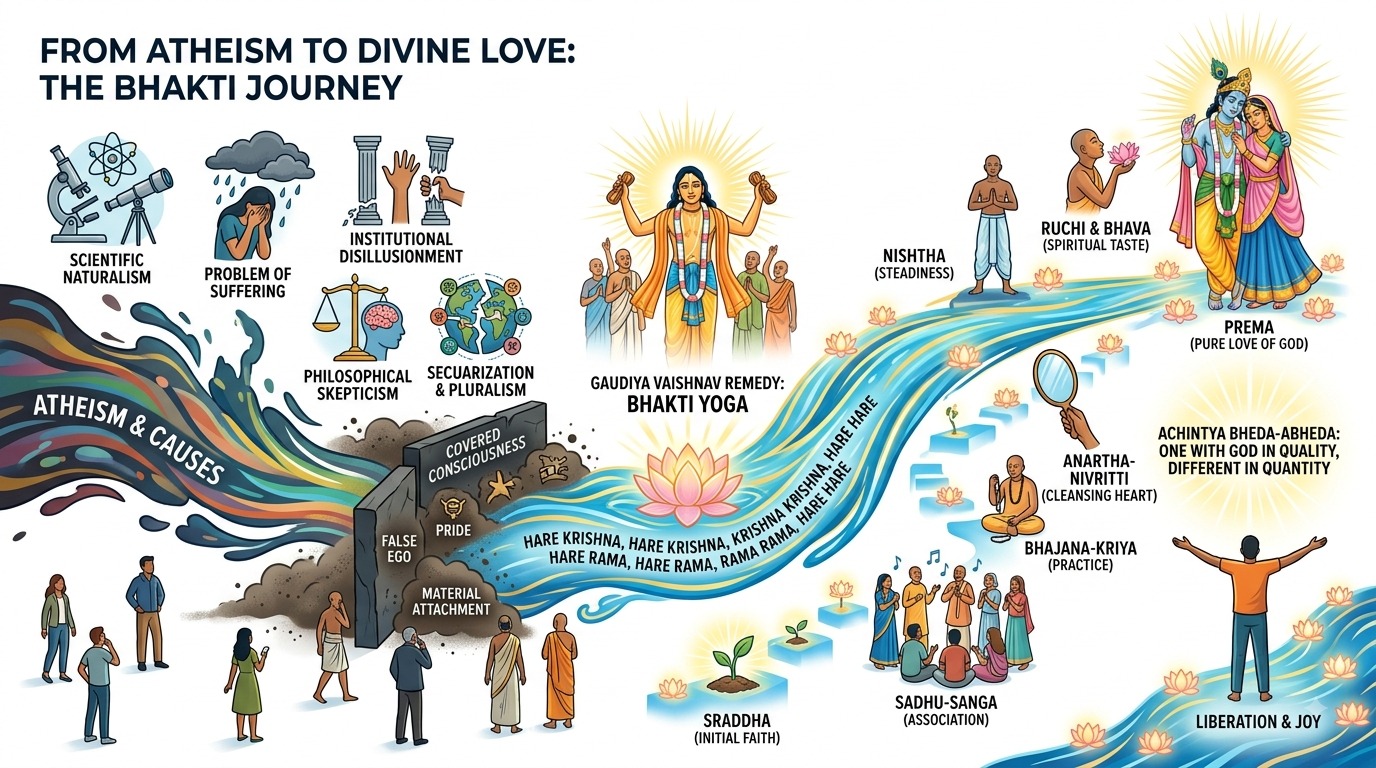
Top 5 Causes of Atheism
- Scientific Naturalism
- Problem of Suffering
- Institutional Corruption
- Philosophical Skepticism
- Cultural & Social Pluralism
1. The Rise of Scientific Naturalism
As scientific explanations expanded — from Newtonian mechanics to neuroscience — the “gaps” where God was previously invoked kept shrinking. This created a sense that nature is a causally closed system where divine intervention is unnecessary.
2. The Problem of Suffering
If a benevolent, omnipotent God exists, why is the world filled with severe suffering, natural disasters, and cruelty? For many, the sheer weight of global pain makes the theistic hypothesis morally unacceptable.
3. Disillusionment with Religious Institutions
Hypocrisy, corruption, dogmatism, and historical oppressions (e.g., inquisitions, caste discrimination, witch hunts) within religious systems drive many to view disbelief as an act of moral resistance.
4. Philosophical Skepticism
Grounded in the principle that extraordinary claims require extraordinary evidence. If religious claims fail to pass rigorous empirical or logical scrutiny, skepticism defaults to non-belief.
5. Cultural and Social Factors
Modern secularisation, individualism, and social pluralism erode the traditional, taken-for-granted status of religious worldviews, leading to intergenerational declines in religious transmission.
Summary Table: Historical Causes vs. Arguments
| Cause | Core Argument | Historical Era |
|---|---|---|
| Scientific Naturalism | Science explains the physical world without needing God; nature is causally closed. | 19th century onward |
| Problem of Suffering | A benevolent, omnipotent God is incompatible with the reality of evil and pain. | Ancient to present |
| Institutional Corruption | Religious institutions cause systemic harm, making disbelief a moral response. | All periods |
| Philosophical Skepticism | Religious claims lack empirical evidence or are conceptually incoherent. | Ancient Greece onward |
| Secularisation & Pluralism | Pluralistic modern societies erode the cultural automaticity of belief. | 20th century onward |
The Gaudiya Vaishnav Perspective on Atheism
Gaudiya Vaishnavism is a Hindu devotional movement originating in 16th-century Bengal, centred on devotion to Krishna as the Supreme Personality of Godhead, and founded by Sri Chaitanya Mahaprabhu (1486–1534).
From the Gaudiya viewpoint:
- Not an Intellectual Enemy: Atheism is treated not as a philosophical argument to be brutally defeated, but as a symptom of covered consciousness.
- Misidentification: The soul has temporarily forgotten its true identity as an eternal servant of Krishna, misidentifying with the temporary material body and mind.
The Bhagavad Gita’s Analysis: Divine vs. Demoniac
The foundational framework for understanding atheism appears in Chapter 16 of the Bhagavad Gita (Daivasura-Sampad-Vibhaga Yoga):
na viduh svartha-gatim hi visnum duratyaya nrtyajana-curayudha
“They do not know the ultimate goal of life, which is Vishnu. Bewildered by false ego, they are absorbed in materialistic activities and so fall down into hellish conditions.”
— Bhagavad Gita, Chapter 16
The Gita explains that those in an atheistic or demoniac mindset maintain that “the universe is unreal, without foundation, without a God… produced of lust alone.”
Key Takeaway: The Gita frames atheism as an issue of consciousness rather than intellect. The atheist does not fail to see God because evidence is missing, but because the instrument of perception — the heart — is clouded by material attachments.
Atheism as Covered Consciousness
In Gaudiya theology, every soul is sanatana (eternal) and possesses qualities of the Supreme in minute quantity: Sat-Cid-Ananda (eternality, knowledge, and bliss).
Atheism is simply a temporary coating of dust on a mirror. The mirror is not broken; it merely requires cleaning.
Achintya Bheda-Abheda: Simultaneous Difference and Non-Difference
Propounded by Sri Chaitanya Mahaprabhu, Achintya Bheda-Abheda states that the soul is simultaneously one with God in quality, yet different in quantity. Therefore:
- Separation from God is experiential, not metaphysical.
- Atheistic consciousness is an illusion (maya), not an eternal reality.
VAISHNAV INSIGHT
The Gaudiya tradition does not treat atheism as an intellectual puzzle to be solved by argument alone. It treats it as a disease of the heart — a covering of consciousness that requires a remedy, not a refutation.
The Remedy: Bhakti as the Path Back
If atheism is a clouded heart, you cannot argue the dust off the mirror. The remedy must be a practical spiritual process: Bhakti-yoga (the yoga of devotional love).
Hare Krishna, Hare Krishna, Krishna Krishna, Hare Hare
Hare Rama, Hare Rama, Rama Rama, Hare Hare
Prescribed in the Kali-santarana Upanishad, this sixteen-word mantra is considered the primary method for spiritual purification in the current age (Kali-yuga).
Ceto-Darpana-Marjanam: Cleansing the Mirror of the Heart
In the first verse of His foundational text, the Shikshashtaka, Sri Chaitanya Mahaprabhu describes the primary effect of congregational chanting (sankirtana):
ceto-darpana-marjanam bhava-maha-davagni-nirvapanam
sreyah-kairava-candrika-vitaranam vidya-vadhu-jivanam
anandambudhi-vardhanam pratipadam purnamrtasvadanam
sarvatma-snapanam param vijayate sri-krsna-sankirtanam
“All glories to the sankirtana movement! The chanting of the holy name cleanses the mirror of the heart (ceto-darpana-marjanam) and extinguishes the blazing fire of material existence…”
— Shikshashtaka, Verse 1“If you chant this Hare Krishna mantra, then the dirty things which have accumulated in your heart due to material contamination will be cleared off. Even not immediately, it will begin to be removed.”
— A.C. Bhaktivedanta Swami Prabhupada
The 7 Progressive Steps of Bhakti
- Sraddha (Initial Faith): A small spark of open-mindedness or curiosity about spiritual reality.
- Sadhu-sanga (Association with the Devoted): Nourishing faith through community and immersion with spiritual practitioners.
- Bhajana-kriya (Devotional Practice): Regulated practices like chanting japa, studying sacred texts, and honouring prasada.
- Anartha-nivritti (Removal of Unwanted Habits): Cleansing the heart of envy, false ego, and material attachments (like cleaning the Gundica temple).
- Nishtha (Steadiness): Unwavering, stable absorption in devotional life, undisturbed by external circumstances.
- Ruchi and Bhava (Spiritual Taste & Emotion): Developing an authentic, spontaneous taste for the divine, leading to awakening spiritual emotions.
- Prema (Pure Love of God): The full restoration of the soul’s eternal, constitutional position of unalloyed love for Krishna.
THE GRACE DIMENSION
Ultimately, the Gaudiya remedy is not a technique that the ego masters, but a *process of receiving grace. Krishna as *Paramatma (the Supersoul) is already seated within everyone’s heart. The cleansing process simply removes the blockages preventing us from perceiving His presence.
Conclusion
Atheism is an ancient, legitimate philosophical tradition with deep roots across cultures. However, Gaudiya Vaishnavism approaches it not with hostility or mere argument, but with compassionate diagnosis and transformative practice.
The fundamental question is not whether logical arguments can prove God, but whether the *instrument of perception (the heart) has been cleansed. A dusty mirror reflects nothing — but the mirror is not broken. It simply needs to be wiped clean through *sankirtana.
Frequently Asked Questions
Q1: Does the Gaudiya Vaishnav tradition hate atheists?
A: No. The tradition views atheism as a temporary condition of spiritual covering, not a moral failing deserving hatred. The approach is one of compassion and spiritual prescription, not condemnation.
Q2: Can an atheist practise chanting without initial belief?
A: Yes. The holy name is held to be non-different from God and works independently of initial intellectual belief. Faith grows naturally as a result of the cleansing practice.
Q3: What does the Bhagavad Gita say about atheists specifically?
A: Chapter 16 describes the asuri (demoniac) nature, which denies God and focuses on material gratification. The Gita frames this as a state of clouded consciousness driven by pride, lust, and false ego.
Q4: How is the Gaudiya response different from Western apologetics?
A: While Western apologetics focuses heavily on logical proofs and debate, the Gaudiya approach focuses on transformative practice (sadhana-bhakti)** to clean the heart directly.
Q5: Is atheism considered permanent in Gaudiya theology?
A: No soul is permanently lost. Because atheism is merely a temporary covering over the eternal soul, every living entity will eventually return to its natural spiritual position.
Q6: What is the significance of the Hare Krishna maha-mantra?
A: It is the primary spiritual method (yuga-dharma) recommended for the modern age, acting as a sound incarnation of the divine that directly purifies human consciousness.
Sources & Further Reading
- Internet Encyclopedia of Philosophy (Lokayata/Charvaka)
- St Andrews Encyclopaedia of Theology (Caitanya Vaishnavism)
- Bhagavad Gita As It Is (Chapter 16) — A.C. Bhaktivedanta Swami Prabhupada
- Shikshashtaka — Sri Chaitanya Mahaprabhu
- Shrimad Bhagavatam & Caitanya-caritamrita
- Bhakti-rasamrita-sindhu — Rupa Goswami