Understanding the victory of good over evil through the lens of Krishna consciousness
Introduction
Every year, as the monsoon recedes and the air turns crisp, Hindus across India and the world celebrate a sequence of sacred observances — *Navaratri, **Dussehra, and *Vijayadashami. For nine nights, devotees worship the Divine Mother in her many forms. On the tenth day, effigies of Ravana burn in city squares, and families begin auspicious new ventures.
This article explores these celebrations, drawing on the Srimad Bhagavatam, the Sri Brahma-samhita, the Bhagavad-gita, and the teachings of the Gaudiya acharyas.
What Is Navaratri?
Navaratri (Sanskrit: navarātri, “nine nights”) is a festival spanning nine lunar nights and culminating on the tenth day, Vijayadashami. It falls in the Hindu month of Ashvin (September–October), during the bright fortnight (shukla paksha). There are technically four Navaratris in the Vedic calendar, but the autumnal Sharad Navaratri is the most widely celebrated.
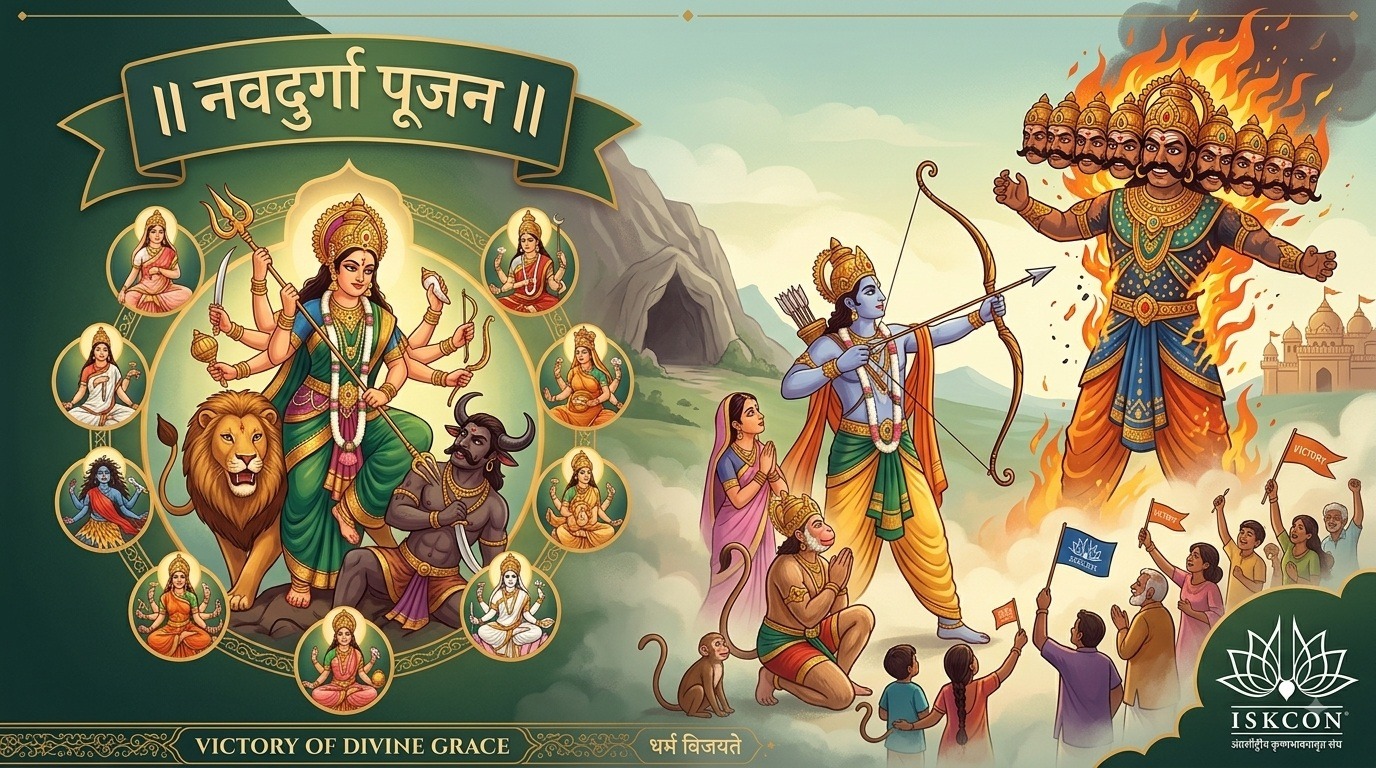
During these nine days, the Divine Mother is worshipped in her nine manifestations — the Navadurga: Shailaputri, Brahmacharini, Chandraghanta, Kushmanda, Skandamata, Katyayani, Kalaratri, Mahagauri, and Siddhidatri. Each form represents a stage of the goddess’s battle with the demon Mahishasura, culminating in his defeat on the tenth day.
The festival is observed through fasting, prayer, scripture recitation (especially the Devi Mahatmyam), devotional dancing (garba and dandiya in western India), and the installation of beautifully decorated clay images of Durga slaying the buffalo-demon.
Who Is Goddess Durga in the Gaudiya Vaishnava Tradition?
A common misconception holds that Vaishnavas do not acknowledge or worship Goddess Durga. This is far from the truth. The Gaudiya Vaishnava understanding is nuanced and deeply scriptural: Durga devi is recognised as a pure devotee and an empowered servitor of the Supreme Lord, Sri Krishna.
Durga as Krishna’s Material Energy
The Sri Brahma-samhita (5.44) offers the foundational verse:
sṛṣṭi-sthiti-pralaya-sādhana-śaktir ekā
chāyeva yasya bhuvanāni bibharti durgā
icchānurūpam api yasya ca ceṣṭate sā
govindam ādi-puruṣaṁ tam ahaṁ bhajāmi“The external potency, Maya, who is of the nature of the shadow of the cit potency, is worshipped by all people as Durga — the creating, preserving, and destroying energy. She acts according to the will of Govinda, the primeval Lord. I worship that Govinda.”
Srila Bhaktisiddhanta Sarasvati Thakura, in his commentary, explains that Durga devi is the shadow of the Lord’s internal spiritual potency (Yogamaya). Yogamaya governs the eternal spiritual world; her expansion, Mahamaya — known as Durga — administers the affairs of the material world.
The Relationship Between Energy and the Energetic
In Gaudiya theology, the energy (shakti) and the energetic (shaktiman) are simultaneously one and different (achintya-bhedabheda). Just as heat and light define fire, energy identifies the energetic. The Gautamiya Tantra declares: “yah Krishna saiva Durga syad yah Durga Krishna eva sya” — Krishna and His energies are non-different.
Srila Jiva Goswami, in his commentary on the Brahma-samhita, notes that Durga is sometimes referred to as the Supreme Controller — and this is correct, because there is no difference between Krishna and His powers. Yet, critically, the energy is always subordinate to and directed by the energetic. Power cannot exist independently of the powerful. Therefore, to worship Durga apart from Krishna — to seek the power without acknowledging its source — is incomplete.
The Bhagavad-gita (9.10) confirms this principle:
mayādhyakṣeṇa prakṛtiḥ sūyate sa-carācaram
hetunānena kaunteya jagad viparivartate“This material nature, which is one of My energies, is working under My direction, O son of Kunti, producing all moving and nonmoving beings. Under its rule this manifestation is created and annihilated again and again.”
Durga as Guardian of the Material World
Srila Prabhupada, in his purport to Srimad Bhagavatam 5.23.3, explains:
“Material nature, the external energy of the Supreme Lord, is also known as Durga, or the female energy that protects the great fort of this universe. The word Durga also means ‘fort.’ This universe is just like a great fort in which all the conditioned souls are kept, and they cannot leave it unless they are liberated by the mercy of the Supreme Personality of Godhead.”
The word Durga itself means “a fort” or “difficult to cross.” She is the divine warden of the material prison house — the place where souls who have turned away from Krishna’s service undergo reformation through the cycle of birth and death. Her purpose is not to punish eternally but to guide the conditioned soul back to Krishna’s shelter.
The Symbolism of Durga’s Form
The popular iconography of Durga is rich with meaning from the Vaishnava perspective:
- Ten hands symbolise the ten directions (the four cardinal, four intermediate, plus above and below), indicating her jurisdiction over the entire material cosmos.
- The trident (trishula) represents the *threefold miseries of material existence: *adhyatmika (miseries of the body and mind), adhibhautika (miseries caused by other living beings), and adhidaivika (miseries inflicted by natural forces). These miseries repeatedly remind the soul of its vulnerability and direct it toward seeking the Supreme Lord.
- Her mount, the lion signifies power and restraint — the capacity to control one’s animalistic tendencies through divine service.
Each element of her form thus points the thoughtful devotee toward Krishna, the ultimate refuge from all material suffering.
Durga Devi in the Pastimes of Lord Krishna
The Srimad Bhagavatam (Canto 10) narrates Durga devi’s intimate connection with the appearance of Lord Krishna. This pastime forms the scriptural backbone of the Gaudiya understanding of Navaratri.
The Mission of Yogamaya
When Devaki conceived her seventh child — Ananta Shesha, the thousand-hooded serpent form of the Lord — Krishna instructed Yogamaya to transfer the child to the womb of Rohini, who was safely residing in Vrindavana. Krishna then revealed His plan:
“After this arrangement, I am personally going to appear in the womb of Devaki. I shall appear as the son of Devaki and Vasudeva. And you shall appear as the daughter of Nanda and Yashoda.”
The Lord declared that since she would appear as His sister and quickly fulfil the desires of her worshippers, people would honour her in many forms — Durga, Bhadrakali, Vijaya, Vaishnavi, Kumuda, Chandika, Krishna, Madhavi, Kanyaka, Maya, Narayani, Ishani, Sharada, and Ambika.
The Birth of Yogamaya in Vrindavana
On the night of Krishna’s appearance, Yogamaya took birth as the daughter of Nanda Maharaja and Yashoda in Gokula. Simultaneously, Krishna appeared as the son of Devaki and Vasudeva. Vasudeva carried baby Krishna across the Yamuna to Gokula and exchanged Him with Yashoda’s newborn daughter.
The Revelation Before Kamsa
When the tyrant Kamsa heard of the birth, he rushed to the prison and seized the baby girl, attempting to dash her against a stone. But the child slipped from his hands, rose into the sky, and assumed her magnificent eight-armed form as Goddess Durga, seated upon her lion mount. She declared:
“O foolish Kamsa! Your enemy, the one who is destined to kill you, has already been born elsewhere. Do not attempt to kill me in vain.”
With this prophecy, she disappeared. She then took up residence in various holy places, accepting worship from devotees. This event — the appearance of Yogamaya/Durga as Krishna’s sister to assist His mission — is celebrated during Navaratri in the Gaudiya tradition.
The significance is profound: Durga devi is not a rival to Krishna but His devoted assistant, arranging the circumstances for His divine pastimes and ultimately directing all souls toward His lotus feet.
The Nine Days of Navaratri: Days of Inner Conquest
While the broader Hindu tradition focuses on Durga’s battle with Mahishasura, the Gaudiya Vaishnava reads Navaratri as an allegory for the soul’s inner battle against material illusion.
The demon Mahishasura — the buffalo-demon — represents the tamasic, beastly nature within us: ignorance, lust, anger, greed, pride, and envy. The nine days of worship signify a progressive purification of consciousness, culminating in the soul’s victory over the lower nature on Vijayadashami.
Srila Prabhupada explains in his purport to Bhagavad-gita 18.61:
“According to the living entity’s desire, Yogamaya, or Maya, the goddess Durga, gives him a particular type of body, which is mentioned as yantra, a machine.”
Thus, the conditioned soul is given a material body as a vehicle (yantra) by Durga devi, based on its desires. When the soul turns its desires toward Krishna, Durga devi — being Krishna’s faithful servant — facilitates that liberation, opening the gates of the material prison.
Navaratri, therefore, is a time to:
- Recognise our entanglement in material nature
- Express gratitude to Durga devi for her protective and reformative role
- Seek her blessing not for material gain but for devotion to Krishna
- Renew our commitment to the path of bhakti
The Ideal Mood of Worship: The Gopis of Vrindavana
The Srimad Bhagavatam (Canto 10, Chapter 22) presents what Gaudiya acharyas consider the ideal mood of worshipping Durga during Navaratri — the worship of Katyayani-devi by the gopis of Vrindavana.
At the beginning of the Hemanta (early winter) season, the unmarried girls of Vrindavana, already deeply attracted to Krishna, undertook a vow. After bathing in the Yamuna at dawn and partaking of havishyanna (a simple preparation of boiled moong dal and rice, without spices), they prepared a deity of Goddess Katyayani each morning. They worshipped her with sandalwood paste, garlands, incense, fruits, grains, and fresh twigs.
Their prayer was remarkable:
“O Katyayani, O great energy of the Lord, O controller of all opulence, please let the son of Nanda Maharaja become my husband. I bow down to you.”
The gopis did not pray for wealth, power, progeny, or liberation. They prayed only for *Krishna as their beloved. This is the essence of the Vaishnava approach to Durga worship: *the energy is approached not for her own sake, nor for material boons, but to attain the service and love of Krishna.
This pastime reveals that Durga devi, far from being averse to Krishna’s devotees, actively facilitates their union with Him. She is the gatekeeper who, when approached with genuine devotion, opens the door to the highest spiritual realisation.
Dussehra: The Victory of Lord Rama
Dussehra (also spelled Dasara) is celebrated on the same tenth day as Vijayadashami. It commemorates Lord Rama’s victory over the demon-king Ravana, the ten-headed ruler of Lanka who had abducted Sita devi.
In the epic Ramayana, Rama — an avatara of Lord Vishnu and the Supreme Personality of Godhead in His majestic form — with the assistance of the devoted Hanuman and the monkey-army of Sugriva, crossed the ocean to Lanka, waged war, and finally slew Ravana, rescuing Sita.
The Symbolism of Ravana’s Ten Heads
The name “Dasara” derives from the Sanskrit “Dasha Hara” — the destruction of ten. Ravana’s ten heads are understood to represent the ten senses (five knowledge-acquiring senses and five active senses) through which the conditioned soul interacts with the material world. When these senses are uncontrolled, they become the seat of demonic tendencies — just as Ravana, despite his immense scholarship and tapasya, fell prey to lust and arrogance.
Lord Rama’s victory signifies that only when the Supreme Lord Himself takes control of our senses can we be truly victorious over the demoniac qualities within. No amount of intellectual prowess or austerity alone can subdue the senses; surrender to the Lord is essential.
The Vaishnava Understanding of Rama
For Gaudiya Vaishnavas, Lord Rama is non-different from Lord Krishna — both are fully the Supreme Personality of Godhead, appearing in different forms according to time, place, and circumstance. Rama’s pastimes demonstrate the Lord’s maryada (majestic, principled) nature, while Krishna’s pastimes reveal His madhurya (sweet, intimate) nature. The victory celebrated on Dussehra is ultimately the Supreme Lord’s victory over the forces of irreligion (adharma)*, a theme that recurs throughout the *Bhagavad-gita and Srimad Bhagavatam.
Vijayadashami: The Day of Ultimate Victory
Vijayadashami (Sanskrit: vijayadaśamī, “victory on the tenth day”) is the grand culmination of the festival period. It marks:
- Durga’s victory over Mahishasura after nine days of battle.
- Rama’s victory over Ravana and the rescue of Sita.
- The beginning of new and auspicious endeavours — in many parts of India, people initiate new businesses, start education (Vidya Arambham), or undertake journeys on this day.
The Deeper Meaning: Victory of the Soul
From the Gaudiya Vaishnava perspective, the true victory (vijaya) of Vijayadashami is *the soul’s return to its original, loving relationship with Krishna. All the battles celebrated during this period — Durga versus Mahishasura, Rama versus Ravana — are external expressions of the eternal truth proclaimed in the *Bhagavad-gita (4.7–8):
yadā yadā hi dharmasya glānir bhavati bhārata
abhyutthānam adharmasya tadātmānaṁ sṛjāmy aham“Whenever there is a decline in dharma and a rise in adharma, O descendant of Bharata, I Myself appear.”
paritrāṇāya sādhūnāṁ vināśāya ca duṣkṛtām
dharma-saṁsthāpanārthāya sambhavāmi yuge yuge“To deliver the pious and annihilate the miscreants, and to re-establish the principles of dharma, I appear age after age.”
The Supreme Lord, either directly or through His empowered energies and devotees, ensures that good ultimately triumphs over evil. Vijayadashami is the celebration of that certainty. It reassures the devotee that no matter how powerful the forces of illusion (maya) and irreligion (adharma) may appear, the Lord’s devotee is never ultimately defeated.
How Gaudiya Vaishnavas Observe festival
While ISKCON temples and Gaudiya Vaishnavas do not perform independent worship of Durga as the Supreme Deity, the festival period is observed with deep spiritual significance:
Temple Observances
- Special kirtans and classes exploring Durga devi’s role as Krishna’s devotee, the pastimes of Lord Rama, and the principle of victory through surrender.
- *Recitation of the *Ramayana* and the *Srimad Bhagavatam pastimes connected to Krishna’s advent and Yogamaya’s appearance.
- Chanting of the Holy Names — Hare Krishna, Hare Krishna, Krishna Krishna, Hare Hare / Hare Rama, Hare Rama, Rama Rama, Hare Hare — which Srila Prabhupada described as the yuga-dharma, the prescribed method of self-realisation for this age.
- Worship of Lord Rama and Lord Krishna as the Supreme Lord, with prayers of gratitude to all His devotees, including Durga devi, for their role in facilitating the soul’s spiritual journey.
Personal Practices for Devotees
- Increase japa (chanting on beads) during the nine days of Navaratri, taking advantage of the spiritually charged atmosphere.
- Observe fasting on select days (especially on the appearance days of the Lord or His devotees), eating only simple prasad.
- Study scripture — the Bhagavad-gita As It Is, the Srimad Bhagavatam, and the pastimes of Lord Rama and Lord Krishna.
- Offer prayers to Durga devi in the mood of the gopis — not asking for material boons but praying for pure devotion to Krishna. A simple prayer: “O Durga devi, O energy of the Lord, please remove the obstacles of illusion from my heart and grant me unalloyed devotion to Sri Krishna.”
- Engage in seva (service) at the temple, feeding gurus and Vaishnavas, and distributing prasad.
- On Vijayadashami, take a vow to begin or deepen a spiritual practice — a new round of japa, a new study commitment, or a new act of devotional service.
The Principle of Respect Without Independent Worship
Srila Prabhupada and the Gaudiya acharyas clarify that what is discouraged in Vaishnava practice is the *independent worship of Durga or any demigod, thinking them to be the Supreme and seeking only material rewards. The *Bhagavad-gita (7.20) states:
kāmais tais tair hṛta-jñānāḥ prapadyante ‘nya-devatāḥ
taṁ taṁ niyamam āsthāya prakṛtyā niyatāḥ prasājam“Those whose intelligence has been stolen by material desires surrender to demigods and follow the particular rules and regulations of worship according to their own nature.”
However, to *respect and honour Durga devi as Krishna’s faithful servitor, to seek her blessing for spiritual progress, and to worship her *alongside the Lord — this is entirely in harmony with Vaishnava teachings. As one Vaishnava maxim holds: “The servant of my Lord is to be honoured, for through the servant’s grace, the Lord’s mercy is obtained.”
The Real Mahishasura: The Inner Demon
In the Gaudiya reading, the demon Mahishasura is not merely a mythological figure. He represents the inner demon of false ego (ahankara)** — the stubborn, buffalo-like ignorance that refuses to bow before the Supreme Lord.
The Bhagavad-gita (16.4) describes the demoniac nature:
hypocrisy, arrogance, conceit, anger, harshness, and ignorance — these qualities belong to one of demoniac nature.
The nine days of Navaratri represent the gradual conquest of this inner demon through nine progressive stages of purification. Each form of Durga worshipped corresponds to a quality the devotee must cultivate:
| Day | Form of Durga | Spiritual Quality to Cultivate |
|---|---|---|
| 1 | Shailaputri | Steadfastness — like the mountain, firm in devotion |
| 2 | Brahmacharini | Discipline — observing vows and austerities for Krishna |
| 3 | Chandraghanta | Alertness — ever vigilant against maya |
| 4 | Kushmanda | Radiance — letting the light of knowledge dispel ignorance |
| 5 | Skandamata | Nurturing — caring for one’s devotional creeper |
| 6 | Katyayani | Surrender — praying, like the gopis, for Krishna’s service |
| 7 | Kalaratri | Fearlessness — destroying the darkness of material fear |
| 8 | Mahagauri | Purity — cleansing the heart of material contamination |
| 9 | Siddhidatri | Perfection — attaining the perfection of Krishna consciousness |
On the tenth day, Vijayadashami, the inner demon is finally vanquished — the false ego dissolves, and the soul reawakens to its eternal identity as a loving servant of Krishna. This is the true victory the festival celebrates.
The Universality of the Message
While Gaudiya Vaishnavism places Krishna at the centre of all worship, the message of Navaratri, Dussehra, and Vijayadashami is universal: good will triumph over evil, truth over falsehood, and devotion over illusion.
The Divine Mother, whether known as Durga, Kali, Chandika, or Yogamaya, is ultimately *Krishna’s energy, working tirelessly — sometimes with sweetness, sometimes with sternness — to bring each soul back home, back to Godhead. Lord Rama’s victory over Ravana assures us that *the Lord personally intervenes when dharma is threatened. And the appearance of Yogamaya alongside Krishna in Vrindavana reminds us that the Supreme Lord never acts alone — His energies, His devotees, and His pure servants are always present, arranging everything for our spiritual welfare.
As Srila Prabhupada would often conclude his lectures: “Chant Hare Krishna and be happy.” This simple instruction encapsulates the entire message of the festival season. By taking shelter of the Holy Name — which is non-different from the Lord Himself — we invoke the same divine protection that Durga devi, Lord Rama, and all the acharyas have eternally secured.
Key Takeaways
- Navaratri honours Goddess Durga as Krishna’s material energy and pure devotee, not as an independent Supreme.
- Durga devi is Yogamaya’s expansion, the guardian of the material world, whose purpose is to guide the conditioned soul back to Krishna.
- The gopis’ worship of Katyayani demonstrates the ideal Vaishnava mood: approaching Durga only to attain Krishna.
- Dussehra celebrates Lord Rama’s victory over Ravana — symbolising the Lord’s triumph over the uncontrolled senses.
- Vijayadashami is the ultimate victory: the soul’s liberation from illusion and return to loving service to Krishna.
- Gaudiya Vaishnavas honour Durga devi and Lord Rama during this period while keeping Krishna at the centre of all worship, knowing that all energies ultimately serve their Supreme Source.
Scriptural References
- Sri Brahma-samhita 5.44 (Durga as Krishna’s external potency)
- Bhagavad-gita As It Is 9.10, 7.20, 16.4, 18.61, 4.7–8 (material nature under Krishna’s direction; demigod worship; demoniac nature; the Lord’s promise to appear)
- Srimad Bhagavatam 10.2–10.4 (Krishna’s advent and Yogamaya’s appearance), 10.22 (the gopis worship Katyayani), 5.23.3 purport (Durga as the fort of the material world)
- Chaitanya Charitamrita (the achintya-bhedabheda principle of simultaneous oneness and difference between the Lord and His energies)
Hare Krishna Hare Krishna Krishna Krishna Hare Hare
Hare Rama Hare Rama Rama Rama Hare Hare
Jai Sri Krishna. Jai Sri Rama. Jai Durga Devi.