The Sacred Vow of the Gopis for Pure Devotion to Lord Krishna
Among the many devotional practices celebrated in the Vedic tradition, the Katyayini Vrata holds a uniquely tender place in the hearts of Krishna devotees. Observed by the unmarried gopis (cowherd girls) of Vrindavan, this sacred vow is not merely a ritual — it is a profound expression of loving surrender to the Supreme Personality of Godhead, Lord Sri Krishna.
In the Gaudiya Vaishnava tradition followed by ISKCON, the Katyayini Vrata illustrates the highest principles of bhakti: that when a devotee surrenders with a pure heart, the Lord Himself becomes the fulfilment of every desire.
What Is the Katyayini Vrata?
The Katyayini Vrata is a month-long vow described in the Srimad-Bhagavatam (Canto 10) and in the Skanda Purana. The unmarried gopis of Vrindavan would observe this vrata during the month of Margashirsha (Agrahayana), the month that immediately follows Kartika, to pray to Goddess Katyayani for Lord Krishna as their husband.
Goddess Katyayani is the sixth form of Goddess Durga, worshipped on the sixth day of Navaratri. She is a fierce warrior form of the Divine Mother who destroyed the demon Mahishasura. Yet within the intimate setting of Vrindavan, she is understood as the Internal Potency (Yogamaya)* of the Lord — one who purifies the heart of a devotee and clears the path toward loving service (*bhakti). As Srila Prabhupada explains, Vaishnavas ultimately worship the Supreme Lord and His internal spiritual energy, and the demigods are honoured as the Lord’s empowered servants who facilitate that devotion.
The Story of the Gopis and the Katyayini Vrata
The account of the Katyayini Vrata is narrated by Sukadeva Goswami to King Parikshit in the Srimad-Bhagavatam. According to this pastime (lila), all the unmarried gopis of Vrindavan desired Lord Krishna as their beloved. To realise this supreme desire, they performed the Katyayini Vrata under the guidance of the elderly gopi Paurnamasi, the confidential associate of the Lord’s internal potency.
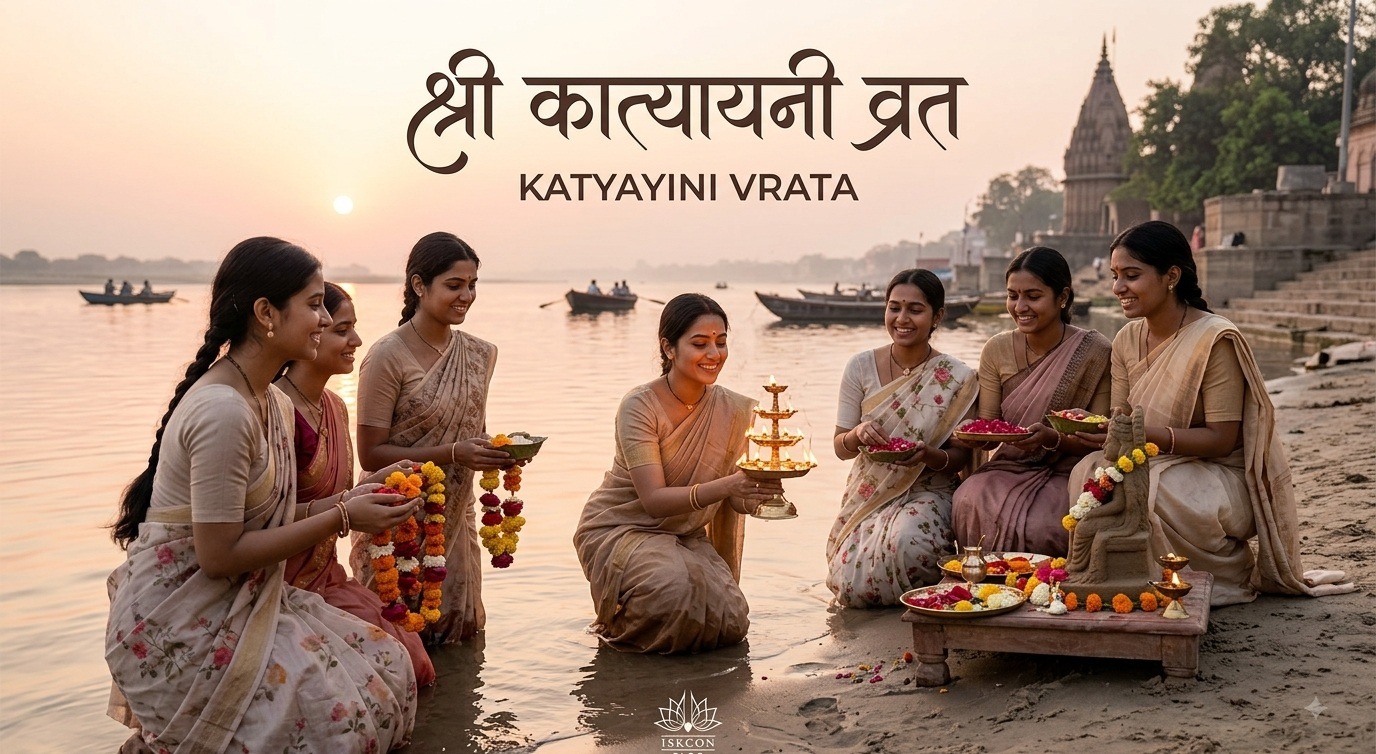
Each morning before dawn, the gopis would bathe in the holy waters of the River Yamuna. After their bath, they would fashion a deity of Goddess Katyayani from the sand of the riverbank. They then worshipped her with chandana (sandalwood pulp), garlands, incense, ghee lamps, fresh butter, fruits, grains, and the twigs of sacred plants — offering everything with deep devotion.
Having completed their worship, the gopis would pray with folded hands, chanting the celebrated Katyayani mantra:
“Devi Katyayani Maha-maye Maha-yoginy Adhishvari / Nanda-gopa-sutam devi patim me kurute namah”
“O goddess Katyayani, O great mystic potency of the Lord, O supreme controller of all, please make the son of Nanda Maharaja my husband. I offer my respectful obeisances unto you.”
The gopis were not ordinary devotees. Their desire was not for material marriage but for unalloyed, eternal service to Krishna in the mood of madhurya-rasa (conjugal love). And because their hearts were completely pure, Goddess Katyayani — the yogamaya potency of the Lord — arranged their meeting with Krishna, who is the prayahs, the supreme fulfilment of all vows.
The Deeper Spiritual Significance
In the Gaudiya Vaishnava understanding, the Katyayini Vrata is far more than a ritual for attaining a suitable husband (though it is also traditionally observed in that spirit). Its inner meaning is the purification of the heart so that the soul may be situated in its eternal constitutional position (svarupa) as a servant and lover of Krishna.
The devotee approaches the material energy (Mahamaya) not for material rewards, but to be cleansed of everything that blocks pure love of God. As the Bhakti-rasamrita-sindhu explains, the devotee performs sadhana-bhakti — regulated devotional practice — and gradually, by the mercy of the Lord’s internal potency (Yogamaya), the heart becomes free from all material desires and attachments. The Katyayini Vrata is a vivid illustration of this process.
Srila Prabhupada clarifies that a devotee of Krishna does not worship demigods for material benefit, but honours them as servants of the Supreme Lord who can help remove obstacles on the path of devotion. The gopis’ worship of Katyayani was therefore fully Krishna- conscious — their entire focus was on the Supreme Lord, and the goddess was the honoured facilitator of their devotional longing.
When Is the Katyayini Vrata Observed?
The Katyayini Vrata is traditionally observed during the month of Margashirsha (also called Agrahayana), the lunar month that follows Kartika Purnima. The vrata begins on the first day of Margashirsha and continues through to the Purnima (full moon) at the month’s end. This timing is significant — Margashirsha comes immediately after the holy month of Damodara (Kartika), which is beloved of Srimati Radharani. The devout observer, having completed Kartika-vrata, then takes up the Katyayini Vrata to deepen their longing for Krishna’s service.
Goddess Katyayani is also specially worshipped on the sixth day (Shashthi tithi) of Navaratri, both in the Chaitra (spring) and Sharad (autumn) Navaratris. On this day, devotees honour the warrior form of the Divine Mother who embodies strength, protection, and the destruction of evil.
How to Observe the Katyayini Vrata
While the full observance as performed by the gopis is specific to Vrindavan’s transcendental setting, devotees today can observe the vrata in a devotional spirit adapted to their circumstances:
- Rise early and purify yourself. Bathe in the early morning, ideally before sunrise. The gopis bathed in the Yamuna; devotees today may bathe while meditating on the Yamuna’s purifying potency.
- Set up a small altar. Place a picture or deity of Goddess Katyayani alongside your deities of Radha-Krishna. The gopis made a deity from the sand of the Yamuna’s bank.
- Offer worship with devotion. Offer chandana (sandalwood), garlands of fresh flowers, incense, a ghee lamp, fruits, and other simple offerings. The sincerity of the offering matters more than its opulence.
- Chant the Katyayani mantra. Recite the mantra “Devi Katyayani Maha-maye…” with full attention, praying to the Lord’s potency to purify your heart and awaken pure love for Krishna.
- Chant the Hare Krishna Maha-mantra. Continue your regular japa of the Hare Krishna maha-mantra — Hare Krishna, Hare Krishna, Krishna Krishna, Hare Hare / Hare Rama, Hare Rama, Rama Rama, Hare Hare — as the core of your devotional practice.
- Read and discuss Krishna’s pastimes. Like the gopis who shared stories of Krishna, read from the Srimad-Bhagavatam (particularly the Tenth Canto) and the Krishna Book by Srila Prabhupada.
- Observe on the full moon day. The vrata concludes on the Purnima of Margashirsha with a celebratory puja and the distribution of prasadam.
The Katyayani Mantra and Its Meaning
The central mantra of the vrata is both simple and profound:
Devi Katyayani Maha-maye Maha-yoginy Adhishvari
Nanda-gopa-sutam devi patim me kurute namah
This verse reveals the soul’s deepest longing: “O goddess Katyayani, O great potency of the Lord, O possessor of great mystic power and supreme controller, please make the son of Nanda Maharaja my beloved. I offer my respectful obeisances unto you.”
Each word is significant. Maha-maye addresses her as the great illusory potency of the Lord — the energy that binds the conditioned souls in the material world but can also, when propitiated with devotion, release them from that bondage. Maha-yoginy Adhishvari glorifies her as the supreme mystic power. Nanda-gopa-sutam identifies Krishna specifically as the son of Nanda Maharaja — His most intimate, Vrindavan identity. The gopis were not seeking the majestic Narayana of Vaikuntha; they longed only for the charming cowherd boy of Vrindavan.
Benefits of the Katyayini Vrata
The scriptures and the acharyas (spiritual teachers) describe several benefits of observing the Katyayini Vrata:
- Purification of the heart. The vrata cleanses material desires and attachments, preparing the heart for pure devotion.
- *Awakening of *bhakti.** Regular observance strengthens one’s love and remembrance of Lord Krishna.
- Removal of obstacles. The Divine Mother clears hurdles — material, emotional, and spiritual — that obstruct the path of devotion.
- Divine guidance. The devotee gains inner clarity and discrimination (buddhi-yoga) to make decisions in harmony with dharma.
- Inner strength. Devotees develop spiritual courage and steadiness in their practice.
- Favourable circumstances. Traditionally, the vrata is also known to bless devotees with righteous companionship and harmony in relationships, particularly for those seeking a spiritually suitable life partner.
Ultimately, however, the supreme fruit of the Katyayini Vrata is not any material benediction but pure, unalloyed love for Krishna — prema-bhakti — which is the goal of human life.
Katyayini Vrata at Your Local ISKCON Temple
Many ISKCON temples organise special programs during the month of Margashirsha to support devotees observing the Katyayini Vrata. These may include early-morning kirtans, classes on the Srimad-Bhagavatam (focusing on the gopi pastimes), aratis honouring Goddess Katyayani, and the distribution of prasadam. Temples typically provide the puja materials — flowers, ghee lamps, sandalwood, and prasadam — so that devotees can focus entirely on their devotional observance.
We warmly invite you to visit your nearest ISKCON temple during Margashirsha to participate in the Katyayini Vrata programs and to draw inspiration from the exemplary devotion of the gopis.
Conclusion
The Katyayini Vrata is one of the most beautiful illustrations of the principle that bhakti is the highest path. The gopis did not approach the Divine Mother for wealth, power, or even liberation; they prayed only for the opportunity to love and serve Krishna. Their vow teaches us that the highest spiritual perfection is not attained through dry renunciation or intellectual speculation, but through the longing of a sincere heart turned toward the Supreme Lord.
As Srila Prabhupada wrote, “The real perfection of life is to please Lord Krishna and to always remain in His service.” The Katyayini Vrata is a sacred means to that perfection — a month of purification, remembrance, and the gentle awakening of the soul’s eternal love for God.
Hare Krishna.
Frequently Asked Questions (FAQ)
1. What is the Katyayini Vrata?
The Katyayini Vrata is a month-long devotional vow observed during the month of Margashirsha, in which devotees worship Goddess Katyayani to purify the heart and deepen their devotion to Lord Krishna. It was famously performed by the unmarried gopis of Vrindavan, as described in the Srimad-Bhagavatam.
2. When should the Katyayini Vrata be observed?
The vrata is traditionally observed during the month of Margashirsha (Agrahayana), beginning on the first day of the month and concluding on the Purnima (full moon) at the month’s end. Goddess Katyayani is also worshipped on the sixth day of Navaratri (Shashthi tithi).
3. What is the Katyayani mantra?
The central mantra of the vrata is: “Devi Katyayani Maha-maye Maha-yoginy Adhishvari / Nanda-gopa-sutam devi patim me kurute namah.” It is a prayer to Goddess Katyayani to grant pure devotion to Lord Krishna, the son of Nanda Maharaja.
4. Who was Goddess Katyayani?
Goddess Katyayani is the sixth form of Goddess Durga, worshipped on the sixth day of Navaratri. She is the fierce warrior form who destroyed the demon Mahishasura. In the Vaishnava tradition, she is understood as the external potency (Mahamaya) of the Lord, who purifies the hearts of devotees and clears the path to pure bhakti.
5. Can unmarried devotees observe the Katyayini Vrata to find a suitable spouse?
Yes. Traditionally, the Katyayini Vrata is also observed by those seeking a righteous and spiritually compatible life partner. The vrata is believed to remove obstacles in marriage. However, the deeper, supreme benefit is the purification of the heart and the awakening of pure love for Lord Krishna.
6. Is the Katyayini Vrata only for women?
No. While the vrata is historically associated with the gopis of Vrindavan, its essence — the purification of the heart and the deepening of devotion — is universal. Devotees of any gender can observe it in a spirit of surrender to the Lord.
7. How is the Katyayini Vrata different from other vratas?
Unlike vratas performed for material benedictions, the Katyayini Vrata is distinguished by its singular focus on the Supreme Lord. The gopis worshipped the Divine Mother only as a means to attain Krishna’s association, demonstrating the principle that all devotional practices should ultimately lead to the Supreme Personality of Godhead.
8. Does ISKCON observe the Katyayini Vrata?
Yes. Many ISKCON temples hold special programs during Margashirsha, including kirtans, Bhagavatam classes on the gopi pastimes, arati for Goddess Katyayani, and the distribution of prasadam. Contact your local ISKCON temple for details of their Margashirsha programs.