Pillars of Gaudiya Vaishnavism
Introduction
In the 16th century, Sri Chaitanya Mahaprabhu ignited a devotional revolution across India, spreading the congregational chanting of the Holy Names — Hare Krishna, Hare Krishna, Krishna Krishna, Hare Hare / Hare Rama, Hare Rama, Rama Rama, Hare Hare. But for this movement to endure through the centuries, it needed more than inspiration; it required scholarship, scripture, and sacred infrastructure. That monumental task fell to the Six Goswamis of Vrindavan.
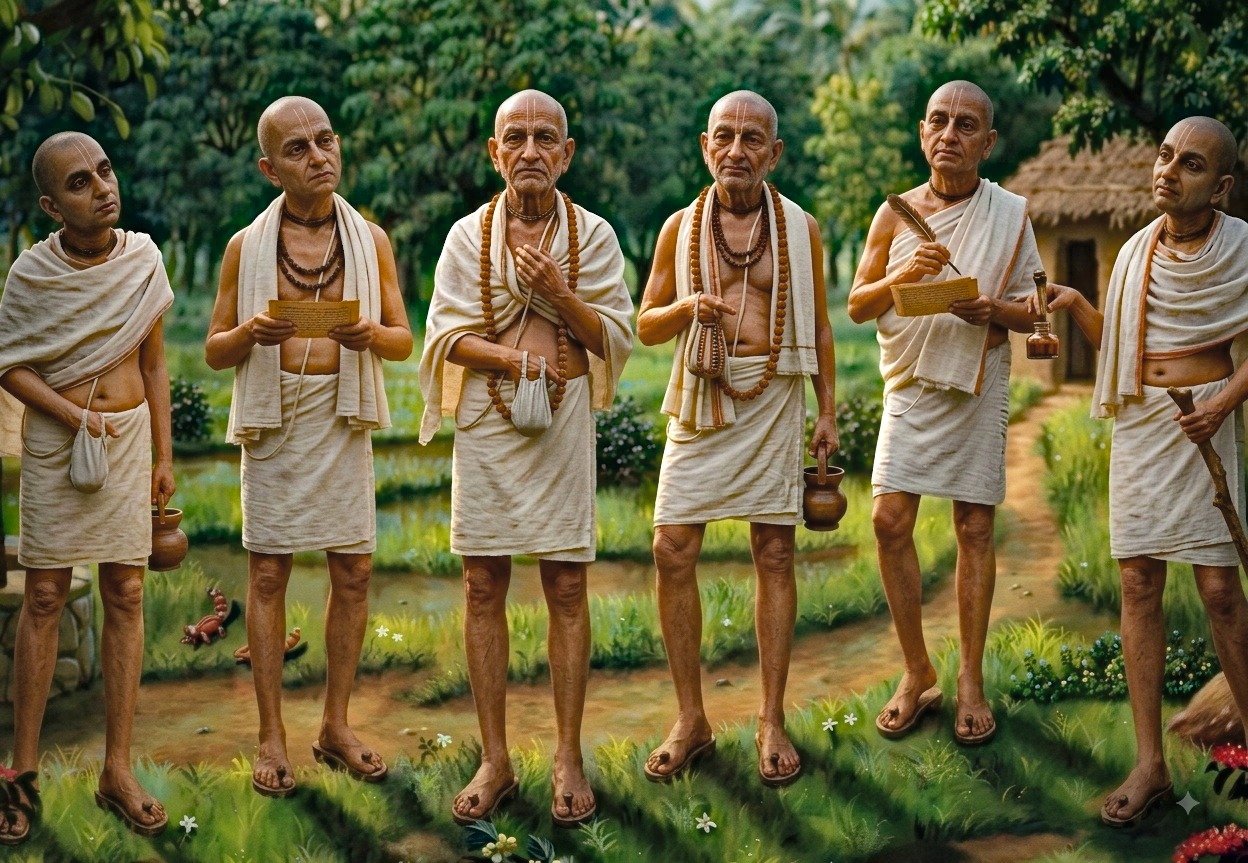
These six saintly scholars — Rupa Goswami, Sanatana Goswami, Raghunatha dasa Goswami, Raghunatha Bhatta Goswami, Gopala Bhatta Goswami, and Jiva Goswami — were personally instructed by Lord Chaitanya to go to Vrindavan, rediscover the lost holy sites of Krishna’s pastimes, establish deity worship, and codify the theology of Gaudiya Vaishnavism in writing. Without their monumental contributions, the Krishna consciousness movement as we know it today — including the worldwide mission of ISKCON — would not exist.
This comprehensive guide explores the life, works, and spiritual legacy of each of the Six Goswamis.
Who Were the Six Goswamis?
The term Goswami (Sanskrit: go-svāmī) literally means “master of the senses.” It is a title earned through rigorous spiritual discipline, not merely inherited. As Srila A.C. Bhaktivedanta Swami Prabhupada explained, all six Goswamis were bona fide spiritual masters situated on the highest platform of devotional service, and only one who is fully self-controlled and engaged in expanding Lord Chaitanya’s mission can truly be called a Goswami.
The Six Goswamis were direct disciples or associates of Sri Chaitanya Mahaprabhu, who is revered in the Gaudiya tradition as the combined incarnation of Radha and Krishna. They collectively:
- Excavated and restored the sacred sites of Vrindavan, including Radha-kunda and Govardhana Hill
- Established iconic temples such as Govindaji, Radha-Ramana, and Radha-Damodara
- Authored hundreds of Sanskrit treatises that form the philosophical backbone of Gaudiya Vaishnavism
- Demonstrated the highest standards of renunciation (vairagya) and pure devotional love (prema-bhakti)
The great Vaishnava saint Srinivasa Acharya glorified them in his famous Shad-goswamy-ashtakam, describing them as “always absorbed in the ecstatic ocean of the gopis’ love for Krishna, bathing repeatedly in its waves.”
Let us now explore each of these extraordinary personalities in detail.
1. Sri Rupa Goswami (1489–1564)
The Chief Architect of Gaudiya Theology
Sri Rupa Goswami is universally regarded as the foremost of the Six Goswamis and the principal disciple of Lord Chaitanya Mahaprabhu. His name is so inseparable from Gaudiya Vaishnava philosophy that the entire tradition is sometimes called the Rupanuga-sampradaya — the disciplic succession following in the footsteps of Rupa Goswami.
Early Life and Renunciation
Rupa Goswami was born in Fateyabad, Bengal, in the late 15th century into a family of scholarly brahmanas. Along with his elder brother Sanatana and younger brother Vallabha (later known as Anupama), he served as a high-ranking minister in the court of Sultan Hussain Shah of Bengal, holding the title Dabir Khas (private secretary). Despite their political positions, the brothers were deeply devoted Vaishnavas at heart.
When Lord Chaitanya passed through Ramakeli on His way to Vrindavan in 1514, the brothers met Him and surrendered completely. They resigned from their ministerial posts — an act of extraordinary courage and renunciation — and dedicated their lives to the Lord’s mission. Lord Chaitanya instructed them to go to Vrindavan, recover the lost holy places, and compose devotional scriptures.
Literary Contributions
Rupa Goswami’s writings form the very foundation of Gaudiya Vaishnava theology. His most important works include:
- Bhakti-rasamrita-sindhu (“The Ocean of the Nectar of Devotion”) — A systematic analysis of bhakti-yoga, categorizing the different stages, types, and flavors of devotional service. This magnum opus defines sadhana-bhakti, bhava-bhakti, and prema-bhakti with extraordinary precision.
- Ujjvala-nilamani (“The Shining Sapphire”) — A treatise on madhurya-rasa, the conjugal loving mellows, detailing the various types of love of the gopis for Krishna.
- Laghu-bhagavatamrita — A condensed philosophical work establishing Krishna as Svayam Bhagavan, the original Supreme Personality of Godhead.
- Vidagdha-madhava and Lalita-madhava — Two devotional dramas depicting Krishna’s Vrindavan and Dwaraka pastimes.
- Hamsaduta — A poetic work about Krishna’s messenger pastimes.
- Stavamala — A collection of devotional prayers and hymns.
Legacy in Vrindavan
Rupa Goswami personally installed the deity of Sri Sri Radha-Govindaji in Vrindavan. He also discovered and restored several sacred sites connected to Krishna’s pastimes. His samadhi is located within the Radha-Damodara temple complex in Vrindavan.
In the eternal pastimes of Krishna (nitya-lila), Rupa Goswami is identified as Rupa Manjari, an intimate maidservant of Srimati Radharani. This identity reveals the essence of his theological contribution — that the highest spiritual perfection is loving service to Radharani in the mood of the gopis.
Lord Chaitanya gave Rupa Goswami the title Bhakti-rasacharya — the acharya of devotional mellows — because of his unparalleled ability to express the deepest mysteries of spiritual love in systematic, scholarly form.
2. Sri Sanatana Goswami (1488–1558)
The Senior Most of the Six Goswamis
As the elder brother of Rupa Goswami, Sanatana Goswami held the position of the most senior figure among the Six Goswamis. Lord Chaitanya Himself treated him with the greatest reverence and entrusted him with weighty theological questions that shaped the entire Gaudiya tradition.
Early Life
Born around 1488 CE, Sanatana served alongside his brother Rupa in the court of Sultan Hussain Shah under the title Sakara Mallik (finance minister). The brothers were famed for their scholarship and devotion even while holding government office. When they met Lord Chaitanya at Ramakeli, the Lord’s influence transformed their lives completely.
Sanatana’s renunciation was particularly dramatic. After resigning his post, he was imprisoned by the Sultan, who was unwilling to lose such capable ministers. Sanatana eventually secured his release by giving up his accumulated wealth and traveling at great personal risk to meet Lord Chaitanya at Varanasi.
The Lord’s Instructions to Sanatana
At Varanasi, Lord Chaitanya gave Sanatana Goswami an extended audience that lasted several days, during which He explained the entire philosophy of Gaudiya Vaishnavism. This historic conversation, recorded in the Chaitanya-charitamrita (Madhya-lila, chapters 20–24), covers:
- The constitutional position of the living entity (jiva)
- The nature of the Supreme Lord (Bhagavan)
- The process of devotional service (bhakti)
- The ultimate goal of life (prayojana) — pure love of Godhead
- The nature of maya and liberation
Sanatana’s questions were so profound that Lord Chaitanya’s answers became the template for all subsequent Gaudiya theology.
Literary Contributions
Sanatana Goswami’s writings are encyclopedic in scope and include:
- Brihad-bhagavatamrita — A comprehensive philosophical work describing the progressive stages of spiritual realization, from the material world through the various planetary systems up to Goloka Vrindavan, the highest spiritual abode.
- Hari-bhakti-vilasa — Compiled in collaboration with Gopala Bhatta Goswami, this is the authoritative guide to Vaishnava rituals, sacraments (samskaras), and daily devotional practices. It serves as the Vaishnava-smriti — the practical code of conduct for Gaudiya Vaishnavas.
- Vaishnava-toshani — A commentary on the Tenth Canto of the Srimad-Bhagavatam.
- Brihad-vaishnava-toshani — An expanded commentary on the Bhagavatam.
- Dashama-tippani — Further commentary on Bhagavatam topics.
Legacy
Sanatana Goswami was also known as Sambandha-jnana Acharya — the teacher of sambandha-jnana, knowledge of the living entity’s relationship with the Supreme Lord. His works systematically establish who God is, who the soul is, and what their eternal relationship is.
He excavated several sacred sites in Vrindavan and established the deity worship of Madana-Mohana, the first of the principal deities installed by the Goswamis. His samadhi is located near the Madana-Mohana temple in Vrindavan.
In Krishna’s eternal pastimes, Sanatana Goswami is identified as Rati Manjari, another of Srimati Radharani’s intimate associates.
3. Sri Raghunatha dasa Goswami (1495–1586)
The Embodiment of Renunciation
Among the Six Goswamis, Raghunatha dasa Goswami is celebrated as the supreme exemplar of vairagya — renunciation and detachment from material life. His life story is one of the most dramatic and inspiring in the entire Gaudiya tradition.
Early Life and Escape
Born around 1495 CE in Saptagram, Hooghly District (present-day West Bengal), Raghunatha dasa was the only son of Govardhana Majumdar, a wealthy Kayastha landlord. His family was enormously rich — his father and uncle together were said to possess wealth comparable to that of demigods. Yet from childhood, Raghunatha showed complete indifference to material pleasures and an intense attraction to devotional life.
At the age of fifteen, he met Lord Chaitanya and was overwhelmed with desire to serve Him. His father, alarmed by his son’s renunciation tendencies, hired armed guards to prevent him from leaving home. For years, Raghunatha lived in golden splendor but felt imprisoned. Eventually, through the mercy of Lord Nityananda and by a clever stratagem, he escaped his guards and made an arduous three-day journey through forests to reach Jagannath Puri and the lotus feet of Lord Chaitanya.
Service at Puri
Lord Chaitanya entrusted Raghunatha dasa to the care of His confidential associate Svarupa Damodara Goswami, under whom Raghunatha served for sixteen years at Jagannath Puri. His renunciation during this period was legendary:
- He ate only rejected mahaprasada — the remnants that others had left
- He slept barely one and a half hours a day, spending over twenty-two hours in chanting the Hare Krishna maha-mantra
- He wore only a torn cloth and a patchwork scarf
- Lord Chaitanya Himself said, “It is not possible for an ordinary jiva to emulate Raghunatha’s renunciation.”
Lord Chaitanya gave Raghunatha His own Govardhana Shila and a gunja-mala (a garland of small sacred beads) — treasures he worshiped for the rest of his life.
Life at Radha-kunda
After Lord Chaitanya’s disappearance from this world, Raghunatha dasa was plunged into grief. He journeyed to Vrindavan intending to end his life by jumping from Govardhana Hill. There, Rupa and Sanatana Goswamis affectionately received him and convinced him to live on, sharing the pastimes of Lord Chaitanya with the Vrindavan Vaishnavas.
Raghunatha dasa settled on the banks of *Radha-kunda, the sacred lake commemorating Srimati Radharani, where he lived for approximately forty years in intense *bhajana (devotional worship). He played a key role in the re-excavation of both Radha-kunda and Shyama-kunda, restoring these most sacred bodies of water for posterity.
Literary Contributions
Raghunatha dasa Goswami wrote numerous devotional works, the most celebrated being:
- Vilapa-kusumanjali — A collection of intimate, desperate prayers to Srimati Radharani, begging for Her service. This work is considered the pinnacle of Gaudiya devotional poetry, expressing the mood of intense longing.
- Manah-siksha — “Instructions to the Mind,” a practical guide for controlling the restless mind and directing it toward pure devotional service.
- Stavavali — A collection of prayers glorifying Radha, Krishna, and the holy dhama.
- Vraja-vilasa-stava — Glorification of the pastimes and residents of Vrindavan.
- Dana-keli-chintamani — A poetic narration of the toll-collection pastime (dana-lila) of Krishna with the gopis.
- Radha-kundashtaka and Govardhana-vasa-prarthana-dasaka — Prayers glorifying Radha-kunda and expressing the desire to reside at Govardhana Hill.
Legacy
Raghunatha dasa Goswami is known as the Prayojana Acharya — the teacher who reveals the ultimate goal of life: intimate loving service to Srimati Radharani and Sri Krishna in the groves of Vrindavan. His prayers establish that the service of Radharani is the supreme spiritual perfection.
In Krishna’s eternal pastimes, he is identified as Rati Manjari (also described as Rasa Manjari in some sources). His bhajana-kutir (place of worship) still exists at Radha-kunda and is visited by pilgrims to this day.
4. Sri Raghunatha Bhatta Goswami (c. 1505–1579)
The Master of Srimad-Bhagavatam Recitation
Raghunatha Bhatta Goswami occupies a unique place among the Six Goswamis. While others are celebrated for their voluminous literary output, Raghunatha Bhatta is honored for his unparalleled mastery of reciting and singing the Srimad-Bhagavatam, and for his embodiment of shravanam (hearing) and kirtanam (chanting).
Early Life
Raghunatha Bhatta was born around 1505 CE in a devotional family in Eastern Bengal. His father, *Tapana Mishra, was a devout Vaishnava who had been personally instructed by Lord Chaitanya on the goal of life — that *harinama-sankirtana, the congregational chanting of the Holy Names, is both the supreme goal and the means to attain it.
When Lord Chaitanya visited Tapana Mishra’s home in Varanasi, young Raghunatha Bhatta had the precious opportunity to personally serve the Lord by massaging His feet and cleaning His eating area. These simple, heartfelt services earned him the Lord’s deep affection.
Service at Jagannath Puri
After completing his studies in Sanskrit grammar, rhetoric, and poetry, Raghunatha Bhatta traveled to Jagannath Puri, where he spent eight months serving Lord Chaitanya. He cooked for the Lord regularly, and his preparations were so pleasing that Mahaprabhu personally praised them. Pleased by his devotion, Lord Chaitanya gave Raghunatha Bhatta a Tulasi garland from His own neck and betel nut offered to Lord Jagannatha — sacred remnants he treasured for the rest of his life.
Lord Chaitanya instructed Raghunatha Bhatta to remain a lifelong brahmachari (celibate), never marry, to serve his aging Vaishnava parents, and to study the Srimad-Bhagavatam from a pure devotee. After his parents passed away, Raghunatha returned to Puri for another eight months of service before the Lord sent him to Vrindavan.
Life in Vrindavan
In Vrindavan, Raghunatha Bhatta placed himself under the guidance of Rupa and Sanatana Goswamis, as instructed by Lord Chaitanya. His recitation of Srimad-Bhagavatam became legendary:
- He would sing each verse in multiple melodies (ragas), his voice described as sweet as a cuckoo’s call
- While reciting, he would frequently be overwhelmed with ecstatic love — tears, trembling, and choking of the voice — and could not continue
- Even great sages like Vyasadeva were said to take pleasure in his recitation
- He earned the title Kirtana Acharya — the master of devotional chanting
His humility was equally remarkable. He never listened to criticism of any Vaishnava, believing that everyone was sincerely serving the Lord according to their realization. He engaged only in discussions about Krishna and worshiped Him day and night.
Contribution to Temple Worship
Although Raghunatha Bhatta did not write extensive theological texts like the other Goswamis, his contribution to the development of Vrindavan was significant. Under his inspiration, a wealthy disciple funded the construction of the magnificent Govindaji Temple — the red sandstone marvel that remains one of the most beautiful temples in Vrindavan. He personally crafted various ornaments for the Govindaji deity, including a flute and distinctive earrings, and served the deity for forty years.
Legacy
Raghunatha Bhatta Goswami is the embodiment of the path of hearing (shravanam) and chanting (kirtanam). His life demonstrates that spiritual perfection is not measured by scholarly output alone but by sincerity, humility, and pure love. His disciples included *Krishnadas Kaviraja Goswami, the author of the Chaitanya-charitamrita, and *Gadadhar Bhatta Goswami, a renowned poet.
The sacred Tulasi garland and Bhagavatam given to him by Lord Chaitanya are still preserved and worshiped at the Raghunath Bhatta Goswami Peeth (Bhatt Ji ke Haveli) in Vrindavan, along with his wooden sandals (padukas).
In Krishna’s eternal pastimes, he is identified as Raga Manjari (or Rasa Manjari), one of the eight principal maidservants (asta-manjaris) of Srimati Radharani.
5. Sri Gopala Bhatta Goswami (1503–1578)
The Acharya of Vaishnava Ritual and Worship
Gopala Bhatta Goswami holds a distinctive position among the Six Goswamis as the authority on Vaishnava rituals, sacraments, and deity worship. His scholarly background in the Sri Vaishnava tradition of South India brought a unique dimension to the Gaudiya school.
Early Life in South India
Gopala Bhatta Goswami was born around 1503 CE in *Srirangam, South India, into a prominent Sri Vaishnava brahmana family of the Ramanuja-sampradaya. His father, *Venkata Bhatta, was a learned scholar and devotee of Lakshmi-Narayana.
In 1511 CE, during Lord Chaitanya’s tour of South India, the Lord stayed at Venkata Bhatta’s home for four months during the chaturmasya period. This was a transformative experience for the entire family. Through the Lord’s merciful association, Venkata Bhatta, his brother Prabodhananda Saraswati, and the young Gopala Bhatta all embraced the worship of Radha and Krishna in the Gaudiya tradition.
As a mere boy, Gopala personally served Lord Chaitanya, who treated him affectionately, giving him His remnants and blessing him to become an acharya. When the Lord was about to depart, Gopala Bhatta was so distressed that the Lord agreed to stay a few more days. In a visionary dream, Lord Chaitanya revealed His identity as Krishna Himself and instructed Gopala that he would meet Rupa and Sanatana Goswami in Vrindavan.
Education and Journey to Vrindavan
After Lord Chaitanya’s departure, Gopala Bhatta studied under his uncle Prabodhananda Saraswati, becoming expert in Sanskrit grammar, poetry, rhetoric, Vedanta, and the devotional scriptures. After his parents passed away — they departed this world meditating on Lord Chaitanya — Gopala Bhatta traveled to Vrindavan.
When Rupa and Sanatana learned of his arrival, they wrote to Lord Chaitanya, who was overjoyed and instructed them to accept Gopala Bhatta as their own younger brother. The Lord also sent Gopala Bhatta some of His personal belongings — including His wooden sitting plank (khadira)*, His *undergarments (kaupina)*, and an *upper cloth — which are still worshiped in the Radha-Ramana temple today.
The Appearance of Sri Radha-Ramana
During a pilgrimage to the holy places of North India, Gopala Bhatta obtained twelve Shalagrama-shilas (sacred stones) from the Gandaki River. On one auspicious day, one of these Shilas miraculously manifested as a beautiful three-armed deity of Krishna holding a flute — the famous Radha-Ramana deity. This extraordinary event, which occurred around 1542 CE, established one of the seven principal deities of Vrindavan.
Since that time, Radha-Ramana has been worshiped with meticulous devotion following precise shastric rituals. Remarkably, no separate deity of Radharani is present; the Shalagrama-shila itself embodies both Radha and Krishna.
Literary Contributions
Gopala Bhatta Goswami’s contributions, though fewer in number, were deeply influential:
- Hari-bhakti-vilasa — Compiled in collaboration with Sanatana Goswami, this is the authoritative Vaishnava code of rituals, ceremonies, and daily practices. Sanatana Goswami, out of deep affection, published the work under Gopala Bhatta’s name.
- Sat-kriya-sara-dipika — “Light on the Essential Sacraments,” a guide to Vaishnava samskaras — birth ceremonies, sacred-thread initiation, marriage, sannyasa, and funerary rites.
- Sat-sandarbha-karika — The foundational notes and outline that Jiva Goswami later expanded into the monumental Sat-sandarbhas.
- Krishna-karnamrita commentary — A commentary on Bilvamangala Thakura’s devotional poem.
- Foreword to the Sat-sandarbhas — Written at Jiva Goswami’s request.
Legacy
Gopala Bhatta Goswami was renowned for his extraordinary humility. When Krishnadas Kaviraja approached him for permission to write the Chaitanya-charitamrita, Gopala Bhatta granted it — on the condition that his name not be mentioned. As a result, he appears only sparingly in that great work, despite being one of the most important figures of the tradition.
His prominent disciples included *Srinivasa Acharya, who carried the Goswamis’ writings to Bengal, and **Gopinatha Pujari, a lifelong brahmachari who served Radha-Ramana. Gopala Bhatta resided in Vrindavan for forty-five years, mostly performing *bhajana at Radha-kunda. His samadhi is located within the Radha-Ramana temple compound.
In Krishna’s eternal pastimes, he is identified as Ananga Manjari (also described as Guna Manjari in some sources), one of the asta-manjaris of Srimati Radharani.
6. Sri Jiva Goswami (c. 1513–1598)
The Greatest Philosopher of Gaudiya Vaishnavism
Jiva Goswami is widely regarded as the most prolific and systematic philosopher in the history of Gaudiya Vaishnavism. He systematized the teachings of Lord Chaitanya, Rupa, and Sanatana into a comprehensive theological framework that remains the definitive expression of the tradition.
Early Life and Education
Jiva Goswami was born around 1513 CE in Ramakeli, Bengal — the same village where his uncles Rupa and Sanatana had served as ministers. He was the son of Anupama (the youngest of the three brothers, originally named Vallabha), who was known for his devotion to Lord Rama. From childhood, Jiva was attracted to Vaishnava dharma and was deeply attached to his uncles.
After the passing of Lord Chaitanya and the departure of Rupa and Sanatana for Vrindavan, young Jiva felt intense renunciation. He declined to marry and set out for Navadvipa, where he met Lord Nityananda, who showed him around the holy places of Sri Chaitanya’s pastimes and directed him to Vrindavan.
On the way, Jiva stopped at Varanasi, where he studied Nyaya (logic) and Vedanta philosophy under Madhusudana Vacaspati, becoming, in a short time, the foremost scholar of both disciplines in Kashi.
Arrival in Vrindavan and Scholarship
Upon reaching Vrindavan, Jiva surrendered himself at the feet of Rupa Goswami and studied the entire corpus of bhakti-shastra under his guidance. His erudition was so extraordinary that he was soon accepted as the supreme acharya of the Gaudiya sampradaya.
The Mughal Emperor Akbar is said to have become an admirer of Jiva Goswami and reportedly donated paper for his writing — a remarkable testament to the scholar’s fame and sanctity.
The Sat-sandarbhas: Jiva’s Magnum Opus
Jiva Goswami’s most celebrated contribution is the Sat-sandarbhas (“Six Weavings”), a systematic thematic arrangement of the Srimad-Bhagavatam that presents Gaudiya Vaishnava philosophy in its most rigorous and comprehensive form. Building on preliminary notes by Gopala Bhatta Goswami, Jiva expanded the work into six volumes:
- Tattva-sandarbha — Establishes epistemology (pramana) and identifies the Srimad-Bhagavatam as the supreme evidence and the natural commentary on the Vedanta-sutra.
- Bhagavat-sandarbha — Establishes sambandha-jnana: the relationship between the Supreme Lord, the living entity, and material nature. Establishes Krishna as Svayam Bhagavan, the original Supreme Personality.
- Paramatma-sandarbha — Discusses the Lord’s localized manifestation as Paramatma (Supersoul) and the nature of the material cosmos.
- Krishna-sandarbha — Proves from scripture that Krishna is the source of all incarnations and the supreme object of worship.
- Bhakti-sandarbha — Establishes abhidheya: the process of devotional service (bhakti) as the means to attain the supreme goal.
- Priti-sandarbha — Establishes prayojana: pure love of Godhead (prema) as the ultimate perfection of life.
A seventh work, the Krama-sandarbha, is a commentary on the Srimad-Bhagavatam and is often described as the “seventh” of the Sandarbhas.
The Sat-sandarbhas represent the perfection of sambandha-jnana, abhidheya-jnana, and prayojana-jnana — knowledge of relationship, process, and goal — and are considered the most important philosophical treatise in the entire Chaitanya Vaishnava tradition.
Other Literary Works
Jiva Goswami authored at least 25 works, classified into four categories:
Treatises and Theology:
- Sat-sandarbhas (described above)
- Krishna-sandarbha, Bhakti-sandarbha, Priti-sandarbha (parts of the above)
Commentaries:
- Durgama-sangamani — Commentary on Rupa Goswami’s Bhakti-rasamrita-sindhu
- Locana-rochani — Commentary on Ujjvala-nilamani
- Krama-sandarbha — Commentary on the Srimad-Bhagavatam
- Commentary on the Brahma-samhita
- Commentary on the Gopala-tapani Upanishad
- Commentary on the Yoga-sara-antara
Grammar and Poetics:
- Hari-namamrita-vyakarana — A Sanskrit grammar specially designed for studying Vaishnava scriptures, where every grammatical rule illustrates Krishna’s holy names and pastimes
- Sutra-mala and Dhatu-sangraha — Supporting grammatical works
- Rasamrita-shesha — A treatise on rhetoric and poetics
Literary Works:
- Gopala-champu — An ambitious literary masterpiece narrating the complete pastimes of Krishna in Vrindavan, combining prose and verse
- Madhava-mahotsava — A work describing the coronation festival of Srimati Radharani
- Sankalpa-kalpavriksha — A devotional work
Institutional Contributions
In 1542 CE, Jiva Goswami established the Radha-Damodara temple in Vrindavan, installing deities of Radha-Krishna that had been personally carved by Rupa Goswami. He also established:
- The Vishva Vaishnava Raja Sabha (World Vaishnava Association) — an assembly for Vaishnava governance and coordination
- The Rupanuga Vidyapitha — an educational institution for the systematic study of Rupa and Sanatana’s works
After the passing of Rupa and Sanatana, Jiva Goswami became the foremost authority in the Gaudiya Vaishnava line. Great figures such as *Krishnadas Kaviraja, **Srinivasa Acharya, **Narottama Dasa Thakura, and *Shyamananda all came to him for guidance and instruction. He is credited with personally training the next generation who would carry the tradition to Bengal and beyond.
Legacy
Jiva Goswami’s influence on Gaudiya Vaishnavism cannot be overstated. He systematized and defended every aspect of the theology:
- He established the *Srimad-Bhagavatam as the supreme *pramana** (evidence) and as the natural commentary on the Vedanta-sutra
- He articulated the philosophy of Achintya-bheda-abheda — the “inconceivable simultaneous oneness and difference” of the living entity with the Supreme
- He proved that Krishna is Svayam Bhagavan, the original Supreme Personality of Godhead, the source of all other incarnations
- He established prema (pure love of Godhead) as the fifth and ultimate prayojana (goal of life)
- He showed that Radha and the gopis are the topmost devotees, and that Vrindavan (Gokula) is the highest spiritual abode, beyond even Vaikuntha
Bhaktivinoda Thakura compared Jiva Goswami to Sri Ramanujacharya in the depth of his Vedantic scholarship. Western academics are now studying the Sandarbhas and marveling at the philosophical sophistication contained therein.
Jiva Goswami’s samadhi is located within the Radha-Damodara temple complex in Vrindavan. He never left Vrindavan-dhama after arriving there, spending his entire life in scholarship and devotion.
The Collective Legacy of the Six Goswamis
What They Accomplished Together
The Six Goswamis, though each distinct in personality and contribution, together accomplished what no individual could have done alone:
- Restoration of Vrindavan-dhama — They rediscovered the sacred sites of Krishna’s pastimes that had been lost to time, excavated holy lakes like Radha-kunda and Shyama-kunda, and transformed Vrindavan from an obscure village into a thriving center of devotion.
- Establishment of Temple Worship — They installed and established worship of the principal deities of Vrindavan: Madana-Mohana (Sanatana), Govindaji (Rupa), Radha-Ramana (Gopala Bhatta), and Radha-Damodara (Jiva). These temples remain active centers of worship today, nearly five centuries later.
- Systematic Theology — They composed hundreds of Sanskrit treatises that established Gaudiya Vaishnavism on a firm scriptural and philosophical foundation. Their writings cover every aspect of the tradition — from ritual practice (Hari-bhakti-vilasa) to devotional aesthetics (Bhakti-rasamrita-sindhu) to the highest metaphysical conclusions (Sat-sandarbhas).
- Living Examples of Renunciation — Despite their aristocratic backgrounds, they lived as mendicants, sleeping under trees, eating frugally, and dedicating every moment to bhajana and writing. Raghunatha dasa Goswami’s standard was so extreme that Lord Chaitanya Himself said it was impossible for an ordinary soul to emulate.
- Training the Next Generation — Through their disciples — especially Srinivasa Acharya, Narottama Dasa Thakura, and Shyamananda — they transmitted the tradition to Bengal and across India, ensuring its survival and spread.
Their Relevance for ISKCON Today
The International Society for Krishna Consciousness (ISKCON), founded by Srila A.C. Bhaktivedanta Swami Prabhupada in 1966, stands in direct disciplic succession from the Six Goswamis. Srila Prabhupada’s translations and commentaries — particularly his Bhakti-rasamrita-sindhu (published as The Nectar of Devotion) and Sri Chaitanya-charitamrita — make the Goswamis’ teachings accessible to the modern world.
Every ISKCON temple around the world perpetuates the mission the Goswamis began:
- The deity worship follows the standards they established in Hari-bhakti-vilasa
- The philosophical curriculum is drawn from their writings
- The emphasis on sankirtana — congregational chanting — fulfills Lord Chaitanya’s original instruction
- The goal of life — pure love of Krishna — is exactly as they described it
The Six Goswamis showed that bhakti is not a sentimental activity but the essence of Vedic knowledge, supported by scripture and demonstrated in pure conduct. As Srila Prabhupada wrote: “Devotional service is not a sentimental activity. The essence of Vedic knowledge is devotional service.”
Conclusion
The Six Goswamis of Vrindavan — Rupa, Sanatana, Raghunatha dasa, Raghunatha Bhatta, Gopala Bhatta, and Jiva — were not merely historical figures. They were divinely empowered acharyas who carried out the direct order of Sri Chaitanya Mahaprabhu to establish the Krishna consciousness movement on a permanent foundation of scripture, worship, and pure devotion.
Their lives teach us that the highest spiritual realization is available to anyone willing to surrender sincerely to the Lord and His devotees. Their writings remain the authoritative guide for anyone seeking to understand and practice Gaudiya Vaishnavism. And their legacy — the holy dhama of Vrindavan, the temples they built, the literature they composed, and the unbroken disciplic succession they established — continues to uplift millions of souls across the world today.
As the Shad-goswamy-ashtakam concludes:
“The Six Goswamis are always engaged in the transcendental loving service of Radha and Krishna. I offer my respectful obeisances unto them.”
To study their lives is to study the science of pure devotion. To follow their teachings is to walk the path back home, back to Godhead.
Frequently Asked Questions (FAQs)
Who were the Six Goswamis of Vrindavan?
The Six Goswamis were Rupa Goswami, Sanatana Goswami, Raghunatha dasa Goswami, Raghunatha Bhatta Goswami, Gopala Bhatta Goswami, and Jiva Goswami. They were the foremost disciples of Sri Chaitanya Mahaprabhu, entrusted with establishing the theology, rituals, and sacred sites of Gaudiya Vaishnavism in 16th-century Vrindavan.
Why are they called “Goswamis”?
The word Goswami (Sanskrit: go-svāmī) means “master of the senses.” It is a title earned through spiritual realization and self-control, not merely inherited. The Six Goswamis were given this title because they were bona fide spiritual masters on the highest platform of devotional service.
What is the connection between the Six Goswamis and ISKCON?
ISKCON, founded by Srila Prabhupada, is part of the Brahma-Madhva-Gaudiya disciplic succession that passes through the Six Goswamis. The practices, philosophy, and deity worship in ISKCON temples are directly based on the Goswamis’ writings and the standards they established.
Which books did the Goswamis write?
Their most important works include Rupa Goswami’s Bhakti-rasamrita-sindhu and Ujjvala-nilamani, Sanatana Goswami’s Brihad-bhagavatamrita and Hari-bhakti-vilasa, Jiva Goswami’s Sat-sandarbhas, Raghunatha dasa Goswami’s Vilapa-kusumanjali and Manah-siksha, and Gopala Bhatta Goswami’s Sat-kriya-sara-dipika.
Where are the samadhis of the Six Goswamis located?
The samadhis of the Goswamis are located in Vrindavan: Rupa Goswami and Jiva Goswami at the Radha-Damodara temple, Sanatana Goswami near the Madana-Mohana temple, Raghunatha dasa Goswami at Radha-kunda, Gopala Bhatta Goswami at the Radha-Ramana temple, and Raghunatha Bhatta Goswami’s ashes in two samadhis at Radha-kunda and the 64 Samadhis area.
What is the Shad-goswamy-ashtakam?
The Shad-goswamy-ashtakam is a famous prayer composed by Srinivasa Acharya that glorifies the Six Goswamis. It describes their renunciation, their absorption in the ecstasy of the gopis’ love for Krishna, and their role in delivering conditioned souls. It is regularly sung in ISKCON temples.
Hare Krishna Hare Krishna, Krishna Krishna Hare Hare / Hare Rama Hare Rama, Rama Rama Hare Hare