The Shocking Evolution of Pashu Yajna, Origins, Myths, and Kali Yuga Realities
The practice of animal sacrifice—conceptually framed as Pashu Bali or Pashu Yajna—occupies a deeply complex, highly debated space within the massive corpus of Hindu sacred literature. While modern Hinduism has predominantly evolved into a Sattvic framework centered around Ahimsa (non-violence) and symbolic offerings, ancient texts paint a sophisticated, multi-layered picture of this ritual.
1. Vedic Foundations: What Do the Primary Texts Say?
To accurately decode the concept of Bali, one must return to the Vedas and Brahmanas (ritual treatises), where the earliest frameworks of Yajna (sacred sacrifice) were established.
Historically, the word “Bali” did not explicitly imply slaughter. In early texts like the Rigveda and Atharvaveda, Bali translates broadly to “tribute,” “tax,” or “an offering of sustenance” (such as grains, ghee, and milk) presented to deities or nature spirits.
However, complex ritual manuals like the Yajurveda and the Satapatha Brahmana do explicitly detail Pashu Yajna (animal rituals). The texts justify and contextualize these practices through specific spiritual and metaphysical laws:
- The Metaphysical Exchange: The Vedas operate on the principle of cosmic interdependence. Humans take from nature, and in return, they must feed the cosmic energies (Devas and Bhutas) that sustain life.
- Karmic Upward Mobility: The Manava Dharmasastra (Laws of Manu) and various Brahmanas assert that an animal consecrated and sacrificed in a strictly authorized Vedic ritual undergoes spiritual acceleration. The animal’s soul is said to instantly bypass lower evolutionary rebirths and ascend directly to higher planetary realms (Svarga).
- The Adhvara Clause: Critically, the Rigveda frequently refers to Yajna as Adhvara—a Sanskrit term explicitly meaning “injury-less” or “free from violence.” This created an early theological division: true Vedic sacrifice was meant to be an act of cosmic alignment, not casual cruelty.
2. Puranic Manifestations: Daksha Prajapati & Great Kings
As the pastoral Vedic period shifted into the era of the Itihasas (Epics) and Puranas, Pashu Bali transformed into grand state rituals performed by powerful monarchs and progenitors (Prajapatis) to display imperial sovereignty, seek progeny, or purify empires.
The Litmus Test: Daksha Prajapati’s Yajna
The most famous textual account of a macro-scale sacrifice is the *Daksha Yajna, recorded across the *Bhagavata Purana, Vayu Purana, and Shiva Purana.
- Daksha Prajapati, the cosmic progenitor, organized a monumental Brihaspatistava sacrifice, intentionally refusing to invite his son-in-law, Lord Shiva.
- The ritual involved immense displays of wealth and animal offerings overseen by the sage Bhrigu.
- When Sati (Shiva’s consort) immolated herself in response to Daksha’s insults, an enraged Shiva manifested the fierce deity Virabhadra, who disrupted the entire ritual and decapitated Daksha.
- The Ultimate Symbolism: When Shiva ultimately showed mercy and revived Daksha, his severed human head was replaced with the *head of a sacrificial goat/ram. This Puranic event serves as a stark scriptural warning about the dangers of *Ahankara (ego) hijacking sacred rituals. Daksha, who sought to sacrifice others out of pride, became the sacrifice himself.
Great Kings and the Sovereignty Sacrifices
Throughout the Puranas and Epics, legendary emperors turned to grand-scale animal rituals to solidify their reigns:
- King Yudhishthira (The Mahabharata): Following the catastrophic Kurukshetra war, Yudhishthira was consumed by guilt over the mass slaughter. On the advice of Sage Vyasa and Sri Krishna, he performed the ultra-complex Ashvamedha Yajna (Horse Sacrifice) to purify the realm, establish his status as a Chakravarti (Universal Emperor), and bring prosperity back to a fractured land.
- King Sagara (The Ramayana): The Solar dynasty king famously initiated an Ashvamedha that triggered the cosmic chain of events leading to the descent of the Holy River Ganga.
- King Harishchandra (Markandeya Purana): His legends explicitly navigate the boundaries of Purushamedha (symbolic or historical human sacrifice) and Pashu Bali, highlighting a systemic Puranic pushback against taking human or unnecessary animal life, substituting physical blood with intense personal truth and penance.
3. Classifications of the Great Sacrifices
Vedic and Puranic literatures classify large-scale animal sacrifices based on the specific animal archetype utilized, each carrying deep cosmic symbolism:
| Sacrifice Type | Core Subject | Primary Purpose / Symbolism |
|---|---|---|
| Ashvamedha | Consecrated Horse | Performed exclusively by powerful kings for imperial sovereignty, political unity, and national prosperity. The horse symbolized the untamed cosmos brought into order. |
| Gomedha | Consecrated Bull/Ox | Performed to bless agricultural land, bring rain, and increase the vitality of the earth. Note: Later commentaries interpret this purely as the cultivation of speech/senses. |
| Agnisomiya | Consecrated Goat | The most foundational, routine component of the complex Soma sacrifices, where a goat was offered to the dual deities Agni (Fire) and Soma (Nectar/Moon). |
4. Sacred Liturgy: The Core Mantras
A Vedic Pashu Bali was strictly gated by highly exact liturgical speech. It was completely forbidden to kill an animal without the chanting of authorized mantras by qualified Hotri and Adhvaryu priests.
The inner philosophy of these mantras shifted the act from a slaughter to a sacrament. The core mantras centered around two vital concepts:
A. The Apology and Liberation
Before any weapon was drawn, the priest whispered mantras into the animal’s ear to soothe its spirit and decouple its consciousness from the physical form.
Om Pasupataye Namah… Pasu-pasa vimoksanam
“Salutations to the Lord of All Creatures (Pasupati). May this soul be untied and entirely liberated from the biological bondage (Paasha) of its animal form.”
B. The Shield Against Karma
The Yajurveda contains explicit directives commanding the blade to cause minimal trauma, ensuring that the act did not generate negative Prarabdha Karma for the performer:
“O Herb, protect him! O Axe, do not injure him!”
— Yajurveda 1.2.1
The liturgy insisted that the physical meat and blood were merely being returned to the elements (Prithvi, Agni, Vayu) while the vital life breath (Prana) was consciously directed upward into the cosmos.
5. What is Obsolete vs. Relevant Today?
Sanatana Dharma operates on the brilliant structural flexibility of Desa, Kala, Patra (Location, Time, and Era Context). Because the current cosmic age is recognized as Kali Yuga (the age of spiritual decline), the scriptural relevance of physical animal sacrifice has shifted dramatically.
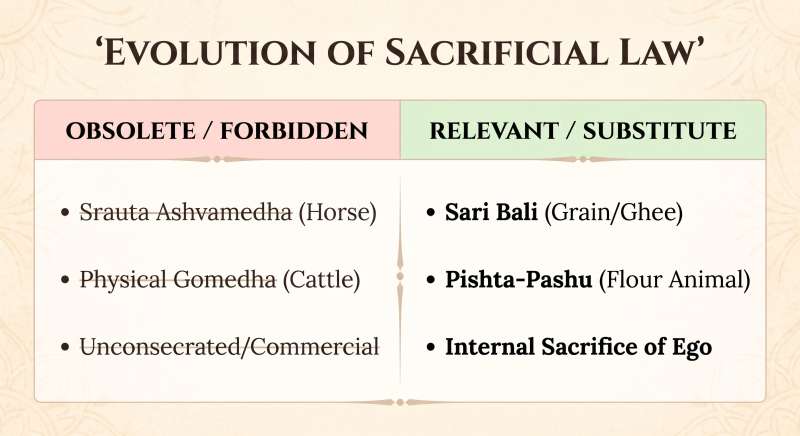
What is Scripturally Obsolete Today
Modern texts like the Brahma Vaivarta Purana and the Kali Santarana Upanishad explicitly declare that the macro-scale Vedic animal sacrifices are strictly forbidden (Varjya) in the current epoch:
“In the age of Kali, five acts are strictly forbidden: the horse sacrifice (Ashvamedha), the cow sacrifice (Gomedha), the acceptance of sannyasa in a distorted framework, the offering of flesh to ancestors, and producing children through a brother.” — Adi Purana
The reasoning is deeply pragmatic: the ultra-pure, spiritually flawless priests (Rtviks) capable of chanting the exact acoustic frequencies required to instantly liberate and elevate an animal’s soul simply do not exist in the modern era. Without that absolute spiritual mastery, physical sacrifice degrades into raw, sinful violence (Himsa).
What Remains Relevant Today
- The Concept of Substitution (Pishta-Pashu): The Mimamsa school of Hindu philosophy and various Upanishads provide an elegant alternative: *substitution. Modern Vedic rituals replace the live animal with *Pishta-Pashu—an image of a goat or horse meticulously crafted out of rice flour, sesame, or urad dal dough. Pouring red kumkum water over a broken coconut or pumpkin mimics the energetic dispersal of blood without harming a living being.
- The Internalization of Yajna: The highest philosophical realizations of the Upanishads teach that external sacrifices were merely kindergarten steps for human consciousness. The true, timeless Pashu Bali is entirely internal.
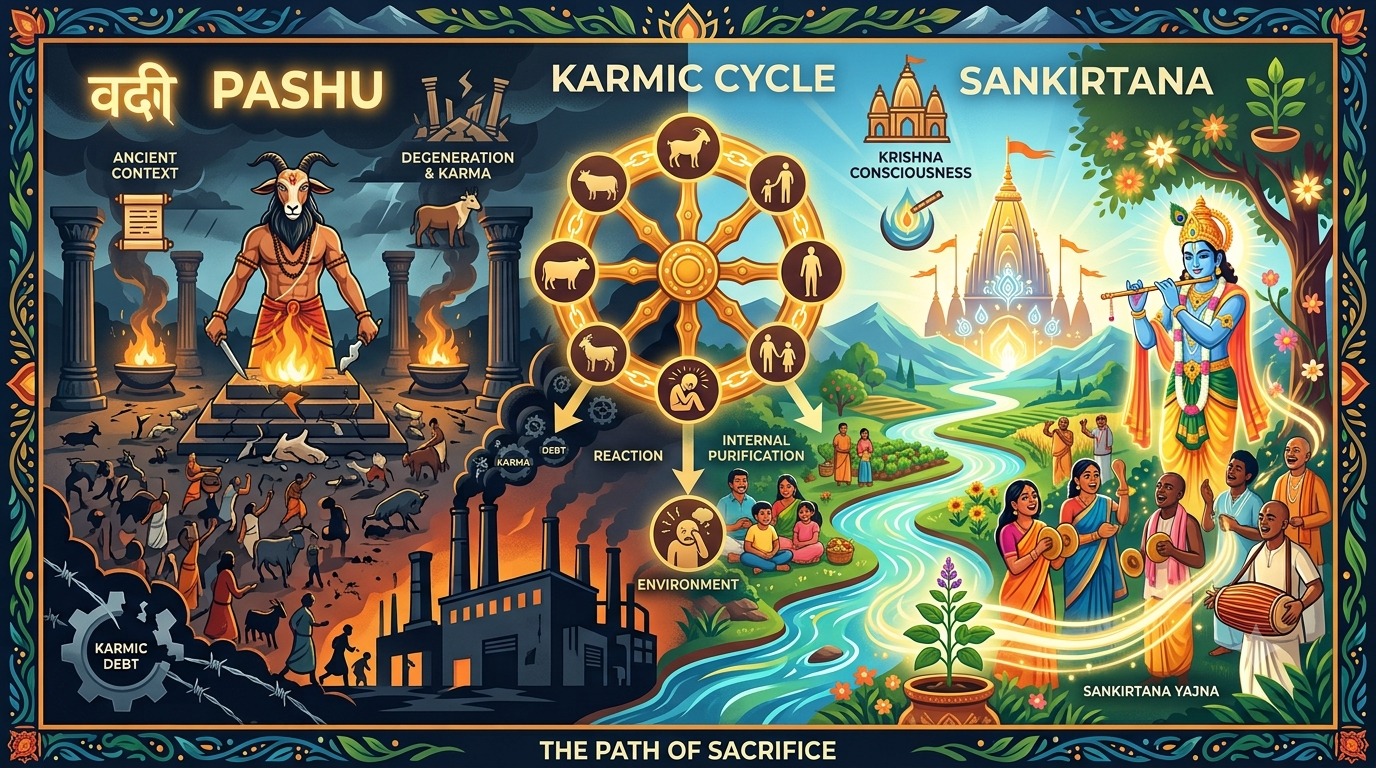
1. The Degeneration: From Holy Sacrament to Brutal Mass Killing
In the ancient Vedic era, Pashu Yajna was a highly restricted, precise acoustic science. It was never a commercial mechanism for slaughter. However, as the centuries advanced into Kali Yuga (the current age of spiritual decline), greed and the desire for sense gratification hijacked scripture. Unscrupulous people distorted the complex allegories of the Vedas to justify the wholesale mass slaughter of animals for the palate.
When the sacred mantras lost their potency due to the corruption of the priestly class, the sacrificial arenas effectively transformed into nothing more than commercial butcher shops.
Effects on the Human Psyche and Consciousness
- Destruction of Mercy (Daya):* The *Srimad Bhagavatam states that mercy is one of the four core pillars of religion. Mass animal killing completely blunts human empathy, rendering human consciousness coarse, highly aggressive, and blind to the spiritual spark within other living entities.
- The Proliferation of Chaos: When society normalizes the systematic torture and slaughter of millions of innocent, helpless creatures, it breeds a collective subconscious filled with fear, anxiety, and extreme unrest. This mental degradation directly manifests as systemic societal violence, domestic discord, and global conflict.
Environmental Degradation
From a Vedic perspective, the earth (Bhumidevi) is a sentient, living mother.
- Metaphysical Suffocation: The heavy, Tamasic (dark/ignorant) energy generated by the sheer terror, pain, and blood of billions of slaughtered animals spiritually chokes the planet.
- The Ecological Debt: In ancient texts, Yajna was a system of cyclical replenishment. Modern industrial mass killing breaks this cycle entirely. It drains the earth’s vital resources, disrupts natural weather patterns (as outlined in Bhagavad Gita 3.14, where rain depends on pure sacrifice), and poisons the soil and water with the toxic energy of death.
Karmic Reactions Already Being Experienced
The laws of Karma operate on absolute cosmic geometry: for every action, there is an equal and inescapable reaction. The Srimad Bhagavatam (4.25.7) vividly warns that the souls of animals killed without absolute Vedic authorization await the perpetrator’s death to exact vengeance.
On a collective level, humanity is already paying this massive karmic debt through:
- Incurable Diseases and Pandemics: Severe physical ailments and widespread biological crises are identified as the direct return-karma of violating the bodily integrity of innocent animals.
- Geopolitical Instability and War: When collective Prarabdha Karma (accumulated reaction) peaks, the laws of nature enforce a violent re-balancing. The blood spilled in slaughterhouses returns to human society in the form of unstoppable wars, social revolutions, and natural disasters.
- The Law of Rebirth (Mamsa):* The very etymology of the Sanskrit word for meat, **Mamsa, carries a terrifying karmic decree: *”Mam sah khadati iti mamsah”—“What I am eating now, will eat me in a future life.”
2. Footnote: The Krishna Conscious Relevance
From the perspective of Krishna Consciousness (Gaudiya Vaishnavism), as propagated by the ancient scriptures and modern Acharyas like Srila Prabhupada, physical animal sacrifice is completely unauthorized, offensive, and obsolete in this age.
When humanity began abusing Vedic texts to justify mass slaughter, the Supreme Lord personally descended in two profound incarnations to rectify the error:
- Lord Buddha: He appeared specifically to reject the authority of the Vedas temporarily, because people were using scriptural loopholes to slaughter animals. He established Ahimsa (non-violence) as the foundational step toward spiritual recovery.
- Lord Chaitanya Mahaprabhu: He quoted the Brahma-Vaivarta Purana to emphasize that the five great sacrifices—including Ashvamedha (horse sacrifice) and Gomedha (cow sacrifice)—are strictly forbidden (Kali-varjya) in this age because there are no qualified, pure priests to execute them safely.
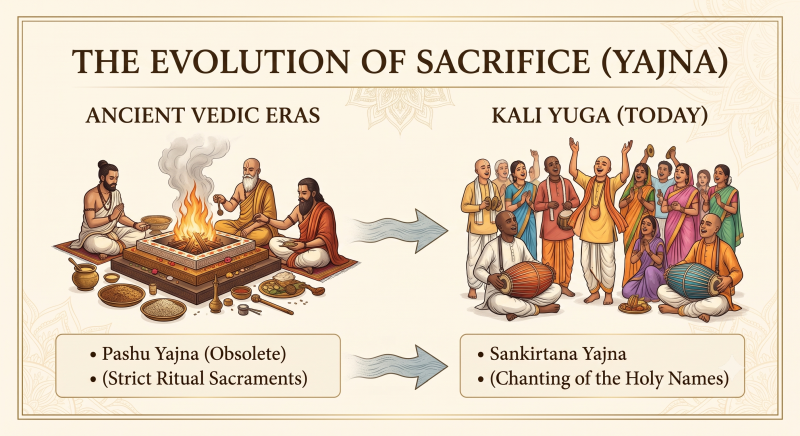
The Only Authorized Yajna Today
In Krishna Consciousness, the ultimate remedy for the dark age of Kali is Sankirtana Yajna—the collective chanting of the holy names of God, specifically the Maha-Mantra:
Hare Krishna, Hare Krishna, Krishna Krishna, Hare Hare
Hare Rama, Hare Rama, Rama Rama, Hare Hare
In the Bhagavad Gita (14.4), Lord Krishna declares, “Aham bija-pradah pita”—“I am the seed-giving father of all living entities.” This means every animal, bird, and insect is a spiritual child of God, housing an eternal soul (Atma). To kill a child in the presence of the Father is a severe spiritual crime.
Furthermore, Krishna explicitly outlines what He accepts as an offering in Bhagavad Gita (9.26): a leaf, a flower, a fruit, or water offered with deep love and devotion. By transitioning from a diet of violence to one of Prasadam (sanctified, karma-free vegetarian food offered to Krishna), human consciousness is immediately purified, the heavy chains of collective karma are broken, and the soul is systematically elevated back to its original, constitutional position of divine love.
The animal to be slaughtered is not an innocent creature; it is the Pashu within—our own base animalistic instincts, greed, blinding anger, and deep-seated ego (Ahamkara). Offering that internal beast into the fire of self-knowledge (Jnana Agni) remains the ultimate and most urgent relevance of Vedic sacrifice today.