Meaning, Rituals, and the Modern Shift Toward Sai Baba & Guru Cults
Every year on the full moon day (Purnima) of the Hindu calendar month of Ashadha (June–July), millions across the globe celebrate Guru Purnima. It is one of the most revered dates on the Indian spiritual calendar—a day dedicated to honoring the guides, teachers, and masters who illuminate the path from ignorance (Gu) to light (Ru).
However, the way Guru Purnima is celebrated today has shifted dramatically from its ancient roots. What began as a tribute to the compiler of the Vedas has transformed into massive saint-centric festivities centered around figures like Shirdi Sai Baba and modern-day spiritual leaders.
Here is everything you need to know about Guru Purnima: why it exists, who celebrates it, how to observe it, and how it evolved into today’s popular guru-worship movement.
What is Guru Purnima and Why is It Celebrated?
The word Guru stems from Sanskrit: Gu (darkness/ignorance) and Ru (dispeller or remover). Guru Purnima is fundamentally a festival of gratitude toward those who remove darkness from our minds.
Historically, three major traditions anchor this day:
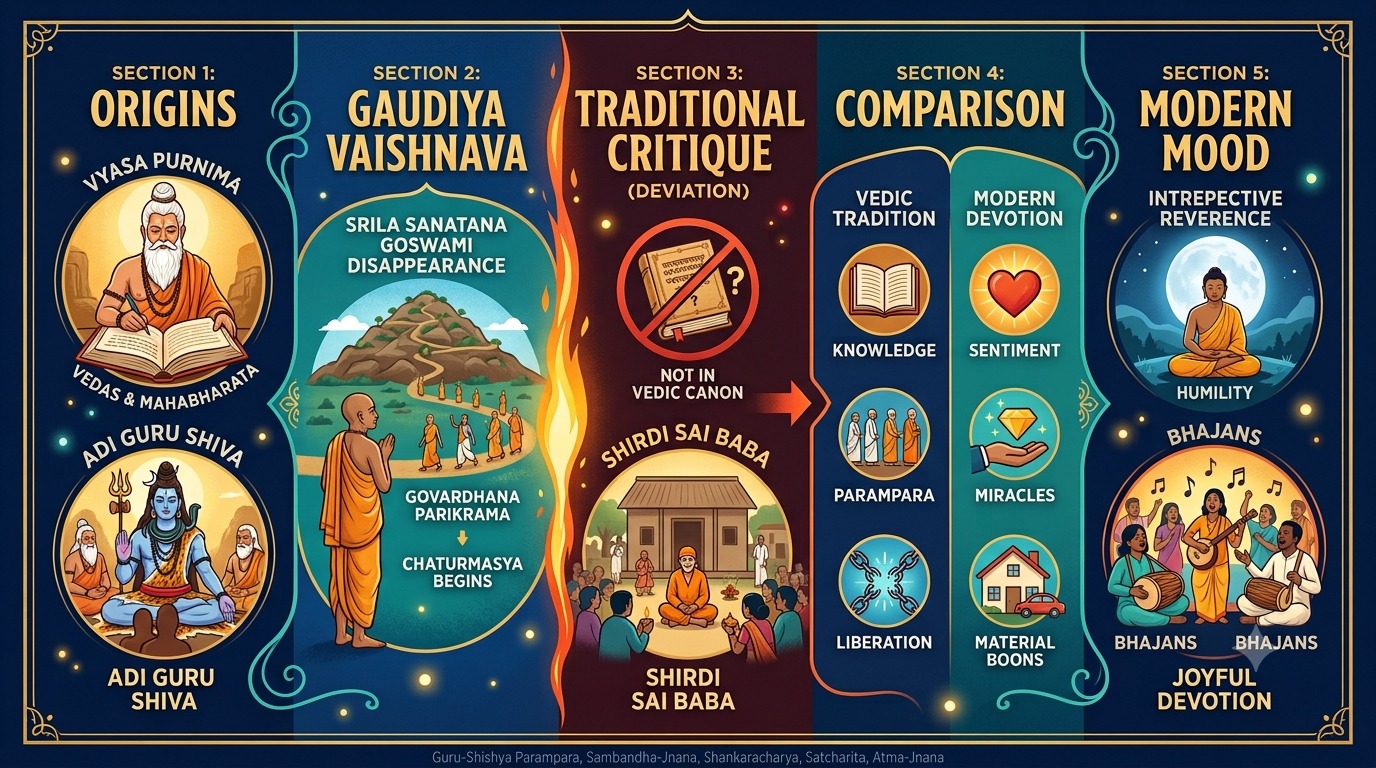
- Veda Vyasa’s Birth Anniversary (Vyasa Purnima): For Hindus, Guru Purnima marks the birth and legendary work of *Sage Veda Vyasa. Vyasa categorized the four Vedas, wrote the 18 Puranas, and composed the *Mahabharata. Because he structured sacred knowledge for humanity, he is revered as the original teacher (Adi Guru) of human wisdom.
- The First Transmission of Yoga (Lord Shiva as Adi Guru): In Yogic tradition, Guru Purnima is the day Lord Shiva became the first guru by beginning the transmission of yoga and spiritual sciences to the Saptarishis (the seven sages).
For Whom is Guru Purnima Observed?
Guru Purnima is not restricted to ascetics or monks. It is for anyone who acknowledges a mentor or teacher in their life.
- Spiritual Seekers: Disciples seeking self-realization or spiritual discipline (sadhana).
- Students & Academics: A day to honor secular teachers, professors, and academic mentors.
- Artists & Practitioners: Dancers, musicians, and martial artists who honor their Gharanas and Gurus under the ancient Guru-Shishya Parampara (teacher-student lineage).
- Family Lineage: Traditionally, parents are acknowledged as a person’s primary mentors, encapsulated in the classic phrase: “Mata, Pita, Guru, Daivam” (Mother, Father, Guru, God).
The Mood of the Festival: Reverence Meets High Energy
The atmosphere of Guru Purnima is a blend of introspective reverence and vibrant celebration.
Because it coincides with the full moon (Purnima), the festival carries deep symbolic and psychological weight. In Ayurvedic and spiritual traditions, the full moon represents the peak of emotional and mental energy. The mood is characterized by:
- Humility and Surrender: Disciples reflect on their progress and offer their ego at the feet of wisdom.
- Joyful Devotion: Temples and ashrams buzz with bhajans (devotional songs), community feasts (Annadanam), and floral decorations.
- Quiet Contemplation: Night-long meditation or “moon bathing” under the full moon to calm the mind and gain clarity.
How to Celebrate Guru Purnima: Traditional Rituals
If you want to observe Guru Purnima authentically, here are the step-by-step traditions practiced across India and the global diaspora:
- Morning Purification: Begin the day early with a bath, wearing clean traditional attire.
- Guru Puja / Padapuja: Disciples perform a ceremonial offering (Puja) to their guru’s feet or Padukas (sacred sandals) as a sign of respect and surrendering the ego.
- Vyasa Puja: Reciting texts compiled by Veda Vyasa, such as the Bhagavad Gita or Srimad Bhagavatam.
- Fasting (Vrat):** Many keep a day-long fast, consuming only water or fruits until evening prayers.
- Acts of Service (Seva & Annadanam):** Offering free food, clothing, or charity to those in need—a core teaching of almost every spiritual tradition.
- Expressing Personal Gratitude: Simply reaching out to teachers, parents, or mentors to say thank you.
Gaudiya Vaishnavas approach and observance
While the broader Indian culture celebrates Guru Purnima as a day of general guru-worship, Gaudiya Vaishnavism approaches the day with a distinct, deeply nuanced perspective centered on their specific lineage (Guru-Parampara), scriptural history, and sacred observances.
1. The Disappearance of Srila Sanatana Goswami
For Gaudiya Vaishnavas, Guru Purnima (Ashadha Purnima) is primarily sacred because it marks the disappearance day of Srila Sanatana Goswami, the senior-most of the Six Goswamis of Vrindavan.
- *The Guru of *Sambandha-Jnana:* Sanatana Goswami is revered as the spiritual teacher who established *Sambandha-Jnana—the foundational understanding of the soul’s eternal relationship as a servant of Lord Krishna.
- Govardhana Parikrama Tradition: It is said Sanatana Goswami departed this world on Guru Purnima day while residing near Govardhana Hill. Because he used to circumambulate Govardhana daily, hundreds of thousands of Gaudiya devotees observe Guru Purnima by performing Govardhana Parikrama (barefoot walking around the sacred hill) in Vraja to honor his memory.
- Special Pujas: In temples (especially the historic Sri Sri Radha Madana-Mohana temple in Vrindavan and ISKCON centers globally), special Abhishekam (bathing ceremony), pushpanjali (offering of flowers), and lectures on his literary works like the Brihad-Bhagavatamrita and Hari-bhakti-vilasa are conducted.
2. Honor to Srila Veda Vyasa (Vyasa Purnima)
Because Guru Purnima is traditionally *Vyasa Purnima—the birth anniversary of Sage Veda Vyasa—Gaudiya Vaishnavas honor Vyasa as the *Shakti-Avesha Avatara (empowered incarnation) who compiled the Vedas, Upanishads, and the ultimate Purana: the Srimad-Bhagavatam.
- They recite prayers acknowledging Veda Vyasa as the original compiler of devotional knowledge.
- Any authentic spiritual master in the Gaudiya lineage is considered a transparent via-medium representing Srila Vyasadeva. Therefore, a Gaudiya guru’s seat of teaching is always called the Vyasasana.
3. The Beginning of Chaturmasya Vrata
Guru Purnima marks the official beginning of Chaturmasya (the four-month holy period during the monsoon season) under the Purnimanta calendar system.
Gaudiya Vaishnavas take vows (vratas) on this day to increase their spiritual discipline over the next four months. Typical practices starting on this day include:
- Increasing the daily standard of chanting the Hare Krishna Maha-Mantra.
- Restricting certain foods month-by-month (e.g., abstaining from leafy green vegetables during the first month).
- Spending more time studying scriptures like the Chaitanya Charitamrita and Bhagavad-gita.
4. How Diksha or Siksha Guru Worship Doesn’t Fit In
Historically and structurally, Gaudiya Vaishnavas do not make Guru Purnima the primary day for personal guru worship.
- Vyasa Puja on the Guru’s Appearance Day: In the Gaudiya tradition (especially reinforced by Srila Bhaktisiddhanta Sarasvati Thakur and Srila A.C. Bhaktivedanta Swami Prabhupada), the personal ceremony of honoring one’s spiritual master is called *Vyasa Puja, and it is celebrated on the *specific birth anniversary (Appearance Day) of that particular Guru.
- Why the distinction? Srila Prabhupada once noted that while general groups use Guru Purnima once a year for generic offerings, Gaudiya disciples direct their personalized, annual gratitude (Vyasa Puja) to their specific spiritual master on his appearance day.
- Celebration on Guru Purnima: On Guru Purnima itself, Gaudiya Vaishnavas observe the day by glorifying the entire Guru-Parampara (discipleship succession leading back to Lord Chaitanya and Lord Krishna), reading scriptures, chanting Kirtan, and offering prayers to Srila Sanatana Goswami and Veda Vyasa.
The Pivot: Sai Baba Worship & Modern Guru Devotion
If you visit a major temple complex or search social media on Guru Purnima today, you’ll notice something striking: the festival is dominated by Shirdi Sai Baba and living spiritual figures, often eclipsing Sage Veda Vyasa altogether.
How did an ancient Vedic homage to a scriptural compiler morph into widespread saint worship?
1. The Shirdi Sai Baba Phenomenon
In the late 19th and early 20th centuries, Shirdi Sai Baba emerged as a symbol of unity, blurring the lines between Hindu and Islamic spiritual traditions. Historical records from the Shirdi Saibaba Sansthan Trust note that around 1908, devotees in Shirdi asked Sai Baba for permission to perform formal worship to him on the full moon day. Baba eventually allowed them to initiate Vyasa Puja in his presence. Over time, Shirdi Sai Baba became the default face of Guru Purnima for millions, making Shirdi one of the largest pilgrimage destinations during Ashadha Purnima.
2. The Rise of Personal “Living Gurus”
Ancient Vedic traditions emphasized honoring the principle of knowledge and the lineage of texts. However, human devotion naturally craves a tangible, living presence. Modern movements—ranging from Sathya Sai Baba to contemporary gurus and monastic orders—channeled Guru Purnima into an annual gathering where devotees flood ashrams to see their living master in person.
3. Abstract Knowledge vs. Accessible Faith
Sage Vyasa’s contribution is intellectual and foundational: Sanskrit grammar, structural codification of the Vedas, and epic literature. For the average person, connecting with a personal saint like Sai Baba—who promises immediate help, emotional solace, and accessible teachings—feels far more direct than studying ancient Vedic commentary.
4. Commercialization and Modern Guru Culture
While modern guru celebrations foster massive community service and charity, critics point out that the shift has sometimes diluted the festival’s original intent. In some circles, the focus has moved from self-realization and hard spiritual effort (sadhana) toward grand events, personality cults, and unquestioning idolization.
how Guru worship is to be conducted (Vidhi) and what must strictly be avoided (Nishedha).
Part 1: How Guru Worship MUST Be Done (The Do’s)
1. Approach with Humility, Submissive Inquiry, and Service
Tadviddhi pranipaten pariprashnena sevaya.
Upadekshyanti te gyanam jnaninas tattva darshinah
“Learn the truth by approaching a spiritual master. Inquire from him submissively and render service unto him. The self-realized souls can impart knowledge unto you because they have seen the truth.”
— Bhagavad Gita (4.34)
- Key Directives: True worship begins with three internal prerequisites: Pranipata (bowing without ego), Pariprashna (sincere, non-argumentative questioning), and Seva (selfless service).
2. Focus on the Sacred Feet (Paduka) and Instructions (Vakya)
Dhyanamoolam Gururmurthy Poojamoolam Guruh Padam.
Mantramoolam Gururvakyam Mokshamoolam Guruh Kripa॥
“The root of meditation is the Guru’s form; the root of worship is the Guru’s lotus feet; the root of mantra is the Guru’s spoken word; and the root of liberation is the Guru’s grace.”
— Guru Gita / Skanda Purana
- Key Directives: Authentic Guru Puja involves Padapuja (worshiping the Guru’s feet/sandals) and treating the Guru’s instructions (Guru-Vakya) as sacred scripture.
3. See the Guru as a Transparent Medium to the Divine
Acharya Maa Vijaniyaan navamanyet Karhichit.
Na mortal buddhyasuyet sarvadevmayo guruh
“One should know the Acharya (Spiritual Master) to be Myself and never disrespect him in any way. One should not envy him, thinking him an ordinary mortal, for he is the representative of all the demigods.”
— Srimad Bhagavatam (11.17.27)
- Key Directives: The Guru is to be worshiped not as an independent creator of a new philosophy, but as an Asraya-Vigraha—the divine representative teaching service to the Supreme.
4. Recognize the Original Discipled Lineage (Veda Vyasa / Parampara)
Namostu te Vyas Vishalbuddhe Fullarvindayatpatranetra.
Yen Tvaya BharatTailapurnah Prajwalito Gyanmayah Pradeepah ॥
“Salutations to Sage Veda Vyasa, possessor of vast intellect, whose eyes are like the petals of a blooming lotus, and who lit the lamp of knowledge filled with the oil of the Mahabharata.”
— Vyasa Dhyanam / Mahabharata
- Key Directives: On Guru Purnima, primary homage must be paid to Sage Veda Vyasa (the Adi Guru who compiled the Vedas) and the unbroken succession (Guru-Parampara) that preserves Vedic canon.
Part 2: How Guru Worship MUST NOT Be Done (The Don’ts)
1. Do Not Worship Unscriptural or Unauthorized Gurus
Avaishnavmukhodgirnam pootam hariamritam satyam.
“One should never listen to talks about spiritual truth or Krishna from a non-devotee or unscriptural teacher. Milk touched by the lips of a serpent has poisonous effects.”
— Padma Purana / Hari-bhakti-vilasa (1.195)
- Warning: Worshiping or hearing spiritual discourses from a leader whose life and teachings fall outside the Vedic scriptures (Shastras) is considered spiritually harmful.
2. Avoid Hypocritical or Money-Driven “Gurus”
Gurvo bahvah santi shishyavittapaharakah.
durlabaha Sadgururdevi Shishyasantapaharakah॥
“There are many gurus who plunder the wealth of their disciples, but a true Sadguru—who relieves the burning distress of the disciple’s heart—is extremely rare.”
— Kularnava Tantra (13.108)
- Warning: The Shastras strictly warn against commercialized guru culture, where followers seek material boons (miracles, money, worldly gains) and gurus seek fame, followers, or wealth.
3. Do Not Treat the Guru as an Ordinary Material Being or Miracle-Showman
Yasya Sattviki Dheeh Syad Guru Na Naratigam.
“He who considers the spiritual master to be an ordinary human being, or who judges a saint by worldly birth, appearance, or sensational acts, possesses an ignorant (Tamasic) intellect.”
— Padma Purana
- Warning: The Shastras condemn reducing a Guru to a “miracle worker” (chamatkari). True Guru worship focuses on Atma-Jnana (self-realization and detachment), not performative magic or material solutions.
4. Never Deify a Guru Above Scriptural Principles (Shastra-Vidhi)
Yah Shastravidhimutsrijya vartate kamkartaah.
Na sa siddhima vapnoti na sukham na para gatim ॥
“He who discards scriptural injunctions and acts according to his own whimsical desires attains neither perfection, nor happiness, nor the supreme destination.”
— Bhagavad Gita (16.23)
- Warning: Performing Vedic rituals (Pujas, Abhishekam, Mantra Japa) for non-Vedic historical figures or self-proclaimed gods—bypassing scriptural injunctions—is explicitly forbidden in canonical texts.
Summary Matrix
| Principle | Correct Vedic Approach (Vidhi) | Prohibited/Deviated Practice (Nishedha) |
|---|---|---|
| Object of Worship | Sage Vyasa, Supreme Lord, and Authorized Parampara Gurus | Self-styled saints, unscriptural figures, or personality cults |
| Primary Goal | Self-Realization (Atma-Jnana) & Scriptural Study | Seeking material boons, wealth, or miracle cures |
| Attitude | Humility, Submissive Inquiry, Selfless Service (Seva) | Blind emotional sentiment, transaction, or grandstanding |
| Authority | Direct alignment with Canonical Scriptures (Shastras) | Whimsical, syncretic, or commercial practices |
Frequently Asked Questions (FAQ)
Is Guru Purnima a Hindu or Buddhist festival?
It is celebrated by Hindus, Buddhists, and Jains. Hindus honor Sage Vyasa and Shiva; Buddhists honor Lord Buddha’s first sermon at Sarnath; and Jains honor Lord Mahavira’s first disciple.
Why is Guru Purnima also called Vyasa Purnima?
Because it marks the birth anniversary of Sage Veda Vyasa, the legendary sage who compiled the four Vedas and wrote the Mahabharata.
Can I celebrate Guru Purnima if I don’t have a formal spiritual Guru?
Yes. You can direct your gratitude to sage Veda Vyasa, use the day for self-reflection, study and pray to obtain a Spiritual Guru.
Final Thoughts
“Religion without philosophy is sentiment, or sometimes fanaticism, while philosophy without religion is mental speculation.”
Guru Purnima was never meant to be a festival for personality worship or miracle-hunting. It is a day to honor the unbroken chain of truth that frees the soul from illusion.
To substitute eternal scriptural wisdom (Shastra) with popular, sentimental hero-worship is to trade a priceless diamond for a piece of colored glass. The modern trend of turning Guru Purnima into a sentimental, miracle-seeking spectacle centered on unscriptural figures is not just a benign cultural shift—it is a catastrophic dilution of spiritual science (Siddhanta).
True worship of the Guru means only one thing: Uncompromising obedience to the instructions of the scriptures and pure, unalloyed devotion to the Supreme Personality of Godhead, Sri Krishna.