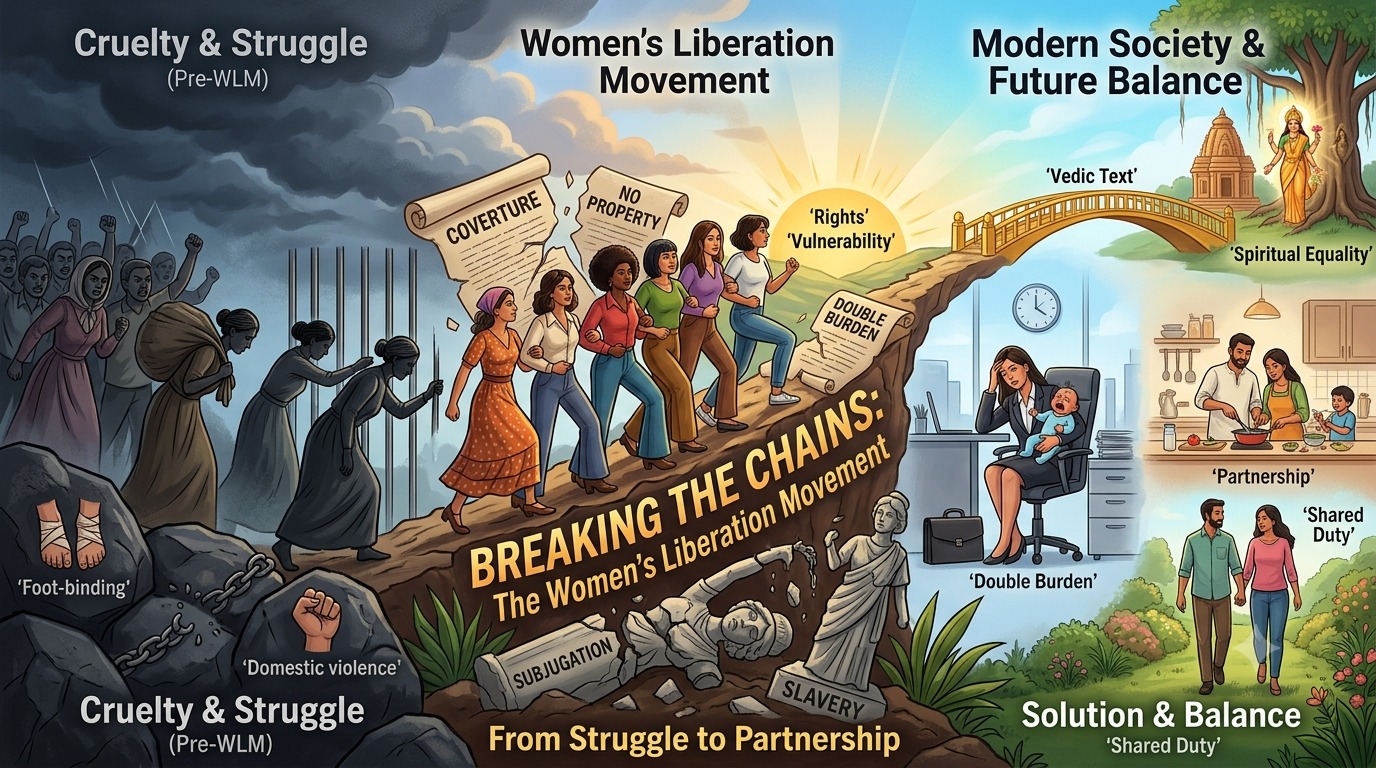
For centuries, across almost every major civilization, history was not a peaceful tapestry of traditional family values—it was a horror story for women. From ancient empires to the birth of modern western democracies, women were not viewed as partners; they were viewed as property, sub-humans, and tools of labor and reproduction.
The women’s liberation movements didn’t start out of ego, boredom, or a desire to upend society for a trend. It started as a desperate, survivalist response to millennia of structural cruelty, systemic exploitation, and absolute legal erasure.
1. The Historical Trap: Women as Sub-Humans and Property
To understand why women eventually rebelled, you have to look at how deeply rooted this mistreatment was across both Eastern and Western cultures.
The Philosophical Erasure: “Do Women Have Souls?”
For centuries, major religious and philosophical institutions actively debated whether women were even fully human.
- In Western Europe, early Christian theological debates—such as those surrounding the Council of Macon—frequently questioned the spiritual status of women.
- Prominent philosophers like Aristotle openly declared that “the female is as it were a deformed male,” lacking the full capacity for rational thought.
If a society believes half its population lacks a soul or a rational mind, any act of cruelty against them becomes justifiable.
Structural Cruelty, Punishments, and Sex Slavery
Across the globe, women’s bodies were heavily policed, and their lives were cheap.
- Western and Middle Eastern Cultures: For thousands of years, women captured in war were explicitly treated as spoils of war. From the Roman Empire to the Ottoman Empire, institutionalized sex slavery was a normalized, legal economic engine. Women had zero right to bodily autonomy; their bodies belonged to their captors or their buyers.
- Extreme Punishments: While men were often fined or exiled for societal infractions, women faced horrific physical violence for arbitrary “sins.” Practices like honor killings in various Middle Eastern and Mediterranean cultures, or the public burning and drowning of women accused of “witchcraft” or “scolding” in Western Europe, were used to enforce absolute compliance.
- Physical Mutilation: In Eastern cultures, practices like foot-binding in China systematically crippled young girls for centuries just to satisfy a aesthetic and patriarchal standard of elite marriageability.
To truly grasp why the women’s liberation movement exploded, you have to look at the cold, hard numbers. The cruelty wasn’t a collection of isolated incidents; it was a global, calculated system of violence used to keep half the population physically broken and socially paralyzed.
The historical data, locations, and methods reveal how deep the structural cruelty cut.
1. Mass Democide: The Witch Trials (Western & Central Europe)
From the 15th to the 18th century, Early Modern Europe weaponized religious hysteria to purge non-conforming women. If a woman was a widow holding property, a midwife whose delivery went wrong, or simply “disobedient,” she was labeled a witch.
- The Numbers: Historians estimate that between 40,000 and 60,000 people were executed during the European witch trials—and roughly 80% of them were women. In specific regions like Essex, England, or Switzerland, the percentage of female victims reached up to 90%.
- The Ways: Under the judicial handbook Malleus Maleficarum (“The Hammer of Witches”), torture was legally sanctioned. Women were subjected to sleep deprivation, thumbscrews, and “pricking” (driving needles into the body to find areas insensitive to pain, viewed as the Devil’s mark) before being publicly burned at the stake, hanged, or drowned.
2. Calculated Crippling: Foot-Binding (Eastern Asia / China)
Starting in the 10th century and aggressively expanding through the Qing Dynasty until it was banned in the 20th century, China practiced foot-binding to enforce submission and satisfy an aesthetic fetish.
- The Numbers: By the 19th century, it is estimated that 40% to 50% of all Chinese women had their feet bound. For the upper-class Han Chinese women, the prevalence was nearly 100%.
- The Ways: At the fragile age of 4 to 6, a young girl’s toes were deliberately broken, bent backward against the sole of the foot, and bound tightly with silk or cotton bandages to achieve a 3-inch “golden lotus” shape. The process restricted blood flow, causing flesh to rot, toenails to grow into the skin, and sometimes leading to gangrene. The specific intent was to structurally cripple women, ensuring they physically could not run away or leave the domestic sphere without assistance.
3. Murder as a Corporate Asset Protection: “Honor Killings” (Middle East & South Asia)
In highly patriarchal societies across the Middle East, North Africa, and South Asia, a woman’s body was treated as the collective currency of a family’s reputation.
- The Numbers: The United Nations Population Fund (UNFPA) estimates that at least 5,000 women and girls are murdered annually in “honor killings,” though humanitarian groups state underreporting means the true number is likely closer to 20,000. Nearly half of these documented cases historically concentrate in India and Pakistan.
- The Ways: If a girl refused an arranged marriage, was the victim of a sexual assault (which was viewed as bringing shame), or simply spoke to an unrelated man, she was executed by her own father, brothers, or uncles. The methods were brutal—stoning, strangulation, throat-slitting, or pouring acid—and local laws often treated these murders as “provoked” crimes, giving the male perpetrators light sentences or complete immunity through family-pardon loopholes.
4. Institutional Sex Slavery: Comfort Women (East & Southeast Asia)
During World War II, the subjugation of women was institutionalized at a military scale by the Imperial Japanese Army.
- The Numbers: Historians estimate that between 50,000 and 200,000 women and young girls across Korea, China, the Philippines, and occupied Dutch territories were forced into military sexual slavery.
- The Ways: Women were abducted from their homes or lured with false promises of factory jobs, then locked into military-run “comfort stations.” They were subjected to repeated, daily gang-rapes by dozens of soldiers, beaten for resistance, and heavily subjected to forced abortions and sexually transmitted infections. Only an estimated 10% to 25% survived the war.
The Modern Continuance: The Shadow Pandemic
The cruelty didn’t vanish with the advent of modern technology; it simply adapted. Today, data from international governing bodies shows that the foundational exploitation that triggered the 1960s liberation movement remains an ongoing crisis.
- Femicide by the Numbers: According to the UN Office on Drugs and Crime (UNODC), approximately *50,000 to 80,000 women and girls are killed globally every year by intimate partners or family members. That averages out to *one woman or girl killed in her own home every 11 minutes.
- Human Trafficking: In the modern global economy, women and girls still make up 61% of all detected human trafficking victims, and the vast majority of them are trafficked exclusively for forced labor and sexual exploitation.
- The Weaponization of Technology: In modern digital spaces, 1 in 10 women in the European Union report experiencing severe cyber-harassment since age 15, while studies in Arab States show up to 60% of female internet users face online violence, deepfake exploitation, and doxxing explicitly meant to silence them in public discourse.
The Modern Transition: From Legal Chattel to Economic Exploitation
As the world transitioned into the Industrial Revolution and the 20th century, the outright slavery of the past morphed into institutionalized exploitation.
The Erasure of Marriage (Coverture)
In 19th-century Western Europe and America, a legal doctrine called coverture dictated that a woman’s legal identity ceased to exist upon marriage. She could not own property, sign contracts, keep her own wages, or write a will. Her husband legally owned everything—including her.
Modern Exploitation and the Workforce
When women finally entered the modern workforce during the World Wars and the mid-20th century, society didn’t liberate them—it exploited them.
- The Double Burden: Women were forced to work grueling hours in factories and offices for a fraction of a man’s pay, only to return home to complete 100% of the domestic labor and childcare.
- Complete Vulnerability: Well into the 1970s and 1980s in the West, a woman could not open a bank account, get a credit card, or obtain a mortgage without a husband or male relative co-signing.
- Legalized Violence: Domestic abuse was viewed as a “private family matter.” Shockingly, marital rape was completely legal in most western countries for most of the 20th century (and wasn’t fully criminalized across all 50 US states until 1993).
The Catalyst: Turning Pain Into the Women’s Liberation Movement
By the mid-20th century, the pressure cooker exploded. Women across America and Europe realized that waiting for society to grant them humanity out of the goodness of its heart was a failed strategy.
The Women’s Liberation Movement of the 1960s and 70s was forged from this exact realization.
| Phase of Liberation | Core Driver | The Reality It Fought |
|---|---|---|
| The Breaking Point | Survival & Autonomy | Women were tired of being legally trapped in abusive marriages with no financial escape. |
| The Action | Collective Organizing | Women grouped into consciousness-raising circles, realizing their depressions, isolation, and abuse weren’t personal failures—they were systemic. |
| The Deliverables | Concrete Rights | They fought for the right to control their own reproductive health, equal pay laws, protection from workplace sexual harassment, and criminal domestic violence laws. |
A Basic Need, Not a Battle of Egos
When modern critics attempt to frame feminism as a movement born out of female ego, selfishness, or a desire to “ruin men,” they are rewriting history.
The Women’s Liberation Movement did not form because women suddenly developed an “ego.” It formed because individual women, sharing their stories in underground meetings, realized that their pain wasn’t an isolated domestic misfortune. It was a global, systemic war on their bodies. Organizing wasn’t a choice; it was a coordinated breakout from a historical cage. Women were being beaten without legal consequence, stripped of their children in divorces, forced into financial dependency, and treated as second-class citizens on the very earth they helped populate. It wasn’t a battle of egos; it was a desperate, hard-fought battle for the basic, fundamental right to survive.
When you lay these numbers out side-by-side, a chilling realization emerges: there was no safe geographic harbor for women. Whether you were a wife under coverture in London losing your children to an abusive spouse, or a girl in Beijing having your bones systematically broken for marriageability, the core mechanism was identical. Women were a global underclass.
Women’s Liberation Movement?
It emerged in the *late 1960s and flourished through the 1970s, primarily in the United States, the United Kingdom, and Western Europe. It is often referred to historically as the *Radical Wing of “Second-Wave Feminism.”
While previous generations of women fought quietly or focused strictly on legalistic policy, the WLM was a loud, grassroots, and confrontational rebellion. It was characterized by “consciousness-raising groups”—small, informal meetings where women gathered in living rooms to share their personal stories of abuse, workplace degradation, and marital trapdoors, realizing their private misery was actually a collective, political reality.
The movement did not have a single, definitive corporate founder; it was a decentralized explosion. However, historians pinpoint its precise catalyst to the United States between 1967 and 1969, born directly out of the frustrations of women working within the Civil Rights and Anti-Vietnam War movements.
The Catalyst
Women in left-wing, radical political groups realized that while they were fighting for the liberation of Black Americans or opposing the war, the male leaders of those very movements still treated them like secretaries, maids, and sexual objects.
Key Pioneers & Core Groups
- The First Groups (1967–1968): In 1967, activists like Shulamith Firestone and Pam Allen formed the Chicago Women’s Liberation Group. Around the same time, Clara Fraser and Susan Stern launched Radical Women in Seattle. In New York, groups like the New York Radical Women (co-founded by Firestone and Robin Morgan) took center stage.
- The Protest That Put Them on the Map (1968): In September 1968, the New York Radical Women organized a massive protest against the Miss America Pageant in Atlantic City. They famously tossed items of female oppression—braziers, high heels, girdles, and copies of Playboy—into a “Freedom Trash Can.” Contrary to popular myth, they didn’t burn the bras (the city wouldn’t give them a fire permit), but the media coined the term “bra-burning feminists,” and the Women’s Liberation Movement became a household name overnight.
- The Intellectual Voices: Authors like Betty Friedan (whose 1963 book The Feminine Mystique laid the psychological groundwork) and Gloria Steinem became the mainstream faces, while radical theoreticians like Shulamith Firestone (The Dialectic of Sex) and Kate Millett (Sexual Politics) provided the aggressive structural critiques of patriarchy.
Is It the Same as Feminism?
No, not exactly. While they are deeply intertwined, Feminism is the giant umbrella; the Women’s Liberation Movement was a specific, radical storm under that umbrella.
Think of it as a difference in scope, philosophy, and tactics:
| Attribute | Mainstream Feminism (Liberal/Reformist) | Women’s Liberation Movement (Radical) |
|---|---|---|
| The Core Philosophy | Equality: Women should have the same rights as men within the existing system (laws, banks, corporate structures). | Liberation: The existing system is fundamentally broken and patriarchal. It needs to be entirely dismantled and rebuilt. |
| The Primary Targets | Legislation, voting rights, equal pay, access to credit, and education. | Deeper cultural structures: the nuclear family, sexual objectification, domestic dynamics, and bodily autonomy. |
| The Strategy | Lobbying politicians, passing bills, and filing lawsuits (e.g., the National Organization for Women – NOW). | Direct action, public protests, grassroots community building (building the first rape crisis centers and domestic abuse shelters). |
The Ultimate Difference
Mainstream feminism asked, “How do we get women a seat at the corporate or political table?”
The Women’s Liberation Movement asked, “Why are we trying to sit at a table built on our exploitation in the first place?” They introduced the world to concepts we take for granted today, including the phrase “The personal is political”—meaning that what happens to a woman in the privacy of her bedroom, kitchen, or marriage is a direct result of political power dynamics.
Are Feminists Happy Today?
If we look at the data, the short answer is: No, not entirely. In fact, modern social sciences have highlighted a deeply troubling trend known as “The Paradox of Declining Female Happiness.”
Economic and sociological studies (such as the famous National Bureau of Economic Research paper by Stevenson and Wolfers) show that while women’s legal, educational, and professional rights have skyrocketed over the last 50 years, their overall self-reported happiness has steadily declined both in absolute terms and relative to men.
Why is a movement that achieved so many of its core goals leaving its participants feeling burned out, exhausted, and unhappy? There are three main reasons:
- The “Double Burden” (The Second Shift): Feminism successfully opened the doors to the corporate boardroom, but society failed to structurally reorganize the home. Today, millions of women work 40+ hours a week in a demanding corporate job, only to come home and perform the vast majority of unpaid domestic labor, emotional tracking, and childcare. They didn’t trade domestic isolation for professional liberation; they just added a second full-time job.
- The Commodification of Human Worth: Modern Western society measures a human being’s value strictly by their economic output (their corporate title, salary, and hustle). By adopting this hyper-capitalist framework, modern feminism inadvertently pushed the idea that being a mother, a homemaker, or a community anchor is “lesser than” corporate employment. Women are left feeling like they are failing at work if they focus on family, and failing at family if they focus on work.
- A Culture of Combat, Not Community: Because feminism was forged as a reactive political movement to fight historic oppression, its default state is defensive and adversarial. While this was necessary to break legal chains, maintaining a permanent wartime footing in private life destroys relationships. Men and women have increasingly come to view each other as competitors or political adversaries rather than allies.
Is Feminism the Answer to Those Problems?
Feminism has provided the most successful modern, legal, and political corrective to the historical atrocities women faced.
If we look at the core issues that triggered the movement—the legal erasure of women, the normalization of domestic violence, and total economic dependency—mainstream feminism successfully built the legal architecture to stop them.
- The Victories: Feminism gave women the right to vote, the right to own property independently, protection against workplace exploitation, and the criminalization of marital rape and domestic violence. It proved to be a highly effective defensive shield against a heavily rigged system.
- The Modern Debate: However, whether it is the ultimate or complete answer remains a subject of intense global debate. Critics argue that while feminism fixed the legal framework, certain radical waves fractured familial structures or left women carrying a “double burden” (the expectation to manage a full-time career while still doing the majority of domestic labor).
Essentially, feminism was an emergency surgical intervention for a dying patient—it stopped the bleeding, but society is still figuring out how to achieve long-term, balanced health.
What Do the Vedic Texts Prescribe?
Long before modern political movements, the ancient Vedic texts of India (composed roughly between 1500 BCE and 500 BCE) offered a drastically different framework. They didn’t approach gender through the lens of a political power struggle (men vs. women). Instead, they prescribed a paradigm of spiritual equality and absolute cosmic complementarity.
While later, post-Vedic eras (such as the medieval period) introduced regressive customs like child marriage, purdah (seclusion), and the denial of education, the original early Vedic era is widely considered a golden age for women’s autonomy.
1. Absolute Spiritual and Intellectual Equality
The Vedas did not view women as lacking a soul or being intellectually inferior. In fact, women had access to the highest forms of spiritual education.
- The Sages: The Rig Veda features hymns composed by at least *27 female rishis (seers), known as *Rishikas or Brahmavadinis (women who dedicated their lives to spiritual philosophy). Figures like Gargi and Maitreyi were intellectual powerhouses who publicly debated top male philosophers in royal courts on the nature of the absolute truth.
2. The Concept of Ardhangini (The Equal Half)
Vedic philosophy dictates that the Supreme Being divided itself into two equal halves to create the universe. Therefore, a man and a woman are two sides of the same exact reality.
- Partnership over Subjugation: A wife is referred to as a Sahachari (equal companion/co-traveler) rather than an Anuchari (follower).
- Ritual Necessity: In Vedic rituals, a man is forbidden from performing major sacred sacrifices (Yajnas) alone. The ceremonies are considered spiritually invalid unless his wife sits beside him as an equal partner.
3. Freedom of Choice in Marriage
Unlike the forced child marriages of later centuries, Vedic texts describe women marrying at a mature age. The practice of Swayamvara (where a woman independently chooses her own husband from a gathering of suitors) is documented and celebrated. Furthermore, the Rig Veda contains provisions allowing for the remarriage of widows.
4. The Warning of the Texts
The texts explicitly warn that mistreating women brings about the total ruin of a civilization. A famous verse from the later Manusmriti (reflecting core Vedic sentiments on the domestic sphere) states:
“Yatra naryastu pujyante ramante tatra Devata; yatraitaastu na pujyante sarvaastatrafalaah kriyaah.”
Where women are honored, divinity blossoms there; but where they are not honored, all sacred actions and efforts become entirely fruitless.
Comparison: Feminism vs. The Vedic Paradigm
The difference between the two frameworks comes down to their starting points:
- Modern Feminism was forged in fire. It is a reactive, rights-based political movement designed to yank power back from an oppressive, hostile system.
- The Vedic Ideal is a proactive, duty-based (Dharmic) spiritual framework. It assumes that both genders are divine, interdependent halves of a singular whole, where society only functions correctly when both are mutually respected.
The tragedy of history is that societies abandoned the original Vedic principles of balance, forcing women centuries later to launch the liberation movements just to reclaim their basic humanity.
The solution is not to go backward and strip women of their rights—no one wants to return to a world where domestic abuse is legal and women cannot own property. The solution is to transition from Reactive Feminism to a framework of Complementary Balance.
To fix the happiness crisis, society must integrate the legal victories of modern feminism with the timeless, foundational wisdom found in frameworks like the Vedic texts.
1. Shift from “Sameness” to “Complementarity”
Modern society confuses equality with sameness. Men and women are biologically, emotionally, and psychologically distinct. The solution is to honor the Vedic principle of Ardhangini (the interdependent, equal halves).
- The Change: Stop forcing women to behave like men in corporate cut-throat environments to be deemed successful, and stop devaluing men’s natural protective and structural instincts. True balance treats masculine and feminine energies as distinct but precisely equal in value—like two wings of a bird. A bird cannot fly with two left wings.
2. Structural Partnership in the Home
If a woman is contributing 50% to the economic survival of the household, the man must contribute 50% to the emotional and physical maintenance of the home.
- The Change: Men must step into the domestic sphere not as “helpers” doing a favor for their wives, but as equal stakeholders. Simultaneously, workplaces must evolve to support families—offering robust paternal and maternal leave, flexible hours, and ending the toxic culture of endless overtime that punishes anyone trying to raise a family.
3. Re-elevating the Sacred Status of the Domestic Sphere
We must dismantle the toxic idea that corporate labor is the only labor that matters.
- The Change: Raising balanced, emotionally secure children and maintaining a peaceful, stable home is the most critical foundation of any civilization. Society must economically and socially re-elevate the role of caregiving. Whether a man or a woman chooses to pause their career to raise children, they should be met with deep societal respect, not condescension.
4. From Rights-Based Ego to Duty-Based Dharma
Modern movements focus entirely on Individual Rights (“What do I get? How do I protect myself?”). While vital for laws, a relationship built solely on calculating individual rights will eventually collapse.
- The Change: We must return to a framework of Dharma (mutual, sacred duties). Marriage and family function beautifully when both partners are not asking “What am I getting out of this person?”, but rather, “What is my duty toward the person I love?” When a man acts out of his duty to respect, honor, and protect his partner, and a woman acts out of her duty to nurture, support, and uplift, the adversarial power struggle vanishes.
The Ultimate Takeaway
Feminism was the necessary shield to stop the historical cruelty women endured. But a shield can only protect you from an enemy; it cannot feed you, comfort you, or build a home. The solution today is to put down the weapons of political warfare and intentionally rebuild the sacred, complementary alliance between men and women based on mutual respect, shared responsibility, and spiritual equality.