Introduction: More Than a Festival of Lights
Diwali, or Dīpāvalī — literally “a row of lamps” — is one of the most widely celebrated festivals in the world. Across India and wherever the Indian diaspora has settled, homes glow with the warm, flickering light of clay dīpas, families gather, sweets are exchanged, and the night sky briefly surrenders to a thousand small suns. The popular narrative speaks of light overcoming darkness and good conquering evil. Yet for the Gauḍīya Vaiṣṇava — the devotional tradition stemming from Śrī Caitanya Mahāprabhu and carried to the world by His Divine Grace A.C. Bhaktivedanta Swami Prabhupāda — Diwali carries an even more intimate and transcendental meaning, one that reaches far beyond seasonal celebration into the very heart of loving devotion to the Supreme Lord.
The Etymology: What Does “Dīpāvalī” Mean?
The Sanskrit word Dīpāvalī is formed from dīpa (a lamp or light) and āvalī (a row or series). Together they describe “a row of lamps.” In his letter to disciples, Śrīla Prabhupāda explained the essence clearly:
“Dīpāvalī means the same thing — dīpa means candles, and bali means numerous. When numerous candles are lighted, it is called Dīpāvalī.”
This simple definition carries a profound implication. Diwali is not about a single light but about many lights — a collective illumination, where each devotee contributes their own small flame to push back the surrounding darkness. In Vaiṣṇava theology, this mirrors the idea that every soul, however humble, can carry the light of spiritual consciousness and contribute to the collective well-being of the world.
The Return of Lord Rāmacandra to Ayodhyā
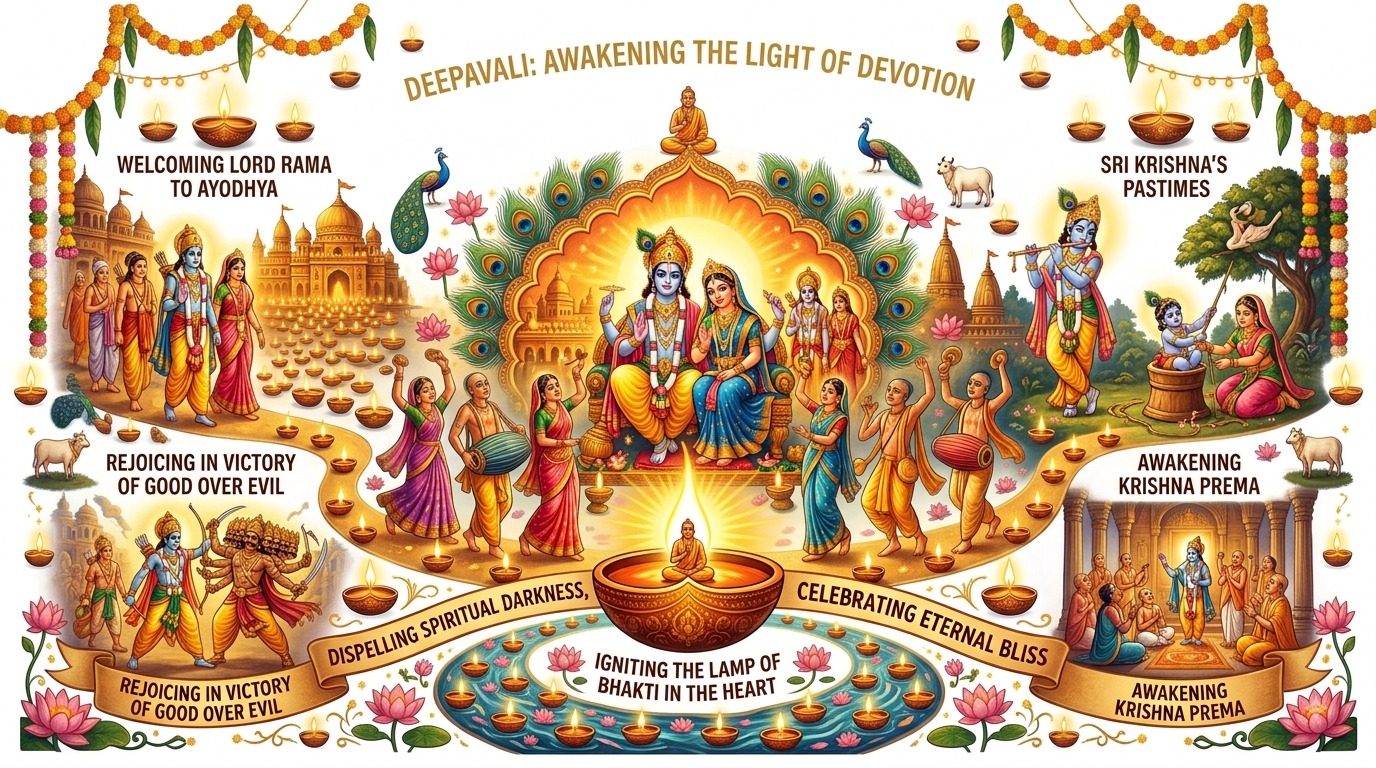
The most universally known story behind Diwali is the return of Lord Rāmacandra to His kingdom of Ayodhyā after fourteen years of exile. Having defeated the demon Rāvaṇa and rescued Sitā-devī, the Lord was welcomed back by a city overflowing with joy. The citizens, unable to contain their ecstasy, illuminated every home, every rooftop, and every pathway with lamps — transforming the dark new-moon night into a sea of light. As Śrīla Prabhupāda writes:
“This ceremony was observed by the inhabitants of Ayodhyā, the Kingdom of Lord Rāmacandra, while Lord Rāmacandra was out of His kingdom due to His fourteen years’ banishment by the order of His father. His younger step-brother Bharata took charge of the kingdom, and the day on which Lord Rāmacandra took back the charge again from His brother, and seated on the throne, this is observed as Diwali.”
For Gauḍīya Vaiṣṇavas, Lord Rāmacandra is not a mythical hero of the past but a genuine avatāra of the Supreme Lord — the same Supreme Person who later appeared as Śrī Kṛṣṇa in Vṛndāvana. Rāma’s return, therefore, is the return of the Supreme Lord to the hearts of His devotees. The lights of Ayodhyā symbolize the joy that floods the heart when the Lord, long absent due to our own spiritual forgetfulness, finally takes His rightful place upon the throne of our consciousness. Diwali invites every soul to re-light the lamp of remembrance and welcome the Lord back home.
The festival falls on the new-moon (amāvasyā) night of the month of Kārttika, the darkest night of the year. This is significant: it is precisely in the darkest hour that the light of divine remembrance shines brightest. The Vaiṣṇava message is that no matter how covered the heart may be by ignorance and material entanglement, the arrival of the Lord can transform that very darkness into a festival of light.
The Damodara Pastime: When the Supreme Was Bound by Love
For the Gauḍīya Vaiṣṇava, perhaps the most cherished Diwali connection lies not in Ayodhyā but in the pastoral village of Vṛndāvana, in a most intimate pastime of the baby Kṛṣṇa. Śrīla Viśvanātha Cakravartī Ṭhākura, quoting from the Vaiṣṇava-toṣaṇī of Śrīla Sanātana Gosvāmī, reveals in his commentary to Śrīmad-Bhāgavatam (Canto 10, Chapter 9):
“The incident of Kṛṣṇa’s breaking the pot of yogurt and being bound by mother Yaśodā took place on the Dīpāvalī day, or Dīpa-mālikā.”
The story is familiar to every devotee of Kṛṣṇa. Mother Yaśodā, the queen of Nanda Mahārāja’s household, was personally churning yogurt into butter one day, singing songs about her darling child’s playful pastimes. The milk came from cows that grazed on fragrant grasses, and Yaśodā wanted to prepare the butter herself, believing that Kṛṣṇa’s butter-stealing from the neighbors was simply because He was dissatisfied with the ordinary fare. While she churned, the pot of yogurt sitting nearby caught the mischievous eye of the crawling infant. Seizing His chance while His mother was briefly distracted, little Kṛṣṇa broke the pot, helped Himself to the fresh butter, and then, in the innocence of a child, distributed the stolen treat to the monkeys.
When Yaśodā discovered the mischief, she lovingly decided to teach her naughty child a lesson by binding Him with ropes. But here is the astonishing paradox at the heart of Gauḍīya theology: the Supreme Personality of Godhead, whom no force in the material or spiritual worlds can bind or constrain, allowed Himself to be tied to a wooden mortar by the pure love of a simple cowherd woman. No rope of yogic mysticism, no chain of cosmic power, could ever fetter the Supreme Lord — but the slender rope of a mother’s selfless affection bound Him effortlessly. This is the pastime that gives the holy month of Kārttika its alternate name, Dāmodara — dāma meaning “rope” and *udara” meaning “belly” — the Lord whose belly was encircled by mother Yaśodā’s rope.
Diwali, then, falls within the auspicious month of Dāmodara. In ISKCON temples across the world, devotees gather each evening of Kārttika to sing the Dāmodarāṣṭakam, eight beautiful verses that glorify this very pastime, and to offer a small ghee lamp to the Lord. The festival of Diwali, for the Gauḍīya Vaiṣṇava, is inseparable from this vision of the Supreme Lord as a helpless, butter-smeared child, bound not by rope but by pure, causeless maternal love.
This pastime conveys a revolutionary spiritual truth: the Supreme Lord is not won by the power of one’s austerity, intellect, or material piety. He is conquered only by love — and even the humblest soul, like a cowherd woman of Vṛndāvana, can hold the Lord captive in their heart through pure devotion.
The Lamp of Knowledge: Diwali as Inner Illumination
Beyond its historical and līlā-based meanings, Diwali carries a universal spiritual symbolism that the Gauḍīya tradition embraces fully. In the Bhagavad-gītā (10.11), Lord Kṛṣṇa personally describes how He lights the lamp of knowledge in the heart of His devotee:
“To show them special mercy, I, dwelling in their hearts, destroy with the shining lamp of knowledge the darkness born of ignorance.”
This “lamp of knowledge” (jñāna-dīpa) is no ordinary light. The Bhagavad-gītā (5.16) and the Śrīmad-Bhāgavatam (1.3.43) both compare it to the blazing sun — a light so powerful that the moment it arises, all the accumulated darkness of ignorance simply vanishes. The real Diwali, therefore, is the moment when transcendental knowledge awakens within the heart, burning away the darkness of material identification — the false sense that “I am this body, this mind, these possessions.”
The Śrīmad-Bhāgavatam (1.2.3) declares that hearing the messages and pastimes of the Supreme Lord — Kṛṣṇa-kathā — is what kindles this inner lamp. Just as the citizens of Ayodhyā lit their clay lamps to welcome Lord Rāma, every soul is invited to light the lamp of spiritual realization by hearing, chanting, and remembering the Lord’s holy names and pastimes. This is the real celebration of Dīpāvalī — not a once-a-year ritual of firecrackers and sweets, but a lifelong illumination of consciousness.
The Day After Diwali: Govardhana Puja and Annakūṭa
The Gauḍīya Vaiṣṇava observance does not end with the night of Diwali. The very next day — the first day of the bright fortnight of Kārttika — is one of the most joyous festivals in the Kṛṣṇa consciousness calendar: *Govardhana Puja, also known as *Annakūṭa, the “mountain of food.”
The pastime is described in the Śrīmad-Bhāgavatam (Canto 10, Chapter 24). The residents of Vṛndāvana, following tradition, were preparing the annual Indra-yajña — a grand sacrifice to honor Indra, the king of heaven and custodian of rains, who they believed ensured their harvests. The young child Kṛṣṇa, with innocent but authoritative reasoning, questioned this practice. He pointed out that their true sustenance came not from the demigods but from Govardhana Hill, whose fertile slopes grew the grass that fed their cows, and from the cows themselves, who gave milk and ploughed the fields. Krishna persuaded the Vrajavāsīs to redirect their offerings to Govardhana Hill and the brāhmaṇas instead.
This was no mere childhood prank. It was a profound theological statement: all benefits that the demigods bestow are ultimately sanctioned by the Supreme Lord Himself, and exclusive devotion to the Supreme Personality of Godhead is of far greater value than worship of any subordinate celestial power. Indra, enraged by what he saw as an insult, unleashed a devastating storm upon Vṛndāvana — torrential rain, hail, and flood. Krishna, the all-powerful Supreme Lord, simply lifted Govardhana Hill with the little finger of His left hand and held it aloft like a giant umbrella. For seven days, while Indra’s fury raged, the people and cattle of Vṛndāvana sheltered safely beneath the hill, gazing in wonder at their beloved Lord. Humbled, Indra ultimately bowed before Kṛṣṇa and acknowledged Him as the true master of all.
The spiritual lesson is clear: when a devotee takes complete shelter of the Supreme Lord, the Lord Himself becomes the protector, lifting the mountain of whatever burden weighs upon them. Govardhana Puja, therefore, is a festival of surrender and gratitude — the recognition that our very life, nourishment, and protection flow from the Lord’s mercy.
In ISKCON temples worldwide, Govardhana Puja is celebrated with extraordinary devotion. Devotees prepare hundreds — sometimes thousands — of vegetarian dishes, sweets, savories, and food preparations, artfully arranged into a great mountain of prasāda (sanctified food) before the Deity of Lord Kṛṣṇa. This Annakūṭa — “mountain of food” — is offered with love and reverence, mirroring the original offering of the Vrajavāsīs. A replica of Govardhana Hill is often constructed from food or cow dung, decorated with flowers and lamps. After a grand mahā-ārati, the entire offering is distributed as prasāda to the thousands who gather. This festival is deeply meaningful for children too, as it joyfully transmits the cultural and spiritual values of devotion, gratitude, and reliance on the divine.
Diwali in the Gauḍīya Calendar: A Season of Devotion
Diwali and Govardhana Puja fall within the month of Kārttika (October–November), known in the Gauḍīya tradition as the holiest month of the year. Kārttika is also called *Dāmodara month, because it is during this time that mother Yaśodā bound the Lord. The *Padma Purāṇa recommends the daily offering of a ghee lamp to Kṛṣṇa throughout this month, and so in ISKCON temples around the world, devotees offer dīpas each evening while singing the Dāmodarāṣṭakam.
The Padma Purāṇa further states that any devotional act — even the smallest — performed during the month of Kārttika yields results far greater than the same act performed at any other time. Devotees observe special vows (vratas) of increased chanting, hearing, fasting, and service. Diwali, therefore, is not an isolated celebration but the luminous heart of an entire month given over to deepened devotion.
The festival calendar of this season, as observed by Gauḍīya Vaiṣṇavas, reads like a love letter to the Lord. *Rāsa-yātrā, the night of Kṛṣṇa’s rāsa dance with the *gopīs, falls on the full-moon night of Kārttika. Diwali marks the return of Lord Rāma and the Dāmodara pastime of Kṛṣṇa. Govardhana Puja celebrates the lifting of the hill. Gopāṣṭamī commemorates Kṛṣṇa’s first day as a full cowherd boy. Each festival draws the devotee deeper into the mood of Vṛndāvana, the land where the Supreme Lord is not feared as the awe-inspiring creator of the cosmos but loved as the most beloved child, friend, and beloved.
How ISKCON Temples Celebrate Diwali
In his guidance to disciples, Śrīla Prabhupāda recommended a simple but deeply meaningful observance:
“Diwali ceremony can be observed in the temple by illuminating hundreds of candles, in different parts of the temple, and offering special prasāda to the Deity.”
This remains the standard in ISKCON temples worldwide. The observances typically include:
Temple Illumination. Temples are decorated with hundreds of candles, dīpas, and strings of lights, creating a warm, radiant atmosphere that mirrors the illuminated Ayodhyā of old. The Deities are dressed in special festival attire, often with fresh flower garlands and ornamental dīpas.
Special Ārati and Kīrtana. A grand ārati is performed, accompanied by jubilant saṅkīrtana — the congregational chanting of the holy names of the Lord. This chanting is itself a form of light, for as Lord Caitanya taught, the holy name disperses the darkness of material existence just as the sun disperses the night.
Offering of Ghee Lamps. Devotees personally offer small ghee lamps to the Deities, especially to Lord Dāmodara, remembering the bound Lord of Vṛndāvana. Each lamp is offered with a prayer that the darkness of ignorance be removed from one’s own heart and from the hearts of all living beings.
Kṛṣṇa-kathā and Discourses. Senior devotees and sannyāsīs speak on the pastimes of Lord Rāmacandra’s return and Lord Kṛṣṇa’s Dāmodara līlā, drawing out their philosophical and devotional significance. These talks are not mere storytelling — they are the spiritual transmission of the lamp of knowledge from teacher to student.
Festival Feast (prasāda).* A grand feast of sanctified vegetarian food is prepared and distributed freely to all who visit the temple, continuing the spirit of the original Vṛndāvana celebration. *Prasāda distribution is a cornerstone of ISKCON’s mission, recognizing that feeding the body while nourishing the soul is an act of compassion that embodies the Lord’s love.
Annakūṭa Preparation (the following day). The day after Diwali, the grand Govardhana Puja is held, with the Annakūṭa — a mountain of food offerings — as the centerpiece. Devotees spend hours preparing hundreds of dishes, and the sheer abundance is a testament to the generosity of the Lord and the devotion of His followers.
A Note of Clarification: The Vaiṣṇava Approach to Diwali
An honest discussion must acknowledge a nuance. Śrīla Prabhupāda, in certain contexts, noted that the Vaiṣṇava tradition does not treat Diwali as one of its core prescribed festivals in the same way it does Janmāṣṭamī or Rāma-navamī. He observed that, in the broader society, Diwali had become associated with the worship of Goddess Lakṣmī for material wealth and with the beginning of the mercantile new year — concerns that are, from a strictly spiritual standpoint, secondary.
However, Prabhupāda also clearly affirmed the spiritual legitimacy of observing Diwali as the celebration of Lord Rāmacandra’s return and as a festival connected to Kṛṣṇa’s Dāmodara pastime. He encouraged temples to illuminate candles, offer special prasāda, and use the occasion to glorify the Lord and attract people to Kṛṣṇa consciousness. The Gauḍīya approach is therefore not to reject the popular Diwali but to spiritualize it — to redirect its celebration toward the Supreme Lord and away from mere material acquisition.
This is the genius of the Vaiṣṇava tradition: it does not negate the cultural instincts of the people but elevates them. The natural human impulse to celebrate light, to gather in joy, and to exchange gifts is given its highest expression when directed toward the Supreme Person. Diwali, observed in this spirit, becomes not a compromise with materialism but a transcendence of it.
The Deeper Symbolism: Lighting the Lamp of Bhakti
When all the stories and rituals are gathered together, a unified spiritual picture emerges. The Gauḍīya Vaiṣṇava celebration of Diwali weaves together several luminous threads:
The light of the Lord’s return — as the citizens of Ayodhyā lit lamps to welcome Rāma, the soul lights the lamp of remembrance to welcome the Lord back into the heart from which He has long been absent.
The light of the Dāmodara pastime — the Supreme Lord, bound by the rope of Yaśodā’s love, reminds us that the highest spiritual attainment is not power or liberation but intimate, affectionate service to the Lord in a mood of selfless devotion.
The lamp of transcendental knowledge (jñāna-dīpa) — kindled by hearing and chanting the glories of the Lord, this light destroys the darkness of ignorance and material identification.
The light of surrender and protection — Govardhana Hill, lifted by the Lord’s own hand, stands as an eternal symbol that the devotee who takes full shelter of the Supreme is never forsaken.
The light of the holy name — the saṅkīrtana movement of Lord Caitanya, the yuga-dharma for this age, is described in the scriptures as a radiant sun that disperses the darkness of Kali-yuga. To chant Hare Kṛṣṇa, Hare Kṛṣṇa, Kṛṣṇa Kṛṣṇa, Hare Hare / Hare Rāma, Hare Rāma, Rāma Rāma, Hare Hare is to light the most powerful lamp of all.
Conclusion: Let the Real Lamp Be Lit
The Gauḍīya Vaiṣṇava vision of Diwali is ultimately a call to the soul. Beneath the clay lamps and the fireworks, beneath the sweets and the family gatherings, there is a quiet, eternal invitation: to light the lamp of love of Godhead within the heart. Lord Rāmacandra returned to Ayodhyā, and the city blazed with light. Lord Kṛṣṇa allowed Himself to be bound by mother Yaśodā’s affection, and the world learned that the Supreme is conquered by love. Lord Kṛṣṇa lifted Govardhana Hill, and the devotees learned that surrender is the highest protection.
These are not stories of a distant past. They are living realities, available to every soul who turns toward the Lord with sincerity. The darkness that Diwali dispels is not merely the darkness of one night of the year — it is the darkness of forgetfulness of our eternal relationship with the Supreme. And the light that Diwali kindles is not merely the flame of a wick — it is the blazing sun of bhakti, pure devotional service, which, once lit, never extinguishes.
This Diwali, may your home be bright with lamps. But more than that — may your heart be bright with love of Godhead. May the Supreme Lord, who allowed Himself to be bound by a mother’s love, bind your heart in the same unbreakable rope of devotion. May the Lord, who lifted Govardhana Hill to protect His devotees, lift every burden from your life. And may the holy name of the Lord, the greatest light of all, forever illuminate your path home.
Hare Kṛṣṇa. Happy Diwali.
Frequently Asked Questions (FAQ)
Do ISKCON devotees celebrate Diwali?
Yes. ISKCON temples worldwide observe Diwali by illuminating candles and lamps, offering special prasāda to the Deities, performing grand ārati and kīrtana, and glorifying the pastimes of Lord Rāmacandra and Lord Kṛṣṇa. Śrīla Prabhupāda encouraged the observance as a way to honor the Lord and attract people to spiritual life.
What is the Gauḍīya Vaiṣṇava meaning of Diwali?
For Gauḍīya Vaiṣṇavas, Diwali commemorates two principal pastimes: the return of Lord Rāmacandra to Ayodhyā after His exile, and the Dāmodara pastime of baby Kṛṣṇa being bound by mother Yaśodā. It also symbolizes the lighting of the “lamp of knowledge” (jñāna-dīpa) that destroys the darkness of ignorance, as described in the Bhagavad-gītā (10.11).
Is Diwali connected to Lord Kṛṣṇa?
Yes. According to Śrīla Viśvanātha Cakravartī Ṭhākura, quoting Śrīla Sanātana Gosvāmī’s Vaiṣṇava-toṣaṇī, the pastime of Kṛṣṇa breaking the pot of yogurt and being bound by mother Yaśodā took place on the day of Dīpāvalī. This pastime is central to the month of Kārttika (Dāmodara month) and is glorified in the Dāmodarāṣṭakam prayers sung daily in ISKCON temples during this period.
What is Govardhana Puja?
Govardhana Puja, celebrated the day after Diwali, commemorates Lord Kṛṣṇa’s lifting of Govardhana Hill to protect the residents of Vṛndāvana from Indra’s wrath. Devotees prepare an Annakūṭa — a “mountain of food” — offer it to the Lord, and distribute it as prasāda. It is one of the most important festivals in the Gauḍīya Vaiṣṇava calendar.
Why is the month of Kārttika special for devotees?
The month of Kārttika (October–November), also called Dāmodara month, is considered the holiest time of year in the Gauḍīya tradition. The Padma Purāṇa states that devotional acts performed during this month yield greatly multiplied spiritual benefit. Devotees observe it with increased chanting, hearing, fasting, and the daily offering of ghee lamps to Lord Dāmodara.
How is Diwali in ISKCON different from the general celebration?
While the general celebration often emphasizes the worship of Goddess Lakṣmī for material wealth and the exchange of gifts, the ISKCON observance centers the festival on the Supreme Lord — glorifying His pastimes, chanting His holy names, and offering everything to Him in devotion. The Gauḍīya approach does not reject the joy of Diwali but spiritualizes it, redirecting its energy toward love of Godhead.
Can I celebrate Diwali at home in a Kṛṣṇa conscious way?
Absolutely. You can light a lamp before the Lord’s picture, chant the Hare Kṛṣṇa mahā-mantra, read from the Śrīmad-Bhāgavatam or Bhagavad-gītā As It Is, prepare and offer vegetarian prasāda, and share it with family and friends. The essence is to direct the celebration toward the Supreme Lord with love and devotion.
For more on the festivals and teachings of the Gauḍīya Vaiṣṇava tradition, visit your nearest ISKCON temple or explore the Bhagavad-gītā As It Is and the Śrīmad-Bhāgavatam.