When we hear the word “art” today, most of us picture painting, music, or dance. But in ancient India, the concept of Kala (कला) went far beyond what we now call “fine arts.” The 64 Kalas — also known as Chausath Kalas or Chathusashti Kalas — were a comprehensive set of sixty-four disciplines spanning science, engineering, medicine, textile-making, administration, military strategy, language, and, yes, the performing arts. Together, they formed the vocational and practical backbone of the Gurukula education system.
In this guide, we’ll explore what the 64 Kalas are, where they come from, why they mattered, and how they remain remarkably relevant today.
What Are the 64 Kalas?
The Sanskrit word Kala (कला) translates broadly to “art,” “skill,” or “craft.” In the context of ancient Indian education, it referred to applied or vocational disciplines — practical crafts that had a direct bearing on day-to-day life. These were distinguished from Vidyas (theoretical disciplines), of which the tradition recognised eighteen major ones. Together, the 18 Vidyas and 64 Kalas constituted the complete curriculum of a student in the Gurukula.
The tradition always talks of 18 major Vidyas (disciplines of knowledge) and 64 Kalas (arts) when referring to the curriculum of ancient Bharata’s education. Where the Vidyas were concerned with philosophy, grammar, and scripture, the Kalas were concerned with livelihood, craft, and the skills that kept civilisation running.
What Does “Kala” Mean?
The root of the word Kala carries rich associations. According to tradition, the syllable ka in Kala represents *Brahma, the creator of the universe. The Sanskrit root words behind Kala translate to “doing something that makes a person happy.” So a Kala was not merely a mechanical skill — it was a discipline that brought joy, connected the practitioner to the divine, and was pursued with the dedication of a *sadhaka (spiritual seeker).
In Hindu scriptures, Lord Shiva is regarded as the master of all Kalas. In the *Lalita Sahasranama, the Devi is invoked as an embodiment of the 64 fine arts. Goddess **Saraswati, the deity of learning, is associated with these 64 Kalas and is referred to as *Kalanidhi (the treasury of arts) and Chausath Kalamayi (the one who possesses 64 arts).
Origins and Textual Sources
There is no single, universally agreed-upon list of the 64 Kalas. Different texts provide slightly different enumerations, reflecting the diversity of India’s knowledge traditions. The principal sources that mention these arts include:
- Natya Shastra by Bharatamuni — the foundational treatise on drama, dance, and performance
- Mahabharata — references to the arts appear throughout
- Bhagavata Purana — its commentary (Bhavaratha Dipika) quotes a Shaiva Tantra enumerating the traditional sixty-four Kalas
- Shukraneeti by Shukracharya — a text on statecraft that offers its own list
- Shivatattvaratnakara by Basavarajendra — an encyclopaedic work from Karnataka
- Shaiva Tantra — an early tantric source
The Story of Krishna and the 64 Kalas
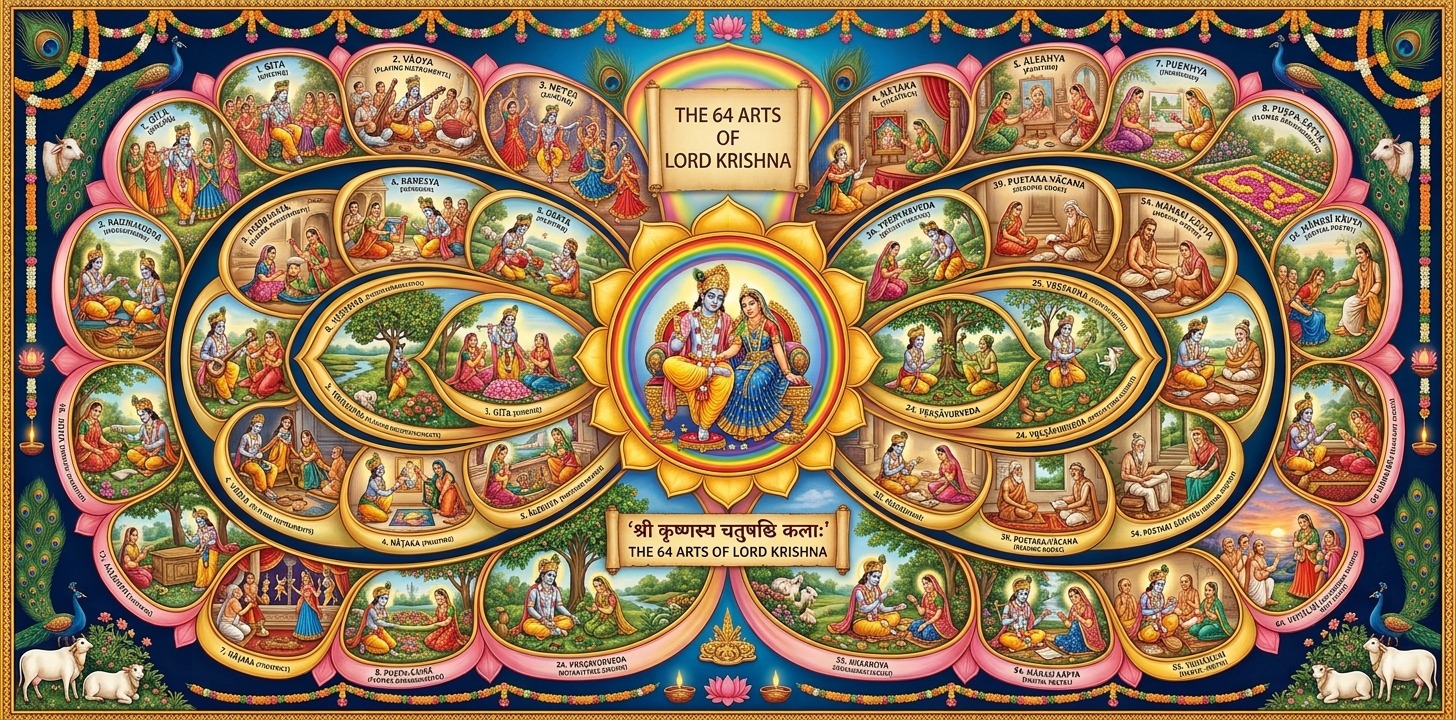
A popular tradition holds that Lord Krishna mastered all 64 Kalas. After slaying Kamsa and completing his thread ceremony (upanayana), Krishna and Balarama went to the ashram of Guru Sandipani in the city of Avanti (modern-day Ujjain). There, within a span of just 64 days, Krishna is said to have learnt the fourteen Vidyas and the sixty-four Kalas — each of which would take an ordinary person two to two-and-a-half years to master.
This story underscores how highly the tradition valued these arts: mastery of the 64 Kalas was considered a mark of a truly complete and cultured individual.
The Complete List of 64 Kalas
Below is the widely cited enumeration based on the Kamasutra of Vatsyayana, with Sanskrit terms and their meanings. To make this list more accessible, the arts have been grouped into thematic categories.
Fine and Performing Arts
| No. | Sanskrit Term | Description |
|---|---|---|
| 1 | Geeta | The art of singing |
| 2 | Vadya | Playing musical instruments |
| 3 | Nritya | The art of dancing |
| 4 | Natya | Acting, dramatics, and theatrical performance |
| 5 | Alekhya | Painting, drawing, and calligraphy |
| 6 | Visheshakacchedya | Painting the face and body with colour and designs |
| 7 | Tandula-kusuma-bali-vikara | Preparing decorative offerings from rice and flowers |
| 8 | Pushpastarana | Making a bed or covering of flowers |
Beauty, Adornment, and Personal Care
| No. | Sanskrit Term | Description |
|---|---|---|
| 9 | Dashana-vasananga-raga | Cleansing teeth, dyeing clothes, and painting the body |
| 10 | Mani-bhumika-karma | Setting precious stones and laying jewelled groundwork |
| 11 | Shayana-rachana | Preparing and arranging a bed |
| 12 | Malya-grathana-vikalpa | Designing and weaving garlands and wreaths |
| 13 | Sekharapida-yojana | Setting the coronet or head ornament |
| 14 | Nepathya-yoga | Dressing and costuming in the tiring room |
| 15 | Karnapatra-bhanga | Decorating the ear, including the tragus |
| 16 | Sugandha-yukti | The practical application of aromatics and perfumes |
| 17 | Bhushana-yojana | Applying and setting ornaments and jewellery |
| 18 | Utsadana | Healing and cleansing a person with perfumed preparations |
| 19 | Kesa-marjana-kausala | The art of combing and dressing hair |
Culinary Arts
| No. | Sanskrit Term | Description |
|---|---|---|
| 20 | Citra-sakapupa-bhakshya-vikara-kriya | Preparing varieties of delicious food and savouries |
| 21 | Panaka-rasa-ragasava-yojana | Preparing palatable drinks and tinging draughts with colour |
Textiles, Needlework, and Crafts
| No. | Sanskrit Term | Description |
|---|---|---|
| 22 | Suci-vaya-karma | Needlework, decorative sewing, and weaving |
| 23 | Tarku-karma | Spinning yarn with a spindle |
| 24 | Vastra-gopana | Enhancing and beautifying the appearance of cloth |
Music and Water Arts
| No. | Sanskrit Term | Description |
|---|---|---|
| 25 | Udaka-vadya | Playing music using water-filled pots as instruments |
| 26 | Udaka-ghata | The art of splashing and manipulating water |
Entertainment and Recreation
| No. | Sanskrit Term | Description |
|---|---|---|
| 27 | Aindra-jala | Juggling and stage illusions |
| 28 | Hasta-laghava | Sleight of hand and magic tricks |
| 29 | Sutra-krida | Puppetry — playing with thread-operated figures |
| 30 | Balaka-kridanaka | Entertaining children with toys and games |
| 31 | Prahelika | Making and solving riddles |
| 32 | Natikakhyayika-darsana | Storytelling and enacting short plays and anecdotes |
| 33 | Dyuta-visesha | Knowledge of specific types of games and gambling |
| 34 | Akarsha-krida | Playing with dice or magnets |
Language, Literature, and Communication
| No. | Sanskrit Term | Description |
|---|---|---|
| 35 | Durvacaka-yoga | Reciting verses in a way that is difficult for others to repeat |
| 36 | Pustaka-vacana | The art of reciting and reading books aloud |
| 37 | Kavya-samasya-purana | Solving enigmatic verses and poetic riddles |
| 38 | Manasi kavya-kriya | Composing verse extempore, especially on stage |
| 39 | Abhidhana-kosha-cchando-jnana | The use of lexicography and poetic metres |
| 40 | Desa-bhasha-jnana | Knowing provincial dialects and languages |
| 41 | Akshara-mushtika-kathana | Talking with fingers — sign language and coded gestures |
| 42 | Samvacya | The art of conversation |
Science, Engineering, and Medicine
| No. | Sanskrit Term | Description |
|---|---|---|
| 43 | Takshana | Carpentry and woodworking |
| 44 | Vastu-vidya | Architecture and engineering |
| 45 | Dhatu-vada | Metallurgy — working and smelting metals |
| 46 | Mani-raga jnana | Identifying, tinting, and grading jewels and gems |
| 47 | Raupya-ratna-pariksha | Testing silver and precious jewels |
| 48 | Akara jnana | Mineralogy and knowledge of mines |
| 49 | Vrikshayur-veda-yoga | Herbal medicine — treating illness with plants |
| 50 | Yantra-matrika | Mechanics and mechanical engineering |
| 51 | Kriya-vikalpa | Designing a literary work or formulating a medical remedy |
Military and Strategic Arts
| No. | Sanskrit Term | Description |
|---|---|---|
| 52 | Pattika-vetra-bana-vikalpa | Designing shields, canes, and arrows |
| 53 | Citra-yoga | Herbal preparations to weaken the enemy |
| 54 | Mlecchita-kutarka-vikalpa | Knowledge of foreign languages and fabricating deceptive arguments to subvert adversaries |
| 55 | Mesha-kukkuta-lavaka-yuddha-vidhi | Knowledge of animal combat — rams, cocks, and birds |
Animal Training and Nature
| No. | Sanskrit Term | Description |
|---|---|---|
| 56 | Suka-sarika-pralapana | Training and understanding parrots and mynahs |
| 57 | Dharana-matrika | The use of amulets and talismans |
Administration and Statecraft
| No. | Sanskrit Term | Description |
|---|---|---|
| 58 | Vainayiki vidya | Enforcing discipline and guiding conduct |
| 59 | Vaijayiki vidya | The art of gaining victory — strategy and statecraft |
Spiritual and Esoteric Arts
| No. | Sanskrit Term | Description |
|---|---|---|
| 60 | Nirmiti-jnana | Interpreting signs and omens |
| 61 | Chalitaka-yoga | Building shrines and consecrated spaces |
| 62 | Vina-damuraka-vadya | Playing the lute and small drum in devotional settings |
| 63 | Vaitaliki vidya | Awakening one’s master with music at dawn |
Miscellaneous
| No. | Sanskrit Term | Description |
|---|---|---|
| 64 | Kaucumara | A specialised art associated with tantric and magical practices |
The 64 Kalas and the Ancient Education System
The ancient Bharata education model aimed at facilitating the four aims of human life — Dharma (righteousness), Artha (livelihood), Kama (fulfilment in family life), and Moksha (liberation). The 18 Vidyas addressed the theoretical and philosophical dimensions, while the 64 Kalas addressed the practical and vocational dimensions.
What stands out is that no opposition was drawn between “art” and “craft.” For the craftsman, the craft was not merely a profession — it was also a form of worship. These arts were taught by a guru to disciples through direct observation and long practice (abhyasa). The training was considered a form of tapa (austerity), and the primary virtue a student had to cultivate was ekagrata — single-pointed concentration.
Who Learnt the Kalas?
The Kalas were not restricted to any single gender or class. The Kamasutra of Vatsyayana notes that both men and women were encouraged to learn these arts. A woman versed in the Kalas, even if she found herself separated from her husband or in a foreign land, could support herself through her knowledge of these crafts. A person skilled in any of the Kalas — whether in metallurgy, carpentry, medicine, or music — was always employable.
Why the 64 Kalas Matter Today
1. They Were the World’s First Holistic Curriculum
The 64 Kalas represent one of the earliest known attempts at a holistic, multidisciplinary education. Long before modern universities began talking about STEM-plus-arts integration, the Gurukula system combined science, engineering, medicine, literature, performing arts, and life skills into a single curriculum. This integrated approach is something modern education systems are still striving to achieve.
2. They Valued Dignity of Labour
Every Kala — from carpentry and spinning to gem-cutting and cooking — was treated with equal respect as a legitimate discipline worthy of dedicated study. The craftsman was held in high esteem as a sadhaka, a devotee whose craft was a spiritual practice. This stands in sharp contrast to the hierarchies that later emerged between “intellectual” and “manual” work.
3. They Are Still Alive in India
Many of these crafts remain important means of livelihood in India today. Handloom weaving, jewellery-making, herbal medicine (Ayurveda), metallurgy, carpentry, perfumery, puppetry, and classical music and dance are all living traditions that trace their roots to this ancient framework. The continuity is remarkable — the same master-disciple (guru-shishya) mode of transmission described in ancient texts is still visible in India’s music gharanas, dance schools, and craft communities.
4. They Offer a Model for Skill-Based Education
As India and the world grapple with the gap between academic learning and employability, the 64 Kalas offer a compelling model. They were explicitly designed to make a person self-reliant — every Kala had a direct vocational application. The historian Will Durant observed: “Every mature workman was a craftsman, giving form and personality to the product of his skill and taste. Probably, no other nation known to us has ever had so exuberant a variety of arts.”
Misconceptions About the 64 Kalas
“The 64 Kalas are only fine arts”
This is the most common misunderstanding. Because Kala is often translated as “art,” people assume the list is limited to singing, dancing, painting, and music. In reality, fine arts form only a small fraction of the 64. The list includes metallurgy, mineralogy, mechanical engineering, aqueduct construction, herbal medicine, carpentry, architecture, military strategy, and foreign-language studies. Many online translations have trivialised or distorted the meanings, often drawing from colonial-era sources rather than the original Sanskrit texts.
“There is one definitive list”
As we’ve seen, multiple texts — the Kamasutra, Natya Shastra, Shukraneeti, Bhagavata Purana, and others — each give slightly different enumerations. The number 64 is consistent, but the specific items vary. This reflects the diversity and regional adaptability of the tradition rather than any contradiction.
“They are outdated”
While some Kalas (such as awakening a master with dawn music) may seem antiquated, the vast majority map directly onto modern professions: metallurgy, mineralogy, herbal medicine, architecture, textile design, gemology, lexicography, and mechanical engineering. The frameworks may have evolved, but the disciplines themselves are very much alive.
Conclusion
The 64 Kalas are a testament to the extraordinary breadth and sophistication of ancient India’s educational vision. They remind us that true education is not about narrow specialisation, but about developing the full range of human capability — intellectual, creative, practical, and spiritual. In a world that increasingly values interdisciplinary thinking, the Chausath Kalas feel less like a relic of the past and more like a blueprint for the future.
Whether you are a student of history, a practitioner of any Indian art form, or simply curious about the depth of India’s knowledge traditions, the 64 Kalas offer a fascinating window into a civilisation that saw no separation between skill, beauty, and the pursuit of the divine.
Sources and Further Reading
- Natya Shastra of Bharatamuni — foundational treatise on performance arts
- Bhagavata Purana (Bhavaratha Dipika commentary) — quotes a Shaiva Tantra listing the 64 Kalas
- Shukraneeti Sara of Shukracharya — provides an alternative enumeration
- Shivatattvaratnakara of Basavarajendra — encyclopaedic source from Karnataka
- Dharmawiki, “64 Kalas (चतुःषष्टिः कलाः)” — scholarly overview with Sanskrit terms
- Sanskriti Magazine, “64 Kalas and 14 Vidyas of Ancient India”
- Living Smartly, “64 Kala Explained: Fine Art plus skills, crafts and trades”