The Day of Eternal Spiritual Fortune
The Sacred Meaning of Akṣaya Tṛtīyā
Akshaya Tritiya is one of the most spiritually potent days in the Vedic calendar. The word Akṣaya means “imperishable,” “inexhaustible,” or “eternal,” while Tṛtīyā refers to the third lunar day (tithi) of the bright fortnight (śukla pakṣa) in the month of Vaiśākha.
This day is not merely auspicious—it is *self-auspicious (svayaṁ-siddha muhūrta). Unlike other days that require astrological alignment, Akṣaya Tṛtīyā inherently carries divine potency. Any spiritual activity performed on this day yields *akṣaya-phala—results that never diminish.
For practitioners in ISKCON, this day is an extraordinary opportunity to deepen bhakti and accumulate eternal spiritual merit.
Scriptural Foundations and Divine Events
Akṣaya Tṛtīyā is glorified across multiple śāstras and is associated with several transcendental events:
1. Appearance of Lord Paraśurāma
This day marks the appearance of Parashurama, the sixth incarnation of Lord Viṣṇu. His descent signifies the restoration of dharma and the protection of brahminical culture.
2. Beginning of Treta Yuga
According to Vedic cosmology, the second age, Treta Yuga, began on this day—an era known for yajña and righteousness.
3. The Akṣaya Pātra Blessing
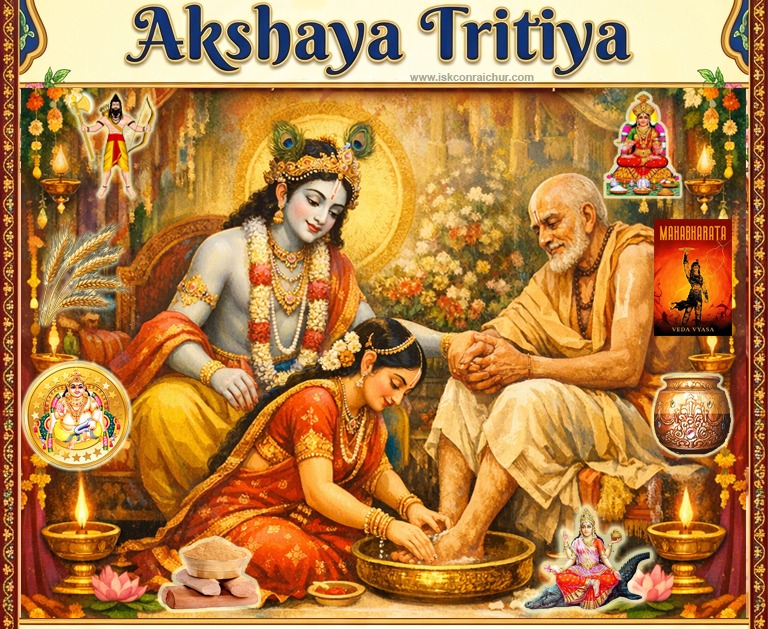
During the exile of the Pandavas, Lord Kṛṣṇa bestowed the Akṣaya Pātra upon Draupadī, a mystical vessel that supplied unlimited food. This symbolizes divine sustenance for surrendered devotees.
4. Sudāmā Brāhmaṇa’s Offering
The humble offering of chipped rice by Sudama Brahmana to Krishna is often remembered in connection with this day—demonstrating that bhakti, not opulence, attracts the Lord.
5. The Composition of the Mahābhārata Begins
On this auspicious day, Vyasa, the literary incarnation of the Lord, is said to have commenced the composition of the great epic Mahabharata. This monumental scripture, which includes the Bhagavad Gita, continues to guide humanity with timeless spiritual wisdom—truly an akṣaya gift to the world.
6. Manifestation of Barley (Yava)
Barley, one of the most sacred grains used in Vedic rituals, is believed to have appeared on this day. As a symbol of sustenance and yajña, barley represents divine provision and the principle that the Lord maintains all living beings.
7. Kubera Attains His Divine Post
On Akṣaya Tṛtīyā, Kubera was appointed as the treasurer of the demigods. His role signifies that all wealth ultimately belongs to the Supreme and is to be engaged in dharmic and devotional purposes.
8. Appearance of Annapūrṇā Devī
Annapurna Devi, the divine mother who nourishes the entire universe, is said to have appeared on this day. She embodies the truth that all food is a manifestation of divine mercy, culminating in the Vaishnava principle of honoring prasādam.
9. Commencement of Chandan Yātrā
The beautiful festival of Chandan Yatra begins on this day and continues for 21 days. During this period, the Deities are anointed with cooling sandalwood paste, offering relief from the summer heat and expressing the devotee’s loving service mood (seva-bhāva).
10. Descent of the River Gaṅgā
The sacred Ganges River is believed to have descended to Earth on Akṣaya Tṛtīyā. Flowing from the spiritual realm, Mother Gaṅgā purifies all who come in contact with her waters, symbolizing the Lord’s causeless mercy descending into the material world.
The Theology of “Akṣaya” in Bhakti
In Gaudiya Vaishnava siddhānta, the concept of akṣaya is deeply aligned with the nature of devotional service:
- Material activities yield kṣaya (temporary results)
- Spiritual activities performed in bhakti yield akṣaya (eternal benefit)
As explained in the Bhagavad Gita (2.40):
“In this endeavor there is no loss or diminution…”
Bhakti is the only path where every sincere effort is permanently preserved. Thus, Akṣaya Tṛtīyā becomes a concentrated moment where this eternal principle is especially accessible.
Importance in Gaudiya Vaishnavism
In the lineage of Chaitanya Mahaprabhu, emphasis is placed not on material prosperity, but on eternal devotional gain.
Śrīla Prabhupāda repeatedly stressed that:
- Real wealth is Kṛṣṇa consciousness
- Real auspiciousness is engagement in devotional service
- Real success is revival of our eternal relationship with Kṛṣṇa
Thus, on Akṣaya Tṛtīyā, devotees focus on increasing their spiritual assets—nāma, seva, śravaṇa, and smaraṇa.
Recommended ISKCON Practices on Akṣaya Tṛtīyā
To fully align with the mood of this day, ISKCON devotees can engage in the following activities:
1. Increased Chanting (Nāma-Japa)
Chanting extra rounds of the Hare Kṛṣṇa mahā-mantra ensures akṣaya spiritual accumulation.
2. Deity Worship and Abhiṣeka
Offer special worship to Radha Krishna with opulent offerings, flowers, and kīrtana.
3. Annadāna (Sanctified Food Distribution)
Inspired by the Akṣaya Pātra pastime, distributing prasādam multiplies spiritual merit.
4. Charity in Service of Kṛṣṇa
Donate for:
- Temple construction
- Book distribution (Bhagavad Gita As It Is)
- Cow protection (Gośālā seva)
Charity done on this day becomes spiritually inexhaustible.
5. Study of Śāstra
Read and discuss:
- Srimad Bhagavatam
- Chaitanya Charitamrita
Hearing transcendental knowledge purifies consciousness deeply on this day.
What Makes Akṣaya Tṛtīyā Unique?
| Aspect | Akṣaya Tṛtīyā | Ordinary Auspicious Days |
|---|---|---|
| Muhūrta Requirement | None (self-auspicious) | Required |
| Result of Actions | Eternal (Akṣaya) | Temporary |
| Spiritual Potency | Exceptionally High | Moderate |
| Focus | Bhakti & Dharma | Mixed (often material + spiritual) |
Common Misconception: Gold Buying
In modern society, Akṣaya Tṛtīyā is often associated with buying gold. While gold symbolizes prosperity, Gaudiya Vaishnavism reinterprets this:
- Gold = temporary wealth
- Bhakti = eternal wealth
True akṣaya-lābha is not in acquiring ornaments, but in serving the Supreme Ornament—Śrī Kṛṣṇa.
Deep Insight: Spiritual Compounding
Akṣaya Tṛtīyā can be understood as a “spiritual multiplier day”:
- One round of japa → multiplied effect
- One act of charity → multiplied merit
- One sincere prayer → deeply impactful purification
However, the key variable remains bhāva (devotional intention).
Conclusion: Invest in the Eternal
Akṣaya Tṛtīyā is a divine invitation to shift from temporary accumulation to eternal investment.
Instead of asking:
“What can I gain today?”
A devotee asks:
“How can I serve more purely today?”
By engaging in sincere devotional service on this day, one aligns with the eternal principle of bhakti—where nothing is ever lost, and every step brings us closer to Krishna.