The new-moon day is the most inward-leaning moment of the lunar month — a day of fasting, ancestor-rites, and dissolution.
1. What is Amavasya?
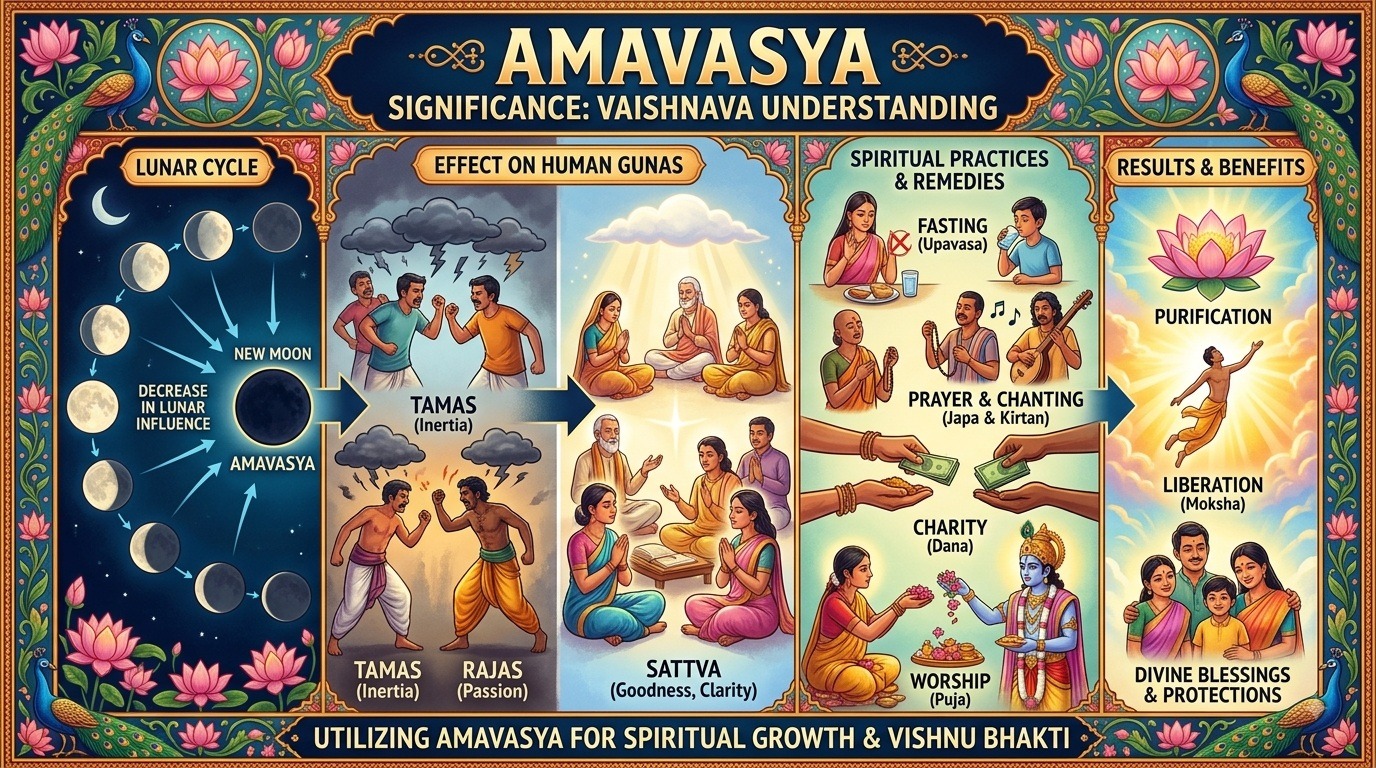
Amavasya is the lunar day of the new moon — the moment when the moon, having waned through the entire Krishna Paksha (dark fortnight), merges its light into the sun and becomes invisible in the night sky. In the amanta tradition of the Hindu lunar calendar, a month ends on Amavasya, making it a threshold: the close of one cycle before the next begins. It is the 30th and final tithi of every lunar month.
Because the moon governs the mind and emotions in Vedic thought, its absence is considered spiritually potent rather than merely empty. Several major festivals fall on Amavasya — most notably Deepavali (the new moon of Kartika) and Mahalaya Amavasya (the concluding day of Pitru Paksha).
2. The Significance of Amavasya Worship & Vrata
Amavasya is significant on three interconnected planes: ancestral, purificatory, and contemplative.
Ancestral worship (Pitru Tarpana)
Amavasya is the day most strongly associated with the propitiation of the pitrs (ancestors). The Varaha Purana recounts that when King Anarta asked why shraddha should be performed specifically on the new moon, he was told that on Amavasya the sun’s rays are obscured and the moon merges with the sun, making the subtle realms closest to the earthly plane. Offerings made then reach the ancestors most directly. Libations of water mixed with black sesame seeds (tila tarpana) and offerings of pinda (rice balls) are the core rites. It is said that shraddha performed on Amavasya ensures the ancestors’ satisfaction for one full month, while shraddha during Pitru Paksha satisfies them for a year.
Fasting and purification
People observe Amavasya vrata in the belief that fasting on this day can fulfil one’s desires and clear karmic obstructions. The fast may be nirjala (without water), phalahara (fruits and milk only), or a single simple meal of havisyanna taken after sunset. Tamasic foods — meat, onion, garlic — are avoided.
Contemplative significance
Because the life-process on the planet is said to slow down on Amavasya, it is regarded as a natural opportunity for inward integration. Where Purnima (full moon) is conducive to wellbeing and abundance, Amavasya is conducive to liberation — to recognising “what is me and what is not me.” The dark fortnight culminating in Amavasya carries a tinge of the destructive aspect of the divine: creation dissolves into stillness, and from that stillness the next cycle of light is reborn.
“If you are seeking wellbeing, Purnima is sacred. If you are seeking liberation, Amavasya is sacred.” — Sadhguru on the significance of the new moon.
3. Which Guna Does the Practice Belong To?
The Bhagavad-gita and the Puranas classify all action under the three gunas — sattva (goodness, luminosity), rajas (passion, activity), and tamas (darkness, inertia). Amavasya itself falls within the Krishna Paksha, the dark fortnight, and so the raw energetic quality of the day carries a strong tint of tamas. The whole purpose of the vrata is to counter and transcend that tamasic influence through conscious, sattvic discipline.
In practice, three modes can be seen:
- Tamasic observance — performed in fear, ignorance, or mere custom, with the motive of warding off ghosts, bad luck, or ancestral curses. The Gita calls such action “born of ignorance.”
- Rajasic observance — performed with desire for material results: progeny, wealth, social prestige, or relief from pitru dosha. This is action “born of passion,” undertaken for fruitive reward.
- Sattvic observance — performed as a duty of gratitude and remembrance, with faith, without hankering for reward, in a clean and calm state of mind. The fast becomes an aid to introspection and surrender rather than a transaction.
Scriptures therefore recommend that Amavasya be observed sattvically — in cleanliness, silence (mauna vrata is especially associated with Mauni Amavasya), vegetarian fasting, mantra, and meditation — so that the natural tamas of the dark moon is transformed into a vehicle for self-knowledge.
4. The Results of Observing Amavasya
Scriptural and traditional sources describe both material and spiritual results:
- Ancestral wellbeing: tarpana and shraddha on Amavasya satisfy the pitrs and relieve pitru dosha, bringing harmony, health, and continuity to the family lineage.
- Karmic purification: the vrata is said to burn away accumulated sins and lighten one’s karmic load, allowing one to enter the next lunar cycle with a “shuddha atma” (purified soul).
- Mental clarity: because the moon governs the mind, the absence of moonlight on Amavasya turns awareness inward, supporting meditation and the discrimination of the self from the not-self.
- Spiritual progress: for the sadhaka seeking liberation rather than mere wellbeing, Amavasya is described as a natural boon — the upward pull of energy aids dissolution of the ego.
- Fulfilment of desires: popular tradition holds that one who fasts sincerely on Amavasya with faith has one’s righteous desires fulfilled.
However, from the higher standpoint of the bhakti texts, these results — being material — are secondary. The primary fruit is the purification of consciousness that turns the heart toward the Supreme.
5. The Gaudiya Vaishnava Understanding
The Gaudiya Vaishnava tradition, rooted in the teachings of Sri Chaitanya Mahaprabhu and systematised by the six Goswamis of Vrindavan, offers a distinctive lens on Amavasya. Rather than rejecting the day’s observance, it reorients it from karma-kandiya (fruitive ritual) toward Krishna-bhakti.
Krishna as the presiding deity of the ancestors
In the Bhagavad-gita, Krishna declares His identity with the very deity the new-moon rites are addressed to:
“Pitṛṇām aryamā cāsmi” — “Among the ancestors I am Aryama.” (Bhagavad-gita 10.29)
And again:
“Pitṝṇāṁ avyayaḥ kāvaḥ” — “I am the offering to the ancestors.” (Bhagavad-gita 9.16)
For the Gaudiya Vaishnava, this is decisive: the oblation of Amavasya ultimately reaches Krishna, because He is the enjoyer of every offering (the “agrabhokta”). Whatever is given to the ancestors is accepted only when first offered to Lord Vishnu.
Food must first be offered to Vishnu
The Hari-bhakti-vilasa, the standard code of Gaudiya Vaishnava practice compiled by Sanatana Goswami, states plainly that nothing should be offered to the forefathers without first being offered to Lord Vishnu. To offer unoffered food directly to the pitrs is an offence requiring atonement. The correct procedure is to prepare food, offer it to the Deity, and then offer the maha-prasada (the Lord’s remnants) as the oblation to the ancestors.
Vaishnava shraddha in place of smarta ritual
Srila Bhaktisiddhanta Sarasvati Thakura reformed the performance of shraddha among Gaudiya Vaishnavas, replacing the conventional smarta procedure with a simplified, devotionally centred rite. In his view, the departed soul of a devotee is not a wandering preta in need of material food, but a servant of Krishna who has attained the Lord’s eternal abode. The proper “oblation” for such a soul is maha-prasada, accompanied by kirtana, Hari-katha, and the distribution of prasada to Vaishnavas.
“Persons who chant harinama do not consider enjoying fruitive results. Yet their relatives are obliged to offer bhoga to the Lord and then make an oblation with the prasada for the wellbeing of the departed soul… a sacrifice of chanting the holy name should be held.” — Srila Bhaktisiddhanta Sarasvati Thakura
He further taught that devotees in the shelter of the holy name need not fear smarta-vidhi rules, and should honour maha-prasada daily rather than observe the ritual impurity prescribed for non-devotees.
The primacy of bhakti over karma
Srila A.C. Bhaktivedanta Swami Prabhupada carried the same principle forward: the emphasis on Amavasya should be bhakti, not karma-kandiya ritual. Instead of focusing solely on material benefit, a devotee spends the new-moon day chanting the Hare Krishna maha-mantra, studying the Bhagavad-gita and Srimad-Bhagavatam, and engaging in devotional service — which alone yields real spiritual progress.
Lord Chaitanya Himself illustrated the supreme efficacy of association with a pure devotee over any ritual offering. When He met his guru, Ishvara Puri, at Gaya, He said that the moment one sees the lotus feet of a devotee, one’s forefathers are immediately liberated from all bondage — far more than by any shraddha offered at a holy place.
Amavasya in the Gaudiya calendar
In the Gaurabda (Gaudiya Vaishnava) calendar, the two fasting days of primary importance are Ekadashi (the 11th tithi of each fortnight) and the appearance days of Vishnu-tattva incarnations. Amavasya itself is not generally prescribed as a compulsory fast for Vaishnavas — but when it coincides with a festival (such as Deepavali) or borders an Ekadashi, the devotee’s observance is governed by the Vaishnava principle of yukta-vairagya: regulated, Krishna-centred detachment.
6. How a Devotee May Observe Amavasya
Combining the traditional and Gaudiya understandings, a devotee’s Amavasya might include:
- Early holy bath or shower, ideally before sunrise.
- Sattvic fasting — fruits, milk, or a simple grain-free meal, avoiding tamasic foods.
- Offering tarpana to ancestors using water and black sesame seeds, facing south, but with the understanding that the offering is sanctified through the Lord.
- Preparing food, offering it to the Deity, and offering the maha-prasada as oblation — not raw, unoffered food.
- Extra chanting of the Hare Krishna maha-mantra and reading of Bhagavad-gita or Srimad-Bhagavatam.
- Charity (daan) to Vaishnavas, cows, and the needy — the fruits of Amavasya charity are said to be akshaya (undiminishing).
The heart of the Gaudiya approach is this: Amavasya’s darkness is not something to be feared or merely propitiated. It is an invitation to dissolve the false ego and remember that the enjoyer of every offering, the destination of every ancestor, and the Lord of every new moon is Krishna Himself. Observed in that consciousness, the vrata becomes not a transaction with the subtle worlds, but a step toward pure, unalloyed devotion.
Sources: Bhagavad-gita As It Is (10.29, 9.16); Hari-bhakti-vilasa; Varaha Purana; Garuda Purana; Sri Gaudiya Kanthahara (Sraddha-tattva, ch. 16); teachings of Srila Bhaktisiddhanta Sarasvati Thakura and Srila A.C. Bhaktivedanta Swami Prabhupada; Isha Foundation article on Amavasya.