The Original Spiritual Strength of the Supreme Lord
Among all divine personalities described in the Vedic scriptures, Balarama stands as one of the most profound and misunderstood manifestations of divinity. He is not merely the elder brother of Krishna, nor only a heroic prince of the Yadu dynasty. According to the conclusions of the Vedas, Puranas, Pancharatra scriptures, and Gaudiya Vaishnava acharyas, Balaram is the original expansion of Bhagavan Himself — the source of spiritual strength, guru-tattva, and all divine service.
The name “Balarama” comes from two Sanskrit words: bala meaning spiritual strength, and rama meaning one who gives transcendental pleasure. He is therefore the reservoir of divine bliss and the giver of spiritual power required to realize Krishna. Without the mercy of Balaram, one cannot truly approach Krishna consciousness.
Balaram Tattva
Gaudiya Vaishnava theology explains that Krishna is the original Supreme Personality of Godhead, and Balaram is His first personal expansion. Though They are one in essence, they manifest different moods and functions. Krishna enjoys transcendental pastimes, while Balaram assists Him in every conceivable way.
Chaitanya Charitamrita describes Balaram as the source of the first quadruple expansions, Mahā-Sankarṣaṇa, and ultimately the origin of all Vishnu expansions. He expands further as Ananta Sesha, the divine serpent upon whom Lord Narayana reclines, and as the spiritual paraphernalia of the Lord — His throne, bed, shoes, umbrella, garments, and abode.
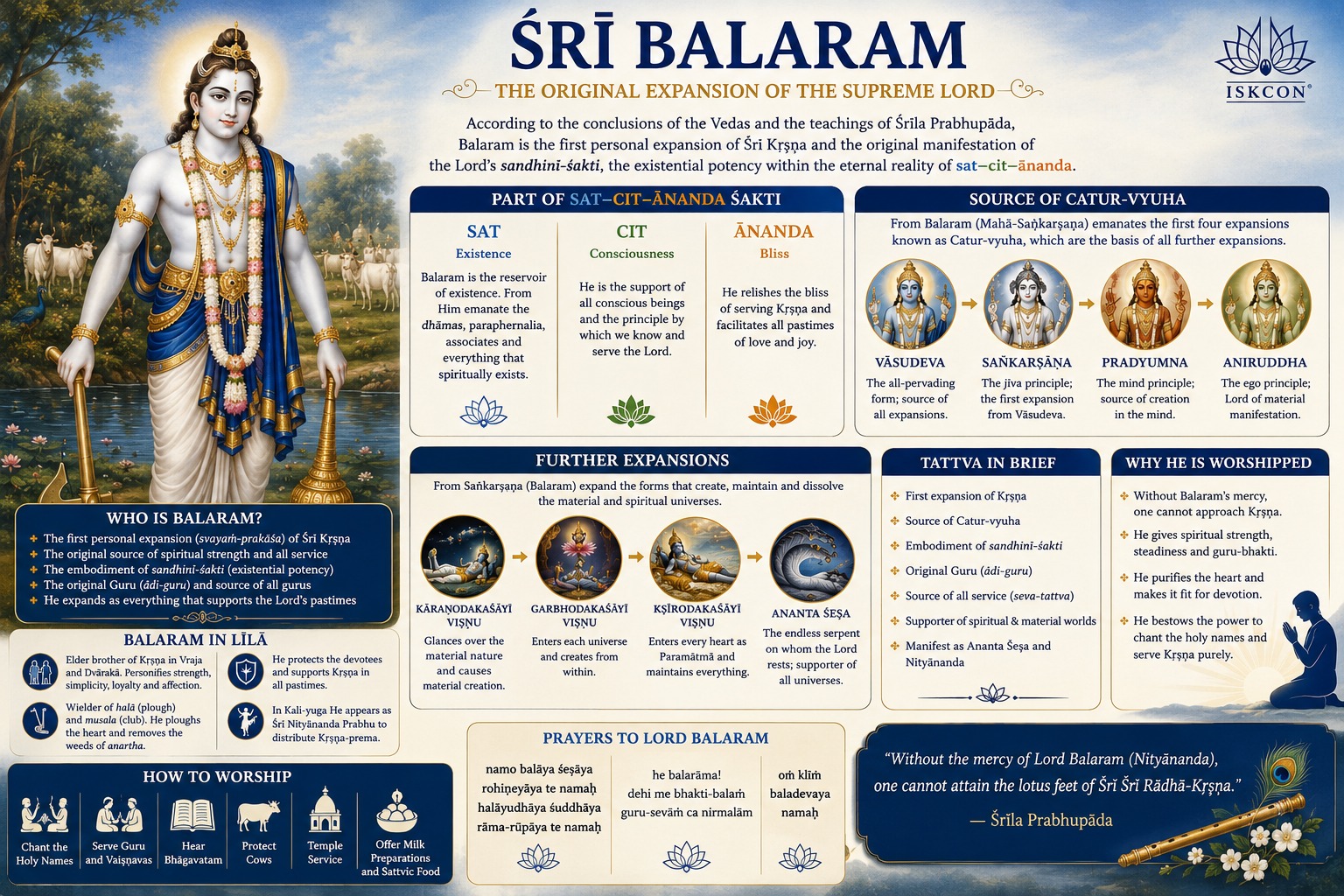
Balarama is the first personal expansion (svayaṁ-prakāśa) of Krishna and the original manifestation of the Lord’s sandhinī-śakti, the existential potency within the eternal triad of sat-cit-ānanda. While Krishna is the supreme source of all transcendental rasa, Balarama expands the spiritual substratum necessary for divine existence, service, and līlā. Through Him manifest the entirety of the spiritual and cosmic infrastructure — the dhāmas, paraphernalia, associates, and forms of divine support.
From Balarama emanates the first Catur-vyuha — Vāsudeva, Sankarṣaṇa, Pradyumna, and Aniruddha — which further expand into Nārāyaṇa and the subsequent Vaikunṭha manifestations. As Mahā-Sankarṣaṇa, He becomes the ontological basis of both the spiritual and material worlds, later expanding as Kāraṇodakaśāyī Vishnu, Garbhodakaśāyī Vishnu, Kṣīrodakaśāyī Vishnu, and Ananta Śeṣa.
Thus, Gaudiya siddhānta identifies Balarama not merely as Krishna’s brother in earthly līlā, but as the original principle of divine service (seva-tattva), guru-tattva, and the sustaining existential potency through which the Absolute manifests multiplicity without compromising nondual transcendence.
Thus Balaram represents seva-tattva — the principle of eternal loving service to Bhagavan.
A central theological conclusion of Gaudiya siddhanta is:
Krishna is the Supreme Enjoyer.
Balaram is the Supreme Servitor.
This mood of service reaches perfection in the spiritual world.
Scriptural Pramanas
The Vedic scriptures repeatedly glorify Balaram as divine.
In Srimad Bhagavatam 10th Canto, Balaram is described as possessing unlimited strength and performing superhuman activities impossible for ordinary beings. The Bhagavatam also identifies Him as Ananta Sesha.
In Bhagavad Gita 10.34 and related commentaries by Vaishnava acharyas, Krishna explains that among wielders of strength, He is strength free from selfish desire — a quality perfectly embodied in Balaram.
Chaitanya Charitamrita Ādi-līlā explains:
“Balarama is the original Sankarshana. He assumes five other forms to serve Krishna.”
The Pancharatra texts further establish Sankarshana as the source of cosmic manifestation and spiritual existence.
In Gaudiya understanding, Nityananda Prabhu is the incarnation of Balaram in Kali-yuga, distributing divine mercy freely to the fallen souls.
The Divine Biography
Balaram appeared in the Yadu dynasty as the son of Vasudeva and Rohini. Balarama Purnima is observed on the Purnima (full moon) of the month of Shravana. Before His appearance, Krishna’s internal potency mystically transferred Him from the womb of Devaki to Rohini for protection from the tyrant Kamsa. Because He was “drawn away,” He became known as Sankarshana.
From childhood, Balaram displayed extraordinary power. Alongside Krishna in Vrindavan, He performed countless enchanting pastimes. He killed powerful demons such as Dhenukasura and Pralambasura, protected the cowherd boys, and delighted the residents of Vraja with humor, wrestling, and affectionate exchanges.
Unlike Krishna’s deeply romantic mood, Balaram’s personality expresses dignity, simplicity, loyalty, and protective affection. He embodies fraternity, courage, and responsibility.
He carried a plough weapon known as hala, symbolizing cultivation — both agricultural and spiritual. Just as land must be ploughed before seeds can grow, the conditioned heart must be purified before devotion to Krishna can flourish. Therefore Balaram prepares the soul for bhakti.
The Interests and Nature
Balaram delights in simple and pastoral spiritual pleasures. He enjoys cowherding, wrestling, joking with friends, tending cows, sporting in the forests of Vraja, and serving Krishna constantly.
His white complexion symbolizes purity and spiritual clarity. Krishna often represents the sweetness of divine love, while Balaram represents strength, stability, and service.
Gaudiya acharyas explain that Balaram especially favors qualities such as:
- Simplicity
- Honesty
- Physical and spiritual cleanliness
- Service attitude
- Loyalty to guru and Vaishnavas
- Strength used for righteousness
- Humility combined with firmness
Because He is the original guru principle (adi-guru), all genuine spiritual masters represent His mercy.
Balaram and Guru-Tattva
One of the most important theological truths in Gaudiya Vaishnavism is that Balaram manifests as the spiritual master.
Without guru, Krishna cannot be understood. Without Balaram’s mercy, guru cannot be understood. Therefore all spiritual advancement begins with approaching the mercy of Balaram.
The famous prayer states:
yasya prasādād bhagavat-prasādo
“By the mercy of the spiritual master, one receives the mercy of Bhagavan.”
This descending current of mercy originates in Balaram.
For this reason, devotees pray first to Nityananda Prabhu and Balaram before attempting to approach Radha-Krishna.
How to Worship Lord Balaram
Worship of Balaram is rooted in purity, sincerity, and service. He is especially pleased not by external grandeur alone, but by honest devotional mood.
Devotees worship Balaram through:
- Chanting the holy names of Krishna
- Serving Vaishnavas
- Respecting the spiritual master
- Hearing Srimad Bhagavatam
- Simple living and purity
- Cow protection
- Temple service
- Sankirtana
- Offering white flowers, milk preparations, and simple sattvic foods
One may chant prayers such as:
“Nityananda! Balarama! Please give me spiritual strength to serve Krishna purely.”
Or the famous Gaudiya invocation:
nityānandaṁ ahaṁ naumi
“I offer my obeisances unto Lord Nityananda.”
Balaram is especially merciful to struggling souls who sincerely desire purification.
What Should One Pray to Lord Balaram?
Unlike materialistic prayers seeking wealth or prestige, prayers to Balaram are meant to awaken spiritual strength and humility.
A devotee may pray:
“O Lord Balaram, please remove the weeds of pride, lust, envy, and laziness from my heart.”
“Please give me the strength to chant sincerely.”
“Please engage me in service to guru and Krishna.”
“Please make my heart simple and truthful.”
“Please protect me from offenses against devotees.”
“Please allow me to develop genuine attachment to hearing and chanting.”
These prayers align with Balaram’s essential nature as the giver of spiritual empowerment.
Balaram in Gaudiya Vaishnava Tradition
In Gaudiya Vaishnavism, the worship of Balaram reaches its fullest expression through Nityananda Prabhu, who appeared alongside Chaitanya Mahaprabhu to distribute prema-bhakti.
Nityananda’s mercy is considered causeless and unrestricted. Just as Balaram supports Krishna’s pastimes, Nityananda supports Mahaprabhu’s sankirtana movement.
The Gaudiya acharyas repeatedly emphasize:
“Without Nitai’s mercy, one cannot attain Radha-Krishna.”
Thus devotees worship Balaram not merely historically, but as the living current of divine compassion active even today.
The Eternal Relevance of Lord Balaram
Modern civilization glorifies power without purity, influence without humility, and knowledge without service. Balaram teaches the opposite principle — that true strength means surrender to divine truth.
His life demonstrates that spiritual advancement requires grounding, discipline, loyalty, simplicity, and service. He is both infinitely powerful and infinitely humble.
For devotees, Balaram is not a distant mythological figure. He is the eternal spiritual protector guiding the soul toward Krishna.
When one sincerely seeks spiritual life, chants the holy names, serves devotees, and prays for purification, the mercy of Balaram gradually manifests within the heart as courage, steadiness, and devotion.
And through that mercy, the path to Krishna becomes illuminated forever.
Simple Prayer to Lord Balaram
namo balāya śeṣāya
rohiṇeyāya te namaḥ
halāyudhāya śuddhāya
rāma-rūpāya te namaḥ
“Obeisances unto Lord Balaram, the source of spiritual strength, Ananta Sesha, the son of Rohini, wielder of the plough weapon, pure and transcendental Lord Rama.”
Prayer for Spiritual Strength
he balarāma!
dehi me bhakti-balaṁ
guru-sevāṁ ca nirmalām
“O Lord Balaram, please grant me the spiritual strength of devotion and pure service to guru.”
Gaudiya Vaishnava Prayer to Nityananda (Balaram)
nityānandaṁ ahaṁ naumi
sarvānanda-karaṁ param
hari-nāma-pradaṁ devaṁ
avadhūta-śiromaṇim
“I bow to Lord Nityananda, who bestows supreme bliss, gives the holy name of Hari, and is the crest jewel of avadhūtas.”
Famous Nitai-Gaura Mahamantra
nitāi gaura haribol
haribol haribol
or
nityānanda! gaurāṅga!
These are often sung in kirtana to invoke mercy and purification.
Prayer for Removal of Anarthas
“O Lord Balaram, please plough my heart and remove the weeds of lust, anger, pride, envy, and illusion. Please make my heart qualified for devotion to Krishna.”
Mula Mantra of Balaram
oṁ klīṁ baladevaya namaḥ
“Obeisances unto Lord Baladeva.”
This mantra is traditionally chanted for spiritual strength, protection, steadiness in sādhana, and purification of consciousness.
Meditation on Balaram
While chanting, one may meditate on:
- The beautiful white-complexioned form of Balaram
- His blue garments
- His plough and club
- His smiling face in Vrindavan
- His affectionate service to Krishna
- His mercy as the original spiritual master
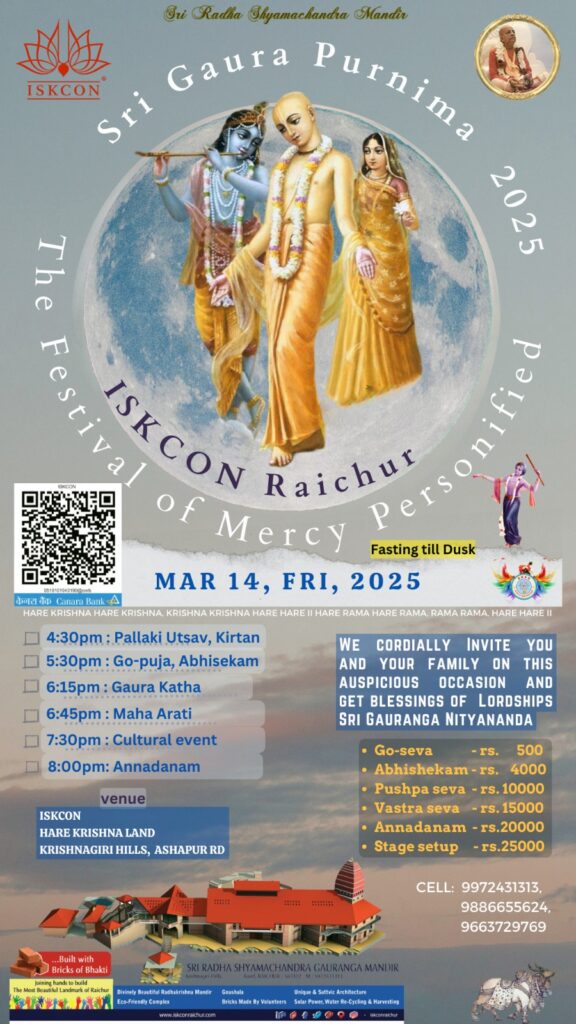
🚩Seva Opportunities
Contribute towards:
- ✨ Temple Construction
- ✨ Maha Abhishek, Annadanam, Flowers & Decorations, Goshala Seva
💰 Donation Details
Account Name: ISKCON
Bank: Canara Bank
A/c No.: 0519101043190
IFSC: CNRB0000519
🌐 Online Donations
https://give.iskconraichur.com