Reclaiming Saucha: How Chaitanya Mahaprabhu Smashed the Dark Evolution of Madi
The Rules of “Madi”: Unpacking the Sacred Logic of Brahmin Ritual Purity
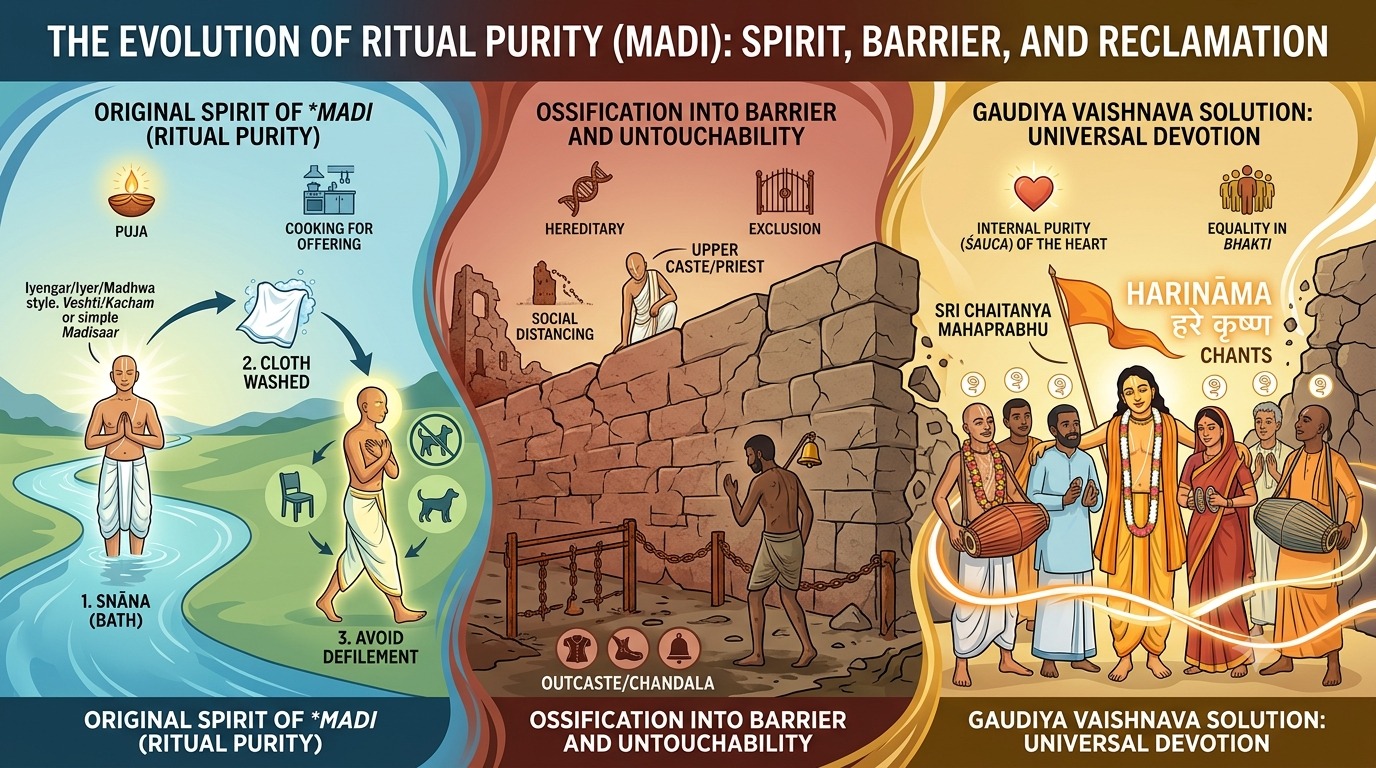
If you have ever spent time in a traditional South Indian Brahmin household—whether Iyengar, Iyer, or Madhwa—you may have witnessed a strange, quiet dance.
Someone emerges from a bath wearing freshly washed, wet-dried clothes, holding their arms close to their body, actively dodging furniture, pets, and family members. If you so much as brush their shoulder with a stray sleeve, they instantly freeze, sigh, and head back to the bathroom to wash up all over again.
This isn’t an obsession with modern germs or a personal quirk. It is Madi — the ancient, rigid practice of ritual purity that governs everything from how a kitchen runs to how temple rituals are performed.
What Exactly is “Madi”?
At its core, Madi is a temporary state of bodily, environmental, and spiritual cleanliness required before engaging in sacred activities—like cooking, offering daily prayers (puja), or entering a temple sanctuary.
Madi vs. Mailige:
- Madi: The state of pure, untainted ritual sanctity.
- Mailige / Vizhuppu: The opposite—the everyday, baseline state of physical or ritual impurity. Everyday clothes, furniture, mattresses, and unbathed bodies are naturally mailige.
The core idea of Madi operates like a *circuit: once you achieve the state of Madi, touching anything that is *mailige immediately breaks the circuit, stripping away your ritual purity instantly.
The 4 Pillars of Attaining and Keeping Madi
Achieving Madi isn’t as simple as hopping in the shower. It follows a strict procedural sequence:
| Step | Action Required | Sacred Logic |
|---|---|---|
| 1. Washing the Garment | Clothes (Veshti/Kacham for men, Madisaar nine-yard saree for women) are washed, wrung, and hung out to dry without touching non-pure lines. | Freshly washed, completely untouched cloth acts as an insulator for pure energy. |
| 2. The Purificatory Bath | A full head-to-toe bath (Snanam), often accompanied by sacred mantras. | Washes away physical and subtle impurities collected during sleep and daily life. |
| 3. Donning the Garment | Putting on the Madi Vasthram without letting it touch the floor, bath mats, or non-Madi towels. | Ensures the body is sealed in the cleansed garment immediately after bathing. |
| 4. Maintaining Isolation | Walking carefully to the kitchen or puja room while avoiding contact with anything mailige. | Keeps the “pure state” intact until the sacred duty (cooking or worship) is finished. |
Madi in the Kitchen: Food as a Sacred Offering
One of the places where Madi is most strictly observed is during cooking. In orthodox homes, food isn’t just sustenance—it is Naivedyam (an offering to the Divine) before it becomes Prasadam for the family.
To cook in Madi:
- The cook must be fully bathed and in Madi clothes.
- Water used for cooking must be freshly drawn.
- No tasting while cooking: You cannot taste food to check for salt, as saliva (Echil / Yeccha) instantly renders the entire pot impure.
- Once the food is offered to the deity, the Madi restrictions end, and the family can eat.
The Modern Dilemma: Hygiene or Social Boundary?
Today, Madi sits at an intriguing cultural crossroads:
- The Traditional / Spiritual Defense: Scholars and practitioners view Madi as an act of high personal discipline and environmental hygiene. Just as a surgeon sterilizes their hands before entering an operating room to avoid contaminating a patient, a practitioner maintains Madi to keep a sacred space uncontaminated by outside energies or dirt.
- The Social Critique: Modern sociologists and critics point out that historical applications of Madi often reinforced rigid caste boundaries and social distancing, transforming a ritual of personal discipline into a tool of social hierarchy and internal division.
In fast-paced modern life, strict Madi is rarely maintained 24/7. However, during major festivals, weddings, or ancestral rites (Shraddha), even urban, tech-savvy families return to these centuries-old rules to keep the thread of tradition intact.
In the Dharma Shastras (classical Hindu texts on code and conduct), the vernacular concept of Madi is referred to as Śauca (शौच – ritual purity) or Ācāra (आचार – right conduct).
The scriptures state that ritual acts, prayers, and cooking for offerings yield no spiritual benefit if performed without śauca. Below are the key slokas from texts like the *Manusmriti, **Bhagavad Gita, and *Apasthamba Dharma Sutra that form the scriptural foundation of Madi.
1. Conduct and Purity as the Foundation of Dharma
Before getting into specific washing rules, the scriptures establish that strict personal conduct (ācāra) and purity are the highest forms of spiritual duty for a Brahmin.
Ācāraḥ paramo dharmaḥ śrutyoktaḥ smārta eva ca |
Tasmādasmin sadā yukto nityam syādātmavāndvijaḥ ||
— Manusmriti (1.108)
Translation: “Right conduct (including rules of purity) is the highest Dharma, as taught in the Vedas and Smritis. Therefore, a twice-born (Dwija) who seeks spiritual self-realization should always remain steadfast in maintaining this conduct.”
2. Washing Clothes & Water Purification (The Core Law of Madi)
The practical execution of Madi involves using fresh water to cleanse garments and food supplies. Verse 5.118 of Manusmriti directly explains the rule of Prokṣaṇa (sprinkling water to purify large items) and Prakṣālana (washing thoroughly in water to purify garments and small items):
Adbhis tu prokṣaṇam śaucam bahūnām dhānya-vāsasām |
Prakṣālanena tv alpānām adbhiḥ śaucaṁ vidhīyate ||
— Manusmriti (5.118)
Translation: “When dealing with large quantities of grains or clothes, purification is achieved by sprinkling water over them (Prokṣaṇa); but for smaller quantities or single garments, ritual purity is established by washing them thoroughly in water (Prakṣālana).”
3. The Three Universal Standards of Pure Things
How do you know if an object, food, or garment is in a state of Madi? Sage Manu defines three conditions that render an object ritually pure for a Brahmin:
Adṛṣṭam madbhiriṇṇaktaṁ yacca vācānuśastam |
Nityam śuddham prajāpatiḥ viprāṇāṁ kalpayatpurā ||
— Manusmriti (5.127)
Translation: “The Creator ordained three things as perpetually pure for Brahmins: that on which no physical defilement is visible, that which has been washed with water, and that which is declared pure by the word of a Brahmin.”
4. Purification of the Body Before Eating or Praying
In the state of Madi, touching saliva (echil / vacchu) or bodily excretions breaks purity immediately. The Apastamba Dharma Sutra dictates that a person must cleanse themselves with water (Aacamana) after touching any impurity or before handling food:
Adbhiḥ gātrāṇi śuddhyanti manaḥ satyena śuddhyati |
Vidyātapobhyāṁ bhūtātmā buddhirjñānena śuddhyati ||
— Manusmriti (5.109)
Translation: “The physical body is purified by water; the mind is purified by truth; the soul is purified by learning and penance; and the intellect is purified by spiritual knowledge.”
5. Outer Cleanliness in the Bhagavad Gita
The Gita includes Śauca (cleanliness/purity) as one of the essential characteristics of divine nature (Daivi Sampad) and a requirement for Tapas (austerity) of the body:
Śaucam ārjavam ahiṁsā… daivīṁ sampadam abhijātasya bhārata
— Bhagavad Gita (16.2–3)Śaucam etat śārīraṁ tapa ucyate
— Bhagavad Gita (17.14)
Translation: “Purity of body, straightforwardness, non-violence… these belong to one born with divine qualities. Cleanliness of the body is declared to be the physical form of austerity (Shariram Tapas).”
How a discipline calcified into Oppression
What started as a temporary, self-imposed state of ritual focus turned into *permanent, hereditary exclusion—shifting from *”I am keeping myself pure for a specific ritual” to “You are inherently dirty by birth.”
Phase 1: The Original Logic — Fluid & Context-Based
Originally, Śauca (purity) was dynamic and situational:
- It was a state of being, not a identity.
- You entered it before cooking or praying, and you exited it when you sat down to eat or perform everyday chores.
- Everyone became “impure” (Mailige) regularly. A Brahmin who woke up, went to the bathroom, or hadn’t bathed was just as mailige as anyone else.
- Crucially, purity could be regained in 10 minutes through a bath and fresh clothes.
Phase 2: The Freeze — When Physics Became Metaphysics
Between 600 CE and 1200 CE, late Smriti commentators and medieval codifiers weaponized the logic of Madi. They took physical, biological, and spatial concepts of purity and turned them into metaphysical, hereditary truths:
[ Temporary State ] [ Permanent Caste ]
“I am holding water, “Your ancestors worked with hides,
so I must not touch so your lineage carries pollution
dusty clothes right now.” —> in its bloodline forever.”
How the Shift Happened:
- Occupational Stigma: Tasks necessary for society to function—cleaning, sewage, working with animal hides, handling corpses—were labeled “permanently polluting”.
- From Action to Bloodline: Instead of the act carrying temporary impurity, the person doing the work was declared permanently impure. Their children inherited that “pollution” at birth.
- The Madi-Mailige Binary weaponized: The very mechanism of Madi—where touching something “impure” instantly destroys your purity—was projected onto human beings. Whole communities were classified as walking “pollutants” whose mere shadow or proximity threatened the Brahmin’s ritual state.
Phase 3: The Spatial Brutality
Once purity froze into social status, the practical rules of Madi were enforced through spatial segregation and physical violence:
| The Madi Logic (Internal) | The Untouchability Application (External) |
|---|---|
| Don’t touch everyday clothes while cooking. | A Dalit person cannot walk down the street where Brahmins live. |
| Draw fresh water for the temple offering. | Deny marginalized communities access to public wells, lest they “pollute” the water. |
| Drop your Madi state gracefully if touched accidentally. | Force people to carry brooms to erase their footprints or bells to announce their presence so upper castes could dodge them. |
The Irony: Internalized Untouchability
Sociologists point out that the obsession with Madi was so intense that Brahmins applied untouchability to themselves:
- A Brahmin mother in Madi could not hug her own child.
- A Brahmin widow was forced into a permanent, lifelong state of restricted madi.
- A Brahmin male in Madi would cringe and recoil like a touch-me-not plant if his own family member accidentally brushed past him.
What began as a way to cultivate inner quiet and focus (tapas) turned outward, becoming an obsession with avoidance. It created a society terrified of touch, where physical distance was mistaken for spiritual elevation.
The Gaudiya Vaishnava tradition—founded by Sri Chaitanya Mahaprabhu in 16th-century Bengal—offered a radical spiritual solution to the rigid, ritualistic obsession with Madi (external ritual purity) and the socio-religious boundaries of caste.
Gaudiya Vaishnavism did not just critique untouchability from a social standpoint; it redefined the very ontology of purity using the highest Vedantic scriptures.
1. The Core Paradigm Shift: From External to Internal Purity
Traditional Madi relies on external boundary maintenance (water, clothes, spatial distance). Gaudiya theology, following the Srimad Bhagavatam, argues that external purity without internal devotion (bhakti) is spiritually dead.
“Even a person born in a family of dog-eaters (Chandala) is immediately purified if they take shelter of the dust of the Lord’s lotus feet, while a Brahmin devoid of devotion remains impure.”
— Srimad Bhagavatam (9.4.21)
In the Chaitanya Charitamrita, Mahaprabhu establishes that the highest cleansing agent is not river water or unbrushed silk, but the Holy Name (Harinama)**:
- Ceto-Darpaṇa-Mārjanaṁ: The first line of Mahaprabhu’s Sikshashtakam states that chanting the Holy Name cleanses the mirror of the core mind/heart (citta).
- The Root vs. The Leaf: Washing the physical body while harbouring prejudice or material ego (ahankara) is like pouring water on the leaves of a dead tree. Chanting Harinama purifies the soul (Jiva), which automatically renders the mind and senses pure.
2. Social Revolution: The Elevation of Haridasa Thakura
In medieval India, Haridasa Thakura was born into a Muslim family, making him an “outcaste” under the strict rules of orthodox ritual purity. According to traditional Madi rules, he would not even be allowed near a temple kitchen or a Brahmin’s house.
Sri Chaitanya Mahaprabhu completely subverted this structure:
- Mahaprabhu embraced Haridasa Thakura publicly, declaring his body to be more sacred than a temple sacrificial fire.
- He named him the Nāmācārya (the supreme authority on the Holy Name).
- When orthodox Brahmins complained that untouchables were chanting sacred mantras, Mahaprabhu’s close associate, Nityananda Prabhu, went into the homes of the most marginalized communities (the cobblers, fishermen, and sweepers), eating food with them and initiating them into spiritual life.
3. Deconstructing Caste through “Jīva-Svarūpa”
The theological engine behind the Gaudiya solution is the ontological identity of the soul:
$$\text{Jīvera ‘svarūpa’ haya — kṛṣṇera ‘nitya-dāsa’}$$
“The true, inherent identity of the living entity is that it is an eternal servant of Krishna.”
If the soul is an eternal servant of the Divine, then:
- Caste, gender, and social status are temporary bodily dresses (Upadhi).
- Applying rules of untouchability based on the birth of a physical body is a spiritual delusion (Maya).
Sanatana Goswami, one of the primary theologians of the tradition, codified this in the Hari-bhakti-vilasa:
tathā dīkṣā-vidhānena dvijatvaṁ jāyate nṛṇām ||
“Just as bell-metal is transformed into gold through a specific chemical process involving mercury, any human being, regardless of birth, becomes a true twice-born (Dwija/Brahmin) when initiated into pure devotional service.”
— Hari-bhakti-vilasa (2.12)
4. How Gaudiya Vaishnavism Handles Madi Today
Gaudiya Vaishnavism does not reject physical cleanliness; rather, it demotes external cleanliness to a secondary helper (Saddhana-anga) rather than an absolute spiritual metric.
| Aspect | The Orthodox Madi View | The Gaudiya Vaishnava Solution |
|---|---|---|
| Primary Source of Purity | Fresh water, untouched garments, spatial isolation. | The Holy Name, Prasadam (sanctified food), and Sanga (holy association). |
| Who can enter the kitchen/altar? | Only those born in specific Brahmin lineages who undergo physical ritual steps. | Anyone properly initiated (Diksha) who maintains personal cleanliness and devotion, regardless of birth background. |
| Handling “Contamination” | Touching an outcaste or impure object destroys your ritual state. | Bhakti is so potent that a true devotee purifies the very objects and places they touch (Tīrthī-kurvanti tīrthāni). |
| The Ultimate Goal | Maintaining personal, ritual isolation from worldly pollution. | Engaging all senses in active service (Hṛṣīkeṇa hṛṣīkeśa-sevanaṁ) to uplift society. |
By substituting hereditary purity with *devotional capacity, the Gaudiya tradition transformed *Madi from a defensive wall of exclusion into an inclusive engine of spiritual equality.