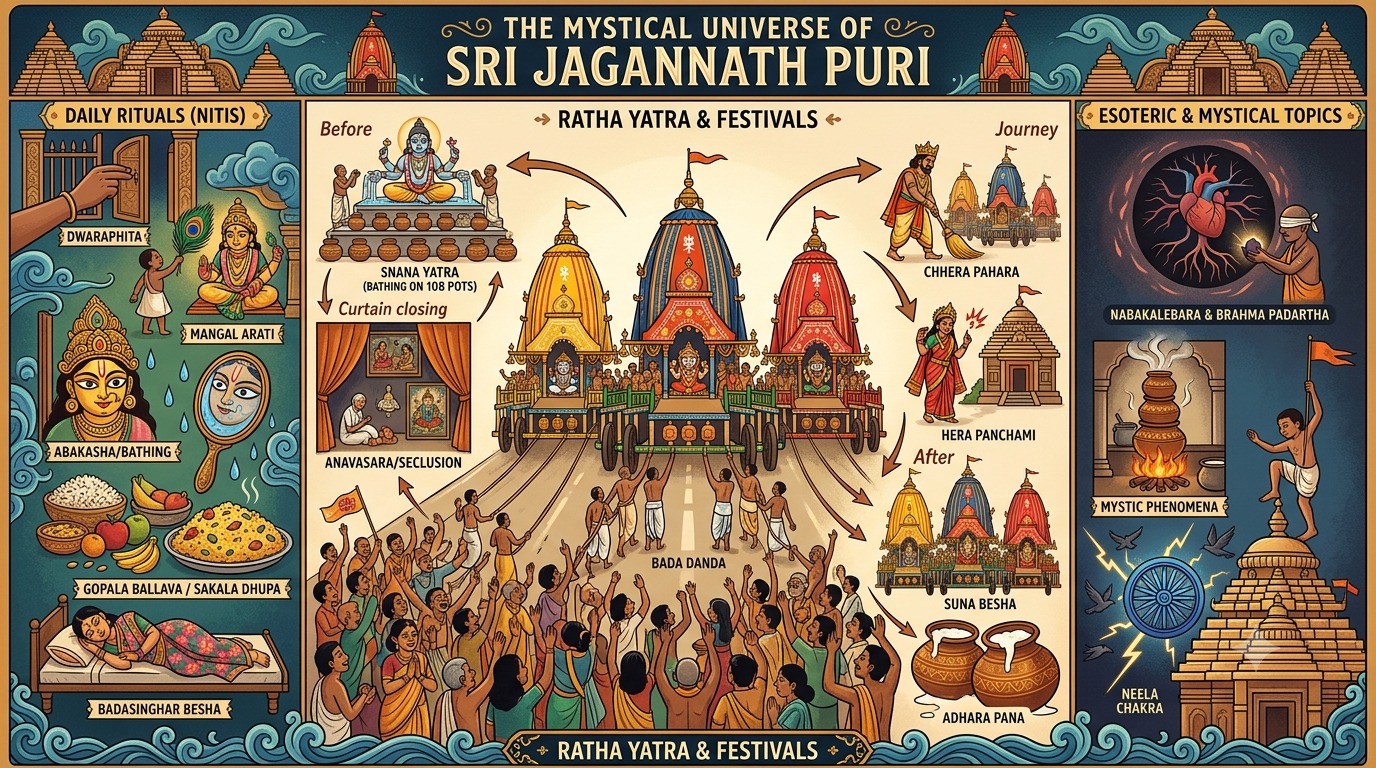
The rituals at the Jagannath Temple in Puri (Srimandir) treat Lord Jagannath, Lord Balabhadra, and Goddess Subhadra not merely as abstract idols, but as living, breathing human beings (Manaviya Leela). Their routine consists of waking up, brushing teeth, bathing, changing attire multiple times, enjoying lavish meals, and going to sleep.
Below is an overview of both the Daily Rituals (Nitis)* and the *Ratha Yatra Ritual Cycle.
Daily Rituals (Nitis) at Srimandir
The daily sequence begins before dawn and continues until midnight, executed by specific hereditary priests (Sevayats):
- Dwaraphita & Mangal Arati (~4:30 AM – 5:00 AM): The main gates (Singhadwara) and inner sanctum doors are unsealed in the presence of designated priests. The auspicious morning lamp service (Mangal Arati) is performed to awaken the Triad.
- Mailam (~6:00 AM): The night dresses, flowers, and Tulsi leaves worn by the deities are removed.
- Abakasha (~6:30 AM): The morning ablutions. Priests clean the deities’ teeth using herbal twigs and perform a symbolic bath using brass mirrors to reflect water mixed with camphor, curd, and sandalwood paste. The temple astrologer reads out the day’s panchang.
- Vesha (Attire Change): The deities are dressed in fresh cotton fabrics, with specific colors corresponding to each day of the week (e.g., Red on Sunday, Yellow on Thursday, White on Friday).
- Sahana Mela (~7:00 AM – 8:00 AM): The general public is allowed to enter the inner sanctum (Garbhagriha) to view the deities up close near the Ratnavedi (jeweled throne).
- Rosha Homa, Surya Puja, & Dwarapala Puja: Sacred fire rituals are performed in the temple kitchen (Rosha), followed by worship of the Sun God (Surya) and the guardian deities of the gates.
- Gopala Ballava Bhoga (~9:00 AM): The morning breakfast offering. Simple delicacies like puffed rice (khai), ripe bananas, curd, and coconut sweets are offered.
- Sakala Dhupa (~10:00 AM): The formal morning meal (Raja Bhoga) prepared in the temple kitchen. Items include Khichdi, Kanika (sweet rice), dals, cooked vegetables, and traditional cakes (Pithas).
- Bhoga Mandapa Niti: Large quantities of food prepared for public purchase and distribution are sanctified in the Bhoga Mandap hall. Once offered to Maa Bimala inside the compound, it becomes Mahaprasad.
- Madhyanha Dhupa (~1:00 PM): The elaborate afternoon lunch offering.
- Madhyanha Pahuda (~1:30 PM – 2:00 PM): The sanctum doors are closed so the deities can rest during the afternoon.
- Sandhya Arati (~6:00 PM): The evening lamp-lighting ritual welcoming dusk.
- Sandhya Dhupa (~7:00 PM – 8:00 PM): The evening meal offering.
- Chandanlagi: Sandalwood paste infused with saffron and musk is applied to the deities’ bodies to cool them.
- Badasinghar Besha (~9:30 PM): The final dress of the night. The deities are adorned with silk clothes (Baralagi Pata) containing woven verses of Jayadeva’s Gita Govinda and decorated with heavy floral garlands.
- Badasinghar Dhupa: A light late-night offering consisting of sweet milk, curd, and small cakes.
- Khata Seja Lagi & Pahuda (~12:00 AM): Beds are arranged in the sanctum. Shayana Thakur (a small representative idol) is moved to the bed, devotional lullabies are recited, and the temple doors are locked until the next morning.
The Ratha Yatra Ritual Cycle
Ratha Yatra is not just a single-day event; it is an extensive, multi-week festival sequence.
Akshaya Tritiya (Chariot Construction)
└─► Snana Yatra (108-pot Bath)
└─► Anavasara (15-day Seclusion)
└─► Netrotsava / Nabajouban Darshan
└─► Ratha Yatra (Pahandi, Chhera Pahara, Chariot Pulling)
└─► Hera Panchami
└─► Bahuda Yatra (Return)
└─► Suna Besha (Golden Attire)
└─► Adhara Pana
└─► Niladri Bije (Homecoming)
1. Akshaya Tritiya
The precursor to Ratha Yatra. Artisans begin constructing the three massive wooden chariots—Nandighosha (for Lord Jagannath), Taladhwaja (for Lord Balabhadra), and Darpadalana (for Goddess Subhadra)—using sacred wood without metal nails.
2. Snana Yatra (Deva Snana Purnima)
Observed on the full moon of the Jyeshtha month, this is Lord Jagannath’s public birthday bath.
- The deities are brought out to the elevated Snana Bedi.
- They are bathed with 108 pots of sanctified water drawn from the sacred Suna Kua (Golden Well).
- In the evening, the deities wear the Hati Besha (Elephant Attire) to honor Lord Ganesha.
3. Anavasara (The Seclusion Period)
Because of the extensive bathing during Snana Yatra, the deities are believed to catch a fever. They are kept in a special sick room (Anasara Gruha) for 15 days.
- The main sanctum remains closed to the public.
- Daitapati priests attend to the deities with traditional secret herbal treatments, fruit diets, and natural oil massages (Phuluri Tela).
- Traditional Pattachitra cloth paintings (Dasaavatara Patti) are displayed on the outer barricade for devotees to offer prayers.
4. Netrotsava & Nabajouban Darshan
On the eve of Ratha Yatra, the deities recover their health. Priests repaint their eyes (Netrotsava), and devotees get their first view of the youthful, fully restored deities during Nabajouban Darshan.
5. Ratha Yatra (The Chariot Festival Day)
- Pahandi Bije: The deities are carried out of the sanctum in a swaying procession. Devotees wear giant floral headgears (Tahiya) on the idols as they are moved step-by-step to their respective chariots amidst gongs and conches.
- Chhera Pahara: The Gajapati King of Puri arrives on a palanquin and sweeps the floor of all three chariots using a golden broom, sprinkling sandalwood water and flowers. This demonstrates that even a king is a humble servant before the Divine.
- Pulling the Chariots: Thousands of devotees pull the heavy cotton ropes (Sankhachuda and Swarnachuda) to draw the chariots 3 km down Bada Danda (Grand Road) to the Gundicha Temple (considered their aunt’s house).
6. Stay at Gundicha Temple & Hera Panchami
The deities stay at Gundicha Temple for about a week.
- Hera Panchami (5th Day): Goddess Lakshmi, upset at being left behind at Srimandir, visits the Gundicha Temple at night. In a symbolic act of anger, her priests break a piece of wood on Lord Jagannath’s chariot (Nandighosha) before returning secretly to the main temple.
7. Bahuda Yatra (The Return Journey)
On the 9th day, the deities begin their return journey to the main Jagannath Temple in their chariots. En route, they stop at the Mausima Temple to partake of Poda Pitha (a traditional baked cake).
8. Suna Besha (Golden Attire)
Upon arriving back outside the Srimandir, the chariots park at the Lion’s Gate. The deities are dressed in over 208 kg of solid gold ornaments (crowns, hands, weapons, and necklaces) while still seated on their chariots.
9. Adhara Pana
Large, tall clay pots filled with a sweet herbal milk drink (Adhara Pana) are placed on the chariots reaching up to the deities’ lips. After offering, the pots are intentionally broken on the chariot floors so that guardian spirits and celestial beings residing around the chariots receive the drink.
10. Niladri Bije (The Homecoming)
The final ritual marking the end of Ratha Yatra. The deities are carried back inside the Srimandir. Goddess Lakshmi’s servants initially block Lord Jagannath’s entry at the Jaya-Vijaya gate due to her lingering anger. The Lord offers her Rasagolas to sweeten the mood, reconciliation takes place, and the deities re-ascend the Ratnavedi.
Behind the public routines and vibrant street processions of Srimandir lies a layer of esoteric, tantric, and closely guarded secret traditions (Gupta Nitis). The Jagannath tradition is a unique syncretic blend of Tribal (Sabara) animism, Tantric Shaktism, Buddhism, and Vaishnavism.
1. Nabakalebara & The Transfer of Brahma Padartha
Every 8, 12, or 19 years (when an extra intercalary month, Adhikamasa, occurs in the Hindu calendar), the deities physically “die” and undergo reincarnation (Nabakalebara).
- Bana Jaga Jatra: Servitors embark on a barefoot pilgrimage to locate specific, sacred Neem trees (Daru Brahma). These trees must bear distinct divine symbols (e.g., no bird nests, a snake pit at the base, and naturally formed markings of a conch, disc, mace, and lotus on the trunk).
- The Midnight Transfer: On the night when the new wooden deities are sculpted, a complete blackout is enforced across the entire city of Puri. Electricity is cut, and armed forces guard the temple perimeter.
- The Blindfolded Ritual: A blindfolded senior Daitapati priest, wearing thick cloth wrapped around his hands, enters the dark inner sanctum. He removes the mysterious core essence—the Brahma Padartha—from the heart of the old deity and transfers it into the chest cavity of the new idol.
- The Secrecy: The priest is strictly forbidden from seeing or feeling the shape of the Brahma Padartha. Legend holds that anyone who sees or recognizes what it truly is will not survive the experience.
- The Divine Funeral: The old idols are buried in a sacred burial ground inside the temple compound called Koili Baikuntha before dawn. The priests then observe a 10-day mourning period (Asoucha), shaving their heads and performing rites just as family members do after the passing of a relative.
2. Gupta Sabara Seva (Secret Tribal Rites)
During the 15-day Anavasara period (when the deities are “sick” after the 108-pot bath), the Brahmin priests step back.
- The temple sanctum is taken over exclusively by the *Daitapatis—servitors who trace their lineage directly to the ancient *Sabara (tribal) king, Biswavasu.
- What transpires behind the bamboo screen (Tati) during these 15 days is confidential. It is an esoteric mix of secret herbal treatments (Phuluri Tela), tribal rites, and ancient rituals that cannot be witnessed by outsiders or recorded in any text.
3. The Esoteric Tantric Core (Tantrik Riti)
Though Jagannath is widely worshipped as the supreme Vaishnava deity, the daily and annual rituals are heavily rooted in Tantra Shastra:
- Yantra under the Throne: The Ratnavedi (jeweled throne) is embedded with a secret, powerful geometric diagram known as the Sri Yantra.
- The Deity as Kali: In esoteric Odia Tantra, Lord Jagannath is equated with Maa Kali (Dakshina Kalika), Lord Balabhadra with *Tara, and Goddess Subhadra with *Bhuvaneshwari.
- Maa Bimala & Mahaprasad Transformation: Food cooked in the temple kitchen is strictly termed Bhoga (simple food) when offered to Lord Jagannath. It becomes Mahaprasad (divinely sanctified food) only after it is re-offered to *Maa Bimala—a major *Shakti Peetha located within the inner temple complex.
- Vimalashtami Night: On Maha Saptami/Maha Ashtami during Durga Puja, a secret midnight animal sacrifice (a goat) takes place inside the temple complex strictly for Goddess Bimala. This ritual is conducted before dawn when the main gates are sealed, and the remnants are cleared before Lord Jagannath “wakes up,” keeping the Vaishnava and Tantric rites strictly separated in time.
4. Daily Esoteric Acts: The Flag Changer (Chuna Seba)
Every single day, 45 feet above the ground, a designated servitor climbs the 214-foot high Shikhar (spire) of the main temple without any safety harness or ropes.
- He climbs barehanded, facing the temple wall, carrying the new flag (Patitapavana Bana) wrapped around his waist.
- The Curse Legend: The flag must be changed every day before sunset. Temple tradition holds that if this daily ritual is missed even once, the entire temple complex must remain locked and closed to the world for 18 consecutive years.
5. Architectural & Phenomenological Anomalies
Devotees and researchers frequently highlight several physical phenomena surrounding the temple compound:
- The Silence at Singhadwara: The moment you step through the main entrance gate (Singhadwara), the roaring sound of the nearby ocean waves completely vanishes. Turn around and step one foot back outside, and the ocean sound instantly returns.
- Reverse Wind Direction: Throughout the world, coastal sea breezes blow from sea to land during the day and from land to sea at night. At Puri, the local wind current behaves in the exact reverse direction.
- Pots Stacked in the Kitchen: In the sacred kitchen (Rosha Ghar), food is cooked over wood fires using seven earthen pots stacked directly on top of one another. Uniquely, the food in the topmost pot cooks first, while the bottom-most pot (closest to the flame) cooks last.
- Shadowless Structure: At any time of day, the main dome of the 12th-century temple casts no visible shadow on the ground.
Beyond the physical rituals, Srimandir is steeped in intense mystical legends, esoteric sacred geometry, and unexplainable physical phenomena that continue to puzzle modern science and theology alike.
1. The Secrets of the Neela Chakra (Blue Wheel)
Atop the 214-foot spire sits a massive 8-metal (Ashtadhatu) wheel weighing over 2,200 kg.
- The Optical Paradox: No matter where you stand in the city of Puri, when you look up at the Neela Chakra, it appears to face directly toward you.
- Natural Lightning Rod: Despite centuries of severe coastal cyclones and violent thunderstorms in Odisha, the metal wheel acts as an ancient, ungrounded lightning diverter, protecting the stone sanctuary from structural damage.
- The Midnight Flag Service (Mahadeepa):* On Ekadashi nights, servitors carry giant lighted earthen lamps (*Mahadeepa) while scaling the smooth outer curve of the main dome, running around the narrow perimeter of the Neela Chakra in pitch darkness.
2. The Unseen Realm: No-Fly Zone
Local tradition and observations highlight a bizarre avian phenomenon:
- No Birds Above the Spire: Birds do not fly directly over the main dome (Shikhara), nor do they perch on top of the Neela Chakra.
- Air Flow Theory vs. Divine Energy: Skeptics suggest the dome creates a micro-thermal updraft that deters birds, while Tantric texts describe the airspace above the temple as an active spiritual portal (Sankha Kshetra) where earthly creatures do not linger.
3. The Mystical Properties of Mahaprasad
The cooking process in the world’s largest temple kitchen operates under conditions that defy conventional thermodynamic and culinary logic:
- The Seven Earthen Pots: Cooks stack seven clay pots on top of one another over a single wood fire. The food in the topmost pot cooks first, followed by the pot below it, down to the bottom pot closest to the flames.
- The Unchanging Quantity Paradox: Whether 2,000 pilgrims visit the temple or a massive surge of 200,000 arrives unannounced, the exact same quantity of food prepared daily mysteriously satisfies everyone without a single pot running short or a single grain being wasted.
- The Fragrance Test: Servitors claim that while food is being carried from the kitchen to the sanctum, it carries no smell. The moment it is offered to the Lord on the Ratnavedi, an intense, divine aroma suddenly radiates from it.
4. Secret Rites of Baisi Pahacha (The 22 Steps)
The flight of 22 stone steps leading from the Lion’s Gate (Singhadwara) to the inner compound holds deep mystical significance:
- Kundalini Elevation: Tantric tradition views the 22 steps as the 22 human vices/attachements that must be crossed to awaken spiritual energy.
- Anandabazar Shadow: It is believed that rolling a child over these steps or touching their feet to the stone grants immunity from spiritual obstacles. Ancestral rites (Pinda Daan) performed on these steps are considered as spiritually potent as those performed at Gaya.
5. The Living Daruda Devata (God in Wood)
Unlike traditional Hindu temples where idols are made of indestructible stone or metal, Lord Jagannath is carved out of perishable Neem wood.
- The Heartbeat Myth: Senior Daitapati priests involved in the secret Nabakalebara transfer of the Brahma Padartha have privately passed down oral accounts describing the core object as something “alive, pulsing, and electric”—resembling a pulsating organ like a human heart.
- Relic Theory: Esoteric oral histories whisper that the Brahma Padartha contains the unburned, mortal remains (or heart) of Lord Krishna, wrapped in layers of sacred silk and preserved through millennia.
6. The Underground Vaults (Ratna Bhandar)
Deep beneath the sanctum lies the Ratna Bhandar (treasury), divided into outer and inner chambers.
- The inner chamber has remained locked for decades. Legend and historical records from previous centuries mention that these deep subterranean vaults are guarded by divine serpents (Nagas) and intricate water-lock traps.
- Tantric texts suggest that these underground chambers hold not just physical gold, but ancient occult scrolls, ancient yantras, and sacred relics dating back to previous cosmic epochs (Yugas).
Reciprocating Activities” (Prema Seva / Bhakta Vatsalya)
The belief that Lord Jagannath is a *living deity (Jivanta Deva) who responds directly and personally to his devotees’ love, fear, devotion, or distress.
1. The Miracle of Lord Jagannath’s Black Hair
One of the most famous temple legends specifically involves hair standing on end—both in fear and in awe.
- The Incident: A devout priest named Talicha Mohapatra offered a flower garland from his own neck to Lord Jagannath. The King of Puri, visiting for darshan, took the garland as prasada and noticed a long strand of black hair caught in the flowers.
- The King’s Anger: Knowing the wooden deity had no hair, the King accused the priest of wearing the garland himself first. Furious, he gave the priest an ultimatum: “Show me that the Lord has hair by tomorrow morning, or face execution.”
- The Reciprocation: Terrified, the priest prayed intensely and kept poison by his bedside, intending to end his life if the Lord didn’t intervene. That night, Lord Jagannath appeared in a dream to comfort him.
- The Miraculous Proof: When the King arrived at the temple the next morning, he was shocked to see *long, thick, black hair flowing down Jagannath’s head. Thinking it was fake hair tied with glue, the King pulled a strand—and *real blood began to trickle from the deity’s scalp. The King fainted on the spot, his hair standing on end from sheer awe and divine fear.
2. Divine Reciprocation (Bhakta Vatsalya)
Lord Jagannath’s interactions are governed by the principle that he takes human emotions seriously—he reciprocalizes whatever feeling (bhava) a devotee offers.
Chaitanya Mahaprabhu’s Ecstatic Horripilation (Sattvika Bhava)
During Ratha Yatra, when Sri Chaitanya Mahaprabhu danced before the chariot, medieval texts (Chaitanya Charitamrita) record that his love was so intense that his bodily hairs stood on end like the prickles of a Kadamba flower (romancha).
- The Reciprocation: As Mahaprabhu danced, Lord Jagannath’s chariot would inexplicably stop dead in its tracks on the Grand Road, refusing to move even when pulled by thousands of devotees and elephants—moving only when Mahaprabhu sang and danced in front of it.
The Story of Dasia Bauri and the Coconut
Dasia Bauri, a devotee from a marginalized low caste, was forbidden from entering the temple.
- He handed a single coconut to a priest at the outer gate and said, “Give this to Jagannath, but only if He extends His hand to take it directly.”
- When the priest stood before the jeweled throne (Ratnavedi) and held up the coconut, two long, divine arms reached out from the idol and took the coconut straight from the priest’s hands.
Salabega’s Chariot Stop
Bhakta Salabega, a Muslim devotion poet, was traveling from far away to reach Ratha Yatra but fell severely ill. He prayed, “Lord, stay on your chariot until I arrive.”
- Lord Jagannath’s chariot (*Nandighosha) mysteriously froze near *Bada Danda and would not budge despite thousands pulling the ropes.
- It moved only after Salabega finally arrived, wept in gratitude, and took darshan.
3. Physical Reciprocations in Daily Temple Rituals
The temple’s daily rituals (Nitis) reflect this human-deity reciprocity:
| Ritual Activity | The Human Concept | The Divine Reciprocation |
|---|---|---|
| Anavasara | Catching a fever after a bath | The deities are treated like sick humans: kept in dark room, fed herbal concoctions, given oil massages, and rested for 15 days. |
| Badasinghar Besha | Bedtime comfort | Devotional verses from Jayadeva’s Gita Govinda are sung to put the deities to sleep, followed by offering sweet milk and soft beds. |
| Chhera Pahara | Humility | The King of Odisha sweeps the chariot floors with a golden broom—in return, Jagannath treats the King not as a ruler, but as a servant, preserving the state under divine protection. |
| Rasagola Offering | Resolving marital anger | During Niladri Bije, Goddess Lakshmi blocks Jagannath from re-entering the temple because he didn’t take her on the chariot. Jagannath offers her sweet Rasagolas to appease her before entering. |