Mantras, Meanings, and Food Guidelines
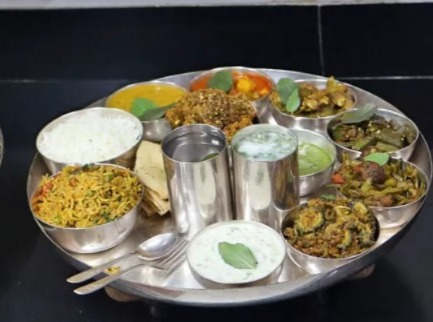
Offering food to the Deity before eating it — a practice known as bhoga offering or naivedyam — is one of the most cherished daily rituals in ISKCON (International Society for Krishna Consciousness), the worldwide Hare Krishna movement founded by His Divine Grace A. C. Bhaktivedanta Swami Prabhupada in 1966. Once food is offered with love and devotion, it is no longer ordinary food — it becomes prasada, literally “mercy,” spiritualized food that is honored rather than merely eaten.
This article explains, step by step, how ISKCON devotees offer bhoga to the Lord, the exact mantras used at each stage along with their meaning, the scriptural and institutional sources these mantras come from, and — importantly — which groceries and vegetables are permitted and which must strictly be avoided.
What Is Bhoga and What Is Naivedyam?
Bhoga refers to the raw or cooked vegetarian food prepared with the intention of offering it to Krishna. Naivedyam (also spelled naivedya) is the technical Sanskrit term for food that has actually been presented before the Deity as an offering. Once the offering is accepted — signified by the ringing of a bell and the recitation of prayers — the food is called prasadam.
This entire process rests on a single verse from the Bhagavad-gita, which ISKCON devotees consider the philosophical foundation of the offering. In Chapter 9, Verse 26, Lord Krishna states that whoever offers Him a leaf, a flower, a fruit, or water with love and devotion, He will accept it.
patraṁ puṣpaṁ phalaṁ toyaṁ yo me bhaktyā prayacchati, tad ahaṁ bhakty-upahṛtam aśnāmi prayatātmanaḥ
Srila Prabhupada translates this verse as meaning that if one offers Krishna a leaf, a flower, a fruit, or water with love and devotion, Krishna accepts it
In his purport, he explains that because Krishna reveals what kind of sacrifice He desires, a devotee should learn what pleases the Lord and offer only that, since one who loves Krishna gives Him only what He wants and never anything undesirable — which is why meat, fish, and eggs are never offered to Him.
Food Is Offered Through the Guru, Not Directly to Krishna
A distinctive feature of the ISKCON offering process is that devotees do not consider themselves qualified to offer food directly to Krishna. Srila Prabhupada’s own instruction on this point, whatever is offered to the Deity actually passes through the spiritual master, guru parampara — offers it to Lord Chaitanya, Lord Chaitanya offers it to Krishna, and only after Krishna, then Chaitanya Mahaprabhu, and then the spiritual master have partaken of it does the food become maha-prasada.
This is precisely why the offering ceremony always begins with prayers to the spiritual master (in ISKCON, primarily Srila Prabhupada, the Founder-Acharya) before any prayer is addressed to Krishna Himself.
The Complete Bhoga Offering Procedure
The standard ISKCON procedure, followed in temples and by devotees at home, is documented on official ISKCON resources such as the ISKCON Deity Worship Ministry website, and internal pujari (priest) training manuals used across ISKCON temples, sometimes compiled as “Archana Seva” guides. Below is the sequence.
Step 1: Personal and Kitchen Purity
Before any cooking begins, the cook bathes, wears fresh clothes, and ideally applies tilaka. The kitchen used for preparing bhoga is kept scrupulously clean, and utensils used for Deity cooking are kept completely separate from those used for other purposes. No one is permitted to taste the food while it is being cooked, since food that has been tasted is considered already “enjoyed” and therefore unfit to offer — Krishna is to receive the first taste.
Step 2: Preparing and Arranging the Plate
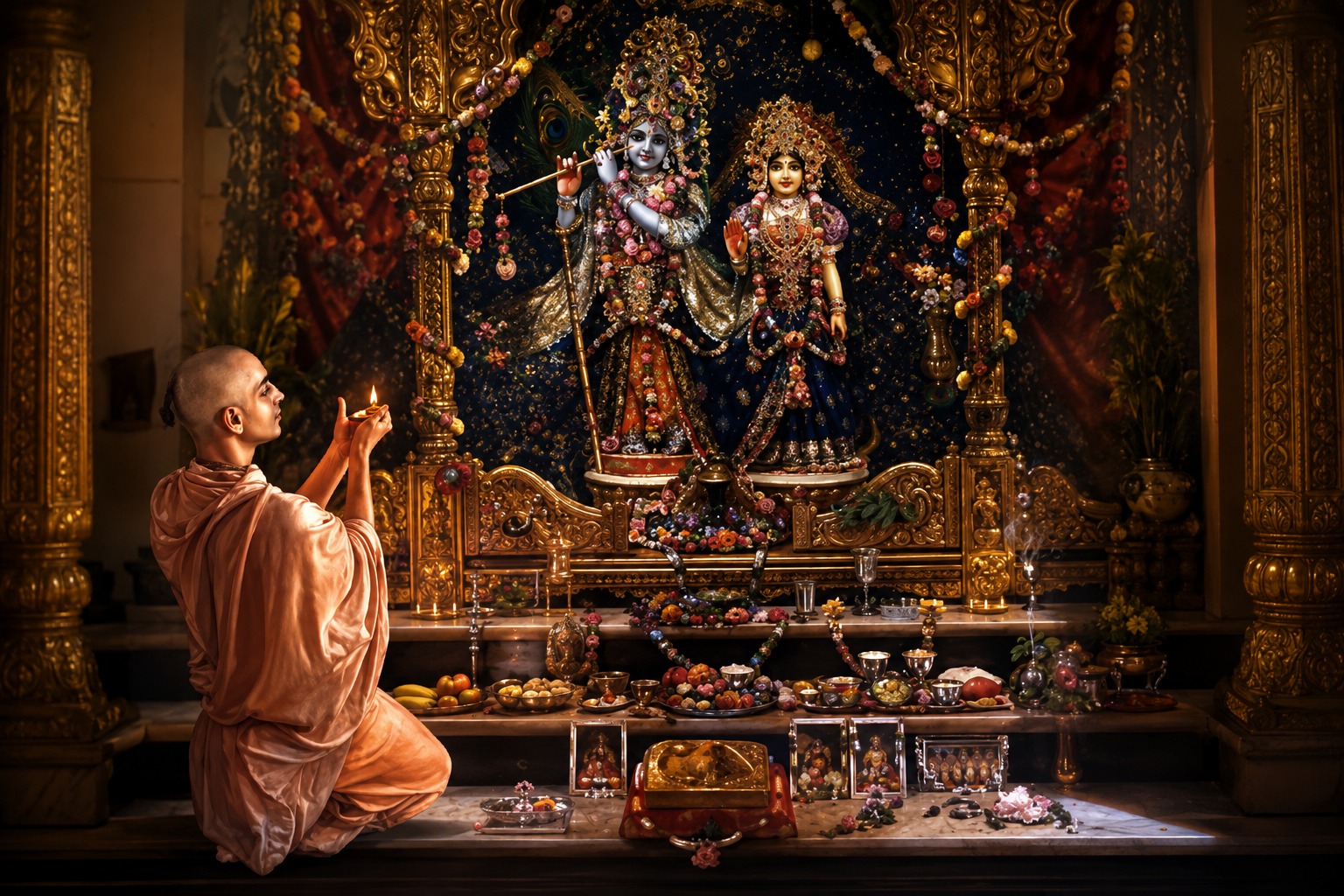
Once cooking is complete, a portion of each preparation is placed on a plate reserved for the Deity, along with a glass or cup of water (paniyam). The plate is brought before the Deity, the altar, or — in home worship where devotees may not have installed Deities — a picture of Sri Sri Radha-Krishna, the Panca-tattva (Lord Chaitanya and His associates), and Srila Prabhupada.
Step 3: Ringing the Bell and Chanting the Guru Pranama Mantras
The devotee sits on an asana (a small mat or seat), rings a small bell with the left hand throughout the mantras, and begins by offering obeisances to the spiritual master.
The first prayer, chanted three times, is the pranama mantra to Srila Prabhupada:
nama oṁ viṣṇu-pādāya kṛṣṇa-preṣṭhāya bhū-tale / śrīmate bhaktivedānta-svāmin iti nāmine
namas te sārasvate deve gaura-vāṇī-pracāriṇe / nirviśeṣa-śūnyavādi-paścātya-deśa-tāriṇe
Meaning: This prayer offers respectful obeisances unto His Divine Grace A. C. Bhaktivedanta Swami Prabhupada, who is described as very dear to Lord Krishna, having taken shelter at the lotus feet of the Lord.
Obeisances unto Srila Prabhupada, a devoted servant of his own spiritual master, Bhaktisiddhanta Sarasvati, who is engaged in broadcasting the message of Lord Chaitanya and is delivering the Western world from voidism and impersonalism.
Step 4: Prayers to Lord Chaitanya
Next, prayers are offered to Lord Chaitanya Mahaprabhu:
namo mahā-vadānyāya kṛṣṇa-prema-pradāya te / kṛṣṇāya kṛṣṇa-caitanya-nāmne gaura-tviṣe namaḥ
Meaning: Obeisances to the most munificent incarnation, Krishna in the form of Lord Chaitanya Mahaprabhu, who is Krishna Himself, but who freely gives what no other incarnation has offered — pure love for Krishna. [Cc. Madhya 19.53]
Step 5: Chant the following prayer three times, offering respect to Lord Krishna:
namo brahmanya-devaya go-brahmana-hitaya ca / jagad-hitaya krishnaya govindaya namo namah
Let me offer my respectful obeisances unto Lord Krishna, who is the worshipable Deity for all brahminical men, who is the well-wisher of cows and brahmanas, and who is always benefiting the whole world. I offer my repeated obeisances to the Personality ofGodhead, known as Krishna and Govinda. – [Vishnu Purana]
Step 6: This is followed by the Panca-tattva mantra and Hare Krishna maha mantra 3 times each
śrī-kṛṣṇa-caitanya prabhu nityānanda / śrī-advaita gadādhara śrīvāsādi-gaura-bhakta-vṛnda
Meaning: Obeisances to Sri Krishna Chaitanya, Prabhu Nityananda, Sri Advaita, Gadadhara, Srivasa, and all other devotees in the line of Lord Chaitanya.
Hare Kṛṣṇa Hare Kṛṣṇa, Kṛṣṇa Kṛṣṇa Hare Hare / Hare Rāma Hare Rāma, Rāma Rāma Hare Hare
In this mantra, “Hare” is a form of address to the Lord’s energy, and “Krishna” and “Rama” are names of the Supreme Lord meaning “the all-attractive one” and “the source of all pleasure,” respectively. Chanting it invokes the direct presence and mercy of the Lord.
Step 6: Formally Presenting the Food — “Idam Naivedyam”
Finally chant idam naivedyam — along with the specific mula-mantra of the deity — followed by idam paniyam and the mula-mantra, for offering the drinking water.
For simpler, less elaborate offerings — such as light morning snacks — devotees may instead chant a condensed version. For fruits, sweets, and beverages offered at odd hours, the phrase idam mistanna-paniyadikam sarvam is used along with the deity’s mula-mantra, while for full meals of grains, vegetables, and beverages served at breakfast, noon, or evening, the phrase idam anna-vyanjana-paniyadikam sarvam is chanted instead.
Meaning: “Idam naivedyam” literally means “this is the offered food”; “idam paniyam” means “this is the offered water.” “Anna-vyanjana-paniyadikam sarvam” means “all this — grains, vegetables, and drink” — a summary phrase acknowledging the full variety of the meal being offered.
Step 7: Leaving the Lord to Honor the Meal
After the offering mantras, the devotee rings the bell once more and quietly steps back or leaves the altar area, allowing the Lord time to relish the food undisturbed. The waiting period typically lasts between five and twenty minutes, after which the bell is rung again, the plate is removed, and the food is transferred back into the main serving vessels, at which point it is considered sanctified prasadam. During this waiting period, many devotees use the time to sit and softly chant japa or gayatri mantras.
Step 8: Offering Water for Washing (in Elaborate Temple Worship)
In fuller, temple-style Deity worship, additional upachara (items of respect) follow the meal, mirroring how one would treat an honored royal guest after a feast. The devotee offers water for washing the hands and mouth while chanting idam hasta-mukha-prakshalanam along with the mula-mantra, followed by etat padyam for washing the feet and idam acamaniyam for sipping water, each paired with the deity’s mula-mantra. A seat is then offered while chanting idam asanam and the mula-mantra, as the devotee meditates on escorting the Lord back to His place on the altar, and finally betel nut (tambulam) is offered while chanting idam tambulam along with the mula-mantra.
Step 9: Honoring the Remnants as Maha-prasadam
Offering Prasada to the Lord’s Associates
- Offer the Lord’s prasada remnants to your spiritual master, Srila Prabhupada and the Lord’s associates with the following mantras
idam maha-prasadam and the guru-mula-mantra;
idam maha-prasadam om ISKCON-samsthapakacaryaya namah;
idam maha-prasadam om sangopangastra-parshadebhyo namah. - Finally, remove the plates and clean the eating area. After washing your hands, offer pranamas to your spiritual master and the Deities. Now, the prasadam considered ready for general honoring (eating) by devotees.
Mantras chanted before honoring the Maha-prasadam
(1)
mahā-prasāde govinde
nāma-brahmaṇi vaiṣṇave
svalpa-puṇyavatāḿ rājan
viśvāso naiva jāyate
(2)
śarīra abidyā-jāl, joḍendriya tāhe kāl,
jīve phele viṣaya-sāgore
tā’ra madhye jihwā ati, lobhamoy sudurmati,
tā’ke jetā kaṭhina saḿsāre
(3)
kṛṣṇa boro doyāmoy, koribāre jihwā jay,
swa-prasād-anna dilo bhāi
sei annāmṛta pāo, rādhā-kṛṣṇa-guṇa gāo,
preme ḍāko caitanya-nitāi
TRANSLATION
1) O King, for those who have amassed very few pious activities, their faith in maha-prasada, in Sri Govinda, in the Holy Name, and in the Vaisnava is never born.
2) O brothers! This material body is a network of ignorance, and the senses are one’s deadly enemies, for they throw the soul into the ocean of material sense enjoyment. Among the senses, the tongue is the most voracious and verily wicked; it is very difficult to conquer the tongue in this world.
3) O brothers, Lord Krsna is very merciful. Just to control the tongue, He has given us the remnants of His own food! Now, please eat these nectarean grains while singing the glories of Their Lordships Sri Sri Radha and Krsna, and in love call out “Caitanya! Nitai!”
The Key Books Behind the Procedure
For readers who want to study the philosophy and mantras in greater depth, the ISKCON tradition points to a handful of core texts:
- Bhagavad-gita As It Is (Srila Prabhupada, Bhaktivedanta Book Trust) — the scriptural basis for offering food to Krishna, especially Chapter 9, Verse 26.
- Nectar of Devotion (Srila Prabhupada’s summary study of Rupa Goswami’s Bhakti-rasamrita-sindhu) — explains the mood and etiquette of devotional service, including food offerings, as an expression of loving exchange with the Lord.
- The Higher Taste — Srila Prabhupada’s guide to vegetarianism and Vedic cooking, combining philosophy with recipes, and the most widely distributed ISKCON book explaining why certain foods are unfit for offering.
- The Hare Krishna Cookbook (1972) — the first Hare Krishna cookbook ever published, containing the original recipes ISKCON cooks used both for daily prasadam and the famous Sunday Love Feast, and explicitly stating the principle that Krishna accepts only foods in the mode of goodness, meaning foods prepared from grains, vegetables, milk products, and fruits — nothing else can be offered or will be accepted.
- Internal pujari training manuals, such as the “Naivedya Seva” and “Archana Seva” guides used in ISKCON temple deity-worship departments worldwide, which lay out the full mantra sequence described above.
What Groceries and Vegetables Can Be Offered
ISKCON’s dietary philosophy is rooted in the concept of the three gunas (modes of material nature) described in the Bhagavad-gita: sattva (goodness), rajas (passion), and tamas (ignorance). Only foods considered to be in the mode of goodness are offered to Krishna. In practical terms, permitted bhoga ingredients include:
- Grains and cereals: rice, wheat, wheat flour (atta), semolina (rava/sooji), most lentils and pulses (dal), barley, millets
- Vegetables: the large majority of common vegetables — potatoes, cauliflower, peas, spinach and other leafy greens, pumpkin, gourds, beans, carrots, tomatoes, brinjal/eggplant (with the exception noted below), okra, and so on
- Fruits: all fresh fruits — bananas, mangoes, apples, oranges, grapes, etc.
- Dairy: milk, ghee (clarified butter), fresh yogurt, paneer (cottage cheese), butter — but only from cow’s milk, not from cheese made using animal rennet
- Sweeteners: sugar, jaggery (gur), rock candy
- Nuts and seeds: almonds, cashews, raisins, sesame seeds, coconut
- Spices and seasonings: most common spices — turmeric, cumin, coriander, cardamom, cinnamon, black pepper, chili, and asafoetida (hing) as a flavor substitute for onion and garlic
- Oils and fats: ghee, vegetable and cooking oils
Everything used must be fresh, ideally purchased and prepared the same day, and cooked specifically with the intention of offering it — not simply “leftover” household food repurposed as an offering.
What Groceries and Vegetables Must Never Be Offered
Certain foods are strictly excluded from bhoga, either because they are non-vegetarian, because they are classed as rajasic or tamasic in nature, or because they are traditionally understood to cloud spiritual consciousness. Drawing on ISKCON’s own community guidance and The Higher Taste, the items to avoid include:
- All non-vegetarian items: meat, fish, and eggs of any kind — these can never be offered under any circumstance, as Srila Prabhupada’s purport to Bhagavad-gita 9.26 explicitly states that meat, fish, and eggs should not be offered to Krishna.
- Onion and garlic: considered rajasic/tamasic foods that agitate the mind and senses; excluded from virtually all ISKCON cooking, not just Deity offerings
- Mushrooms: classed with onion and garlic as unsuitable for offering
- Masur dal (red/pink lentils): specifically excluded, unlike most other dals
- Hing/asafoetida blended with wheat flour fillers — pure asafoetida is fine, but many commercial brands mix in wheat starch or other non-vegetarian binding agents, so the ingredient list should be checked
- Caffeinated items: tea, coffee, and chocolate/cocoa-based products, along with many caffeinated soft drinks, are avoided as intoxicating stimulants
- Alcohol and any intoxicants
- Gelatin-containing sweets or desserts: gelatin is derived from animal bones and hooves and disqualifies a product from being vegetarian
- Rennet-based cheeses: many commercial cheeses use animal rennet (an enzyme from a calf’s stomach) rather than vegetarian rennet
- Certain traditional exclusions cited in community teaching materials: burned rice, white eggplant, hemp, citron, tree saps that have not been boiled first, and milk products from buffalo or goat, as well as milk mixed with salt.
- Stale, canned, or frozen food: it is considered inappropriate to offer canned or frozen food to the Deity, and food containing unhealthy additives such as excess yeast or refined white sugar is best avoided as well.
- Tasted food: any food that has already been sampled or tasted by the cook before the offering is disqualified, since the “first taste” belongs to the Lord
Devotees are also encouraged to read product labels carefully, since hidden animal-derived ingredients — gelatin in candies and yogurts, rennet in cheese, or carmine (a red dye derived from insects) in some milkshakes and food colorings — can inadvertently make an otherwise vegetarian-looking product unfit for offering.
Why This Procedure Matters
For ISKCON devotees, offering bhoga is not a mechanical ritual but a daily act of loving exchange with the Supreme Lord. The chain of mantras — from the spiritual master, to Lord Chaitanya, to Krishna Himself — reflects the Gaudiya Vaishnava understanding that devotional service flows through the parampara (disciplic succession), never bypassing it. Once accepted, the food becomes prasadam, considered spiritually purifying for anyone who honors it, whether or not they personally performed the offering.
This is also why ISKCON temples worldwide — from Govinda’s restaurants to the Sunday Love Feast programs held in local temples — serve only food that has first been through this offering process, and why the strict avoidance of onion, garlic, mushrooms, meat, fish, eggs, and other excluded items is treated as non-negotiable rather than merely a taste preference.
Frequently Asked Questions
Do I need a bell to offer bhoga?
A bell is traditional and recommended, as ringing it is considered part of respectfully inviting the Lord to accept the food, but sincere devotion is considered the most essential element.
What is the difference between bhoga, naivedyam, and prasadam?
Bhoga is the food prepared with the intention to offer; naivedyam is food actually presented before the Deity during the offering ritual; prasadam is the same food once the offering has been accepted and it is honored by devotees.