The Nine Timeless Paths of Devotion in Bhakti Yoga
In an age dominated by distraction, anxiety, endless scrolling, and fragmented attention, humanity continues searching for something ancient yet eternally relevant: genuine spiritual connection. The Vedic tradition offers one of the most profound frameworks for this search through Nava Vidha Bhakti — the nine processes of devotional service.
Rooted deeply within the teachings of the Srimad Bhagavatam, Nava Vidha Bhakti is not merely a ritualistic system. It is a living spiritual psychology designed to transform consciousness, awaken divine love, and reconnect the soul with Bhagavan Sri Krishna.
What is Nava Vidha Bhakti?
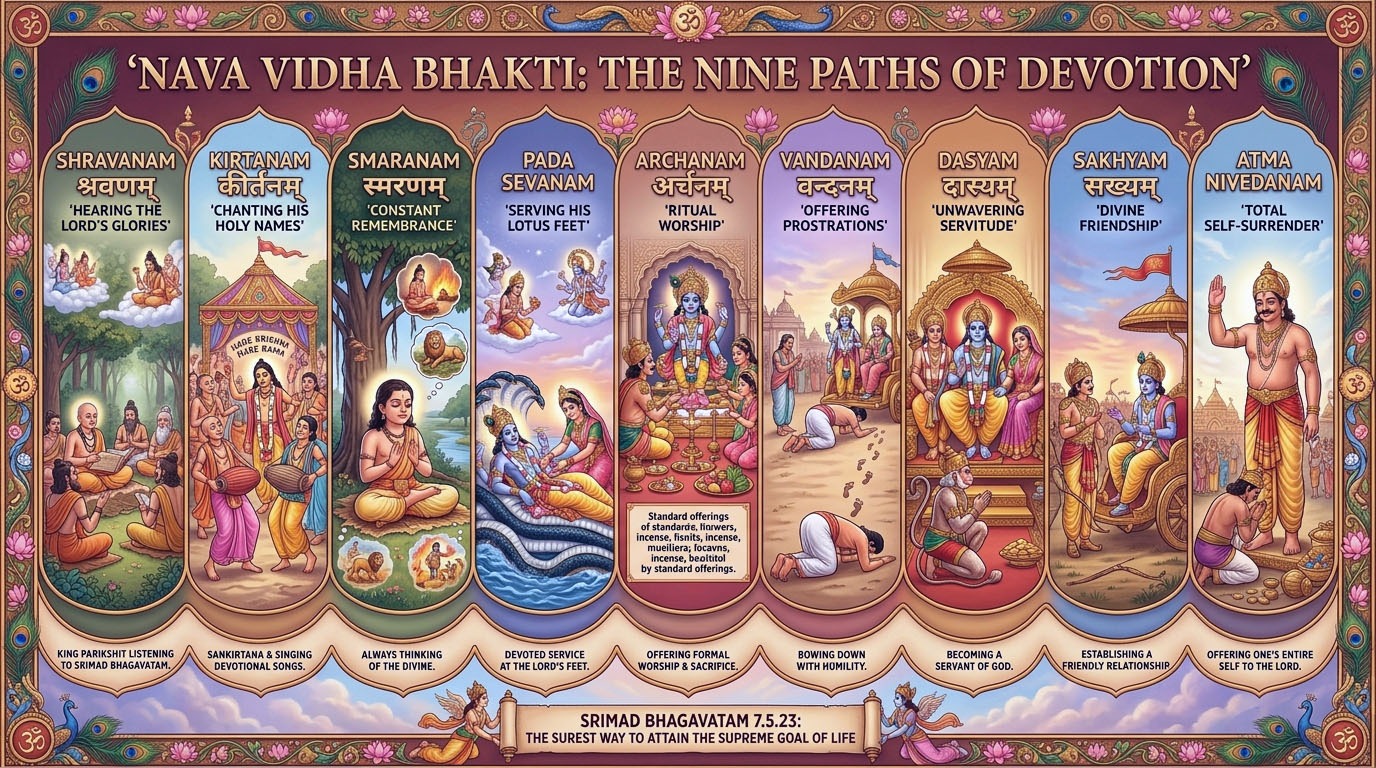
The Sanskrit phrase Nava Vidha Bhakti literally means “nine forms of devotion.” These nine devotional processes are described in the Srimad Bhagavatam (7.5.23-24) by Prahlada Maharaja:
sravanam kirtanam visnoh
smaranam pada-sevanam
arcanam vandanam dasyam
sakhyam atma-nivedanam
The verse explains that hearing about Vishnu, chanting His glories, remembering Him, serving His lotus feet, worshiping Him, offering prayers, becoming His servant, becoming His friend, and fully surrendering oneself are the nine authentic limbs of bhakti.
Unlike rigid religious systems, Nava Vidha Bhakti accommodates every personality type. A scholar may connect through hearing and contemplation. A musician may connect through kirtan. A servant-hearted soul may flourish in practical seva. A deeply emotional person may resonate with surrender and prayer.
The beauty of bhakti lies in this inclusivity.
The Spiritual Foundation of Bhakti Yoga
Bhakti in the Gaudiya Vaishnava tradition is not considered sentimentalism. It is a sophisticated spiritual science centered upon the eternal relationship between the jiva (soul) and Krishna.
According to the Vedic scriptures:
- The soul is eternal.
- Material life creates forgetfulness of our spiritual identity.
- Bhakti purifies consciousness.
- Divine love is the ultimate goal of existence.
Nava Vidha Bhakti functions as both the method and the destination. The practices themselves gradually awaken pure love of God.
Sri Chaitanya Mahaprabhu especially emphasized that in Kali-yuga, devotional practices centered around hearing and chanting become the most accessible means of spiritual realization.
The Nine Processes of Nava Vidha Bhakti
1. Sravanam — Hearing About Krishna
The first and foundational process is sravanam, hearing transcendental topics related to Bhagavan.
In Vedic culture, spiritual hearing is considered transformational. The consciousness absorbs whatever it repeatedly hears. Modern media shapes desires, fears, and identities through constant auditory input. Bhakti redirects this principle toward transcendence.
Hearing includes:
- Listening to Bhagavad-gita classes
- Hearing Srimad Bhagavatam discourses
- Listening to kirtans and bhajans
- Associating with advanced devotees
- Studying the lives of saints and acharyas
Maharaja Parikshit achieved perfection simply through hearing Srimad Bhagavatam from Sukadeva Goswami during the final seven days of his life.
Why Sravanam is Powerful
Hearing purifies the heart gradually. Even without complete intellectual understanding, transcendental sound acts spiritually upon consciousness.
In Gaudiya theology, Krishna and His names are nondifferent. Therefore hearing about Krishna brings one into direct association with Him.
2. Kirtanam — Chanting the Holy Names
If hearing plants the seed of devotion, kirtanam nourishes it.
Kirtanam refers to glorifying Bhagavan through chanting, singing, speaking, or preaching His names and pastimes.
This includes:
- Harinama sankirtana
- Japa meditation
- Bhajans
- Lectures and preaching
- Recitation of scriptures
The Hare Krishna maha-mantra occupies a central role in Gaudiya Vaishnavism:
Hare Krishna Hare Krishna
Krishna Krishna Hare Hare
Hare Rama Hare Rama
Rama Rama Hare Hare
Sri Chaitanya Mahaprabhu propagated nama-sankirtana as the yuga-dharma for Kali-yuga.
The Psychology of Sacred Chanting
Modern neuroscience increasingly acknowledges the transformative effects of repetitive sacred sound upon mental states. However, bhakti philosophy goes beyond psychological benefit.
The holy name is understood to be spiritually absolute, capable of cleansing lifetimes of material conditioning and awakening dormant prema, or divine love.
3. Smaranam — Remembering Krishna
Smaranam means remembrance of Bhagavan.
This remembrance may occur through:
- Meditation on Krishna’s names
- Remembering His pastimes
- Internal prayer
- Contemplating scriptural teachings
- Constant mindfulness of divine presence
Prahlada Maharaja exemplified smaranam. Despite intense persecution from Hiranyakashipu, he never forgot Narasimhadeva.
Bhakti as Consciousness Transformation
Smaranam reveals that bhakti is ultimately internal. External rituals support the deeper goal of uninterrupted remembrance.
The mind constantly remembers something. Bhakti redirects remembrance from temporary material objects toward the eternal.
4. Pada-Sevanam — Serving the Lotus Feet
Pada-sevanam literally means serving the lotus feet of the Lord.
This limb represents humility, reverence, and practical service.
Examples include:
- Temple service
- Pilgrimage
- Cleaning sacred spaces
- Assisting Vaishnavas
- Serving the deity form of Bhagavan
Lakshmi Devi is often cited as the ideal example of pada-sevanam through her eternal service to Narayana.
The Importance of Humility in Bhakti
Unlike paths focused primarily on intellectual mastery, bhakti emphasizes service consciousness.
Service softens egoism and aligns the heart with divine will.
5. Arcanam — Deity Worship
Arcanam refers to worshiping Bhagavan through deity worship and ritual devotion.
In temples and homes worldwide, devotees worship Krishna through:
- Offering flowers
- Cooking bhoga
- Performing arati
- Decorating the deity
- Chanting mantras
- Observing festivals
To an outsider, deity worship may appear symbolic. However, Vaishnava theology explains that Bhagavan mercifully manifests in the archa-vigraha form to accept loving service.
Arcanam in Modern Life
Even a small home altar can become a spiritual center.
Daily worship establishes sacred rhythm in life and transforms ordinary routines into devotional acts.
6. Vandanam — Offering Prayers
Vandanam means offering heartfelt prayers.
Prayer in bhakti is not merely petitioning for material gain. It is relational, emotional, and deeply personal.
The scriptures contain extraordinary prayers spoken during moments of surrender, gratitude, awe, repentance, and divine realization.
Some famous examples include:
- Queen Kunti’s prayers
- Gajendra’s prayers
- Brahma’s prayers
- Prahlada Maharaja’s prayers
Authentic Prayer and Vulnerability
Bhakti encourages emotional honesty before Bhagavan.
True prayer emerges not from performance but from sincerity.
7. Dasyam — Becoming the Servant of the Lord
Dasyam refers to adopting the mood of being Bhagavan’s servant.
Hanuman is the classical embodiment of dasya-bhava through his unwavering service to Lord Rama.
In Gaudiya Vaishnavism, servant consciousness is not seen as degrading. Rather, it represents liberation from false ego.
The Freedom of Service
Material life often revolves around self-centered ambition. Dasyam reorients life around divine purpose.
Paradoxically, surrendering to Krishna frees the soul from slavery to temporary desires.
8. Sakhyam — Friendship with Krishna
Sakhyam means cultivating friendship with Bhagavan.
Arjuna exemplifies this intimate relationship in Bhagavad-gita.
Unlike distant conceptions of God, bhakti theology allows for deeply personal relationships with the Divine.
A devotee may:
- Speak openly with Krishna
- Depend upon Him emotionally
- Share thoughts and fears internally
- Develop intimacy through remembrance and prayer
Divine Relationship Beyond Ritual
Sakhyam reveals the relational depth of bhakti.
Bhagavan is not merely an abstract force but a person capable of reciprocating loving exchanges.
9. Atma-Nivedanam — Complete Self-Surrender
The final process, atma-nivedanam, means complete surrender of oneself to Bhagavan.
Bali Maharaja is celebrated as the ideal example.
Despite losing kingdom, wealth, status, and external power, he surrendered entirely to Vamanadeva.
The Highest Expression of Bhakti
Self-surrender does not imply passivity or weakness.
It means aligning one’s entire existence with divine will.
In advanced devotion, the devotee no longer seeks separate interest from Krishna.
Nava Vidha Bhakti in Daily Life
One of the greatest strengths of Nava Vidha Bhakti is practicality.
These practices are not limited to monks, scholars, or renunciants. Anyone can incorporate bhakti into daily living.
Practical Ways to Practice Bhakti Today
Morning Devotional Routine
- Chant japa meditation
- Read Bhagavad-gita
- Offer simple prayers
- Listen to kirtans
Bhakti at Work
- Practice mindfulness of Krishna
- Avoid harmful speech and behavior
- Offer work results spiritually
Bhakti at Home
- Maintain a small altar
- Celebrate Ekadashi and festivals
- Conduct family kirtan
- Read scriptures together
Bhakti Through Community
Association with devotees remains one of the most powerful catalysts for spiritual growth.
Satsanga strengthens conviction, inspiration, and discipline.
Slokas Associated with Each Limb of Nava Vidha Bhakti
1. Śravaṇam (Hearing)
Srimad Bhagavatam 1.2.17
śṛṇvatāṁ sva-kathāḥ kṛṣṇaḥ
puṇya-śravaṇa-kīrtanaḥ
hṛdy antaḥ-stho hy abhadrāṇi
vidhunoti suhṛt satām
Krishna cleanses impurities from the heart of those who hear His glories.
2. Kīrtanam (Chanting)
Brhan-naradiya Purana
harer nāma harer nāma
harer nāmaiva kevalam
kalau nāsty eva nāsty eva
nāsty eva gatir anyathā
In Kali-yuga, there is no other way for spiritual liberation than chanting the holy name.
3. Smaraṇam (Remembrance)
Bhagavad-gita 8.7
tasmāt sarveṣu kāleṣu
mām anusmara yudhya ca
“Always remember Me while performing your duties.”
4. Pāda-sevanam (Serving the Lotus Feet)
Srimad Bhagavatam 3.25.38
Bhagavan bestows mercy upon those who sincerely take shelter of His lotus feet.
5. Arcanam (Deity Worship)
Bhagavad-gita 9.26
patraṁ puṣpaṁ phalaṁ toyaṁ
yo me bhaktyā prayacchati
tad ahaṁ bhakty-upahṛtam
aśnāmi prayatātmanaḥ
Krishna accepts even a leaf, flower, fruit, or water when offered with devotion.
6. Vandanam (Prayer)
Srimad Bhagavatam 10.14.8
tat te ’nukampāṁ su-samīkṣamāṇo
bhuñjāna evātma-kṛtaṁ vipākam
A devotee offers humble prayers even amidst suffering, seeing the Lord’s mercy.
7. Dāsyam (Servitorship)
Bhagavad-gita 18.66
sarva\text{-}dharmān\ parityajya\ mām\ ekaṁ\ śaraṇaṁ\ vraja
Abandon all varieties of duty and surrender unto Me.
This verse strongly embodies the mood of servant surrender.
8. Sakhyam (Friendship)
Bhagavad-gita 4.3
bhakto ’si me sakhā ceti
rahasyaṁ hy etad uttamam
Krishna tells Arjuna: “You are My devotee and My friend.”
9. Ātma-nivedanam (Complete Surrender)
Srimad Bhagavatam 11.29.34
martyo yadā tyakta-samasta-karmā
niveditātmā vicikīrṣito me
One who fully offers oneself unto Bhagavan attains divine protection and grace.
Traditional Exemplars of Each Limb
A famous traditional summary associates one maha-bhakta with each process:
| Process | Exemplary Devotee |
|---|---|
| Śravaṇam | Maharaja Parikshit |
| Kīrtanam | Sukadeva Goswami |
| Smaraṇam | Prahlada Maharaja |
| Pāda-sevanam | Lakshmi Devi |
| Arcanam | Prithu Maharaja |
| Vandanam | Akrura |
| Dāsyam | Hanuman |
| Sakhyam | Arjuna |
| Ātma-nivedanam | Bali Maharaja |
The Relevance of Nava Vidha Bhakti in Kali-Yuga
Ancient Vedic texts describe Kali-yuga as an age of quarrel, confusion, distraction, and spiritual decline.
Modern society reflects many of these symptoms:
- Chronic anxiety
- Social isolation
- Identity confusion
- Hyper-consumerism
- Mental restlessness
- Spiritual emptiness
Nava Vidha Bhakti addresses these conditions not superficially but fundamentally.
Bhakti restores:
- Purpose
- Inner stability
- Compassion
- Sacred identity
- Emotional purification
- Divine connection
The process does not require wealth, academic qualification, or social status.
It requires sincerity.
The Gaudiya Vaishnava Understanding of Bhakti
Gaudiya Vaishnavism, especially through the teachings of Sri Chaitanya Mahaprabhu, emphasizes that pure devotion transcends ritual formalism.
The ultimate goal is prema-bhakti — ecstatic divine love.
In this tradition:
- Krishna is understood as the Supreme Personality of Godhead.
- The soul’s natural function is loving devotional service.
- The holy name is spiritually identical with Krishna.
- Bhakti surpasses karma, jnana, and yoga as the highest spiritual path.
Sri Rupa Goswami systematically explained these devotional principles in Bhakti-rasamrita-sindhu, establishing the theological foundation of devotional aesthetics and rasa.
Frequently Asked Questions About Nava Vidha Bhakti
Is Nava Vidha Bhakti only for Hindus?
No. Bhakti focuses on the universal relationship between the soul and the Divine. People from diverse backgrounds practice bhakti worldwide.
Which of the nine processes is most important?
All nine are spiritually complete. However, in Kali-yuga, hearing and chanting are especially emphasized.
Can beginners practice Nava Vidha Bhakti?
Yes. Bhakti begins wherever one is spiritually situated.
Even small sincere efforts produce spiritual benefit.
Do I need initiation to begin bhakti?
One may begin hearing, chanting, reading scriptures, and associating with devotees immediately. Formal initiation deepens commitment and guidance later.
Conclusion: The Eternal Path of Devotion
Nava Vidha Bhakti remains one of the most profound spiritual frameworks ever articulated.
It integrates philosophy, emotion, practice, psychology, ritual, ethics, and divine relationship into a unified spiritual path.
Whether one approaches through hearing, chanting, service, prayer, friendship, or surrender, each limb of bhakti gradually purifies the heart and awakens dormant love for Krishna.
In a civilization increasingly fragmented by materialism and distraction, the timeless wisdom of Nava Vidha Bhakti offers something radical:
A return to sacred consciousness.
A return to loving devotion.
A return to the eternal relationship between the soul and Bhagavan.