Equal Souls, Different Psychologies, Shared Spiritual Destiny
Modern discussions about men and women in Vedic culture often become polarized. One side claims the Vedic tradition is completely egalitarian in the modern political sense. Another side claims the scriptures place women permanently beneath men. Neither reading is accurate. The Vedic worldview is subtler.
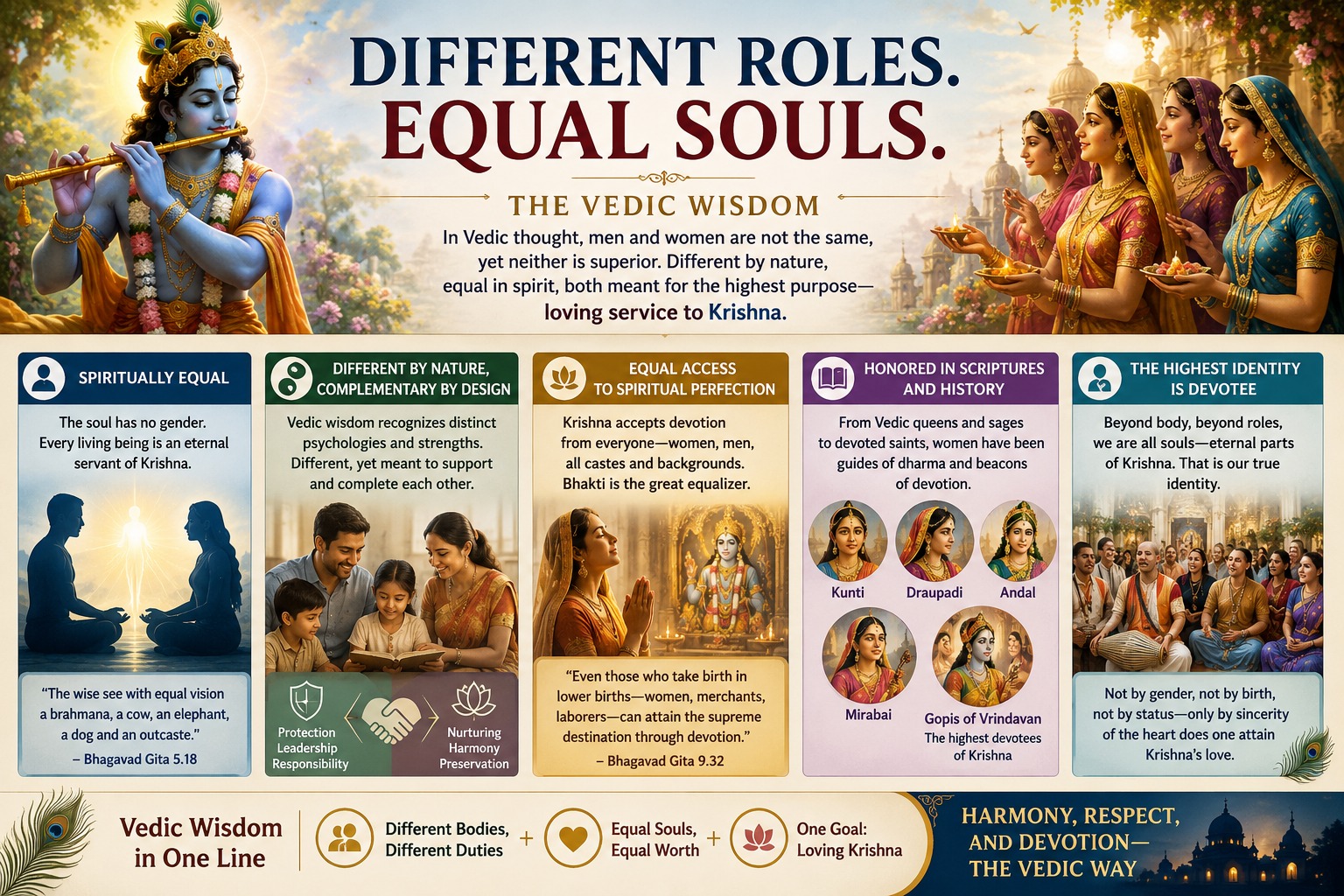
The Vedic texts simultaneously teach two ideas: the soul is spiritually equal in every body, and material bodies carry different psychophysical tendencies and social functions. This is not contradiction. It is the foundation of the Vedic social and spiritual framework.
The confusion begins when people mix spiritual equality with material sameness. The Vedic tradition never teaches that men and women are identical. But it repeatedly teaches that both are equally capable of attaining the highest perfection: pure devotion to Krishna.
In the Bhagavad Gita, Krishna explains the vision of a truly learned person:
“The wise see with equal vision a brahmana, a cow, an elephant, a dog and an outcaste.”
This is not social flattening. Krishna is not denying differences between bodies, abilities, or roles. He is teaching that the ātmā — the soul — is equal in spiritual quality everywhere. The body differs. The soul does not. That distinction is absolutely essential to understanding Vedic civilization.
The Soul Has No Gender
In Gaudiya Vaishnavism theology, the living entity is not male or female. Masculinity and femininity belong to the temporary body and mind. The soul itself is eternal servant of Krishna.
This is why some of the greatest saints in the Vedic tradition are women: Kunti, Draupadi, Andal, Mirabai, and the gopīs of Vrindavan, whom Gaudiya Vaishnavism considers the highest examples of devotion.
In fact, Gaudiya theology places the devotion of the gopīs above even great male sages and yogis. That alone destroys the simplistic accusation that Vedic spirituality considers women spiritually inferior.
Krishna Himself declares in Bhagavad Gita 9.32 that women, merchants, laborers, and even those considered socially disadvantaged can attain the supreme destination through devotion. The emphasis is radical for its time: bhakti is open to everyone.
Equality Does Not Mean Interchangeability
The modern world often assumes that equality requires sameness. Vedic civilization did not operate on that assumption.
The Vedic system viewed society organically, not mechanically. Different people had different inclinations, responsibilities, temperaments, and duties. A father and mother are equally important in a family, yet they are not interchangeable. Eyes and legs are equally valuable to the body, yet their functions differ.
Similarly, Vedic texts describe masculine and feminine psychologies differently. Masculinity was generally associated with external leadership, protection, risk-taking, and physical responsibility. Femininity was generally associated with nurturing, emotional cohesion, relational intelligence, beauty, fertility, and preservation of culture within the home.
This was not originally framed as superiority versus inferiority. It was functional complementarity.
Problems arise when later societies convert functional distinctions into domination or oppression. That degeneration happened historically in many cultures, including within parts of India. But social corruption should not automatically be equated with original siddhānta.
Why Do Some Vedic Texts Sound Harsh Toward Women?
Critics often quote isolated verses from Smritis, Puranas, or later social codes to argue that Vedic literature is misogynistic. A serious reading requires context.
First, Vedic literature spans thousands of years and multiple genres: Shruti, Smriti, Itihasa, Purana, Dharma-shastra, Tantra, and Vedanta. Not all texts carry the same authority or purpose.
Second, many apparently harsh statements are cautionary, contextual, or sociological rather than metaphysical. Some verses describe how material attraction operates psychologically. Others reflect social instability during particular historical eras like Kali-yuga.
Third, many passages criticized today speak harshly not only about women, but also about men, kings, brahmanas, shudras, renunciants, merchants, and almost every category of human being when corrupted by material consciousness.
The Srimad Bhagavatam especially is ruthless toward material ego in every form. A selective reading creates distortion.
The Vedic Fear Was Not Women — It Was Uncontrolled Lust
Much of the negative language around gender in traditional texts is actually anxiety about uncontrolled sexuality and social instability.
Ancient civilization depended heavily on stable families, lineage continuity, economic cooperation, and regulated sexuality. Therefore scriptures often spoke strongly about chastity, fidelity, and self-control.
Men were also repeatedly warned against lust, exploitation, irresponsible sexuality, abandoning wives and children, and abuse of power.
The Vedic texts are not glorifying male indulgence. They are attempting to regulate human passion for spiritual advancement. In Gaudiya Vaishnavism especially, lust is considered the central disease of material existence for both men and women.
The Highest Identity Is Devotee
One of the most overlooked truths in Vaishnava theology is that bhakti dissolves material hierarchy. A devotee is not judged by bodily designation — not by caste, race, wealth, nationality, or gender.
A. C. Bhaktivedanta Swami Prabhupada repeatedly emphasized that Krishna consciousness is transcendental to bodily identity. His commentary on Bhagavad Gita 5.18 explains that bodily differences exist materially, but spiritually all beings are equal because Paramatma resides in every heart.
That is why ISKCON spread globally across gender, nationality, and caste boundaries. The highest qualification in bhakti is not biological identity but sincerity of surrender.
Neither Modern Feminism nor Crude Patriarchy Fully Fits the Vedic Model
The Vedic worldview does not align neatly with modern ideological camps.
It does not teach absolute sameness between men and women, reduction of gender to biology alone, unrestricted sensual individualism, domination of women by men, or spiritual exclusion of women.
Instead, it presents a layered understanding: spiritually equal, psychologically distinct, socially interdependent, materially conditioned, and eternally united in service to Krishna.
This framework can be uncomfortable for both modern secularism and rigid traditionalism because it refuses simplistic binaries.
The Real Question of Civilization
The Vedic texts ultimately ask a deeper question: Are we merely bodies competing for power, or eternal souls learning loving service to God?
If identity is reduced only to bodily politics, conflict becomes endless. But if spiritual identity becomes primary, then male and female become cooperative energies in dharmic civilization rather than rival camps.
That is the deeper narrative of the Vedic tradition. Not “men versus women,” but souls journeying through different material conditions toward the same Supreme Reality.
Foundational Ślokas on Spiritual Equality and Gender in Vedic Thought
Bhagavad Gita 5.18 — Equal Spiritual Vision
vidyā-vinaya-sampanne brāhmaṇe gavi hastini śuni caiva śva-pāke ca paṇḍitāḥ sama-darśinaḥ
“The wise see with equal vision a learned brāhmaṇa, a cow, an elephant, a dog, and an outcaste.”
This is one of the strongest declarations of spiritual equality in all Vedic literature. The body differs; the soul is equal.
Bhagavad Gita 9.32 — Bhakti Is Open to Everyone
māṁ hi pārtha vyapāśritya ye ’pi syuḥ pāpa-yonayaḥ striyo vaiśyās tathā śūdrās te ’pi yānti parāṁ gatim
“O son of Pritha, those who take shelter of Me — women, vaiśyas, and śūdras — can also attain the supreme destination.”
Krishna directly states that spiritual perfection through bhakti is accessible to all.
Śrīmad Bhāgavatam 2.4.18 — Devotion Purifies Everyone
kirāta-hūṇāndhra-pulinda-pulkaśā ābhīra-śumbhā yavanāḥ khasādayaḥ ye ’nye ca pāpā yad-apāśrayāśrayāḥ śudhyanti tasmai prabhaviṣṇave namaḥ
“Even those born in apparently low backgrounds become purified by taking shelter of devotees of the Lord.”
The Bhāgavatam repeatedly transcends bodily identity.
Mahābhārata — Women Must Be Honored
yatra nāryas tu pūjyante ramante tatra devatāḥ
“Where women are honored, the devas rejoice.”
This famous teaching reflects the civilizational importance given to protecting and respecting women.
Śrīmad Bhāgavatam 3.31.41 — The Danger of Lust for Men
yoṣit-saṅgād yathā puṁso yathā tat-saṅgi-saṅgataḥ
“A man becomes materially entangled by excessive attachment to sensual association.”
This verse is often misunderstood. The Bhāgavatam is not attacking women; it is warning against uncontrolled lust and attachment. The same scriptures criticize uncontrolled men equally strongly.
Chaitanya Mahāprabhu’s Teaching — Beyond Material Identity
nāhaṁ vipro na ca nara-patir nāpi vaiśyo na śūdro
“I am not a brāhmaṇa, kṣatriya, vaiśya, or śūdra…”
Chaitanya Mahaprabhu teaches that the true identity of the soul is beyond bodily designation and rooted in eternal service to Krishna.
Why Do Vedic Texts Sound Unequal to Modern Women?
A Straightforward Conversation, Not a Defensive One
Many modern women encounter Vedic literature and feel disturbed. Some verses appear restrictive. Some glorify chastity and dependence. Some speak critically about feminine psychology. Others seem to place men in positions of authority.
These reactions are understandable.
Pretending difficult verses do not exist is intellectually dishonest. But reading them superficially is also incomplete.
The real question is deeper: What exactly were the Vedic texts trying to protect, regulate, and spiritually teach?
The Vedic Texts Were Not Written in a Modern Liberal Framework
Most ancient civilizations — not only Vedic India — were structured around survival, family stability, lineage continuity, and social duty.
The modern world prioritizes individual freedom, self-expression, and personal autonomy. Ancient Vedic civilization prioritized dharma, social harmony, restraint, responsibility, and spiritual evolution.
Therefore many teachings sound uncomfortable today because the foundational assumptions themselves are different.
The texts were not asking, “How can every individual maximize personal independence?” They were asking, “How can human society remain spiritually stable despite powerful material desires?”
That changes the entire tone of the discussion.
The Scriptures Criticize Men Constantly Too
One major misconception is that Vedic literature only criticizes women.
Actually, the texts are relentlessly critical of lustful men, irresponsible husbands, weak kings, greedy brāhmaṇas, hypocritical renunciants, abusive rulers, and materialistic householders.
The Srimad Bhagavatam especially exposes the flaws of conditioned human nature everywhere.
When scriptures warn about women’s beauty or emotional influence, they are usually discussing attachment, sexuality, illusion, and instability of the material mind. The same warnings are directed toward men from the opposite angle.
The target is not women. The target is material bondage.
Spiritual Equality Is Clear in the Core Texts
Krishna repeatedly emphasizes spiritual equality.
The wise see all beings equally at the spiritual level.
And Krishna explicitly says:
Women can attain the supreme destination through devotion.
Gaudiya Vaishnavism goes even further. The highest examples of love for Krishna are not male philosophers or kings. They are the gopīs of Vrindavan. That fact is revolutionary.
“Protection” Is the Most Misunderstood Word
Modern readers often react negatively to verses saying women should be “protected.” Because today, protection is often associated with control, restriction, or infantilization.
But traditionally, protection implied economic responsibility, physical security, social accountability, and lifelong obligation from men.
In Vedic culture, men were not merely given authority; they were burdened with duty. A husband who exploited, abandoned, or mistreated women was considered adharmic.
The ideal was never exploitation. The ideal was responsibility.
The Vedic Tradition Does Recognize Differences
The Vedic worldview does not claim men and women are psychologically identical.
It observes recurring differences in emotional orientation, biological experience, social tendency, and physical nature.
Modern neuroscience and psychology also recognize statistical differences between sexes, even while individual variation exists.
The Vedic conclusion was not “One is superior,” but “Different natures require different responsibilities and guidance.”
Problems begin when difference becomes domination.
Modern Society Has Its Own Contradictions
Modern culture often criticizes traditional femininity while simultaneously commercializing women’s bodies more aggressively than almost any civilization in history.
The Vedic critique of unrestrained sexuality applies powerfully to modern consumer culture: hypersexualization, pornography, emotional fragmentation, unstable relationships, and commodification of beauty.
The tradition would argue that liberation without inner discipline can become another form of bondage. Not all freedom produces peace.
The Highest Identity Is Beyond Gender
Gaudiya Vaishnava theology ultimately moves beyond bodily identity altogether.
The soul is eternal servant of Krishna. Not male servant. Not female servant. Eternal servant.
That is the final philosophical conclusion.
A Mature Reading Requires Both Honesty and Depth
A thoughtful reader does not need to pretend every historical expression in traditional societies was perfect. Nor is it intellectually fair to isolate a few controversial verses and ignore the enormous spiritual dignity granted to women throughout the tradition.
The Vedic worldview is neither modern secular feminism nor crude patriarchy. It is a civilization attempting — imperfectly across history, but profoundly in philosophy — to harmonize duty, psychology, spirituality, family, restraint, devotion, and transcendence.
And at its highest point, it declares something extraordinary:
Every soul, regardless of body, can attain pure love of Krishna.
Women, Household Life, and Happiness in Vedic Civilization: What Changed in the Modern World?
One of the biggest misconceptions about Vedic household life is the assumption that women in traditional society were merely passive, oppressed, or intellectually insignificant. That image is historically simplistic and often shaped more by modern ideological battles than by the actual structure of traditional dharmic civilization.
In Vedic society, the household was not viewed as a secondary or lesser sphere of life. It was the center of civilization itself. Agriculture, economics, education, spirituality, food culture, child development, ritual life, and social stability all emerged from the gṛhastha āśrama — the household order.
And women were central to that structure.
The Sanskrit term gṛha means “house,” but Vedic literature repeatedly states that a building alone is not a home. The woman of the household was considered the emotional, cultural, and spiritual force that transformed a physical structure into a living civilization.
The traditional wife was not seen merely as a domestic worker. She was:
- first teacher of children
- preserver of culture
- emotional stabilizer of family life
- manager of household economy
- guardian of food purity
- participant in ritual life
- transmitter of values across generations
In many traditional settings, women controlled substantial internal family economics, food systems, relationship networks, and child formation. Men often handled external political or economic pressures, but the home itself revolved around feminine influence.
This is why many Vedic texts strongly glorify motherhood and household contribution. Not because women were considered spiritually inferior, but because family stability was viewed as foundational to dharmic civilization.
Why Many Traditional Women Felt Fulfilled
Modern people often ask:
“How could women be happy without modern freedom?”
But the question itself may contain a hidden assumption — that fulfillment comes primarily through autonomy, career identity, or external achievement.
Traditional societies operated differently.
Happiness was deeply connected to:
- belonging
- family cohesion
- spiritual purpose
- stable identity
- interdependence
- meaningful responsibility
- religious culture
- community continuity
Many women found profound emotional meaning in:
- raising children
- maintaining sacred culture
- devotional practices
- festivals
- family bonds
- social respect
- contribution to lineage and tradition
This does not mean every woman in history was happy. Nor does it mean all traditional societies were ideal. Human suffering existed then also. Abuse, patriarchy, neglect, and injustice certainly occurred.
But modern narratives sometimes ignore that many women genuinely valued family-centered life and did not automatically experience it as oppression.
The modern tendency to interpret all traditional domestic roles as forced servitude often projects contemporary assumptions backward into history.
Why Is It Not Working the Same Way Today?
The modern world is radically different from the Vedic social environment.
Traditional life functioned within a larger ecosystem:
- joint families
- shared responsibilities
- strong community
- spiritual culture
- slower pace of life
- economic interdependence
- localized living
- religious identity
- clear social expectations
Modern society has dismantled much of this structure.
Today many women experience:
- isolation
- fragmented families
- economic pressure
- dual burdens of career and household
- hyperindividualism
- constant comparison through social media
- commodification of beauty
- weakened community support
- unstable relationships
- absence of spiritual culture
At the same time, men also face confusion:
- loss of purpose
- emotional immaturity
- avoidance of responsibility
- addiction
- weakened leadership
- fear of commitment
- economic instability
Therefore the crisis is not simply “women leaving tradition.” The crisis is civilizational fragmentation affecting both men and women.
Modernity gave many freedoms, opportunities, and protections that are valuable and necessary. But it also weakened many of the emotional and spiritual structures that once supported stable family life.
Freedom increased. Stability often decreased.
Connection became digital. Loneliness became widespread.
Why Simply “Going Back” Will Not Work
Some people respond by romantically idealizing the past and demanding a total return to traditional gender structures.
That usually fails.
Why?
Because modern psychology, economics, education, urbanization, and technology have fundamentally changed society.
A woman educated in modern systems, exposed to global culture, and participating in public life cannot simply be inserted into an ancient social model unchanged.
Nor should Vedic culture be reduced to superficial imitation of historical externals.
The essence of dharma is deeper than social nostalgia.
What Can Be Revived Today?
The goal is not artificial regression. The goal is recovery of principles.
Several Vedic principles remain profoundly relevant today.
1. Restore Sacredness to Family Life
Modern culture often treats family as secondary to career, consumption, or entertainment.
Vedic civilization treated family as sacred service.
Children were not lifestyle accessories. Marriage was not merely emotional convenience. Household life was spiritual responsibility.
Without restoring dignity to family life, social fragmentation will continue.
2. Men Must Recover Responsibility
Traditional systems only functioned when men accepted sacrifice, discipline, protection, provision, and accountability.
Modern society often expects women to preserve traditional nurturing while men abandon traditional responsibility.
That imbalance creates resentment.
A dharmic model cannot survive with irresponsible masculinity.
3. Women Need Respect, Not Mere Idealization
Vedic culture at its best honored women as intelligent spiritual beings, not merely as symbols of purity or service.
Respect means:
- emotional dignity
- protection from exploitation
- participation in spiritual life
- intellectual engagement
- appreciation of contribution
- safety and stability
Without genuine respect, traditional language becomes hypocrisy.
4. Spiritual Culture Must Return to the Home
In Vedic civilization, the home itself was spiritualized:
- kīrtana
- prasādam
- deity worship
- scriptural hearing
- festivals
- pilgrimages
- service
Without spiritual center, household life easily becomes mechanical, stressful, and materially competitive.
The Vedic solution was not merely social structure. It was Krishna consciousness.
5. Stop Treating Men and Women as Rival Camps
Modern discourse increasingly frames gender as conflict:
- power struggle
- competition
- ideological warfare
The Vedic model viewed masculine and feminine energies as cooperative and complementary.
Not identical.
Not enemies.
Partners in dharma.
The Deeper Issue Is Spiritual Emptiness
The deepest crisis today is not simply feminism, traditionalism, career culture, or household structure.
It is loss of transcendence.
When life loses spiritual purpose, every role becomes psychologically heavy:
- marriage becomes negotiation
- parenting becomes burden
- career becomes identity
- relationships become transactional
But when spiritual purpose returns, ordinary life regains sacred meaning.
That was the real strength of Vedic household culture.
Not merely “traditional gender roles,” but a shared understanding that family life itself could become a path toward Krishna.
The Role of Men in Vedic Civilization — and What Modern Men Must Recover
Much of the modern discussion about gender focuses almost entirely on what women should or should not do. But in traditional Vedic civilization, social stability depended heavily on the quality of men.
A degraded male culture inevitably creates suffering for women, children, and society itself.
The Vedic texts repeatedly place enormous responsibility upon men:
- self-control
- protection
- provision
- sacrifice
- leadership
- moral discipline
- spiritual steadiness
Authority in dharmic culture was never meant to exist without accountability.
A man was not respected merely because he was male. He was respected when he demonstrated character.
In fact, Vedic literature often criticizes weak, lustful, irresponsible, greedy, cowardly, or exploitative men far more severely than modern readers realize.
Traditional Masculinity Was Duty-Centered, Not Pleasure-Centered
Modern culture often trains men toward:
- consumption
- entertainment
- casual sexuality
- emotional escapism
- avoidance of responsibility
- perpetual adolescence
But traditional dharmic masculinity was built around restraint and responsibility.
A man was expected to:
- protect family physically and emotionally
- provide stability
- regulate his senses
- speak truthfully
- honor women
- raise children responsibly
- support spiritual culture
- sacrifice personal comfort for collective wellbeing
Masculinity was measured less by dominance and more by reliability.
A husband was not merely a romantic partner. He was expected to function as protector, provider, guide, and moral anchor.
Without discipline, male power becomes dangerous. Vedic civilization understood this very clearly.
Why Many Modern Men Feel Lost
Many men today suffer from:
- lack of purpose
- addiction
- pornography dependency
- fear of commitment
- emotional confusion
- loneliness
- weak discipline
- absence of mentorship
- social isolation
- spiritual emptiness
Modern society simultaneously criticizes men and deprives them of meaningful rites of passage into mature masculinity.
Traditional cultures gave men structured responsibility early:
- family duty
- apprenticeship
- service
- discipline
- spiritual training
- social accountability
Today many men remain psychologically adolescent well into adulthood because society glorifies comfort more than character.
The result is instability in relationships, marriage, and family life.
Lust Is the Central Male Crisis
The Vedic texts repeatedly warn that uncontrolled lust destroys intelligence, relationships, dignity, and spiritual life.
In the Bhagavad Gita, Krishna explains:
ध्यायतो\ विषयान्पुंसः\ सङ्गस्तेषूपजायते\ सङ्गात्संजायते\ कामः\ कामात्क्रोधोऽभिजायते
Contemplation on sense objects leads to attachment, attachment leads to lust, and lust eventually leads to destruction of intelligence.
Modern technology has amplified this problem dramatically:
- pornography
- hypersexualized media
- endless stimulation
- casual hookup culture
- digital addiction
A man constantly consumed by sensual stimulation struggles to develop steadiness, depth, commitment, or spiritual clarity.
The Vedic solution was not repression for its own sake. It was purification of consciousness.
Men Must Recover Discipline
One of the biggest changes modern men must make is rebuilding discipline.
Not performative masculinity.
Not aggression.
Not domination.
Actual discipline.
This includes:
- waking early
- regulating habits
- controlling speech
- financial responsibility
- physical health
- sexual restraint
- emotional maturity
- consistency in spiritual practice
Without self-control, no amount of external success creates inner strength.
Vedic civilization considered mastery over the senses to be a sign of real intelligence.
Men Must Stop Escaping Responsibility
A major modern pattern is escape:
- escaping commitment
- escaping fatherhood
- escaping marriage
- escaping hardship
- escaping emotional responsibility
- escaping spiritual responsibility
But dharma matures a man through responsibility, not avoidance.
Traditional masculinity was built through sacrifice.
A father staying awake to care for his family.
A husband working through difficulty instead of abandoning responsibility.
A spiritual practitioner maintaining vows despite temptation.
These were considered marks of strength.
Protection Does Not Mean Control
The Vedic idea of protection is frequently misunderstood today.
Protection does not mean domination or ownership.
It means:
- creating safety
- providing stability
- absorbing hardship
- preventing exploitation
- acting responsibly with strength
A strong man makes others feel secure, not fearful.
If authority produces fear, manipulation, or emotional harm, it has already deviated from dharma.
Men Must Become Spiritually Serious
One reason traditional households were more stable was that spirituality was integrated into daily life.
Men were expected to lead spiritually through:
- integrity
- example
- scripture
- worship
- discipline
- humility
Not merely through verbal authority.
Today many households collapse spiritually because men themselves lack inner grounding.
Without spiritual depth, masculinity easily becomes:
- ego
- control
- anger
- escapism
- material obsession
The Vedic solution was Krishna consciousness — purification of consciousness through devotion, discipline, and service.
Women Do Not Need Perfect Men — They Need Responsible Men
Many modern men attempt to compensate for lack of character through:
- status
- money
- image
- dominance
- superficial confidence
But lasting trust is built through reliability.
Historically, women often tolerated economic hardship more easily than instability of character.
Responsibility creates trust.
Discipline creates respect.
Integrity creates security.
The Real Vedic Masculine Ideal
The ideal Vedic man was not merely powerful.
He was:
- self-controlled
- protective
- truthful
- compassionate
- spiritually grounded
- responsible
- loyal
- disciplined
- humble before God
This is why figures like Yudhishthira, Rama, and Arjuna are remembered not only for strength, but for dharma.
The Vedic tradition ultimately teaches that masculinity is not proven by control over others.
It is proven by mastery over oneself.