
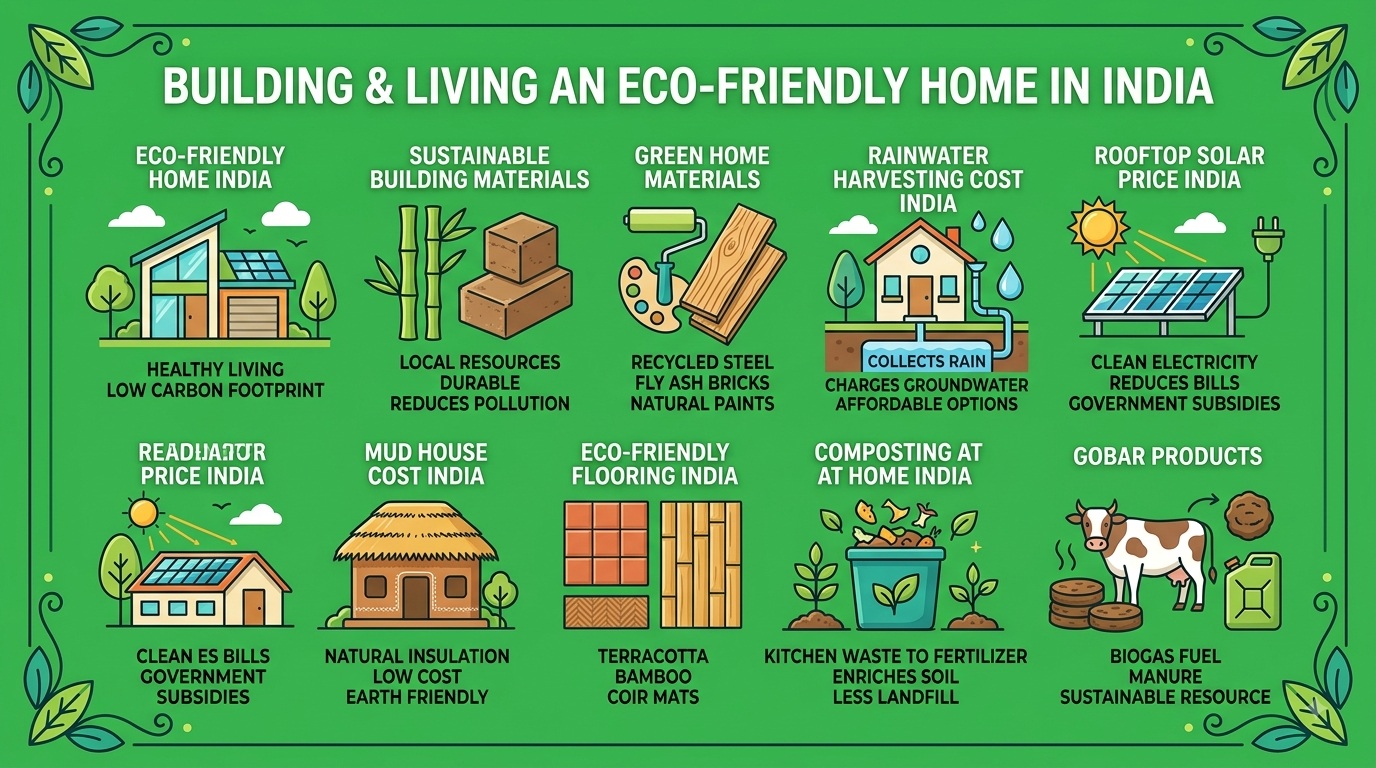
If you are an Indian homeowner thinking about greening your house, this guide is for you. It brings together every genuinely useful eco-friendly material, system and daily practice you can adopt — from mud blocks and bamboo to solar panels, rainwater harvesting and home composting — with honest cost cues, government subsidies and step-by-step how-tos. No fluff, no greenwashing, just what actually works in Indian conditions.
Why an Eco-Friendly Home Matters in India
India is building faster than almost anywhere on earth, and construction is one of the country’s largest sources of carbon emissions and resource use. Cement alone accounts for a significant share of India’s building-related pollution, and the sector is responsible for roughly 30% of building-related emissions nationally. (Source: AECORD — Green Building Materials India)
The good news is that India’s green building materials market has surged over 250% in five years and is expected to reach ₹10,000 crores in the near term. The practical benefits are real: lower operational costs, improved indoor air quality, and resale values that run 10–15% higher in metro cities. Going green is no longer a fringe lifestyle choice; it is becoming the smarter financial decision too. (Source: AECORD — Green Building Materials India)
An eco-friendly home is not one single product. It is a combination of four things working together:
- Materials with low embodied carbon — built from local, renewable or recycled inputs.
- Energy that is generated cleanly and used efficiently.
- Water that is harvested, used carefully and reused.
- Waste that is composted or digested rather than sent to landfill.
The sections below cover each of these in depth.
Part 1: Eco-Friendly Building Materials
1. Compressed Stabilised Earth Blocks (CSEB)
Long before the fired clay brick and the concrete block, India built in earth. Compressed Stabilised Earth Blocks — also called stabilised mud blocks — are the modern, engineered version of that ancient idea. You take the soil that is already on or near your site, add a small dose of a stabiliser (a little cement or lime) and just enough water, compress the damp mix in a press, and let the blocks cure. There is no kiln. Nothing is fired. That single fact is why a well-made CSEB wall carries only a fraction of the embodied carbon of a fired brick wall, while still giving you excellent thermal mass that keeps interiors cool in summer and warm in winter. (Source: Studio Matrx — CSEB Guide)
CSEB is best suited to load-bearing walls in dry and moderate climates, and it pairs beautifully with lime or mud plaster. The main thing to watch is soil quality — too much clay and the block cracks; too much sand and it crumbles. A soil test before you commit is non-negotiable.
2. Mud and Cob (Natural Building)
A natural building is crafted from materials like mud, lime, bamboo, wood, stone and plant admixtures — all sourced from the nature around you. It is more than a structure; it is an extension of the people who live in it. (Source: Thannal — Cost of Natural Building)
On cost, natural building by trained professionals starts at around ₹3,000–₹4,500 per sq ft, compared with conventional cement construction at ₹2,300–₹2,800 per sq ft. So natural building is not automatically cheaper when you hire experts — but it can be dramatically cheaper if you self-build with local labour. A Pune couple built a two-storeyed bamboo-and-mud farmhouse for just ₹4 lakh by sourcing local materials and upcycling waste, using a 700-year-old building method. (Sources: Thannal; The Better India)
Mud walls offer superb thermal comfort — they breathe, regulate humidity naturally, and feel cooler than concrete in summer. The trade-off is maintenance: mud walls need a protective lime or cow-dung plaster and periodic re-coating, and they are vulnerable to driving rain unless detailed well with good overhangs.
3. Bamboo
North-eastern India is blessed with ample bamboo resources, and bamboo’s tensile strength of roughly 28,000 pounds per square inch makes it one of the strongest building materials available. It is especially valuable in earthquake-prone regions like Tripura and the North-East, where its flexibility outperforms rigid “pucca” construction. (Source: NMHS — Construction Manual of Bamboo Houses)
Bamboo is a rapidly renewable material — it regrows in about five years — and it is hygromorphic, meaning it passively absorbs and releases moisture in response to humidity, quietly regulating indoor air without any energy input. (Source: AECORD — Hygromorphic Materials)
Use bamboo for structural frames, partitions, roofing members, ceilings and even flooring (strand-woven bamboo planks). The critical step is treatment: untreated bamboo is destroyed by borers and fungi within a few years. Borax-boric acid treatment is the standard preservation method.
4. Fly-Ash Bricks
Fly-ash bricks (IS 12894) are hydraulically pressed from fly ash, cement or lime, and sand, and cured without firing. When made well, they beat traditional kiln-fired clay bricks on dimensional accuracy, finish and environmental footprint, while costing the same or less all-in. (Source: Studio Matrx — Fly-Ash Bricks vs Clay Bricks)
They are made from power-plant waste that would otherwise sit in a landfill, so every fly-ash brick you use is one less burden on the environment. They also save on plaster because of their uniform surface — a real-world cost benefit that is easy to miss if you only compare brick prices. Choose them when you want the familiarity and strength of a masonry wall without the carbon penalty of kiln firing.
5. Reclaimed and Recycled Materials
- Reclaimed wood: Salvaged Burma teak and old hardwood from demolished buildings give you a floor or door frame with character and zero new-tree cost. Check for nails, rot and termite damage before buying.
- Recycled-content vitrified tiles: Some Morbi-made vitrified tiles now incorporate factory waste and fly-ash into the body, diverting industrial waste from landfill.
- Recycled-chip terrazzo: Made by embedding chips of marble, granite, quartz, glass or recycled materials into a cement or epoxy binder, then grinding and polishing. Terrazzo frequently uses recycled glass and stone offcuts, lasts 40–100 years, and is one of the most genuinely sustainable flooring options for green homes. (Sources: Studio Matrx — Reclaimed Flooring; Elbrus Solutions — Terrazzo Guide)
6. Shipping Containers
For those wanting a radical departure from conventional construction, shipping-container homes are a growing option. A Hyderabad father-son duo built a solar-powered home out of shipping containers that harvests the sun, the rain and kitchen waste. Containers are durable, modular and reuse industrial waste, though they need serious insulation in India’s heat and careful rust-proofing. (Source: The Better India — Hyderabad container home)
Part 2: Eco-Friendly Flooring, Finishes & Interiors
Flooring choices ranked green
| Material | Why it’s green | Indicative cost (material, 2026) |
|---|---|---|
| Local Kota / granite stone | Indian-quarried, low transport carbon, extremely durable | ₹80–₹250/sq ft |
| Bamboo plank | Rapidly renewable (5-year regrowth) | ₹250–₹450/sq ft |
| Reclaimed teak / hardwood | No new trees cut, full of character | ₹400–₹800/sq ft |
| Recycled-chip terrazzo | Uses waste glass/stone chips, 40–100 yr life | ₹200–₹400/sq ft |
| Fly-ash / recycled-content vitrified | Diverts industrial waste from landfill | ₹60–₹150/sq ft |
| Lime (araish) flooring | Low-carbon, breathable, cool traditional finish | ₹150–₹500/sq ft |
| Natural linoleum | Made from linseed oil, wood flour, jute — biodegradable | ₹300–₹500/sq ft |
Costs are indicative material rates per sq ft (2026, varies by city and vendor; add ~18% GST and laying). (Source: Studio Matrx — Eco Friendly Flooring India)
Walls and plasters
- Lime plaster and araish: Long before cement reached Indian sites, our havelis, palaces and temple floors were finished in lime — slaked lime mixed with marble dust, sand or brick aggregate, hand-applied and burnished until it gleams. Lime is breathable, low-carbon and naturally anti-fungal. (Source: Studio Matrx — Lime Flooring India)
- Mud and cow-dung plaster: The most local finish possible, virtually free, and excellent for indoor humidity control.
- Clay paints and low-VOC paints: Conventional paints release volatile organic compounds (VOCs) for months after application. Choose low-VOC or clay-based paints for healthier indoor air.
Insulation and roofs
- Terrace gardens (green roofs): Reduce rooftop temperatures by 5–8°C and cut cooling loads.
- Broken brick / brick bat coba: A traditional, low-cost waterproofing and insulation layer for terraces.
- Reflective cool-roof paints: White reflective coatings cut heat absorption dramatically for a few thousand rupees.
Part 3: Energy — Generate It Cleanly, Use It Efficiently
A sustainable home should be capable of generating its own power with minimal need for the grid, and designed to be a cool home that is not energy-guzzling. (Source: Citizen Matters — sustainable home)
Rooftop solar (SRTPV)
A Solar Rooftop Photovoltaic system (SRTPV) is the backbone of a green home’s energy setup. 2025 prices in India:
| Capacity | On-Grid Price (₹) | Hybrid with battery (₹) |
|---|---|---|
| 1 kW | ₹60,000 – ₹70,000 | ₹1,00,000 – ₹1,20,000 |
| 3 kW | ₹1,80,000 – ₹2,10,000 | ₹3,00,000 – ₹3,60,000 |
| 5 kW | ₹3,00,000 – ₹3,50,000 | ₹5,00,000 – ₹6,00,000 |
| 10 kW | ₹6,00,000 – ₹7,00,000 | ₹10,00,000 – ₹12,00,000 |
(Source: The Bhandari Group — Solar Rooftop Price India 2025)
A 1 kW system costs ₹65,000–₹80,000 on-grid before subsidy, and with the PM Surya Ghar subsidy can come down to around ₹50,000. A typical family of 4–5 needs roughly a 5 kW system, which costs ₹2,00,000–₹4,00,000 including installation. Battery storage adds ₹8,000–₹15,000 per kWh. (Sources: Solar Tiger; RenewConnect)
Real-world proof it pays back: A Bengaluru couple, Manju Nath and Geeta, built an eco-friendly home that runs entirely on solar power and earns Rs 70,000 a year from surplus energy exported to the grid. (Source: The Better India — Bengaluru eco home)
Solar water heater
A fraction of the cost of a full PV system, a solar water heater gives you free hot water for 8–10 months a year and pays back in 2–3 years. Ideal for homes in South, West and Central India.
Energy efficiency (the cheapest watt is the one you don’t use)
- LED lighting throughout — uses 1/10th the power of incandescent.
- 5-star rated appliances (BEE star label) — a 5-star AC can halve cooling bills.
- Natural ventilation and daylighting — large windows on north and south, shaded verandahs, courtyards. This is free cooling.
- Ceiling fans over ACs whenever possible.
Part 4: Water — Harvest, Use Less, Reuse
Rainwater harvesting
The rainfall that lands on your rooftop every monsoon is a free, renewable resource you are currently not using. (Source: Sustainable Spaces — Rainwater Harvesting for Indian Homes)
There are two main approaches:
- Storage-based systems collect rainwater in an above-ground or underground tank for direct use in toilet flushing, gardening, car washing and floor mopping. The tank is the most expensive single component.
- Recharge-based systems direct filtered rainwater back into the ground via a recharge pit, recharging the aquifer beneath your plot.
Cost: On average, a rainwater harvesting system in India costs between ₹20,000 and ₹80,000 for a residential home, running to several lakhs for large villas or apartment complexes. Conveyance (gutters, downpipes) costs ₹150–₹300 per metre, and a first-flush diverter is essential to keep the dust- and debris-laden first rain out of your tank. (Sources: Houseyog; AECORD)
What it can achieve: A retired Navy Commander’s Bengaluru home saves up to 75,000 litres of water a year. Architect Jaya Rayaprolu’s Bengaluru home harvests 1.3 lakh litres of rainwater annually and recycles 800 litres of grey water daily. (Sources: The Better India — Commander’s home; The Better India — Jaya Rayaprolu home)
Greywater recycling
Greywater is the relatively clean waste water from baths, sinks and washing machines. A small-scale greywater recycling system costs ₹1,00,000–₹2,50,000 and can cut your fresh-water demand by 30–50%. Filtered greywater is perfect for flushing, gardening and floor mopping. (Source: RenewConnect)
Efficient plumbing fixtures
The cheapest water upgrade you can make: low-flow faucets, aerated showerheads and dual-flush toilets cost ₹20,000–₹50,000 for a whole house and immediately reduce consumption. (Source: RenewConnect)
Part 5: Waste — Compost and Generate Biogas
Home composting
A home composter turns your daily kitchen waste into nutrient-rich compost in 3–4 weeks. Units cost between ₹5,000 and ₹50,000 depending on capacity and whether they are manual or automated. (Source: RenewConnect)
Options:
- Terracotta pots (₹1,000–₹3,000) — cheapest, breathes well, for small families.
- Khamba-style stacked pots — popularised by Daily Dump, ideal for balconies.
- Electric composter (₹15,000–₹50,000) — processes waste in 24 hours, good for larger families.
Biogas plant
A small home biogas plant (₹30,000–₹1,00,000) converts kitchen and garden waste into cooking gas and liquid fertiliser. A family generating 1–2 kg of food waste daily can produce enough biogas for 30–45 minutes of cooking per day. (Source: RenewConnect)
Zero-waste living
A Mumbai couple, Prashant and Vibhuti Bajaria, run a zero-waste urban home: solar-powered, with a solar water heater, a home composter for wet waste, rainwater harvesting, no plastic bags, and a planned leaf composter. (Source: Ethico India)
Part 6: Gobar Gas & Cow Dung Products — Wealth From Waste
In India the cow is traditionally considered auspicious, and its dung (gobar) is one of the most versatile eco-materials available to a household. A single cow’s daily dung can be turned into cooking fuel, organic fertiliser, building material, and a whole range of everyday products — the very meaning of the GOBAR-DHAN scheme is “cow dung is wealth” (gobar = cow dung, dhan = wealth). This section covers the two biggest uses: gobar gas (biogas) for energy, and cow dung products for the home and garden.
6.1 Gobar Gas (Biogas) — How It Works
A biogas plant is a unit which converts organic waste matter (living biomass) into useful gaseous fuel (methane and carbon dioxide) and organic fertiliser as a byproduct in the form of slurry. The most common feed material in family-size biogas plants is cattle dung. (Source: MNRE — Biogas Programme)
The process is anaerobic digestion: dung (or kitchen waste, crop residue, even toilet waste) is fed into a sealed underground or brick dome where bacteria break it down in the absence of oxygen. The output is methane-rich gas piped straight to your kitchen stove, plus a liquid “slurry” that is an excellent organic fertiliser. The initial setup involves mixing about 150 kg of cow dung with 1,000 litres of water to establish the anaerobic bacteria culture — a one-time process that takes roughly three weeks to activate. After that, you simply feed it daily. (Source: BioEnergy Times — Goa family biogas)
How much gas you get: A 2 cubic metre plant processes around 5 kg of kitchen waste (or the equivalent in dung) daily and generates up to two hours of cooking gas. A larger 7 cubic metre plant handles up to 12 kg of wet waste daily, producing about four hours of cooking gas and 30 litres of slurry. (Source: BioEnergy Times)
What it saves: A household biogas plant can substitute 1–2 LPG cylinders per month, saving ₹900–₹1,800 a month on cooking gas, plus the organic slurry is worth ₹5,000–₹8,000 a year as fertiliser. (Source: GOBAR-DHAN Yojana)
6.2 Real Homes Running on Gobar Gas
The proof that gobar gas works long-term is Kattanbhavi village in Karnataka’s Belagavi district, where 85% of the 250 households have been using gobar gas for daily cooking for over four decades. Most homes own cattle, and the dung — sometimes combined with toilet waste — powers their kitchens. Residents say they have no worries about empty LPG cylinders or booking refills, and there is no fear of explosions. With support from the Khadi Gramodyog Sangh, nearly 30,000 biogas units were installed across Belagavi, Hukkeri and Khanapur taluks between 1990 and 1995. (Source: ETV Bharat — Kattanbhavi village)
In Goa, a family in Mayem village installed a 2 cubic metre MNRE-approved biogas plant for ₹65,000 (nearly half covered by subsidy) that processes their kitchen waste and produces two hours of cooking gas daily, odour-free because the whole process is sealed. (Source: BioEnergy Times)
Across Gujarat, over 7,200 household biogas plants have been set up under the GOBAR-DHAN scheme; in Zakariapura village, 368 farmers installed 2 cubic metre plants that each save them ₹10,000–₹15,000 a year by replacing LPG and firewood. (Sources: The Hindu BusinessLine; Financial Express)
6.3 Gobar Gas Plant Cost & Subsidies
Setting up a household biogas unit costs between ₹15,000 and ₹40,000, with commercial-scale plants running into lakhs or crores. The average cost of a 2 cubic metre plant is about ₹17,000, roughly 30% higher in hilly areas and 50% higher in the North-East. (Sources: Financial Express; MNRE FAQ)
India offers strong central subsidies that make gobar gas remarkably affordable:
- National Biogas and Manure Management Programme (NBMMP) — central subsidy of ₹9,800 to ₹70,400 per plant for small plants (1–25 cubic metre/day capacity), based on size. SC/ST beneficiaries and North-Eastern states get higher rates. (Source: MNRE — Biogas Programme)
- GOBAR-DHAN Yojana (launched 1 February 2018 under Swachh Bharat Mission-Grameen) — household biogas plant subsidy of ₹10,000–₹40,000. In Gujarat, a 2 cubic metre plant costing ₹42,000 total requires only ₹5,000 from the beneficiary, with ₹25,000 from central/state government and ₹12,000 from MGNREGA. (Sources: GOBAR-DHAN Yojana; The Hindu BusinessLine)
- Additional subsidy of ₹1,600 per plant if the biogas plant is linked to a sanitary toilet or an MNRE-approved slurry unit. (Source: MNRE — Biogas Programme)
- Turn-key job fee with a 5-year free maintenance warranty — ₹3,000 per plant for 1–10 cubic metre plants, ₹5,000 for 15–25 cubic metre plants, for onsite brick-masonry models (Deenbandhu fixed dome or KVIC floating gasholder). (Source: MNRE FAQ)
You can apply online through the Biogas Portal (biogas.mnre.gov.in) or contact your Block Development Officer (BDO) / State Nodal Agency. The scheme is implemented by State Rural Development Departments, KVIC, NDDB and Dairy Cooperatives. (Source: MNRE — Biogas Programme)
6.4 The Organic Slurry — A Bonus Fertiliser
The digested slurry that comes out of a biogas plant is arguably as valuable as the gas. It is a rich, pathogen-free organic fertiliser high in nitrogen, phosphorus and potassium that improves soil organic matter, water-holding capacity and cation exchange capacity. (Source: Indian Journal of Extension Education). When 20 kg of cow dung is mixed with an equal amount of water, the plant produces around 40 litres of slurry daily. (Source: BioEnergy Times). Farmers use it directly on crops, sell it as enriched compost, or feed it into vermicompost beds.
6.5 Cow Dung Products for the Home
Beyond gas, cow dung is crafted into a surprisingly wide range of eco-friendly household products. Fresh cow dung is collected, blended with natural binders (husk fibre, jute or straw, a little clay, lime or gum arabic), shaped in moulds, and sun-dried for several days. (Source: Office of the Development Commissioner for Handicrafts — Cow Dung Craft). Here is what you can buy or make:
- Cow dung diyas (lamps) —eco-friendly, biodegradable earthen lamps that decompose harmlessly after festivals, countering cheap Chinese-made alternatives and supporting the “Make in India” idea. (Source: NECTAR — DST)
- Cow dung agarbatti (incense sticks) and dhoop — charcoal-free, natural incense that purifies the air instead of polluting it. Major brands like MDPH have launched cow dung-based agarbattis, dhoop cups and cones under their Gauved line. (Sources: Dharmadhikari; AgriNews — MDPH)
- Cow dung upla / cakes (kanda) — dried dung cakes used for cooking fires, havan and religious ceremonies, producing vibhuti (holy ash). (Source: Office of the Development Commissioner for Handicrafts)
- Biodegradable nursery pots — pots made from cow dung and agricultural waste that replace plastic polybags in nurseries. Once the sapling is grown, you bury the whole pot in the garden; it decomposes and provides nutrients to the roots with zero plant shock and zero plastic waste. (Source: NECTAR — DST)
- Sculptures and decorative items — wall hangings, torans (door hangings), kumkum boxes, spice boxes, pen stands, religious symbol plaques and masks. (Source: Office of the Development Commissioner for Handicrafts)
- Cow dung manure / compost — increases the organic matter content of the soil, leading to improved water infiltration and water-holding capacity. (Source: Indian Journal of Extension Education)
- Vermicompost base — cow dung slurry or dried dung is an excellent feedstock for earthworm beds, producing premium vermicompost.
A study from Kanpur district found that cow dung products — agarbatti, dhoop, diyas, pots and cakes — are “hundred per cent safe and eco-friendly” and provide rural families, especially women, an additional income-generating activity from home. (Source: Indian Journal of Extension Education). One Jammu entrepreneur, Rajat Salgotra, built a business collecting 500 kg of cow dung daily and employing 40 women from self-help groups to make diyas, agarbattis and biodegradable Ganesh idols. (Source: Apni Kheti — Progressive Farmers)
6.6 Can an Urban Home Use Cow Dung Products?
Yes — even without cattle of your own:
- Buy cow dung agarbatti and dhoop cups for daily pooja (widely available online).
- Use cow dung diyas for Diwali instead of plastic or painted clay ones.
- Buy cow dung nursery pots for your terrace or balcony garden.
- If you have a garden, source dried cow dung cakes or slurry from a local gaushala for composting.
- Some compact, prefabricated biogas units (like the Goa family’s) can run on kitchen waste alone, needing an initial dose of cow dung to start the culture.
Part 7: Everyday Eco-Friendly Activities at Home
You do not need to rebuild your house to live greener. These daily practices work for renters and owners alike:
- Segregate waste at source — dry, wet and hazardous in separate bins. This is the single most effective step.
- Compost kitchen waste — even a balcony Khamba handles a family’s daily scraps.
- Grow your own food — a terrace or balcony kitchen garden with tomatoes, mint, coriander, chillies and greens cuts your grocery bill and pesticide exposure. One Bengaluru couple grows 80% of their food organically; another tends 40 varieties of organic produce. (Sources: The Better India — Rajesh & Vallari; The Better India — zero-utility home)
- Eliminate single-use plastic — carry cloth bags, use steel or glass containers, switch to soap and shampoo bars.
- Line-dry clothes instead of using a tumble dryer — saves significant electricity.
- Use a pressure cooker and induction where possible — more efficient than gas for most cooking.
- Adopt a car-free or EV lifestyle — cycle or walk short distances; plan for an electric vehicle when you next upgrade.
- Switch off and unplug — phantom loads from devices on standby add up to 5–10% of your bill.
- Use natural light and ventilation before reaching for a switch.
- Repair, don’t replace — extend the life of furniture, appliances and clothes.
Part 8: Indoor Air Quality & Greenery
- Natural ventilation with cross-ventilation and shaded courtyards is India’s oldest and best air-conditioning.
- Air-purifying indoor plants — areca palm, money plant, snake plant, peace lily — each remove specific VOCs from indoor air.
- Low-VOC paints and finishes prevent the off-gassing that plagues newly painted or furnished rooms.
- Avoid synthetic carpets and pressed-wood furniture that release formaldehyde.
Part 9: What Does It All Cost? — A Practical Breakdown
Here is an honest, consolidated cost picture for greening an Indian home (2025–26 indicative):
| Upgrade | Cost range | Payback |
|---|---|---|
| CSEB / mud walls (vs fired brick) | ₹2,300–₹4,500 / sq ft | Cooler interiors, lower bills |
| Fly-ash bricks (vs clay brick) | Same or cheaper all-in | Immediate |
| Bamboo structure (treated) | ₹150–₹400 / sq ft | Durable, seismic resilience |
| Eco-friendly flooring (stone/bamboo/terrazzo) | ₹80–₹800 / sq ft | 40–100 yr lifespan |
| Rooftop solar 3 kW (on-grid) | ₹1.8–₹2.4 lakh (₹1.3L after subsidy) | 4–6 years |
| Solar water heater | ₹15,000–₹40,000 | 2–3 years |
| Rainwater harvesting | ₹20,000–₹80,000 | Reduces tanker dependency |
| Greywater recycling | ₹1–2.5 lakh | 5–8 years |
| Home composter | ₹5,000–₹50,000 | Pays back in garden produce |
| Gobar gas / biogas plant (2 m³) | ₹15,000–₹42,000 (₹5,000 after subsidy in some states) | Saves 1–2 LPG cylinders/month |
| Cow dung products (diyas, agarbatti, dhoop, pots) | ₹50–₹500 per item | Replaces plastic/charcoal alternatives |
| Efficient plumbing fixtures | ₹20,000–₹50,000 | Immediate on water bill |
(Sources: RenewConnect; The Bhandari Group; Houseyog; Thannal; Studio Matrx; MNRE; GOBAR-DHAN Yojana; Financial Express)
Part 10: Government Subsidies & Schemes
India offers several subsidies that make greening your home much more affordable:
- PM Surya Ghar: Muft Bijli Yojana — subsidises rooftop solar installation. A 1 kW system can drop to ~₹50,000 after subsidy, and households get up to 300 units of free electricity per month. (Source: Solar Tiger)
- State-level solar subsidies — many states add their own top-up on top of the central subsidy.
- GOBAR-DHAN Yojana (launched 1 Feb 2018, under Swachh Bharat Mission-Grameen) — household biogas plant subsidy of ₹10,000–₹40,000. In Gujarat a ₹42,000 plant costs the beneficiary only ₹5,000, the rest coming from central/state government and MGNREGA. Apply at sbm.gov.in/gbdw. (Sources: GOBAR-DHAN Yojana; The Hindu BusinessLine)
- National Biogas and Manure Management Programme (NBMMP) — central subsidy of ₹9,800–₹70,400 per plant for small biogas plants (1–25 cubic metre/day), with higher rates for SC/ST and North-Eastern states. An extra ₹1,600 is available if linked to a sanitary toilet. Apply at biogas.mnre.gov.in. (Source: MNRE — Biogas Programme)
- PMAY-G / Gharkul Yojana — affordable housing schemes increasingly encourage low-cost, eco-friendly materials. (Source: IJRASET)
- IGBC Green Homes, GRIHA, LEED India — rating systems that certify green homes and can qualify you for incentives like property-tax rebates in some municipalities. Many recycled-content materials earn points under these ratings. (Source: Studio Matrx — Reclaimed Flooring)
Always check the current subsidy in your state — they change frequently.
Part 11: How to Get Started — Renters vs Owners
If you own your home
Start with the highest-payback, lowest-hassle upgrades first, and phase the rest:
- Year 1: LED lighting, efficient fixtures, a home composter, segregate waste, start a balcony garden, switch to cow dung agarbatti/dhoop and diyas.
- Year 2: Rooftop solar (with subsidy), solar water heater, rainwater harvesting. If you keep cattle (or can source dung), install a gobar gas plant under GOBAR-DHAN.
- Year 3+: During a renovation, switch to fly-ash bricks or CSEB, lime plaster, eco flooring, greywater recycling.
If you rent
You cannot change the structure, but you can still green your life substantially:
- Install a balcony composter and a few planters (try cow dung nursery pots — they decompose into fertiliser).
- Switch all bulbs to LEDs.
- Use aerated showerheads and faucet aerators (easily removed when you move).
- Eliminate single-use plastic.
- Use cow dung agarbatti and dhoop instead of charcoal-based incense.
- Line-dry clothes, pressure-cook, unplug devices.
- Ask your landlord about rooftop solar — many will agree once they see the subsidy math.
Common Myths About Eco-Friendly Homes
Myth 1: “Eco-friendly homes are always cheaper.”
Not always. Natural building by professionals (₹3,000–₹4,500/sq ft) can cost more than conventional cement construction (₹2,300–₹2,800/sq ft). It is cheaper only when you self-build or use free local materials. (Source: Thannal)
Myth 2: “Mud houses are weak and temporary.”
Properly built mud and CSEB structures last for generations — many of India’s heritage havelis are centuries old. The key is good design: wide overhangs, lime plaster, and a solid foundation.
Myth 3: “Solar doesn’t work in monsoon.”
Output drops, but a correctly sized system still generates 40–60% of peak output on overcast days, and net-metering lets you bank surplus summer production for rainy months.
Myth 4: “Rainwater harvesting is only for villages.”
Bengaluru, Chennai and Mumbai now mandate rainwater harvesting for new buildings. Urban homes harvest lakhs of litres annually and significantly reduce tanker dependence. (Source: The Better India)
Myth 5: “Going green means giving up comfort.”
A well-designed eco-home is more comfortable than a concrete box — cooler in summer, warmer in winter, and full of natural light and fresh air.
Myth 6: “Gobar gas is only for villages.”
Compact prefabricated biogas units (like the one a Goa family installed for ₹65,000) run on kitchen waste alone, needing just an initial dose of cow dung to start the culture. They are sealed, odour-free, and fit in a backyard or large terrace. (Source: BioEnergy Times)
Frequently Asked Questions (FAQ)
What is the cheapest eco-friendly building material in India?
Fly-ash bricks are usually the cheapest green upgrade — they cost the same as or less than fired clay bricks, all-in, while diverting power-plant waste from landfill.
How much does a fully sustainable home cost in India?
Conventional cement construction runs ₹2,300–₹2,800/sq ft. A natural building by professionals starts at ₹3,000–₹4,500/sq ft. A self-built mud-and-bamboo home can be built for as little as ₹4 lakh. (Sources: Thannal; The Better India)
Is rooftop solar worth it in 2025?
Yes. A 1 kW on-grid system costs ₹65,000–₹80,000 before subsidy and around ₹50,000 after subsidy, with a payback of 4–6 years and free electricity thereafter. (Sources: Solar Tiger; The Bhandari Group)
Do I need permission for rainwater harvesting?
Several Indian cities (Bengaluru, Chennai, parts of Mumbai) now mandate it for new buildings. For an existing independent house, a simple storage or recharge system usually needs no special permission. (Source: Sustainable Spaces)
Can I compost if I live in a flat?
Yes. Terrace or balcony composters like the Khamba work in small spaces and are odour-free when maintained correctly.
What is the most sustainable flooring for Indian homes?
Local stone (Kota, granite), reclaimed teak, bamboo, recycled-chip terrazzo and lime araish are all genuinely sustainable — each for a different reason. Pick based on budget and room. (Source: Studio Matrx)
How long does it take for an eco-friendly home to pay for itself?
Energy and water upgrades (solar, rainwater harvesting, efficient fixtures) typically pay back in 2–6 years. Material choices (mud, lime, stone) pay back over decades through lower bills and longer lifespan.
How much does a gobar gas plant cost and is there a subsidy?
A household biogas unit costs ₹15,000–₹42,000. Under GOBAR-DHAN, a beneficiary’s contribution can be as low as ₹5,000, with the rest covered by central/state government and MGNREGA. The NBMMP offers ₹9,800–₹70,400 per plant, with an extra ₹1,600 if linked to a sanitary toilet. Apply at biogas.mnre.gov.in or sbm.gov.in/gbdw. (Sources: MNRE; GOBAR-DHAN Yojana; The Hindu BusinessLine)
What can I make from cow dung at home?
Diyas, agarbatti, dhoop cups, upla (dung cakes), nursery pots, and decorative items. Fresh dung is blended with binders (husk, straw, clay, lime), shaped in moulds, and sun-dried for several days. (Source: Office of the Development Commissioner for Handicrafts)
Conclusion
An eco-friendly home in India is not a single luxury product — it is a set of smart, layered choices. Start with what is within reach today: a composter on the balcony, LED bulbs, a segregated dustbin, a few pots of mint and tomato, and cow dung agarbatti and diyas in your pooja room. Then layer in the bigger moves — rooftop solar with the PM Surya Ghar subsidy, a rainwater harvesting pit, a gobar gas plant under GOBAR-DHAN if you have cattle or kitchen waste, fly-ash or CSEB walls at your next renovation, and lime plaster instead of cement.
Every step pays you back. The Bengaluru couple earning ₹70,000 a year from surplus solar, the commander saving 75,000 litres of water, the Pune couple who built a two-storey home for ₹4 lakh, and the Kattanbhavi villagers who have cooked on gobar gas for four decades are not extraordinary people — they simply made these choices, one at a time. (Sources: The Better India — Bengaluru eco home; The Better India — Commander’s home; The Better India — Pune mud home; ETV Bharat — Kattanbhavi village)
The greenest home is the one you already have, made a little greener every season. Start this monsoon.
Sources & Further Reading
- AECORD — Green Building Materials India: Sustainable Options
- Studio Matrx — Green Building Materials Guide (India) 2026
- Thannal — Mud House Construction Cost in India (2026)
- NMHS — Construction Manual of Bamboo Houses
- The Better India — Bengaluru eco-friendly home (Manju Nath & Geeta)
- Ethico India — Mumbai couple’s zero-waste urban home
- Citizen Matters — How to build a sustainable home
- Solar Tiger — 1kW Solar System Price in India 2025
- The Bhandari Group — Solar Rooftop System Price in India 2025
- RenewConnect — How much it costs to develop a self-sustainable house
- Houseyog — Rainwater Harvesting Cost in India 2025
- Sustainable Spaces — Rainwater Harvesting For Indian Homes
- Elbrus Solutions — Terrazzo Flooring Complete Guide
- IJRASET — Affordable Housing Solutions (PMAY and Gharkul Yojana)
- CSE India — Wisdom to Build (compendium of sustainable construction technologies)
- MNRE — Biogas Programme (National Bioenergy Programme)
- ETV Bharat — No LPG worry for Karnataka village using biogas for four decades
- Office of the Development Commissioner for Handicrafts — Cow Dung Craft
- NECTAR (DST) — Eco-Friendly Cow Dung Diyas and Pots
- Indian Journal of Extension Education — Rural women making cow dung products
- Apni Kheti — Rajat Salgotra, Jammu entrepreneur making cow dung products
- Dharmadhikari — Cow Dung Agarbatti & Dhoop
- AgriNews — MDPH to launch cow dung-based agarbattis, dhoop cups and cones