Introduction: The Vaishnava Vision of the Samskaras
The Sanskrit word “Samskara” (संस्कार) comes from the prefix “sam-” (well, completely, together) joined to the verbal root “kri” (to do, to make). Its literal meaning is “putting together well” — refining, perfecting, making something whole. In the Gaudiya Vaishnava tradition, a Samskara is not merely a social ceremony; it is a purificatory rite that sanctifies every threshold of life with the remembrance and worship of Lord Sri Krishna.
While the broader Hindu tradition recognises the Shodasha Samskaras — the sixteen rites of passage drawn from the Grihya Sutras and the Smritis of Manu, Yajnavalkya, and Vyasa — the Gaudiya Vaishnava sampradaya founded by Sri Chaitanya Mahaprabhu (1486–1533) received these rites through two seminal works: the Hari Bhakti Vilasa and the Sat Kriya Sara Dipika. Compiled in sixteenth-century Vrindavan by the Goswamis, these texts reorient every Samskara toward a single goal — not material prosperity, but krishna-prema, pure love of Godhead.
In all the samskaras, from garbhadhana to the cremation ground, the devotee should worship Lord Vishnu with the mantras of the Vedas. This is the instruction of the Hari Bhakti Vilasa.
The Authoritative Gaudiya Vaishnava Texts on Samskara
Sri Chaitanya Mahaprabhu instructed His followers to live according to Vaishnava smriti — the codified rules of devotional life. Two works emerged from this instruction, and together they form the ritual backbone of Gaudiya Vaishnavism.
1. Hari Bhakti Vilasa
The Hari Bhakti Vilasa (ca. 1540), described as the “Splendour of Devotion to Hari,” is the principal Vaishnava smriti of the Gaudiya tradition. It was compiled by Srila Gopala Bhatta Goswami on the order of Mahaprabhu, with a commentary (Dig-darshini) by Srila Sanatana Goswami. Every manuscript examined by modern scholars identifies Gopala Bhatta as the compiler, while Jiva Goswami and Krishnadasa Kaviraja attribute the work to Sanatana Goswami — later tradition harmonises this by saying that Sanatana Goswami wrote the core and Gopala Bhatta completed and published it.
Across its twenty chapters (vilasas), the Hari Bhakti Vilasa covers the entire arc of Vaishnava life: initiation (diksha), the daily worship of the Deity (arcana), the marks and ornaments of a Vaishnava (tilaka, tulasi, mudras), the rules of eating, bathing, and sleeping, the observance of Ekadashi and other vows, and the conduct of festivals. It is the authorised scripture for arcana — Deity worship — in the Gaudiya line.
2. Sat Kriya Sara Dipika
The Sat Kriya Sara Dipika (“Lamp of the Essence of Ritual Acts”) is Srila Gopala Bhatta Goswami’s manual specifically for the performance of fire sacrifices (yajna) and Samskaras. Where the Hari Bhakti Vilasa is the authority for worship, the Sat Kriya Sara Dipika is the authority for the rites of passage. Srila Bhaktisiddhanta Sarasvati Thakura accepted it as the authorised Vaishnava manual for yajna and samskara and recommended that all Vaishnava grihasthas (householders) follow its procedures.
The text opens with a decisive argument: the usual samskara manuals — those of Aniruddha Bhatta, Bhima Bhatta, Govindananda Bhatta, Narayana Bhatta, and Bhavadeva Bhatta — were compiled for karmis, those seeking material fruits, and they prescribe the worship of devatas (demigods) and pitris (ancestors). Gopala Bhatta Goswami, drawing evidence from the Vedas, Puranas, Pancaratra, and the eighteen Dharma Shastras including Manu Smriti, demonstrates that a Vaishnava should worship only Lord Vishnu and His pure devotees.
The Defining Principle: Worship of Vishnu Alone
This is the single most important distinction of the Gaudiya Vaishnava approach to Samskaras. Where the karmi manuals prescribe worship of Ganesha to remove obstacles, the planetary deities (navagrahas) for astrological protection, the directional guardians (dik-palas), and the sixteen mother-goddesses (matri-gana), Gopala Bhatta Goswami substitutes the worship of Vishnu and His pure devotees.
Citing the Padma Purana, the Sat Kriya Sara Dipika lays out the substitutions that a Vaishnava must make:
- Instead of Ganesha: Worship Vishvaksena — the commander-in-chief of Vishnu’s army in Vaikuntha — and the four Kumaras, to remove obstacles on the spiritual path.
- Instead of the Navagrahas (nine planetary deities): Worship the nine Yogendras — the great liberated devotees such as Kavya Muni (Shukadeva).
- Instead of the Dik-palas (protectors of the ten directions): Worship the Maha-bhagavatas — great devotees such as Brahma, Shukadeva, Sada-Shiva, Garuda, Narada, Kapila, Bali, Bhishma, Prahlada, Hanuman, Ambarisha, Yama, Svayambhuva Manu, and Vyasa.
- Instead of the Matri-gana (sixteen female demigoddesses): Worship the Lord’s consorts and associates — Bhagavati Paurnamasi, Radharani, Candravali, Gayatri, Tulasi, Sarasvati, Ganga, Yamuna, and the queens of the Lord.
The reasoning is theological, not merely procedural. The Padma Purana states that worship of the devatas, who are mixed devotees, brings only material auspiciousness, whereas worship of Vishnu and His associates, who are pure devotees, brings spiritual deliverance. To worship any devata independently, as if equal to or separate from Vishnu, is an offence against the Holy Name (namaparadha) and against devotional service (sevaparadha).
“The devotee of Sri Krishna, with great intelligence, should worship these Vaishnavas according to the proper scriptural rules and should never worship the primary or secondary demigods.” — Sat Kriya Sara Dipika, citing the Padma Purana
The Framework: Bhagavata Dharma over Karma Khanda
Gopala Bhatta Goswami opens the Sat Kriya Sara Dipika by stating that his manual is meant for devotees of Lord Govinda — whether inside the varnashrama system (brahmanas, kshatriyas, vaishyas, shudras) or outside it — who have been initiated with the name and mantra of Lord Krishna by a bona fide guru. The purpose is that they may perform the Vedic Samskaras without giving up bhagavata dharma, the path of pure devotion.
Bhagavata dharma, he explains, is devoid of karmic activities — daily duties (nitya), occasional duties (naimittika), and desire-driven rites (kamya) — and of the worship of devatas and pitris. Because the philosophy of those fixed in bhagavata dharma is superior to that of those fixed in karma, this manual of Vedic Samskaras following bhagavata dharma is declared superior to all the karmi manuals. The Samskaras are thus not abandoned but transvalued: every rite is retained, but its object of worship is redirected to Krishna, and its fruit is offered to Him rather than claimed for oneself.
This is consistent with the teaching of the Srimad Bhagavatam (6.9.22) and the Bhagavad-gita (9.23–25), where Krishna declares that those who worship the devatas worship Him indirectly, but in a misplaced way, and that one should worship Him alone with full devotion. Gopala Bhatta Goswami’s commentary on this verse establishes that the devotee should not worship the devatas even in dreams.
The Panca Samskara: The Rite of Spiritual Initiation
Before turning to the life-cycle rites, it is essential to understand the Panca Samskara — the five sacraments of Vaishnava initiation — because this is the gateway that makes a person eligible to perform the other Samskaras in the Vaishnava way. Described in the Padma Purana and elaborated by Srila Bhaktivinoda Thakura, the Panca Samskara consists of:
- Tilaka: The marking of the body with sacred clay (gopicandana) in the vertical lines of Vishnu, signifying the body as a temple of the Lord.
- Pundra: The application of the U-shaped tilaka marks on twelve parts of the body, sanctifying each as belonging to the Lord.
- Nama: The giving of a spiritual name (such as Krishna Dasa, Govinda Dasa, Chaitanya Dasa) indicating that one is a servant of Hari.
- Mantra: The imparting of the eighteen-syllable Gopala Mantra (or other Vaishnava mantra) by the guru into the ear of the disciple.
- Yaga: The initiation into Deity worship (arcana) of salagrama-sila or the vigraha of Vishnu, which the devotee then performs for life.
Through Panca Samskara, a faithful person enters bhajana-kriya, personal worship of the Lord, which eventually leads to krishna-prema. Without yaga (Deity worship), Bhaktivinoda Thakura warns, the conditioned soul cannot advance properly — even after receiving tilaka, nama, and mantra. This is why the Hari Bhakti Vilasa devotes so many of its chapters to the rules of arcana.
The 16 Samskaras: At a Glance in the Vaishnava Tradition
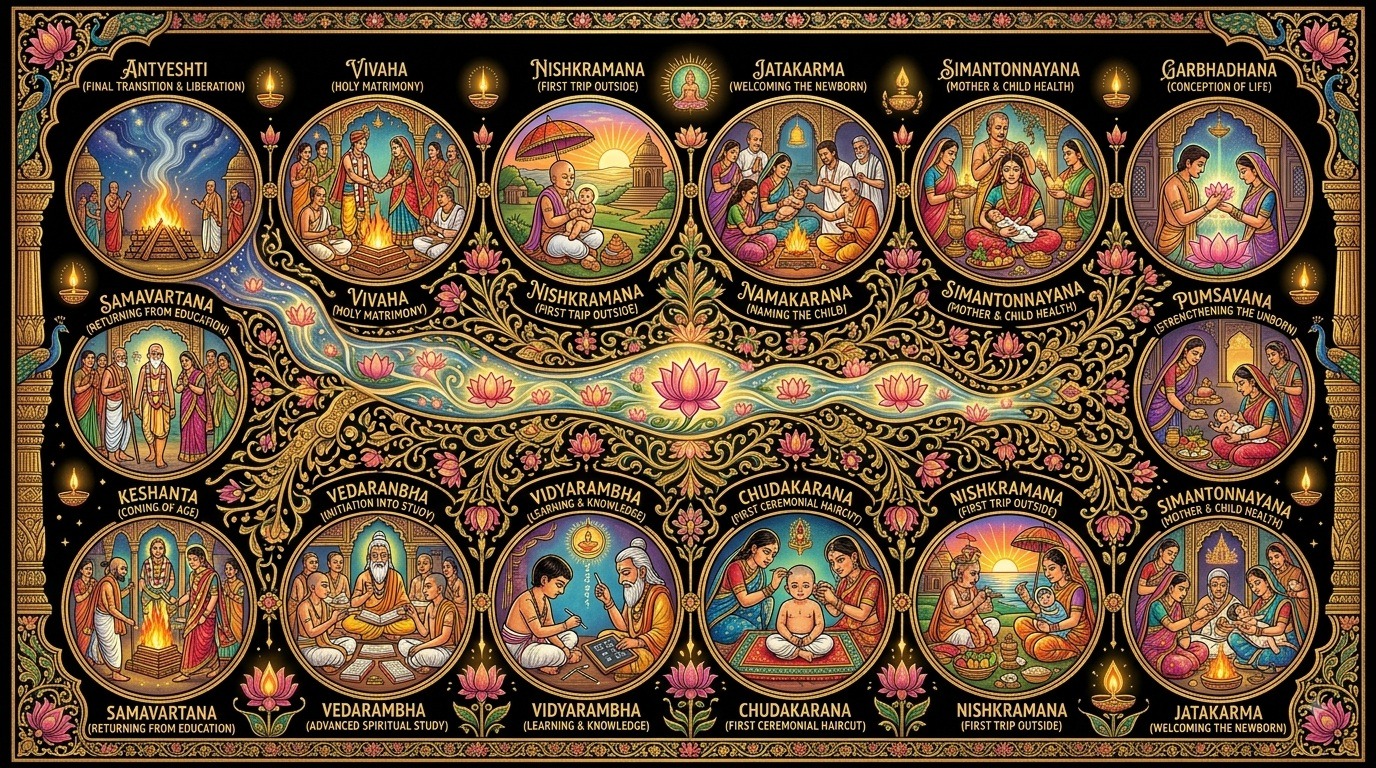
The Hari Bhakti Vilasa and Sat Kriya Sara Dipika acknowledge the full span of life from garbhadhana (niseka) to the cremation ground. The following table presents the sixteen Samskaras as understood in the Gaudiya Vaishnava framework, noting the Vaishnava distinctives in each.
| # | Samskara | Life Stage | Vaishnava Distinctive |
|---|---|---|---|
| 1 | Garbhadhana | Conception | Worship of Vishnu for pure, Krishna-conscious progeny |
| 2 | Pumsavana | 2nd-3rd month of pregnancy | Prayers to Vishnu for the unborn child’s spiritual welfare |
| 3 | Simantonnayana | 7th-8th month | Blessings of Vaishnavas upon the expectant mother |
| 4 | Jatakarma | At birth | First taste of Krishna-prasada (honey and ghee offered to the Lord) |
| 5 | Namakarana | 11th-12th day | A name indicating devotion to Hari (e.g. Krishna Dasa) |
| 6 | Nishkramana | 4th month | First visit to the Vishnu temple; darshan of the Lord |
| 7 | Annaprashana | 6th-7th month | First solid food as Krishna-prasada, offered to the Deity |
| 8 | Chudakarana | 1st-3rd year | Tonsure with prayers to Vishnu, not the planetary deities |
| 9 | Karnavedha | 3rd-5th year | Ear-piercing as an act of consecration to the Lord |
| 10 | Vidyarambha | 5th year | First letters written invoking Krishna and His devotees |
| 11 | Upanayana | 7th-12th year | Sacred thread as a Vaishnava; Gayatri offered to the Lord |
| 12 | Vedarambha | After Upanayana | Study of scripture under a Vaishnava guru |
| 13 | Keshanta / Godana | 16th year | First shave offered to Vishnu, not to a river devata |
| 14 | Samavartana | End of studentship | Return home as a Krishna-conscious graduate |
| 15 | Vivaha | Adulthood | Marriage with Shalagrama worship and the Hare Krishna maha-mantra |
| 16 | Antyeshti | After death | Cremation with Vishnu mantras; body offered to the Lord’s fire |
The 16 Samskaras in Detail
Prenatal Samskaras: Dedication to the Unborn Child (1–3)
The first three Samskaras are performed during pregnancy. In the Gaudiya tradition, the father, as the performer of the rites, worships Lord Vishnu and offers oblations into the sacred fire (Agni) with Vishnu mantras. The goal is not merely a healthy child, but a child inclined toward devotional service — a soul who will take shelter of Krishna.
1. Garbhadhana (गर्भाधान) — The Conception Rite
Garbhadhana, the first Samskara, is also called niseka in the Hari Bhakti Vilasa. It is performed when the couple intends to conceive. The rite purifies the seed and the womb with Vishnu mantras so that the progeny will be endowed with good health, intelligence, and, above all, devotion to the Lord. Gopala Bhatta Goswami insists that at the wedding and at every subsequent function, Lord Narayana or His Shalagrama form should always be worshipped. The conception is thus sanctified not by prayers to the devatas of fertility, but by the mercy of Vishnu.
2. Pumsavana (पुंसवन) — Prayers for the Unborn
Performed in the second or third month of pregnancy, Pumsavana invokes the blessing of Lord Vishnu for the healthy development of the foetus. The Vaishnava form of the rite substitutes the worship of the material shaktis with the worship of the Lord’s consorts — Radharani, Tulasi, and the queens of the Lord — who are the shelter of all spiritual and material energies.
3. Simantonnayana (सीमन्तोन्नयन) — The Hair-Parting Ceremony
In the seventh or eighth month, the husband parts his wife’s hair with darbha grass, accompanied by Vishnu mantras, praying for safe delivery. In the Vaishnava version, the blessings of the assembled Vaishnavas are sought, for the association of devotees (sadhu-sanga) is held to be the most auspicious protection for both mother and child.
Infancy and Childhood: The Foundations of Devotion (4–10)
Samskaras 4 through 10 mark the developmental milestones of early childhood. In the Gaudiya tradition, each is reoriented toward the cultivation of Krishna-consciousness from the earliest age.
4. Jatakarma (जातकर्म) — The Birth Rite
Performed immediately after birth, Jatakarma is the ritual in which the father welcomes the newborn. In the Vaishnava form, the father touches the child’s lips not with ordinary honey and ghee, but with Krishna-prasada — honey and ghee that have first been offered to the Deity. The child’s first taste is thus the mercy of the Lord. The mantras recited invoke Vishnu, not the devatas, as the protector of the new life.
5. Namakarana (नामकरण) — The Naming Ceremony
On the eleventh or twelfth day, the child is formally named. In the Gaudiya Vaishnava tradition, the name given to the child indicates devotion to Hari — names such as Krishna Dasa, Govinda Dasa, or Chaitanya Dasa. This principle, established in the Panca Samskara, extends to the naming of children at birth: the name itself becomes a constant remembrance of the Lord and a declaration of the child’s identity as His servant.
6. Nishkramana (निष्क्रमण) — The First Outing
In the fourth month, the child is taken out of the home for the first time. In the Vaishnava practice, the first outing is ideally to a Vishnu temple, so that the child’s first darshan — first sacred sight — is of the Deity of the Lord. The sun and moon are recognised as creations of Vishnu, but the object of worship is the Lord Himself.
7. Annaprashana (अन्नप्राशन) — The First Solid Food
In the sixth or seventh month, the child receives its first solid food. In the Sat Kriya Sara Dipika, this food is first offered to Lord Krishna in the form of the Shalagrama or the Deity, and the child receives the prasada. The implication is profound: from the very first meal, the child’s nourishment is sanctified as the Lord’s mercy, and the habit of offering food to Krishna before eating — a central practice of Vaishnava life — is established at the outset.
8. Chudakarana (चूडाकरण) — The First Tonsure
The first shaving of the head, performed in the first or third year, symbolises purification. In the Vaishnava rite, the prayers are directed to Vishnu rather than to the planetary deities, and the cut hair is offered to the Lord. The shikha (tuft) retained at the crown is understood as a sign that the body belongs to Vishnu and is maintained for His service.
9. Karnavedha (कर्णवेध) — Ear-Piercing
Ear-piercing, performed in the third to fifth year, is accompanied by Vishnu mantras. The Sushruta Samhita cites health benefits, and the Gaudiya tradition does not reject these, but adds the spiritual dimension: the body is consecrated as an instrument of devotional service.
10. Vidyarambha (विद्यारम्भ) — The Beginning of Learning
Around the fifth year, the child writes its first letters. In the Vaishnava version, the first letters written are the names of Krishna and His devotees, or the invocation to the Lord. Education, in the Gaudiya vision, begins with the holy name. The Hari Bhakti Vilasa’s emphasis on proper initiation and the study of scripture under a Vaishnava guru begins to take shape here.
Education and Initiation: The Student Years (11–14)
The next four Samskaras structure the student years. The Gaudiya tradition places the greatest emphasis on Upanayana, for it is the gateway to the Panca Samskara — the rite that makes one a Vaishnava in the formal, initiated sense.
11. Upanayana (उपनयन) — The Sacred Thread and Spiritual Initiation
Upanayana marks the child’s second birth (dvija) into the world of knowledge. In the Gaudiya tradition, this is the occasion at which the Panca Samskara is conferred: the child receives tilaka, the sacred thread (yajnopavita), a spiritual name, the Gopala Mantra, and initiation into Deity worship. The guru whispers the mantra into the child’s ear, and from this point the child is charged with the worship of Vishnu alone. The three strands of the sacred thread represent the three debts — to the devatas, the rishis, and the ancestors — but in the Vaishnava understanding, all three are discharged through devotion to Krishna: the devatas are satisfied by offering them Krishna-prasada, the rishis by studying Vaishnava scripture, and the ancestors by continuing the line of devotion.
12. Vedarambha (वेदारम्भ) — Commencement of Study
After Upanayana, the student commences formal study under a Vaishnava guru. The curriculum, in the Gaudiya ideal, includes not only the Vedas but the Srimad Bhagavatam, which is held to be the ripened fruit of Vedic knowledge. In most modern practice this Samskara is merged with Upanayana.
13. Keshanta / Godana (केशान्त / गोदान) — The First Shave
Around the sixteenth year, the first shaving of facial hair marks the approach of adulthood. In the Vaishnava rite, the cut hair is offered to Vishnu, not to a sacred river devata, and the prayers invoke the Lord’s protection as the student matures.
14. Samavartana (समावर्तन) — The Convocation
Samavartana marks the end of studentship. The student takes a ritual bath and returns home, ready to enter the householder stage. In the Gaudiya tradition, the snataka (graduate) is now qualified — provided he has received the Panca Samskara — to perform the Samskaras for his own future children in the Vaishnava way.
The Householder: Vivaha (15)
15. Vivaha (विवाह) — Marriage
Vivaha is the most elaborate of all the Samskaras and, in the Hari Bhakti Vilasa, the one most fully detailed. The Sat Kriya Sara Dipika describes the Vivaha Karma at length: the groom performs the Kushandika rites (the establishing of the sacred fire), installs Vishnu’s form as the fire named “Yojaka,” and throughout the ceremony worships the Shalagrama-sila or the Deity of the Lord.
The Saptapadi — the seven steps around the sacred fire — remains the binding act, each step a vow of mutual dharma. But in the Vaishnava marriage, the fire itself is Vishnu, and the vows are taken in His presence. The father of the bride performs Vishnu-smaranam (meditation on Vishnu) and recites the Hare Krishna maha-mantra, followed by kirtana and obeisances to the spiritual master, the Vaishnavas, Lord Chaitanya, and the Deities. The Grihastha ashrama is thus understood as the foundation of society, and the Vaishnava householder discharges his three debts not by independent worship of the devatas and pitris, but by offering them the remnants of what is offered to Krishna — a principle the Hari Bhakti Vilasa states explicitly: the grihastha should offer the remnants of Krishna’s prasada to the Devas and Pitris, and by this they are satisfied.
“The grihastha who is a devotee of Vishnu should, without any doubt, worship Krishna in everything he does. He abandons the worship of many Devas and Devis, and since they are all devotees of Krishna, the Devas are satisfied with him.” — Hari Bhakti Vilasa
The Final Rite: Antyeshti (16)
16. Antyeshti (अन्त्येष्टि) — The Last Sacrifice
Antyeshti, the last sacrifice, is the only Samskara performed for the person rather than by them. In the Gaudiya Vaishnava tradition, the cremation is conducted with Vishnu mantras, and the body — understood as a temporary covering of the eternal soul (dehino ‘smin yatha dehe, Gita 2.13) — is offered back to the five elements through the agency of Agni, who is recognised as a servant of the Lord.
The Sat Kriya Sara Dipika specifies that the fire used in cremation is first purified (Agni-samskara), with a burning stick cast in a southerly direction to expel inauspicious elements, using Vishnu mantras rather than the usual prayers to Yama. The subsequent rites — the collection of bones (asthi-sanchaya), their immersion in a sacred river, and the shraddha ceremonies — are performed in the Vaishnava way: with offerings of Krishna-prasada to the departed and to the ancestors, and with the chanting of the holy name. The Hari Bhakti Vilasa is clear that one who offers shraddha to the Pitris with the remnants of Krishna’s offerings satisfies them fully, whereas one who worships the Pitris and Devas independently, with a Mayavada mentality, commits an offence against the Holy Name.
In the Gaudiya vision, the ultimate fruit of a life of Samskaras is not a heavenly rebirth but liberation from the cycle of samsara altogether — return to the soul’s eternal constitutional position as a servant of Krishna in the spiritual world, Goloka Vrindavan. The Samskaras, performed with devotion, purify the consciousness (citta-shuddhi) so that at the final moment the soul may remember the Lord (antya-smriti) and attain Him.
Vedic life is bookended by yajna. It begins with the sacred fire at Garbhadhana, runs through the homas of Upanayana and Vivaha, and ends with the body itself offered as the final yajna — all in the name of Vishnu, whose servant Agni is.
Are the Vaishnava Samskaras Still Observed Today?
Srila Bhaktisiddhanta Sarasvati Thakura, the founder of the Gaudiya Matha in the early twentieth century, accepted both the Sat Kriya Sara Dipika and the Hari Bhakti Vilasa as the authorised scriptures for Vaishnava householders and recommended that they follow the procedures given therein. His successor, Srila A.C. Bhaktivedanta Swami Prabhupada, carried these principles into the international ISKCON movement, where Vaishnava Samskaras — particularly Vivaha, Namakarana, and the installation of the sacred thread — are performed in temples around the world.
The Sat Kriya Sara Dipika itself acknowledges that a complete observance of every Samskara is rare, and that what matters most is the intention: to perform the rites in devotion to Krishna, under the guidance of a bona fide guru, in keeping with one’s sampradaya. The text was republished through the efforts of Srila Bhaktivinoda Thakura in the nineteenth century, who re-established the flow of pure devotion, and it remains the standard manual for those who wish to perform Vaishnava Samskaras today.
For the modern devotee — whether in Vrindavan, Mayapur, or a temple in the West — the deepest teaching of the Gaudiya Samskara tradition is this: every threshold of life, from the womb to the pyre, is an opportunity to remember Krishna. The Samskaras are not superstition; they are the infrastructure of a life offered to the Lord.
Sources & Further Reading
- Hari Bhakti Vilasa by Srila Gopala Bhatta Goswami, with the Dig-darshini commentary of Srila Sanatana Goswami (authorised Vaishnava smriti for arcana and conduct).
- Sat Kriya Sara Dipika by Srila Gopala Bhatta Goswami (authorised Vaishnava manual for yajna and samskara), published by the Sri Kesavaji Gaudiya Matha, Mathura.
- Samskara Dipika by Srila Gopala Bhatta Goswami (appendix to the Sat Kriya Sara Dipika, on the rules of sannyasa).
- Padma Purana (cited extensively in the Sat Kriya Sara Dipika for the worship of Vishnu and the substitution of devata worship).
- Srimad Bhagavatam, especially 6.9.22 and 11.3.21 (on the supremacy of Vishnu worship and the association of devotees).
- Bhagavad-gita 9.23-25 (on the worship of the devatas and the worship of Krishna).
- Srila Bhaktivinoda Thakura, “Prameya Ratnavali” and “Sri Chaitanya-sikshamrita” (on the Panca Samskara and bhajana-kriya).
- Critical edition and annotated translation of the Haribhaktivilasa, Volume One, by Mans Broo (Brill, 2023).