Beyond the Big Bang: What Vedic Wisdom Reveals About Creation, Evolution, Consciousness and the Purpose of Life
Introduction: A Student’s Question
A young university student once approached a Vaishnava monk after a lecture.
“Swamiji,” he asked, “science has already explained everything. We know the universe came from the Big Bang. We evolved from lower species. The strong survive. Consciousness is just brain chemistry. Isn’t religion becoming obsolete?”
The monk smiled.
“My dear friend,” he replied, “science has explained many things, but has it explained why anything exists at all? Has it explained consciousness? Has it explained love, morality, purpose, or the origin of the laws that govern the universe?”
The student remained silent.
For thousands of years, the Vedic scriptures have addressed these questions. They do not merely describe physical mechanisms; they reveal the ultimate causes behind them.
Today humanity stands at a crossroads between two worldviews:
One says that everything arose accidentally from matter.
The other says that consciousness, intelligence, and purpose are fundamental realities originating from the Supreme Conscious Being, Sri Krishna.
Let us explore some of the most influential materialistic theories of modern times and compare them with the timeless wisdom of the Vedas.
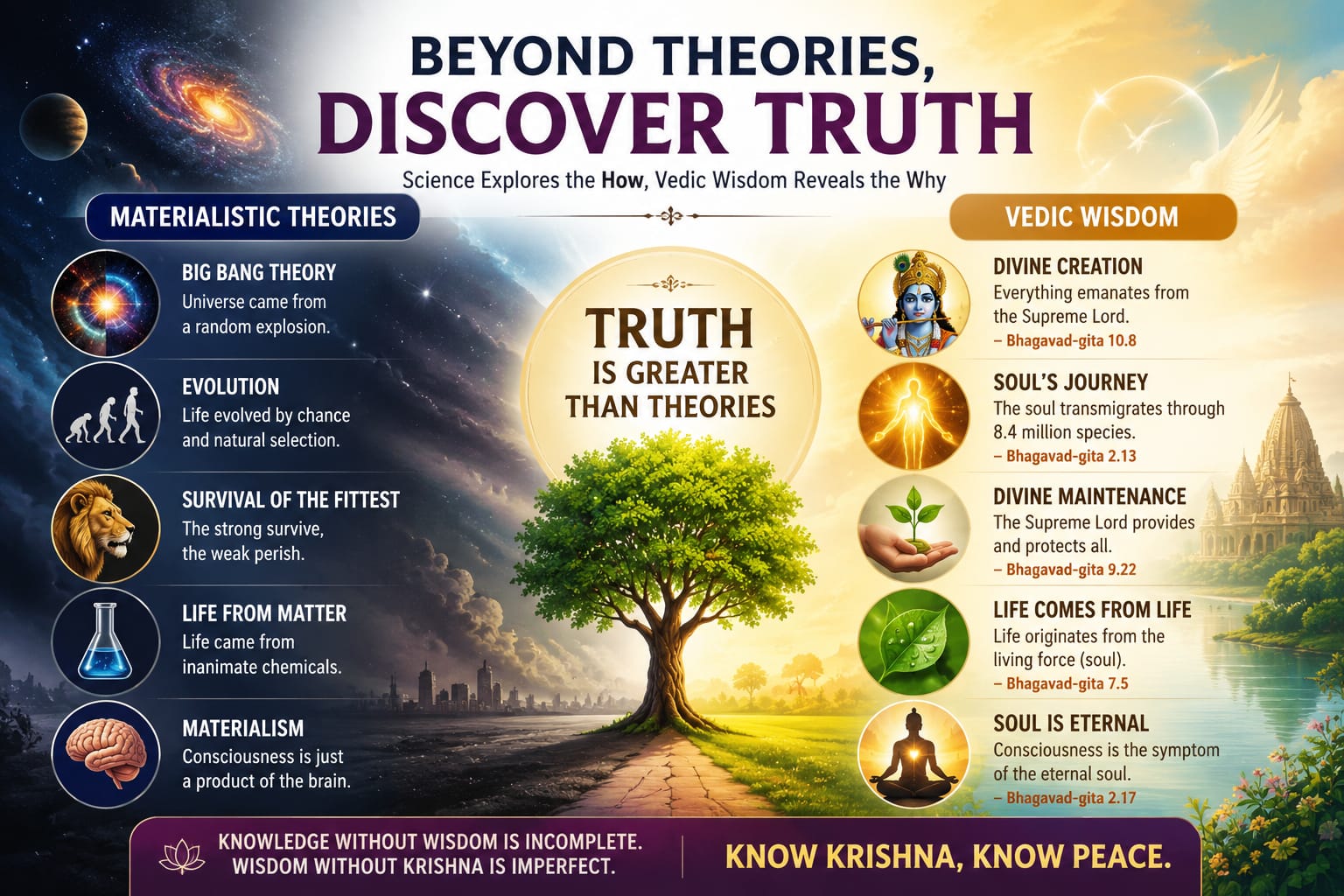
Theory 1: The Big Bang — Did Everything Come From Nothing?
Modern cosmology teaches that around 13.8 billion years ago, the universe emerged from an unimaginably dense singularity.
This explanation raises profound questions.
What existed before the singularity?
What caused it?
Who established the laws of physics that governed its expansion?
Why does anything exist at all instead of nothing?
The Vedic scriptures begin where science reaches its limits.
Lord Krishna declares:
ahaṁ sarvasya prabhavo
mattaḥ sarvaṁ pravartate
“I am the source of all spiritual and material worlds. Everything emanates from Me.”
(Bhagavad-gita 10.8)
The Vedic understanding is not that matter appeared from nothing. Rather, all energies originate from the Supreme Person.
The Srimad Bhagavatam describes that innumerable universes emerge from Mahā-Viṣṇu just as countless bubbles arise from an ocean.
Creation is not an accident.
It is an expression of divine intelligence.
Theory 2: Evolution — Are We Merely Advanced Animals?
Few scientific theories have influenced modern thought more than Darwinian evolution.
The popular interpretation teaches that life developed through random mutations and natural selection, eventually producing human beings.
The Vedic scriptures offer a fascinating perspective.
They agree that living beings pass through many species.
However, the traveler is not the body.
The traveler is the soul.
dehino ‘smin yathā dehe
kaumāraṁ yauvanaṁ jarā
tathā dehāntara-prāptir
“As the embodied soul continuously passes from childhood to youth to old age, similarly the soul passes into another body at death.”
(Bhagavad-gita 2.13)
The Padma Purana describes 8.4 million species through which the soul journeys.
Thus the Vedic model is not merely biological evolution.
It is evolution of consciousness.
Bodies change.
The eternal soul remains unchanged.
Theory 3: Survival of the Fittest — Is Competition the Ultimate Law?
Modern culture often glorifies competition.
The strongest survive.
The weak perish.
Many have unconsciously accepted this as the fundamental law of existence.
Yet nature itself tells a different story.
Birds do not own corporations.
Deer do not maintain savings accounts.
Fish do not attend business schools.
Still they survive.
Why?
The Vedic answer is simple.
eko bahūnāṁ yo vidadhāti kāmān
“The Supreme One supplies the necessities of all living beings.”
(Katha Upanishad 2.2.13)
Krishna further promises:
yoga-kṣemaṁ vahāmy aham
“I personally preserve what My devotee has and carry what he lacks.”
(Bhagavad-gita 9.22)
Competition exists within nature.
But maintenance ultimately comes from divine arrangement.
The real struggle is not against other creatures.
It is against ignorance.
Theory 4: Abiogenesis — Can Life Come From Matter?
For over a century, scientists have searched for an explanation of how life emerged from chemicals.
Despite enormous technological advancement, no laboratory has ever created life from dead matter.
Scientists can manipulate existing life.
They cannot create it.
The Vedic conclusion is direct:
Life comes from life.
Matter comes from life.
Never the reverse.
Krishna explains:
apareyam itas tv anyāṁ
prakṛtiṁ viddhi me parām
jīva-bhūtām
“Besides this material energy there is another, superior energy—the living entities.”
(Bhagavad-gita 7.5)
The living force animates matter.
Without the soul, the body becomes a collection of chemicals.
No amount of chemistry restores life to a corpse.
Theory 5: Scientific Materialism — Is Consciousness Just Brain Activity?
One of the greatest mysteries confronting modern science is consciousness.
A living brain and a dead brain may contain nearly identical chemicals.
Yet one possesses awareness while the other does not.
Where does consciousness come from?
Materialism claims it emerges from neural activity.
The Vedas teach otherwise.
Consciousness is the symptom of the soul.
avināśi tu tad viddhi
yena sarvam idaṁ tatam
“Know that which pervades the body to be indestructible.”
(Bhagavad-gita 2.17)
The body is compared to a machine.
The soul is the driver.
Without the driver, the machine cannot function.
Theory 6: Atheism — Is the Universe Self-Operating?
Many modern thinkers argue that no creator is necessary.
Nature simply operates by itself.
Yet every law implies a lawmaker.
Every system implies organization.
Every code implies intelligence.
Krishna explains:
mayādhyakṣeṇa prakṛtiḥ
sūyate sa-carācaram
“Material nature works under My supervision.”
(Bhagavad-gita 9.10)
The Vedic sages observed extraordinary order throughout creation.
The precise movements of planets.
The mathematical structure of atoms.
The complexity of DNA.
Order suggests intelligence.
Not randomness.
Theory 7: Hedonism — Is Pleasure the Goal of Life?
Modern advertising constantly sends one message:
Consume more.
Enjoy more.
Acquire more.
The assumption is that happiness comes through sensory gratification.
Yet history demonstrates otherwise.
The wealthiest individuals often experience anxiety, loneliness, and dissatisfaction.
Krishna explains:
ye hi saṁsparśa-jā bhogā
duḥkha-yonaya eva te
“Material pleasures are sources of future misery.”
(Bhagavad-gita 5.22)
Temporary pleasures cannot satisfy an eternal soul.
A fish cannot be happy outside water.
Similarly, the soul cannot find lasting happiness disconnected from Krishna.
Theory 8: Nihilism — Does Life Have No Meaning?
Many modern philosophers conclude that life is ultimately meaningless.
The universe is accidental.
Human existence is temporary.
Death ends everything.
The Vedas strongly reject this conclusion.
Life possesses profound purpose.
The soul is eternal.
The Supreme Lord is eternal.
The relationship between them is eternal.
sa vai puṁsāṁ paro dharmo
yato bhaktir adhokṣaje
“The highest occupation for humanity is loving devotional service unto the Lord.”
(Srimad Bhagavatam 1.2.6)
Purpose is not invented.
Purpose is discovered.
Theory 9: Transhumanism — Can Technology Defeat Death?
Some futurists predict that biotechnology, artificial intelligence, and genetic engineering will eventually eliminate aging and death.
The Vedas appreciate technological advancement but point out a fundamental limitation.
Death belongs to the body.
The soul was never dying in the first place.
janma-mṛtyu-jarā-vyādhi
duḥkha-doṣānudarśanam
“A wise person sees the miseries of birth, death, old age and disease.”
(Bhagavad-gita 13.9)
The solution is not merely extending bodily existence.
The solution is realizing one’s eternal spiritual identity.
Theory 10: Chance Theory — Did Order Arise Randomly?
Many materialistic explanations ultimately appeal to chance.
The universe happened by chance.
Life emerged by chance.
Consciousness evolved by chance.
Yet chance explains nothing.
Chance is merely a label placed upon ignorance.
The Vedic view is different.
Nothing occurs independently of divine supervision.
sarva-kāraṇa-kāraṇam
Krishna is “the cause of all causes.”
Intelligence precedes creation.
Creation does not produce intelligence.
The Fundamental Difference: Matter First or Consciousness First?
Every philosophy ultimately answers one question.
What came first?
Matter or consciousness?
Materialism says:
Matter produced consciousness.
The Vedas say:
Consciousness is primary.
The Supreme Conscious Being, Krishna, is the source of everything.
From Him come all energies, all living beings, and all universes.
Why Vedic Revelation Matters
Human senses are limited.
We cannot directly observe the beginning of creation.
We cannot observe the soul with microscopes.
We cannot experimentally recreate the origin of life.
The Vedic sages therefore recommend a higher source of knowledge.
evaṁ paramparā-prāptam
“This supreme science is received through disciplic succession.”
(Bhagavad-gita 4.2)
Just as a child learns his father’s identity from a reliable authority, humanity learns ultimate truth from divine revelation.
Conclusion: Science Explains Processes, Vedic Wisdom Explains Purpose
Science is valuable.
It reveals many mechanisms operating within nature.
But mechanisms are not causes.
Processes are not purpose.
The Vedic scriptures complete the picture by answering the questions science cannot:
Who am I?
Why am I suffering?
What happens after death?
What is consciousness?
What is the source of existence?
The conclusion of all Vedic literature is clear.
We are not temporary collections of chemicals.
We are eternal souls.
The universe is not a cosmic accident.
It is the purposeful creation of the Supreme Personality of Godhead, Sri Krishna.
When knowledge is united with devotion, science and spirituality cease to be enemies.
They become two perspectives pointing toward the same ultimate truth—the Supreme Cause of all causes.
janmādy asya yataḥ
“The Absolute Truth is He from whom everything emanates.”
The journey of wisdom begins when we move beyond asking merely “How?” and begin asking “Why?”
Frequently Asked Questions (FAQ)
Does the Bhagavad-gita reject science?
No. The Bhagavad-gita encourages knowledge but teaches that material science alone cannot explain consciousness, the soul, or the ultimate purpose of life.
What is the Vedic explanation of evolution?
The Vedas describe the soul’s journey through 8.4 million species and emphasize evolution of consciousness rather than merely evolution of physical bodies.
What does Krishna say about creation?
Bhagavad-gita 10.8 states that Krishna is the source of all spiritual and material worlds.
Can life come from matter according to the Vedas?
No. Vedic wisdom teaches that life comes from life and consciousness originates from the eternal soul.
What is the purpose of life according to Vedic scriptures?
The purpose of life is self-realisation and the revival of our eternal loving relationship with Sri Krishna through bhakti-yoga.