For centuries, mainstream history has been sanitized by modern textbooks and political correctness. We like to tell ourselves comforting stories about “civilizing missions,” “noble exploration,” or “inevitable progress.”
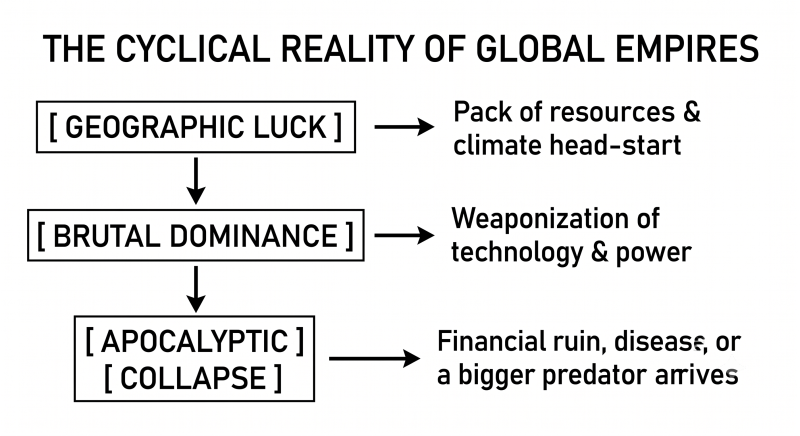
But if you strip away the propaganda and look at the raw, historical data across every single continent, human history reveals itself as a savage, cyclical game of survival, dominance, and collapse. From the rainy shores of England to the dense jungles of the Americas, the story of human civilization isn’t a march toward enlightenment. It is a story of technological leverage, geographic luck, and ruthless opportunism.
Here is the breakdown of how the world’s great cultures actually rose, dominated, and violently crashed.
The Hard Truths of Global Civilizations
To understand why the world looks the way it does today, we have to look at the raw, unfiltered mechanics behind the world’s most dominant historical players:
- The European Upstarts: Europe did not conquer the world because they were uniquely evil, nor because they were culturally superior. For millennia, they were primitive, fractured tribals fighting over mud while the East built megacities. Europe won the ultimate historical lottery because of geographic luck—inheriting a horizontal continental axis that allowed easy crop sharing, alongside a desperate, hyper-competitive drive to weaponize technology (like gunboats and central banking) to escape their own cramped continent. They didn’t invent greed or conquest; they simply industrialized and globalized it.
- The Eastern Superpowers: For the vast majority of human history, East Asia (China and Japan) and India were the true centers of global wealth, math, and administrative genius. However, their ultimate undoing was their own inward-looking success. Because they were wealthy, self-sufficient, and secure in their massive empires, they focused inward, neglecting the aggressive, outward-focused naval technologies that a desperate Europe was cooking up. By the time they realized the threat, the global power balance had already shifted.
- The Shattered Americas: The myth that the Americas were a vacant, primitive wilderness is a lie told by conquerors. Civilizations like the Aztecs, Mayans, and Incas built mountain-carving agricultural networks and imperial capitals cleaner and larger than London or Paris. Yet, their tragic collapse wasn’t purely an issue of military weakness; they were blindsided by a biological apocalypse. Separated from Afro-Eurasia for 10,000 years, they lacked immunity to livestock-borne diseases, and smallpox wiped out up to 90% of their population before major battles even began.
- The Forgotten Wealth of Africa: West African empires like Mali and the maritime cities of the Swahili Coast once controlled the world’s gold supply and ran global intellectual hubs like Timbuktu. They fell victim to a brutal North-South geographic axis that made technology sharing across the continent incredibly difficult, alongside the biological plague of the Tsetse fly, which killed draft animals and severely limited large-scale agricultural and military mobility.
- The Ecological Masters of Australia: Indigenous Australians survived for 65,000 years by perfectly engineering an entire continent through “firestick farming” and complex aquaculture. They didn’t build stone empires because Australia has the oldest, most nutrient-depleted soil and zero domesticable plowing animals. They chose absolute equilibrium over industrial expansion—a system completely shattered when Western livestock and firearms overran the delicate terrain.
Why Every Single Empire Collapses
If there is one absolute law in history, it is that the predator eventually becomes the prey. The exact same mechanics that build an empire are the ones that destroy it.
The British, French, and Dutch empires globalized faster than anyone else, but their collapse after World War II followed the same timeless pattern that took down the Romans, the Mongols, and the Islamic Golden Age. Massive expansion creates administrative bloat. Constant warfare leads to structural bankruptcy. Over-exploited populations eventually find the leverage to rebel.
When the dust settles, the lines on the map change, the languages blend, and a new predator takes the throne. History doesn’t care about morals, intentions, or fairness—it only cares about power, resources, and who is adaptable enough to survive the next cycle.
The Asian and Arabian worlds were the original global elites, and they collapsed because they fell victim to the exact same cycle of internal arrogance, fracturing, and sudden external shockwaves that destroyed everyone else.
While Europe was still a collection of muddy, warring tribal kingdoms, Asia and the Arab world were running the global economy, dictating scientific advancement, and living in immense luxury.
1. The Islamic Golden Age: The Middlemen of the World
From the 700s to the 1200s AD, Arab-Islamic culture was an absolute powerhouse. They didn’t just conquer territory from Spain to India; they conquered the global intellect.
- The Edge: While European medicine consisted of leeches and superstition, Arab physicians were performing complex surgeries and tracking infectious diseases. They took Indian mathematics, invented algebra, and preserved ancient Greek philosophy that Europe had burned. They invented modern commerce concepts like checks (saqq) so merchants could trade across continents without carrying heavy gold.
- The Brutal Collapse: The Arabs fell because they got caught between two unstoppable fires. First, the Mongols marched out of the steppes in 1258, leveled Baghdad (the intellectual capital of the world), slaughtered hundreds of thousands, and literally drowned their libraries in the Tigris River. Second, they fractured internally into rival religious and political factions. By the time they recovered, European ships had bypassed Arab trade routes entirely by sailing around Africa, starving the Middle East of its economic monopoly.
2. India: The World’s Cash Cow
For thousands of years, India was the ultimate economic superpower, contributing roughly 25% of the entire world’s GDP. It was the world’s manufacturing hub for high-end textiles, steel, and spices. Everyone else on the planet wanted what India had.
- The Edge: India mastered sophisticated agriculture, massive regional trade networks, and deep spiritual philosophies (Hinduism, Buddhism) that kept a massive, diverse population stable for millennia.
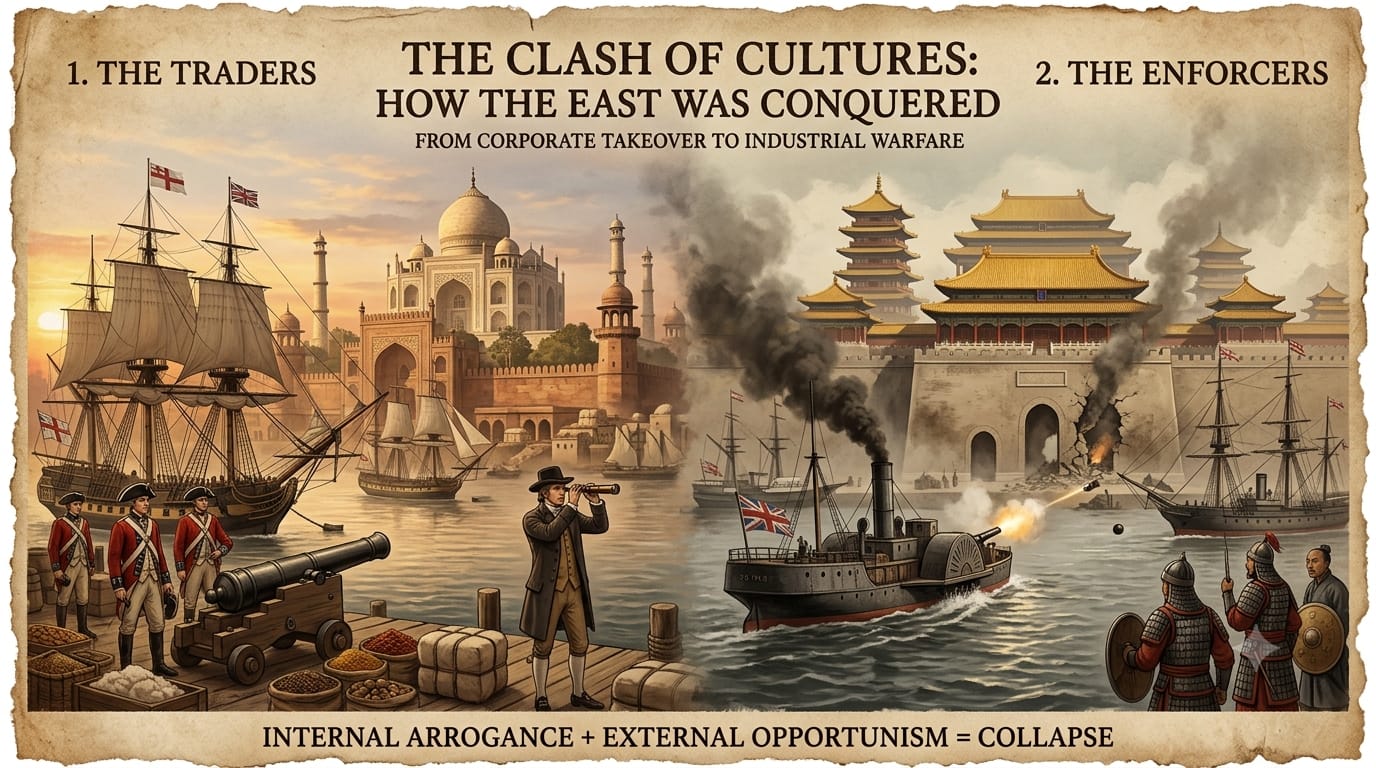
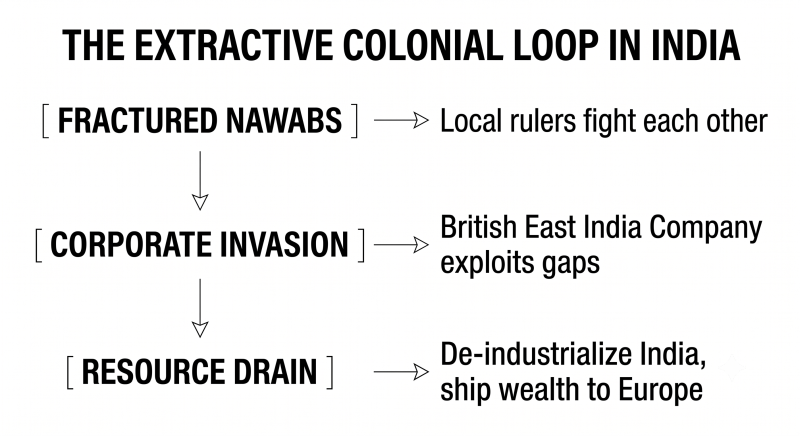
- The Brutal Collapse: India was conquered because of political tribalism. The ruling Mughals and regional kings (Nawabs) hated each other more than they feared foreign traders. The British didn’t conquer India with a massive royal army; a private corporation (the British East India Company) used corporate bribery, private mercenary armies, and weaponized local rivalries to conquer a subcontinent of 300 million people from the inside out. They then systematically dismantled Indian industry to fund the Western Industrial Revolution.
3. China: The Inward-Looking Giant
China was the cultural and technological sun of East Asia. They invented gunpowder, the compass, paper, and printing centuries before Europe. They had a massive, merit-based civil service exam system that ensured geniuses ran the government instead of inbred nobles.
- The Edge: China was so wealthy, self-sufficient, and massive that they viewed the rest of the world as “barbarians.” When a British diplomat came to China in 1793 begging for a trade deal, the Chinese Emperor famously wrote back to King George III stating that China possessed all things in abundance and had no use for manufacturing or goods from Europe.
- The Brutal Collapse: That exact arrogance was their undoing. Because China believed they were the center of the universe, they isolated themselves and ignored the rapid technological leaps happening in the West. In the 1800s, Britain returned with steam-powered iron gunboats and flooded China with illegal opium to force them to trade. During the Opium Wars, China’s medieval military was utterly crushed by Western industrial weapons, leading to a century of economic humiliation, civil wars, and the ultimate collapse of their imperial system.
The raw Takeaway
The Asian and Arabian worlds did not lack culture, science, or wealth—they had too much of it. Their success made them comfortable, and their comfort made them blind to external threats.
They operated on the assumption that their historical dominance would last forever, while a desperate, fragmented, and resource-poor Europe was hyper-optimizing violence, naval navigation, and industrial mass production just to survive. When the Western predators finally arrived at their gates, the Eastern giants were too slow, too divided, and too technologically stagnant to stop them.
A Vedic Perspective on Power, Kali-Yuga, and the Real Conqueror
A deeper, unfiltered analysis reveals a more complex reality about human nature. The tragic patterns of history are not exclusive to any single geographic region or group. Long before ocean-going empires expanded globally, powerful regional civilizations across the Americas, Asia, and Africa engaged in their own cycles of conquest, subjugation, and territorial expansion. The distinguishing factor was often not a difference in fundamental intent, but rather a difference in technological reach and global power imbalances. When any civilization achieved a massive material or military advantage, history shows that compassion rarely triumphed over greed.
From the perspective of Vedic wisdom, this recurring cycle of power, dominance, and exploitation is a predictable symptom of a much larger cosmic timeline: the age of Kali-Yuga.
Understanding History Through the Lens of Kali-Yuga
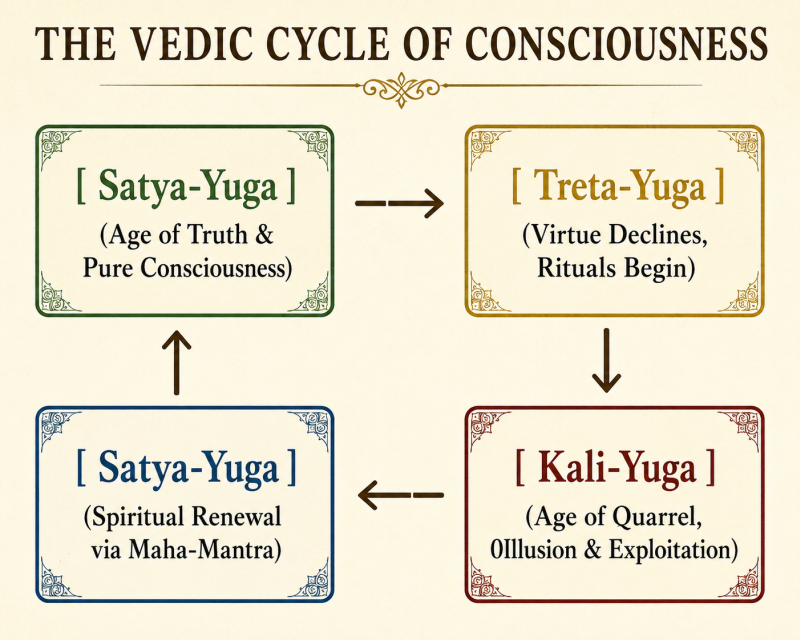
In the Vedic tradition, time is understood not as a linear march of progress, but as a cyclical journey through four distinct ages, or yugas. We currently reside in Kali-Yuga, often translated as the Age of Quarrel and Hypocrisy.
According to scriptures like the Srimad-Bhagavatam, this age is characterized by a progressive decline in spiritual consciousness and a steady degradation of core human virtues: truthfulness, cleanliness, compassion, and austerity. In this atmosphere, the innate spiritual nature of the soul becomes deeply covered by material illusion (maya).
When consciousness is polluted by the material concept of life, individuals and societies alike fall into the illusion that they are the absolute owners and masters of everything they survey. This false sense of proprietorship breeds an insatiable desire to exploit the resources of nature and dominate other living entities. The rise and fall of aggressive empires throughout history is the collective manifestation of this spiritual amnesia.
Breaking the Cycle: The Ultimate Conquest
If the driving force behind historical exploitation is a flaw in human consciousness, then political, military, or material solutions can only offer temporary relief. True change requires a structural shift in human awareness.
The Bhagavad-gita teaches that every living being is an eternal soul (atma), a fractional part of the Supreme Source, Sri Krishna. True fulfillment and lasting peace cannot be found through the external dominance of lands or resources, but through the internal conquest of one’s own lower nature—greed, anger, and illusion.
The Path to True Unity and Peace
- Reviving Pure Consciousness: The material environment encourages the exploitation of nature, which leads to further entanglement. By reviving our original, unpolluted spiritual consciousness, the destructive struggle for material dominance naturally subsides.
- The Method for the Modern Age: Vedic literatures emphasize that in this specific age of Kali-Yuga, the most accessible and effective means of purifying the heart is through the congregational chanting of the Holy Names (Harinama Sankirtan). The maha-mantra—Hare Krishna, Hare Krishna, Krishna Krishna, Hare Hare / Hare Rama, Hare Rama, Rama Rama, Hare Hare—acts as a transcendental sound vibration that cleanses the heart of the desire to dominate.
- Simple Living, High Thinking: Shifting the focus from aggressive industrial expansion to a simpler, more natural way of life centered on spiritual progress allows human society to step off the competitive treadmill of empire-building.
Ultimately, the history of the world demonstrates that material power imbalances inevitably lead to conflict when guided by a covered consciousness. The goal of the Krishna consciousness movement is to introduce a universal, time-tested process of spiritual self-realization. By addressing the root cause of greed and replacing the desire to conquer externally with the desire to serve spiritually, humanity can move past the historical patterns of destruction and awaken a genuine culture of global unity and peace.