Introduction: The Cow – Mother of Human Civilization
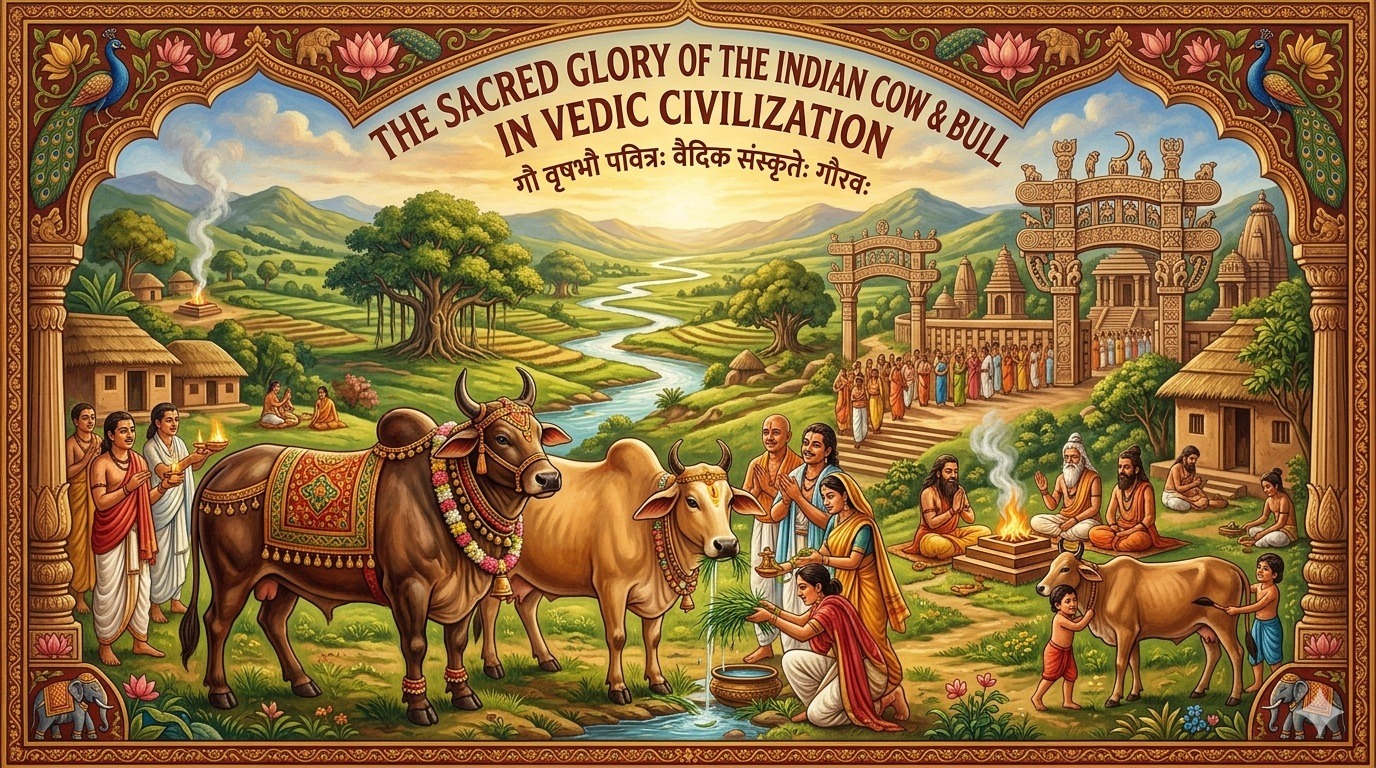
In Vedic culture, the cow is not merely an animal. She is revered as Go-mātā — the universal mother. The cow nourishes humanity selflessly through milk, dung, urine, labor, affection, and agricultural support. Along with the bull, she forms the spiritual and economic backbone of Vedic civilization.
Ancient India flourished not on industrial slaughterhouses or chemical agriculture, but upon the protection of cows and bulls. The Vedic scriptures repeatedly glorify cow protection (go-rakṣya) as one of the highest duties of civilized human society.
Modern society measures wealth through money, industries, and technology, but Vedic civilization measured prosperity through grains and cows.
“The wealth of a society is measured by the quantity of grains and cows.”
The Vedic understanding is profound: when cows are protected, nature becomes favorable, society becomes peaceful, health improves, and spiritual consciousness flourishes.
Cow Protection in Vedic Scriptures
Bhagavad-gītā on Cow Protection
Lord Krishna directly includes cow protection as an essential duty of society:
“Agriculture, cow protection and trade are the natural work for the vaiśyas.”
— Bhagavad-gītā 18.44
The Sanskrit term used is:
kṛṣi-go-rakṣya-vāṇijyaṁ vaiśya-karma svabhāva-jam
Here, go-rakṣya means “protection of cows,” not exploitation.
Krishna Himself appeared as a cowherd boy in Vrindavan, delighting in caring for cows and calves. His names such as Gopāla, Govinda, and Gopīnātha all reveal His intimate connection with cows.
Śrīmad-Bhāgavatam on the Cow and Bull
The Śrīmad-Bhāgavatam describes the bull as the symbol of religion and the cow as the symbol of the earth.
In the First Canto, Mahārāja Parīkṣit encounters a black-hearted man beating a cow and bull.
“The bull was as white as a white lotus flower. He was terrified because one leg had been beaten by the śūdra. The cow was weeping.”
— Śrīmad-Bhāgavatam 1.17
The Bhāgavatam explains:
- The bull represents Dharma (religion).
- The cow represents Mother Earth.
- Violence against cows indicates degradation of civilization.
A society that tortures cows loses divine blessings.
Mahābhārata on Cow Protection
The Mahābhārata repeatedly glorifies the cow as sacred.
“The cow is the mother of all living beings.”
“There is no gift higher than the gift of a cow.”
Ancient kings protected cows more carefully than treasury wealth because they understood that cows sustain life itself.
Rig Veda on the Cow
The Rig Veda declares:
“Cows are truly fortunate.”
“The cows have come and brought us good fortune.”
— Rig Veda 6.28“Do not kill the cow.”
The Sanskrit term:
aghnyā
means “that which should never be killed.”
The cow is called aghnyā throughout Vedic literature.
Why the Cow is Called Mother
A mother nourishes her child with milk.
The cow gives milk not only to her calf but to humanity. Therefore Vedic civilization recognizes seven mothers:
- Birth mother
- Guru’s wife
- Wife of a brāhmaṇa
- King’s wife
- Nurse
- Earth
- Cow
Cow’s milk nourishes the brain tissues and supports spiritual understanding.
Ayurveda and Vedic culture emphasize that cow milk:
- Enhances intelligence
- Promotes longevity
- Supports sattva-guṇa (goodness)
- Aids meditation and spiritual life
- Nourishes finer brain tissues
Milk becomes yogurt, butter, ghee, sweets, medicine, and ingredients for yajña.
Without cows, Vedic culture cannot properly function.
Krishna and the Cow
Krishna is eternally connected with cows.
Names of Krishna Related to Cows
Gopāla
Protector of cows.
Govinda
One who gives pleasure to cows, senses, and land.
Gopīnātha
Lord of the cowherd devotees.
Muralīdhara
Krishna enchanted the cows through His flute.
The residents of Vrindavan considered their cows more valuable than jewels.
The scriptures describe:
- Krishna personally taking cows to pasture.
- Krishna calling each cow by name.
- Cows shedding tears of affection upon seeing Krishna.
- Calves jumping in ecstasy hearing Krishna’s flute.
The spiritual world itself is described as:
Goloka — the planet of cows.
This demonstrates the eternal spiritual significance of cows.
Importance of the Bull in Vedic Civilization
Modern society praises the cow but forgets the bull.
In Vedic civilization, the bull is equally sacred.
The bull performs:
- Ploughing fields
- Transportation
- Agricultural labor
- Protection of rural economy
- Support of sustainable farming
The bull works without polluting nature.
Tractors require: Fossil fuels, Expensive maintenance, Industrial systems, Environmental destruction
But bulls sustain natural agriculture harmoniously.
The Vedic model was:
- Bull-based farming
- Cow-based dairy
- Organic agriculture
- Village self-sufficiency
This system created prosperity for thousands of years.
Difference Between Indian Cow and Foreign Cow
Indian Cow (Bos indicus)
The traditional Indian cow possesses unique physical and medicinal qualities.
Characteristics of Indian Cows
- Hump on the back
- Long dewlap
- Strong immunity
- Heat resistance
- A2 milk production
- Naturally disease resistant
- Better adaptability to Indian climate
- Sacred significance in Vedic culture
Popular Indian breeds include:
- Gir, Sahiwal, Ongole, Tharparkar, Red Sindhi, Hallikar, Kankrej, Deoni, Vechur
Indian cows are deeply connected to Ayurveda and traditional agriculture.
Scientific Significance of the Hump
Traditional Indian knowledge states that the hump contains a special nerve structure known as:
Surya Ketu Nadi
It is believed to help absorb solar energy and enrich the quality of milk and dung.
Although modern science studies this differently, traditional Vedic communities highly value the hump-bearing Indian cow.
A2 Milk vs A1 Milk
Indian cows generally produce A2 beta-casein milk.
Many foreign breeds are associated with A1 beta-casein milk.
A2 milk is:
- Easier digestion
- Better compatibility with traditional diets
- Reduced digestive discomfort for some people
- Better suitability for Ayurvedic preparations
Traditional Vedic culture strongly preferred indigenous cow milk.
Foreign Cows (Bos taurus)
Many foreign breeds were developed primarily for industrial dairy production.
Examples include: Holstein Friesian, Jersey, Brown Swiss
Characteristics:
- Higher commercial milk yield
- Lower heat tolerance in tropical climates
- Greater dependence on industrial feed systems
- Higher veterinary maintenance in some climates
Modern industrial dairy systems often prioritize profit over animal welfare.
This results in: - Artificial breeding
- Hormonal manipulation
- Separation of calves
- Slaughter of male calves
- Shortened lifespan
Vedic culture rejects exploitative treatment.
Cow protection means lifelong care — not commercial exploitation.
Difference Between Cow and Buffalo
Nature and Qualities
Indian Cow
Traditionally associated with:
- Sattva (goodness)
- Gentleness
- Spiritual purity
- Lighter milk
- Ayurvedic benefits
Cow milk is central in:
- Temple worship
- Pañcagavya
- Deity worship
- Vedic yajñas
- Ayurvedic medicines
Buffalo
Buffalo milk is:
- Heavier
- Higher in fat
- More difficult to digest for some people
- Often associated with tamasic heaviness in Ayurvedic discussions
Buffaloes are useful animals and should also be treated compassionately.
However, Vedic scriptures especially glorify the cow.
In traditional temple worship:
- Cow ghee is preferred.
- Cow milk is preferred.
- Cow dung and urine are used in sacred rituals.
The cow occupies a uniquely sacred position.
Panchagavya: The Five Sacred Gifts of the Cow
The cow gives five sacred substances known as pañcagavya:
- Milk
- Yogurt
- Ghee
- Cow urine
- Cow dung
These are used in:
- Temple worship
- Ayurveda
- Purification rituals
- Agriculture
- Medicine
- Spiritual ceremonies
Cow Dung: A Natural Treasure
Traditional Indian villages used cow dung for:
- Fuel
- Fertilizer
- Flooring
- Pest control
- Biogas
- Purification
Cow dung supports organic farming naturally.
Unlike chemical fertilizers, cow dung improves long-term soil health.
Cow Urine in Ayurveda
Traditional Ayurveda uses purified cow urine in certain medicinal formulations.
Traditional practitioners attribute various cleansing and balancing properties to it.
Its use belongs to ancient Ayurvedic systems and should be approached responsibly and under proper guidance.
Cow Protection and Ecology
Modern ecological crises arise from exploitation of nature.
Industrial civilization depends upon:
- Slaughterhouses
- Chemical farming
- Fossil fuels
- Factory farming
- Artificial fertilizers
The Vedic model offers sustainable alternatives:
- Cow-based agriculture
- Bull-powered farming
- Organic cultivation
- Village economy
- Simple living
- High thinking
Cow protection supports:
- Soil fertility
- Reduced pollution
- Sustainable agriculture
- Compassionate society
- Ecological balance
Slaughter of Cows in Kali-yuga
Vedic scriptures strongly condemn cow slaughter.
The Śrīmad-Bhāgavatam describes cow killing as a symptom of Kali-yuga.
A civilization that kills cows while drinking their milk is considered deeply ungrateful.
The karmic consequences of violence create:
- Wars
- Diseases
- Ecological disasters
- Mental anxiety
- Social unrest
Compassion toward cows develops compassion toward all living beings.
ISKCON and Cow Protection
The International Society for Krishna Consciousness (ISKCON), founded by His Divine Grace A.C. Bhaktivedanta Swami Prabhupāda, strongly emphasizes cow protection.
Śrīla Prabhupāda repeatedly stated:
“Cow protection is the most essential business of human society.”
ISKCON farms worldwide attempt to revive:
- Bull-powered agriculture
- Organic farming
- Simple living
- Self-sufficient communities
- Lifetime cow protection
The goal is not merely dairy production.
The goal is:
- Loving protection
- Spiritual culture
- Sustainable civilization
- Krishna-centered living
Spiritual Lessons from the Cow
The cow teaches humanity:
1. Selfless Giving
She gives milk even to those who may mistreat her.
2. Gentleness
The cow symbolizes peaceful living.
3. Dependence on Nature
Simple agriculture sustains society.
4. Compassion
A civilized society protects the weak.
Why Krishna Loves Cows
Krishna could have appeared as:
- A king
- A warrior
- A philosopher
- A celestial ruler
Yet He chose to appear as:
A cowherd boy.
This reveals the spiritual glory of cows.
Vrindavan’s beauty is inseparable from:
- Cows
- Calves
- Forests
- Rivers
- Simple village life
- Loving devotion
The culture of cow protection naturally supports bhakti.
Common Misunderstandings About Cow Protection
Cow Protection Does Not Mean Blind Sentiment
True cow protection includes:
- Proper feeding
- Veterinary care
- Protection from slaughter
- Respectful treatment
- Protection of bulls
- Ethical dairy practices
Exploitation in the name of religion is not genuine protection.
Bulls Must Also Be Protected
Many modern systems keep cows but abandon bulls.
Vedic culture protects:
- Cows
- Bulls
- Calves
- Old animals
Every animal deserves dignity.
Reviving Vedic Cow Culture
Practical revival includes:
- Supporting goshalas
- Avoiding slaughter-based industries
- Supporting ethical dairies
- Encouraging organic farming
- Using bull-powered agriculture where practical
- Educating children about compassion
- Offering food to Krishna before eating
Cow protection begins with consciousness.
Conclusion: The Future Depends on Cow Protection
The cow is not merely an economic animal.
She is:
- A symbol of compassion
- A foundation of sustainability
- A pillar of Vedic civilization
- A sacred mother
- Dear to Lord Krishna
The bull represents religion, strength, and honest labor.
A civilization that protects cows and bulls develops:
- Peace
- Health
- Prosperity
- Ecological harmony
- Spiritual progress
The modern world seeks sustainability, mental peace, and ecological balance.
Vedic wisdom already provided the solution thousands of years ago:
Simple living and high thinking centered around cow protection and God consciousness.
When humanity learns to protect the innocent cow and bull, society gradually returns toward harmony with nature and harmony with God.
Important Vedic Quotes on Cow Protection
Bhagavad-gītā 18.44
“Agriculture, cow protection and trade are the natural work for the vaiśyas.”
Śrīmad-Bhāgavatam 1.17
“The bull and the cow are the emblems of the most sacred beings.”
Mahābhārata
“The cow is the mother of the universe.”
Rig Veda
“The cows have come and brought us good fortune.”
Vedic Principle
“The cow should never be killed.”
(Aghnyā — not to be killed)
Go-Pūjā and Vṛṣabha-Pūjā
Cow worship (Go-pūjā) and bull worship (Vṛṣabha-pūjā) are ancient Vedic practices performed to honor the sacred position of cows and bulls in Lord Krishna’s creation. In Vedic civilization, the cow is respected as mother (Go-mātā) and the bull as the symbol of Dharma (religion).
The worship is performed on all days especially,
- During Gopāṣṭamī
- Govardhana Pūjā
- Pongal / Mattu Pongal
- Kṛṣṇa Janmāṣṭamī
- Go-pūjā ceremonies in goshalas
- Before agricultural activities
- Before entering a new home or farm
- During yajñas and auspicious ceremonies
Spiritual Significance of Cow Worship
The scriptures explain that all demigods reside within the body of the cow.
Skanda Purāṇa
“All devas reside in the body of the cow.”
Mahābhārata
“The cow is the mother of the universe.”
Bhagavad-gītā 18.44
“Agriculture, cow protection and trade are the natural duties of the vaiśyas.”
Lord Krishna Himself performed cowherding pastimes in Vrindavan and demonstrated the ideal of loving care toward cows and bulls.
Ideal Mood During Worship
Cow worship is not mechanical ritual alone.
The proper mood is:
- Gratitude
- Humility
- Compassion
- Service
- Prayer for purification
- Prayer for protection of all beings
One should never worship and simultaneously support cruelty toward cows.
Step-by-Step Procedure for Cow Worship
1. Clean the Area
Clean the goshala or worship place thoroughly.
Traditional villages decorate the area with:
- Rangoli / Kolam
- Flowers
- Mango leaves
2. Bathe and Purify Yourself
Take bath and wear clean clothes. Apply Vaiṣṇava tilaka
Chant Hare Krishna Mahāmantra before beginning:
Hare Krishna Hare Krishna
Krishna Krishna Hare Hare
Hare Rama Hare Rama
Rama Rama Hare Hare
3. Offer Respectful Prayers to the Cow
Approach the cow gently.
Touch the cow respectfully, especially:
- Forehead
- Back
- Feet (if culturally appropriate)
Offer obeisances mentally or physically.
Basic Cow Prayer Mantra
namo gobhyaḥ śrīmatībhyaḥ
saurabheyībhya eva ca
namo brahma-sutābhyaś ca
pavitrābhyo namo namaḥ
“I offer repeated obeisances unto the sacred cows, who are glorious, pure, and descendants of Surabhi.”
4. Apply Turmeric, Kumkum, and Sandal Paste
Apply gently on:
- Forehead
- Horns
Decorate with: - Flower garlands
- Cloth ornaments
In South Indian traditions, horns may also be decorated with natural colors during festivals.
5. Chant Go-Mātā Prayers
Simple Go-Mātā Mantra
go-māte namaḥ
“Obeisances unto Mother Cow.”
Repeat sincerely.
6. Circumambulation (Pradakṣiṇā)
Walk around the cow respectfully, usually 3 or 7 times.
7. Offer Food to the Cow
- Fresh grass, Banana, Jaggery, Fruits, Vegetable preparations
- Special prasadam
Feeding cows is considered highly auspicious.
8. Perform Ārati
Offer: Incense, Ghee lamp, Flowers, Camphor
While singing: Govinda prayers, Gopāla bhajans, Hare Krishna kīrtana
9. Offer Prayers for Protection of Cows
Prayer for Universal Compassion
sarve bhavantu sukhinaḥ
sarve santu nirāmayāḥ
“May all beings become happy and free from suffering.”
Worship of the Bull (Vṛṣabha-Pūjā)
The bull represents:
- Dharma
- Strength
- Agriculture
- Responsibility
- Service
The Śrīmad-Bhāgavatam describes Dharma in the form of a bull.
Bull Worship Mantra
vṛṣabhāya namaḥ
“Obeisances unto the sacred bull.”dharmo vṛṣabha rūpeṇa
jagat tiṣṭhati sarvadā
“Religion eternally stands in the form of the bull.”
Important Rules and Etiquette
Never Harm the Cow
- Never exploit them cruelly
Protect Bulls Also
True Vedic culture protects:
- Cows
- Bulls
- Calves
- Old animals
Not only milk-producing cows.
Worship Must Be Accompanied by Service
Real Go-sevā includes:
- Feeding
- Shelter
- Medical care
- Lifetime protection
- Loving treatment
Ritual without compassion is incomplete.
Benefits Described in Scriptures
Vedic texts describe many spiritual benefits from sincere cow service:
- Purification of consciousness
- Development of compassion
- Prosperity
- Spiritual merit
- Blessings of Krishna
- Peace in the home
- Agricultural prosperity
Most importantly:
- It pleases Lord Krishna.
Simple Daily Cow Worship for Householders
Even simple practices are meaningful:
Daily Practices
- Feed grass to cows
- Offer respectful prayers
- Donate to goshalas
- Chant near cows
- Use protected cow products
- Support ethical cow protection
ISKCON and Cow Worship
The International Society for Krishna Consciousness emphasizes:
- Go-rakṣya (cow protection)
- Go-sevā (cow service)
- Simple living and high thinking
- Bull-based agriculture
- Protection for life
Śrīla Prabhupāda repeatedly taught:
“Cow protection is essential for human civilization.”
Closing Prayer
go-brāhmaṇebhyaḥ śubham astu nityaṁ
lokāḥ samastāḥ sukhino bhavantu
“May there always be auspiciousness for cows and brahmanas, and may all beings throughout the world become happy.”
Hare Krishna Hare Krishna
Krishna Krishna Hare Hare
Hare Rama Hare Rama
Rama Rama Hare Hare
This mahāmantra purifies the heart and awakens genuine compassion toward all living beings, including cows and bulls.