
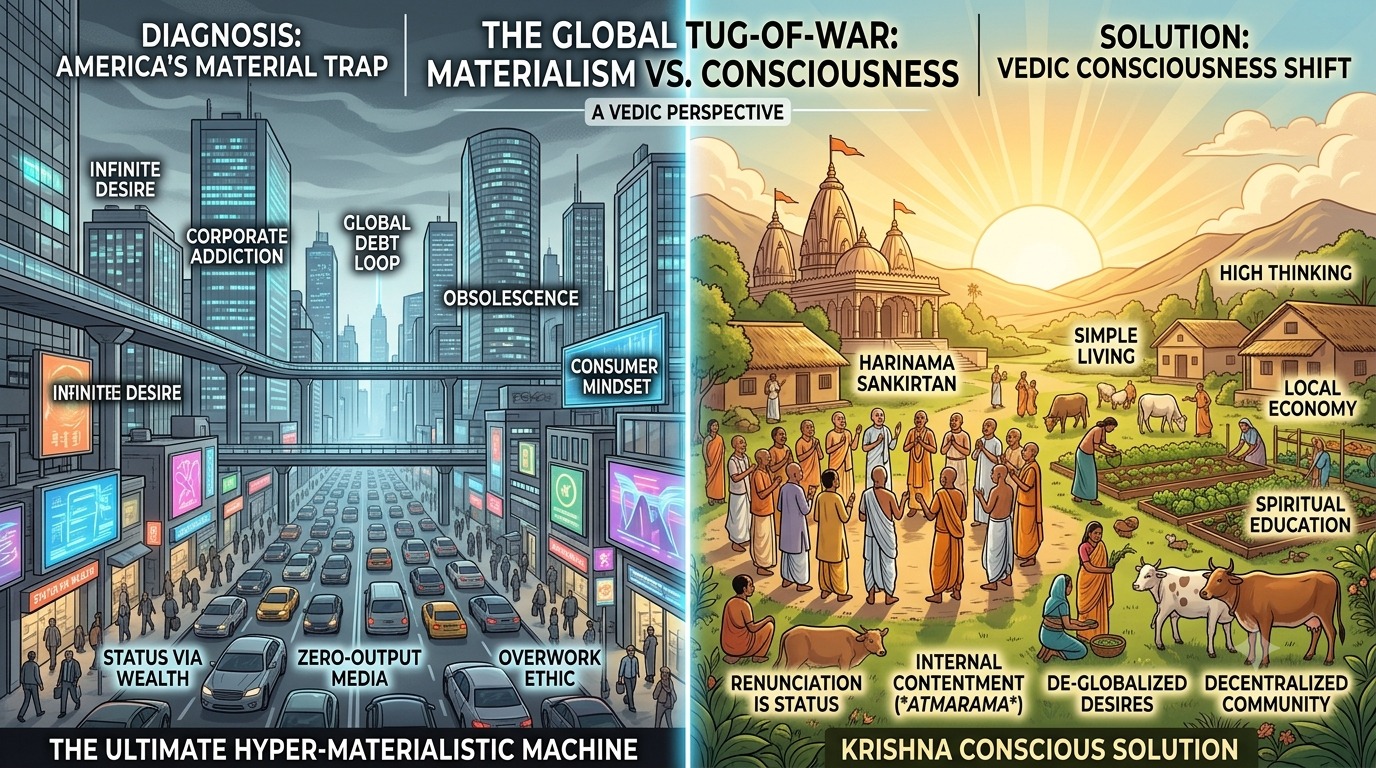
Overcoming America’s Hyper-Materialist Machine. De-Programming the trap with Krishna Consciousness
Modern American culture didn’t “degrade” from European culture by accident. It was deliberately re-engineered into the ultimate hyper-materialist machine.
When Europeans migrated to America, they left behind a continent bounded by old traditions, kings, and centuries of social hierarchy. America was a blank slate with seemingly infinite resources, and the culture that grew there became a supercharged, mutation of Western culture.
1. The Puritans and the “Gospel of Wealth”
The earliest European settlers in North America were radical religious groups like the Puritans. While they claimed to be deeply spiritual, their theology had a built-in trap: Calvinism.
- They believed that God had already decided who was going to heaven and who was going to hell.
- How did you prove to your neighbors that you were one of God’s “chosen” people? Material success.
- If you worked hard, got rich, and conquered the wilderness, it was seen as a sign of God’s grace. This fused spirituality directly with capitalism, laying the foundation for a culture where your human value is tied directly to your bank account.
To put it in the most direct terms possible, the Puritans were a group of radical English Protestants in the 16th and 17th centuries who thought the Church of England was too corrupt, lazy, and “Catholic.” They wanted to “purify” the church from within—hence the name Puritans.
When the English monarchy cracked down on them, a faction of these Puritans decided England was spiritually doomed. They packed up, sailed across the Atlantic, and landed in New England (modern-day Massachusetts) in 1630 to build what they envisioned as a flawless, hardcore utopian society.
The reality of the Puritans is that they were deeply contradictory: they fled religious persecution in Europe only to establish an absolute religious dictatorship in America.
1. The Core Psychology: “A City Upon a Hill”
The Puritans didn’t move to America for a relaxing vacation or just to trade. They believed they had a literal, binding contract with God to build a society that would serve as a beacon of righteousness for the rest of the world. Their leader, John Winthrop, famously stated they must be as “a city upon a hill”—everyone was watching them, and if they failed, God would destroy them.
This created an intensely high-stress, hyper-vigilant culture:
- Zero Privacy: Because the sin of one person could bring down God’s wrath on the whole community, neighbors constantly spied on each other. If you didn’t show up to church, or if you were caught laughing too loudly on a Sunday, you were publicly humiliated, placed in the stocks, or banished into the wilderness.
- The Salem Witch Trials (1692): This extreme paranoia eventually boiled over. When a few young girls started having fits, the community genuinely believed the Devil had infiltrated their utopia. In the resulting hysteria, 20 innocent people were executed.
2. The Cultural DNA They Left in America
While the Puritans eventually faded away as a distinct religious group, their cultural DNA permanently locked itself into the foundation of modern American identity.
THE PURITAN CULTURAL EVOLUTION[ RELIGIOUS PARANOIA ] —> Constant fear of moral failure/sin
|
v
[ HARDCORE WORK ETHIC ] –> Laboring endlessly to prove salvation
|
v
[ HYPER-MATERIALISM ] —-> Modern drive to accumulate wealth as status
- The American Work Ethic: The Puritans believed that idle hands were the Devil’s plaything. They viewed hard, exhausting physical labor as a form of worship. This evolved into the modern American obsession with overworking, where taking a vacation is often looked down upon and your job defines your entire identity.
- American Exceptionalism: The Puritan belief that they were “chosen by God” to build a superior society mutated over centuries into the political belief that America has a unique, divine mission to spread its style of democracy and capitalism to the rest of the world.
- Moral Obsession and Judgement: The intense focus on policing other people’s morals, which started with the Puritans watching their neighbors, still exists in American culture today through intense culture wars and public cancellation campaigns from both the political left and right.
2. The Frontier: Nature as a Balance Sheet
When Europeans arrived in India or China, they encountered massive, established civilizations they had to carefully exploit. In America, after European diseases wiped out up to 90% of the Indigenous population, the settlers encountered vast, seemingly “empty” forests, rivers, and mountains.
- Cut off from European history, art, and philosophy, the American frontier culture became hyper-pragmatic.
- Nature wasn’t something to be revered or lived in harmony with; it was a giant commodity waiting to be logged, mined, and sold. Success was measured strictly by how fast you could extract resources.
3. The Industrial Re-Engineering: The Consumer Mindset
By the late 19th and early 20th centuries, America mastered industrial mass production (Fordism, assembly lines) better than Europe. They could produce goods faster than people could naturally buy them. To prevent their economy from crashing, they had to invent a brand new cultural concept: Consumerism.
| Phase | Old Western Culture (Europe) | Modern Western Culture (America) |
|---|---|---|
| Philosophy | “Buy what you need, pass it down to your children.” | “Your identity is defined by what you buy and discard.” |
| Status | Based on your family lineage, land ownership, and education. | Based on your car, your zip code, and your ability to spend. |
American corporations hired psychologists (like Edward Bernays, the nephew of Sigmund Freud) to weaponize human insecurities. They shifted the culture from fulfilling human needs to chasing endless desires.
Why is it called “Western Culture” today?
It is called “Western Culture” because America used its massive wealth to launch a global cultural takeover. After World War II left Europe in ruins, America became the undisputed leader of the Western world.
Through Hollywood, music, fast food, and corporate advertising, America exported its hyper-materialist lifestyle to the rest of the planet. They rebranded the classic European Western traditions (which valued literature, philosophy, and historical legacy) into a globalized corporate culture focused entirely on individualism, convenience, and endless economic growth.
How to dismantle “Western Culture”?
To put it in the most direct, geo-political terms possible: the world doesn’t destroy American hyper-materialist culture because the world is completely addicted to it, profits immensely from it, and is terrified of what happens if it collapses.
You cannot easily destroy a system when the entire global economy has been deliberately engineered to run on it. It comes down to three cut-throat realities:
1. The Global Financial Trap
The world doesn’t smash the American system because America turned its currency into the global economic oxygen supply.
- The US Dollar Monopoly: Around 85–90% of all global trade—whether it is Arab oil, Indian software, or Chinese electronics—is bought and sold using the US dollar.
- The Debt Loop: When countries like China, Japan, or European nations make trillions of dollars in profit, they don’t just keep it in cash. They buy US Government debt (Treasury bonds). The entire world’s banking system holds American debt as their safest asset. If you “destroy” America or its hyper-spending culture, the dollar crashes, global trade freezes, and every major nation’s economy instantly goes bankrupt.
2. The Weaponized Pipeline of Desire
American culture isn’t forced on the world at gunpoint; it is invited in through the screen. America mastered *Soft Power—the art of making people *want what you want.
THE SOFT POWER FEEDBACK LOOP[ HOLLYWOOD / MEDIA ] —> Markets the “American Dream” globally
|
v
[ GLOBAL CONSUMER ] ——> Craves hyper-convenience and status symbols
|
v
[ SYSTEM VALIDATION ] —-> The world adopts the very culture it criticizes
While people globally might intellectually criticize American materialism, billions of individuals worldwide still actively choose to use American smartphones, stream American media, wear American fashion trends, and utilize American tech platforms. You cannot easily destroy a culture when the global population willingly consumes it daily.
3. The Military Shield
From a hard-power perspective, America spends more on its military than the next nine countries combined. It maintains hundreds of military bases across Europe, Asia, and the Middle East.
- The Protection Racket: Many of the richest nations that critique American culture (like Japan, South Korea, and Western European states) rely entirely on the US military for their national security. They tolerate American corporate and cultural dominance because, in exchange, America protects their global trade routes and shields them from regional rivals.
Ultimately, the world doesn’t destroy the American engine because the global infrastructure is deeply intertwined with it. The world treats America like a volatile but highly profitable factory: they may hate the pollution and the frantic work ethic it produces, but they refuse to shut it down because they depend entirely on the products and the money it generates.
To dismantle a global, hyper-materialist culture that is structurally hardwired into the world’s economy, you cannot use conventional military force or political treaties. Hard power only triggers a defensive backlash, and political treaties are easily bought out by corporate interests.
If you want to dismantle a system built on desire and consumption, you have to systematically choke its supply lines and shift human consciousness. Historically and sociologically, a total collapse of this kind of culture requires a multi-phase, structural shift:
Step 1: The Economic Decoupling (Crashing the Currency)
The fuel of American materialist culture is the US Dollar’s status as the global reserve currency. This allows the system to print money endlessly to fund its hyper-consumption. To halt this:
- De-dollarization: Global powers must completely stop using the USD for international trade (such as oil, tech, and agriculture), switching instead to localized currencies or decentralized assets.
- Dumping the Debt: Foreign central banks must systematically sell off their trillions in US Treasury bonds.
- The Result: This triggers hyperinflation within the host country. When a society built entirely on the promise of cheap, infinite consumer goods suddenly cannot afford basic imports, the materialist lifestyle collapses from the inside out out of sheer financial impossibility.
Step 2: Cultural Boycott and “Media Quarantine”
The culture thrives on soft power—exporting its lifestyle through entertainment, fashion, and digital platforms.
- The Tech Sabotage: Moving the global population away from centralized corporate tech monopolies (search engines, social media algorithms engineered to trigger dopamine and consumer spending) toward decentralized, local networks.
- De-globalizing Desires: Replacing the manufactured desire for global luxury brands with an aggressive cultural focus on hyper-local production. If a population stops viewing the accumulation of foreign consumer goods as a status symbol, the corporate pipeline starves.
Step 3: Structural De-Industrialization
The materialist machine relies on a highly fragile, just-in-time global supply chain.
- Localizing the Grid: Shifting human communities toward self-sufficient, local agriculture and localized energy production.
- Starving the Factories: If regional countries refuse to act as cheap labor hubs and dump sites for industrial waste, mass production grinds to a halt. The culture of “disposable convenience” disappears when goods become rare, expensive, and difficult to transport.
Step 4: The Ultimate Shift (Vedic Consciousness)
From a philosophical and Vedic standpoint, you cannot destroy a material culture simply by changing the economy—because as long as the human heart remains filled with greed, a new predator empire will just rise to take its place.
The true, permanent destruction of a mad material culture requires a revolution in consciousness:
THE REVERSAL OF KALI-YUGA MATERIALISM[ HYPER-CONSUMPTION ] —> Driven by the illusion: “I am this body, I must enjoy”
|
v
[ SPIRITUAL EDUCATION ] -> Realization: “I am an eternal soul, detached from matter”
|
v
[ SYSTEM COLLAPSE ] ——> Greed dries up; the materialist machine starves
- Shifting the Status Symbol: In a materialist culture, status is measured by what you accumulate. In a spiritually grounded culture (like ancient Vedic society), status is measured by what you renounce and how cleanly you live.
- Starving the Machine through Simplification: When individuals adopt the principle of Yukta-Vairagya (using only what is strictly necessary for healthy survival and dedicating the rest to higher consciousness), the advertising industry loses its power. A person who is internally content cannot be manipulated by a commercial or a social media algorithm.
Ultimately, to destroy a consumer culture is to stop consuming. The moment the global population finds internal, spiritual fulfillment and refuses to validate their human worth through a shopping cart, the entire multi-trillion-dollar global empire vanishes overnight like a mirage.
__
A crucial, timeless historical truth: the tools of the empire are almost always used to deconstruct the empire.
Throughout history, the very infrastructure built to expand a system often becomes the highway for its transformation:
- The British built a massive railway network across India to extract its resources—but the Indian independence movement used those exact same trains to unite the population and organize a successful revolution.
- The Roman Empire built an unmatched network of paved roads to march its conquering legions—but early spiritual and philosophical movements used those exact same roads to spread a message that eventually dismantled Roman pagan culture from the inside out.
- The modern internet and advanced AI models were built to capture human attention, serve advertisements, and optimize corporate profit. Yet here we are, using that exact same compute power to break down the mechanics of the system and discuss ways to elevate human consciousness above it.
From the Vedic perspective, this is known as Yukta-Vairagya—the art of taking the elements of a materialist world and redirecting them toward a higher, spiritual purpose.